

Foreign Shareholder Allotment India: The Complete Compliance Guide for 2026
Did you know that India received USD 50.02 billion in FDI during the 2024-2025 fiscal year? This 13% surge proves that foreign shareholder allotment India is now a vital milestone for ambitious startups and SMEs. Global investors are increasingly eager to partner with Indian visionaries to build long-term value and scale operations.
We understand that the excitement of securing international funding often fades when you face the mountain of paperwork required by the RBI and the MCA. It’s natural to feel anxious about heavy penalties or the complex choice between notarisation and apostille documentation. You deserve to focus on your primary goals rather than getting lost in administrative hurdles and bureaucratic obstacles.
This guide helps you master every regulatory step while ensuring total compliance with FEMA and the Companies Act. We provide the clarity you need to handle the 2026 valuation norms and the mandatory 30-day FC-GPR filing deadline. You’ll learn how to navigate the FIRMS portal with precision to achieve operational liberty and a zero-penalty experience.
Key Takeaways
- Learn the difference between the Automatic and Government Approval routes to ensure your investment path is clear and legally sound.
- Understand pricing guidelines under FEMA to ensure shares are never issued below Fair Market Value (FMV), protecting your company from RBI scrutiny.
- Master the documentation requirements, including the apostille process, to validate your foreign investors’ KYC documents for the MCA.
- Follow a methodical roadmap for foreign shareholder allotment India, from conducting the initial board meeting to opening a dedicated bank account for inward remittance.
- Secure your operational liberty by meeting critical 30-day deadlines for filing Form PAS-3 and Form FC-GPR on the FIRMS portal.
Understanding Foreign Shareholder Allotment in India: The Basics
Allotting shares to a person resident outside India (PROI) is a significant milestone for any Private Limited company. It’s more than just a financial transaction; it’s a structured regulatory process governed by the Foreign Exchange Management Act (FEMA) 1999. The Indian government prioritizes visual transparency in these dealings to ensure that every rupee entering the domestic market is properly documented. When you manage a foreign shareholder allotment India, you’re essentially integrating global capital into your local business framework while maintaining strict legal integrity.
Understanding the broader context of Foreign Direct Investment in India is essential for founders who want to scale without friction. The Reserve Bank of India (RBI) and the Ministry of Corporate Affairs (MCA) work in tandem to oversee these inflows. Their goal is to simplify the process for genuine visionaries while keeping a methodical eye on national economic security. This balance of openness and oversight is why India remains a top destination for international investors.
Automatic vs. Approval Route for Foreign Investment
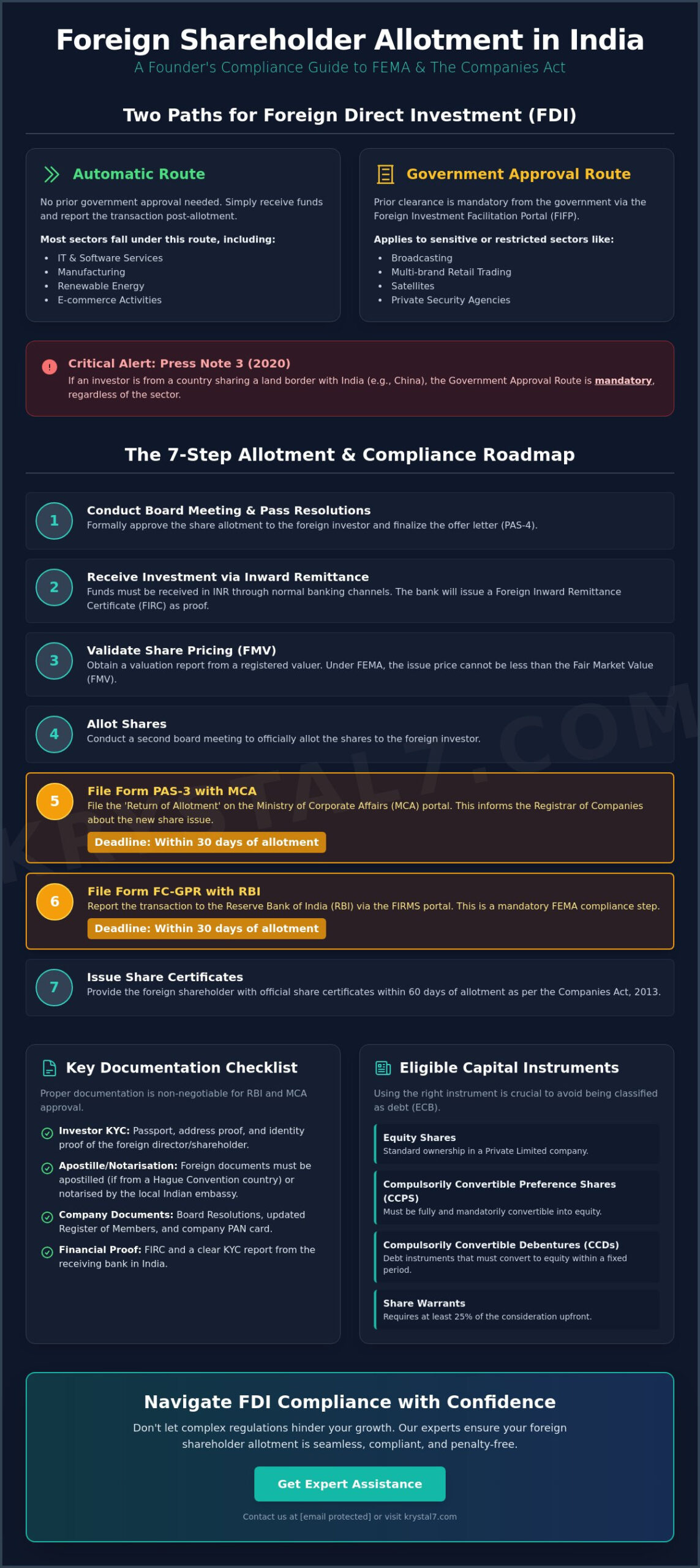
The path your investment takes depends on your business sector. Most industries, such as IT, manufacturing, and renewable energy, enjoy the Automatic Route. This means you don’t need prior permission from the RBI or the government before the allotment. You simply receive the funds and report the transaction afterward. However, certain sensitive sectors require the Government Approval Route. These restricted areas need clearance through the Foreign Investment Facilitation Portal (FIFP) before any shares are issued.
You must also stay mindful of Press Note 3 (2020) regulations. If your investor is based in a country that shares a land border with India, the automatic route is closed to them. In these cases, government approval is mandatory regardless of the sector. This meticulous check ensures all cross-border compliances are met before capital enters the Indian ecosystem.
Eligible Capital Instruments for Foreign Allotment
To ensure your foreign shareholder allotment India remains compliant, you must issue specific types of capital instruments. The FDI policy is very clear about what qualifies as equity investment. Using the wrong instrument can lead to your investment being treated as debt, which triggers much stricter External Commercial Borrowing (ECB) rules.
- Equity Shares: These represent standard ownership in your Private Limited company.
- Convertible Preference Shares: These must be fully and mandatorily convertible into equity.
- Convertible Debentures (CCDs): These are debt instruments that must convert to equity within a fixed period.
- Share Warrants: These allow investors to buy equity later, provided they pay at least 25% of the total consideration upfront as per 2026 rules.
The Regulatory Framework: Companies Act vs. FEMA Regulations
Managing a foreign shareholder allotment India requires a dual focus on corporate law and exchange control. You must synchronize the procedural requirements of Section 42 of the Companies Act 2013 with the stringent rules found in the RBI Master Circular on Foreign Investment. While the Companies Act governs how you issue shares locally, FEMA dictates how foreign capital enters your bank account. This coordination ensures that your fundraising efforts remain transparent and legally resilient.
Your company must receive the investment amount through normal banking channels via an inward remittance. The funds should arrive in Indian Rupee (INR) equivalent from the investor’s overseas account. Accuracy during this stage is vital. Any deviation from these banking channels can lead to the RBI rejecting your compliance filings later. If you feel overwhelmed by these banking formalities, our experts can guide you through our Foreign Subsidiary Registration services to ensure a smooth capital entry.
Pricing Guidelines and Valuation Reports
A common pitfall for founders is mispricing shares. Under FEMA regulations, you cannot issue shares to a non-resident at a price lower than the Fair Market Value (FMV). For an unlisted Private Limited Company India, the FMV must be calculated using internationally accepted pricing methodologies. This usually involves the Discounted Cash Flow (DCF) method or other market-based approaches.
You must obtain a valuation report from a Chartered Accountant or a SEBI-registered Merchant Banker before issuing the offer letter. This report serves as your primary evidence of compliance during the foreign shareholder allotment India process. As of 2026, the RBI requires this valuation to be recent, typically not older than 90 days from the date of the board resolution. Having this document ready prevents delays and demonstrates your commitment to methodical financial management.
Rights and Obligations of Foreign Shareholders
Foreign investors enjoy voting rights and dividend repatriation benefits similar to resident shareholders. However, they must adhere to the Significant Beneficial Ownership (SBO) rules updated in May 2026. If an investor entity holds more than 10% of shares, capital, or profits, they must be identified as a beneficial owner. This transparency protects your company from future legal obstacles and aligns with the Prevention of Money Laundering Act standards.
Repatriating dividends or sale proceeds is generally permitted under the automatic route, provided all taxes, including TDS, are paid. You must maintain meticulous records of these transactions to satisfy annual audit requirements. Establishing clear disclosure norms early in the partnership builds a foundation of trust and operational liberty for both the founder and the investor.
KYC and Documentation: Navigating the Foreign Allotment Hurdle
Securing capital is a victory, but the paperwork that follows requires meticulous attention. Your Authorised Dealer (AD) Bank acts as the first gatekeeper in the foreign shareholder allotment India process. They must verify the identity and source of funds for every non-resident investor before any filings reach the RBI. This verification relies heavily on authenticated Know Your Customer (KYC) documents that meet international legal standards.
Individual investors must provide a certified copy of their passport and proof of overseas residence, such as a recent utility bill or bank statement. Corporate investors face a higher bar. They need to submit their Certificate of Incorporation, an updated Memorandum and Articles of Association, and a Board Resolution authorizing the investment. All these documents must be in English. If the original is in another language, you must provide a certified translation to maintain transparency.
Don’t overlook the Bank Reference Letter. This document, issued by the investor’s overseas bank, confirms their financial standing and the length of their banking relationship. It’s a non-negotiable requirement for the AD Bank to process the inward remittance. Once these documents are verified, you’ll eventually report the transaction on RBI’s FIRMS Portal to complete your compliance journey.
The Apostille Process for Global Investors
Documents issued outside India aren’t automatically accepted by the MCA or RBI. They must undergo notarisation and an apostille process in the investor’s home country. This provides a chain of legal validity that Indian authorities trust. For countries that are members of the Hague Convention, an apostille stamp is sufficient. If the investor resides in a non-Hague country, the documents require consularization at the Indian Embassy or Consulate.
Common mistakes often involve missing the “true copy” stamp or failing to apostille the translation along with the original. Such errors can lead to the rejection of your application for a Digital Signature Certificate (DSC). Every foreign director or subscriber needs a DSC to sign electronic forms on the MCA portal. We recommend starting this documentation phase early to avoid delays in your allotment timeline.
Bank Reference and Remittance Documentation
When the funds arrive, your bank will issue a Foreign Inward Remittance Certificate (FIRC) and a KYC report. These aren’t just receipts; they’re essential evidence for your foreign shareholder allotment India. Ensure the FIRC explicitly mentions “investment in equity shares” as the purpose of the remittance. This link is vital for the RBI to recognize the inflow as Foreign Direct Investment (FDI) rather than a loan or service payment.
- FIRC: Confirms the amount received in INR and the exchange rate used.
- KYC Report: A bank-to-bank verification of the investor’s identity.
- Purpose Code: Use the correct RBI-mandated code for share capital to prevent misclassification.
Managing these cross-border hurdles requires a methodical approach. Our team handles the heavy lifting of document verification so you can stay focused on scaling your venture. By delegating these administrative burdens, you gain the operational liberty to lead your business with confidence.
Step-by-Step Roadmap for Foreign Shareholder Allotment India
Executing a foreign shareholder allotment India requires a synchronized timeline between the Ministry of Corporate Affairs (MCA) and the Reserve Bank of India (RBI). You can’t treat these as separate tasks. They’re part of a single, methodical flow designed to bring order to your capital structure. The process begins with a Board Meeting to approve the valuation report and the specific terms of the share offer. This ensures every director is aligned with the new investment’s impact on the company.
Once the board gives the green light, you must open a separate bank account to receive the foreign inward remittance. This isn’t just a suggestion; it’s a legal requirement to keep investment funds isolated from your daily operational cash flow. You have exactly 60 days from the date of receiving these funds to allot the shares. If you miss this window, you’re legally obligated to refund the money to the investor immediately. This strict timeline protects the investor’s interests and maintains financial transparency.
MCA Compliance: From Offer to Allotment
After the board meeting, you’ll need to convene an Extraordinary General Meeting (EGM) to pass a Special Resolution. This resolution authorizes the private placement to your foreign investor. You then issue the Letter of Offer in Form PAS-4. Once the shares are allotted, you must file Form PAS-3 with the Registrar of Companies (ROC) within 30 days. This filing officially updates the MCA records regarding your new shareholders.
Maintaining these records is a core part of your Annual Compliance for Private Limited Company. Every document, from the attendance sheet of the EGM to the stamped share certificates, must be meticulously filed. Missing these ROC deadlines can lead to significant penalties, often starting at INR 1,000 per day of delay. Staying organized from day one is the best way to avoid these unnecessary costs.
RBI Reporting: Master the FIRMS Portal
The final and most critical step in the foreign shareholder allotment India journey is reporting to the RBI. You must register your company on the Single Master Form (SMF) via the FIRMS portal. Within 30 days of the share allotment, you must file Form FC-GPR. This form acts as the official record of the foreign investment in the RBI’s database. It’s the primary document your investor will need if they ever decide to repatriate their funds.
You’ll need several key documents for this filing, including a Company Secretary (CS) certificate, the valuation report, and the Foreign Inward Remittance Certificate (FIRC). The RBI is strict about these deadlines and the quality of the uploaded documents. If you find the portal navigation confusing, our Annual Compliance Package ensures your filings are accurate and on time. Completing this step successfully grants you the operational liberty to use your new capital without fear of regulatory pushback.
Avoiding Penalties and Ensuring Post-Allotment Compliance
Completing your foreign shareholder allotment India is a major win, but the regulatory journey doesn’t end when you issue the shares. You must now transition into a phase of meticulous record-keeping to protect your company from heavy RBI and MCA penalties. This ongoing vigilance ensures that your path to growth remains clear and free from bureaucratic obstacles.
The 30-day window for filing Form PAS-3 with the ROC and Form FC-GPR with the RBI is non-negotiable. If you miss these deadlines, you face immediate financial consequences. The RBI imposes a Late Submission Fee (LSF) for delayed FC-GPR filings, which can accumulate quickly based on the investment size. For more serious or prolonged delays, you may have to undergo compounding of offences, a formal process where you admit the lapse and pay a penalty to avoid legal prosecution.
Penalties for Non-Compliance under FEMA and Companies Act
Missing an MCA deadline can lead to your company being labeled a defaulter on the official portal. This status prevents you from filing other essential documents and can damage your professional standing with future investors. Under the Companies Act, the penalty for failing to file a return of allotment can reach INR 1,000 for every day the default continues. This financial drain is entirely avoidable with a methodical approach to your filing calendar.
Compounding under FEMA is a more complex administrative burden. It involves filing a detailed application with the RBI, attending personal hearings, and explaining the reasons for the delay. While this process provides a way to regularize your records, it’s a stressful experience that diverts your focus from your core business goals. We handle these complexities so you can maintain your operational liberty and peace of mind.
The Annual Compliance Cycle for Foreign-Owned Companies
Every company with foreign investment must file the Foreign Liabilities and Assets (FLA) Return by July 15th every year. This filing provides the RBI with a snapshot of your company’s financial health and the current value of foreign holdings. Failing to file the FLA return is a contravention of FEMA and can lead to penalties similar to those for late FC-GPR filings. It’s a recurring task that requires precise accounting data from the previous financial year.
You must also keep your Company Registration records updated by maintaining a physical Register of Members. This register should reflect the new foreign shareholder allotment India and include specific details of the share certificates issued. At Krystal7 Consultants, we integrate these tasks into our Annual Compliance Package, ensuring you never miss a deadline or a reporting requirement. Our advisors provide the calm competence you need to navigate the Indian regulatory landscape successfully.
Empower Your Venture Through Compliant Global Partnerships
Achieving a successful foreign shareholder allotment India is a definitive step toward scaling your vision on a global stage. You now have the roadmap to navigate valuation norms, manage the 60-day allotment window, and handle mandatory RBI reporting with confidence. By prioritizing visual transparency in your filings, you protect your company from the anxiety of penalties and the complexity of compounding procedures. This methodical approach ensures that your capital inflows translate directly into operational liberty rather than administrative hurdles.
Our Gurugram-based specialists offer deep expertise in FEMA regulations and RBI FIRMS portal filings to support your journey. We provide transparent pricing for cross-border compliance, allowing you to delegate technical formalities to a trusted partner with global client experience. We handle the meticulous details of MCA and RBI synchronization so you can focus on building your legacy. Secure your foreign investment compliance with Krystal7 Consultants; contact us at business@krystal7.com or visit krystal7.com for expert assistance. Your ambition deserves a foundation of calm competence and legal resilience.
Frequently Asked Questions
What is the deadline for filing Form FC-GPR after share allotment?
You must file Form FC-GPR within 30 days from the date of the share allotment. This mandatory report is submitted through the RBI’s FIRMS portal and requires specific attachments, including a certificate from a practicing Company Secretary. Missing this window triggers a Late Submission Fee (LSF), so it is vital to initiate the filing immediately after your board meeting concludes.
Can an Indian company issue shares to a foreign resident at a premium?
Indian companies can absolutely issue shares at a premium to foreign residents. However, you must ensure the issue price is not lower than the Fair Market Value (FMV) as determined by a Chartered Accountant or SEBI-registered Merchant Banker. While FEMA does not set a maximum cap on the premium, the price must be clearly documented in your valuation report to satisfy regulatory scrutiny.
Is a valuation report mandatory for every foreign shareholder allotment in India?
Yes, a valuation report is mandatory for every foreign shareholder allotment India to ensure compliance with RBI pricing guidelines. This report must be prepared using internationally accepted pricing methodologies, such as the Discounted Cash Flow method. It serves as the official benchmark to prove that shares were not issued below the minimum permissible price to a person resident outside India.
What happens if the company fails to allot shares within 60 days of receiving funds?
If you don’t allot shares within 60 days of receiving the investment, you must refund the money to the foreign investor within 15 days. Failure to refund this amount within the total 75-day window is treated as a violation of the Companies Act 2013 and FEMA. The un-allotted money will then be classified as a deposit, which carries much stricter regulatory consequences and potential interest penalties.
Do foreign shareholders need a PAN card to receive share allotments in India?
A PAN card is not strictly mandatory just to receive a share allotment in an Indian company. However, foreign shareholders will need a PAN or a Tax Identification Number from their home country to comply with the Indian Income Tax Act during future dividend distributions. If they plan to eventually sell their shares or become a director, obtaining an Indian PAN is highly recommended to simplify banking procedures.
What is the difference between Form FC-GPR and Form FC-TRS?
Form FC-GPR is used when an Indian company issues fresh shares directly to a foreign investor. In contrast, Form FC-TRS is filed when existing shares are transferred between a resident and a non-resident through a sale or gift. While both are filed on the FIRMS portal, FC-GPR is a post-allotment compliance, while FC-TRS tracks the change in ownership of already issued capital instruments.
Can a foreign company be a shareholder in an Indian Private Limited Company?
Yes, a foreign company can be a shareholder in an Indian Private Limited Company. This is the standard structure for establishing a foreign subsidiary in India. You must ensure the foreign entity provides its Certificate of Incorporation and a Board Resolution. These documents must be apostilled or consularized in their home country to be legally valid for the MCA and RBI registration processes.
How much is the Late Submission Fee (LSF) for RBI reporting delays?
The Late Submission Fee (LSF) for RBI reporting delays starts at a minimum of INR 100 per day for smaller investment amounts. However, for larger capital inflows, the fee is calculated as a percentage of the total investment amount. This fee can escalate quickly, making it essential to complete your foreign shareholder allotment India reporting within the 30-day window to maintain your company’s operational liberty.

Article by
Nihal Srivastava
Nihal Srivastava is the Co-Founder of Krystal7 Consultants, helping Indian entrepreneurs and startups navigate company registration, compliance, trademark protection, and regulatory requirements with clarity and confidence. With 6+ years of hands-on expertise in MCA filings, GST compliance, and corporate structuring, Nihal has guided 1000+ businesses across India through their legal and compliance journeys. He believes every business dream deserves crystal clear foundations, and that no founder should be held back by paperwork or red tape.