

FC-GPR Compounding with RBI: A 2026 Guide to FEMA Compliance for Founders
Imagine you’ve just closed a successful funding round, only to realize your team missed the 30-day filing window for Form FC-GPR. The initial excitement of growth can quickly turn into anxiety when you consider the potential for heavy financial penalties during the FC-GPR compounding RBI process. It’s natural to feel overwhelmed by the complex bureaucratic paperwork and the fear of a non-compliance record affecting your next round.
We’re here to show you that compounding isn’t a punishment, but a liberation mechanism designed to regularize your foreign investment and restore your operational freedom. You’ll gain a clear, step-by-step compliance framework to navigate the latest FEMA rules and protect your company’s reputation with future investors. Our goal is to handle the regulatory complexity so you can pursue your primary business goals with confidence.
This guide explores the Foreign Exchange (Compounding Proceedings) Rules, 2024, and the latest RBI Master Direction from April 2025. We’ll walk through the FIRMS portal requirements, the INR 5,000 application fee, and how to leverage discretionary penalty caps for non-reporting. This article gives you a transparent path to clean your compliance record and focus back on scaling your business.
Key Takeaways
- Understand the distinction between a simple reporting delay and a FEMA contravention to ensure your foreign investment remains legally sound.
- Navigate the FC-GPR compounding RBI framework with a step-by-step approach to regularize reporting delays and maintain a clean compliance record for future funding rounds.
- Master the difference between the Late Submission Fee (LSF) and full compounding to choose the most cost-effective path for regularizing your FDI filings.
- Discover how to draft a precise Memorandum of Contravention and organize necessary Annexures to simplify bureaucratic hurdles at the RBI regional office.
- See how a methodical compliance strategy transforms a complex regulatory burden into a streamlined process that protects your company’s operational liberty and long-term growth.
Understanding FC-GPR and the Compounding Mechanism
Every time an Indian Private Limited company receives Foreign Direct Investment (FDI), it must report the share allotment to the Reserve Bank of India. This is done through Form FC-GPR, which stands for Foreign Collaboration-General Permission Route. It’s the mandatory document that tells the regulator you’ve followed the rules for bringing foreign capital into your business. If you miss the specific timelines or procedures set by the RBI, you’ve committed what the law calls a “contravention.” This is where FC-GPR compounding RBI procedures become a vital tool for founders who want to keep their records clean.
A contravention under the Foreign Exchange Management Act (FEMA) is essentially a breach of any rule, notification, or direction issued by the regulator. Compounding is a voluntary process where the entity in default admits the mistake and seeks a settlement. It’s a way to resolve the issue without facing a long, expensive litigation process. Successfully managing an FC-GPR compounding RBI application allows a founder to regularize the investment and move forward with total operational liberty.
It’s vital to understand that compounding is a “one-time” settlement for a specific contravention. It doesn’t give you a blanket pass for future mistakes, but it does wipe the slate clean for the specific delay or error you’ve reported. This mechanism is designed to be facilitative rather than punitive, provided the breach wasn’t intentional or linked to serious financial crimes.
Why FC-GPR Compliance is Non-Negotiable
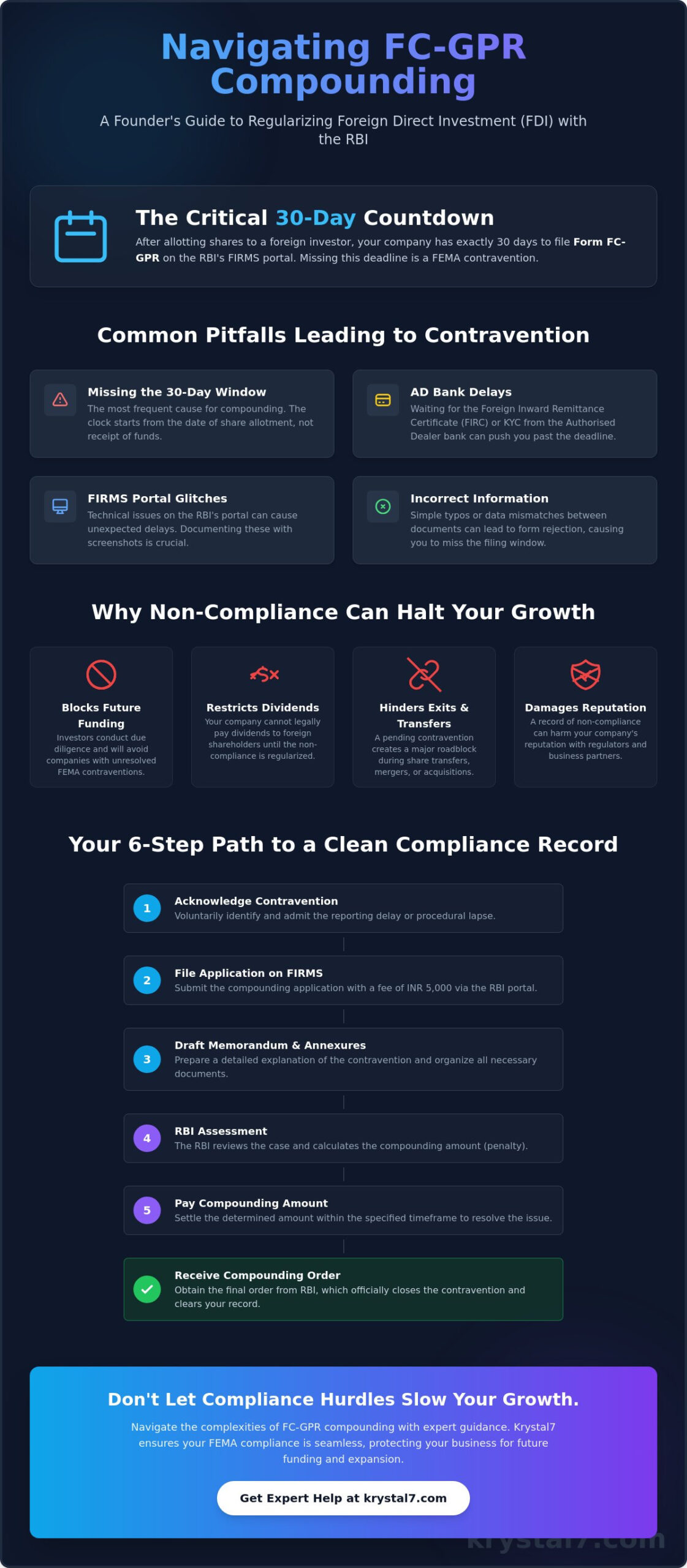
The clock starts ticking the moment you allot shares to a foreign investor. You have exactly 30 days to file Form FC-GPR on the FIRMS portal using the Single Master Form (SMF). Delays here are the most common reason for RBI notices. If your filing isn’t compliant, your company cannot legally pay dividends to those foreign shareholders. It also creates a massive roadblock during future share transfers or exits. Investors in 2026 are meticulous; they won’t put money into a company with an unresolved FEMA breach.
The Legal Basis: FEMA 1999 and RBI Master Directions
Section 13 of FEMA 1999 outlines the penalties for contraventions, while Section 15 grants the RBI the power to compound these offenses. The RBI has delegated this authority to different levels of officials based on the amount of the contravention. As of the 2026 updates to the Master Direction on Compounding, the process is more transparent than ever. These rules ensure that technical lapses, like missing a filing date by a few weeks, don’t result in disproportionate legal consequences for visionaries building in India. By following the prescribed framework, you can settle the matter by paying a compounding amount and get back to scaling your business.
Common Causes of FC-GPR Contraventions in FDI Reporting
Most FEMA breaches aren’t the result of intentional defiance. They usually stem from small procedural oversights that snowball into a legal headache. The most frequent cause for FC-GPR compounding RBI applications is missing the strict 30-day reporting window. This clock starts the moment your Private Limited company allots shares to the foreign investor, not when the money hits your bank account.
Founders often struggle with obtaining the Foreign Inward Remittance Certificate (FIRC) from their banks in time. Without this document and the associated KYC report from the Authorised Dealer (AD) Bank, you can’t complete the filing on the FIRMS portal. Even a simple typo in the KYC details provided by your bank can lead to a rejection of your form, pushing you past the legal deadline. If you’re struggling to coordinate these moving parts, our team at Krystal7 can help you manage your foreign investment compliance more effectively.
Technical glitches on the FIRMS portal also present a significant hurdle. While the RBI acknowledges that portal downtime happens, it’s rarely accepted as a valid excuse for long delays. It’s your responsibility to document these issues with screenshots and helpdesk tickets if you hope to use them as a defense during the compounding process.
Procedural Lapses vs. Substantive Breaches
The RBI distinguishes between minor procedural lapses and more serious substantive breaches. A procedural lapse might be filing your form 35 days after allotment instead of 30. A substantive breach is more severe, such as using an incorrect valuation certificate that doesn’t comply with the discounted cash flow (DCF) method. If you have multiple allotments happening across different months, these small delays can overlap, leading to a complex web of compliance failures that require a methodical FC-GPR compounding RBI strategy.
The Role of the AD Bank in Reporting Delays
Your AD Bank acts as the gatekeeper for all FDI reporting. If their internal processing is slow, your Unique Identification Number (UIN) might not be generated in time to meet the filing deadline. You can find detailed RBI guidance on compounding contraventions which explains how these bank-led delays are viewed by the regulator. Despite any bottlenecks at the bank level, the legal onus of timely filing remains entirely with the Indian company. You must proactively follow up with your bank to ensure all KYC and FIRC documents are ready before the allotment date.
The Step-by-Step Compounding Process for RBI Compliance
Once you’ve identified a delay in your FDI reporting, the path to resolution starts with a voluntary admission. This proactive approach is the cornerstone of FC-GPR compounding RBI procedures. You aren’t waiting for the regulator to find the error; you’re stepping forward to regularize your records. This admission demonstrates your commitment to transparency, which often works in your favor during the final assessment.
The first formal move is preparing the compounding application. This includes a detailed “Memorandum of Contravention” where you explain the specific facts and reasons why the delay occurred. You’ll need to pay a fixed application fee of INR 5,000 via Demand Draft or the updated electronic payment details provided by the RBI in late 2025. You then submit this package to the relevant RBI Regional Office or the Central Office in Mumbai, depending on the investment amount involved.
After the RBI reviews your documents, they may invite you for a personal hearing. This isn’t a trial; it’s an opportunity to explain the circumstances of the breach and highlight any technical hurdles you faced. For more technical details on eligibility and specific regional jurisdictions, you can refer to the RBI FAQs on FEMA Compounding. Once the authority is satisfied, they issue a Compounding Order specifying the penalty amount. You have exactly 15 days from the date of the order to make the payment. Once paid, the RBI issues a Certificate of Compounding, which serves as your final proof of regularisation.
Documentation Checklist for the Application
A methodical approach to documentation prevents unnecessary rejections and delays. Your application must be comprehensive to show the RBI that you’ve been diligent in your broader corporate responsibilities. You’ll need:
- Copies of the filed Form FC-GPR and the certified Board Resolution for share allotment.
- FIRC and KYC documents provided by your AD Bank to prove the source of funds.
- A signed undertaking confirming no other investigations by the Directorate of Enforcement (ED) are pending.
- Proof that your Annual Compliance for Private Limited Company filings are up to date.
Timeline for Completion in 2026
The entire process, from the date of your application to the final order, typically takes about 180 days. While this might seem long, it provides a structured window for the RBI to assess the case fairly. It’s crucial to remember that the RBI’s compounding order is final and cannot be appealed or challenged in any court. Once you pay the specified amount within the 15-day window, the contravention is legally settled. This finality allows you to close the chapter on past mistakes and focus on your company’s future growth.
Calculating Penalties and Compounding Fees in 2026
Understanding the financial implications of a filing delay is the first step toward regaining your operational liberty. The RBI has streamlined the process by introducing the Late Submission Fee (LSF) as a primary method for regularizing simple reporting delays. If your only mistake was missing the 30-day window for Form FC-GPR, you might be eligible to pay the LSF directly on the FIRMS portal without undergoing the full FC-GPR compounding RBI process. This fee acts as a structured penalty that allows companies to move forward without a formal admission of contravention.
However, if the breach involves more than just a timeline delay, or if the RBI specifically directs you to do so, compounding becomes necessary. Choosing compounding over a long court battle is a strategic move for visionaries. It’s often 90% cheaper than litigation and results in a final settlement that clears your record. If you’re unsure which path applies to your situation, you can consult our compliance experts to evaluate your specific case.
LSF vs. Compounding: Which Path to Take?
The LSF is generally available for procedural delays in reporting FDI through the Single Master Form. You can calculate this fee based on the duration of the delay and the investment amount. If you miss the window to pay the LSF or if the contravention involves structural issues, the RBI will mandate the compounding route. Maintaining a clear understanding of your corporate structure is vital. Referencing our Private Limited Company in India guide can help you ensure your foundational compliance is strong enough to avoid these hurdles entirely.
Factors Influencing the Penalty Amount
The RBI uses a methodical, formula-based approach to determine the compounding amount. They consider several concrete data points to ensure the penalty is fair. The primary factors include:
- The Investment Amount: The penalty is typically 1% of the total investment for a delay in filing Form FC-GPR.
- Duration of Delay: For the first six months, the penalty ranges from a minimum of INR 5,000 to a maximum of INR 5,00,000 per month. After six months, these rates double.
- Nature of Breach: The authority distinguishes between a technical lapse and a wilful defiance of rules. Under the April 2025 Master Direction, the compounding authority has the discretion to cap the maximum penalty at INR 2,00,000 for non-reporting contraventions, depending on the specifics of your case.
This structured approach ensures that founders aren’t unfairly penalized for genuine hardships or technical glitches. By admitting the contravention voluntarily through the FC-GPR compounding RBI framework, you demonstrate a commitment to financial openness that the regulator values.
Streamlining Your Cross-Border Compliance with Krystal7
Managing FEMA regulations shouldn’t feel like a barrier to your vision. Krystal7 acts as your Transparency Partner, bringing precision to the often-opaque world of RBI regulations. We believe in granting you operational liberty by handling the administrative weight of FC-GPR compounding RBI procedures. Our methodical approach ensures that every detail is captured accurately, from the initial audit to the final Certificate of Compounding.
We take a deep dive into your records to draft a robust Memorandum of Contravention. This document isn’t just a list of facts; it’s a strategic narrative that explains the specific reasons behind the delay. By presenting a clear and honest case, we help you secure the most favorable outcome. We often leverage the discretionary penalty caps introduced in the April 2025 Master Direction to minimize the financial impact on your startup.
Underlying reporting errors at the AD Bank level are a common cause of application rejection. We don’t just tell you what’s wrong; we liaise directly with your bank to rectify FIRC and KYC discrepancies. This proactive coordination ensures your application moves through the RBI Regional Office without hitting avoidable roadblocks. We handle the bureaucracy so you can stay focused on scaling your business.
Why Professional Assistance Matters for FEMA
Avoiding technical errors is critical because a rejected application can lead to higher regulatory scrutiny. We ensure your foundational company registration documents and board resolutions are perfectly aligned with FEMA requirements. Our advisors provide strategic clarity on whether your breach qualifies for the simpler Late Submission Fee (LSF) or requires the full compounding path. This expert guidance prevents you from overpaying penalties or choosing a more complex route than necessary.
Your Next Steps for Regularisation
Your path to total compliance starts with a comprehensive audit of all past FDI filings. This identifies hidden gaps before they trigger an official RBI notice. As you prepare for the 2026 annual filing cycle, having a clean record is your best asset for attracting global investors. We provide a methodical roadmap to fix past errors and set up a robust reporting system for the future.
- Request a full compliance audit of your past Form FC-GPR filings.
- Prepare your documentation for the upcoming 2026 annual filing cycle.
- Contact us for a confidential consultation to discuss your compounding needs.
Successfully managing FC-GPR compounding RBI requirements is about more than just paying a penalty. It’s about protecting your company’s professional standing and ensuring you’re ready for the next stage of growth. Contact Krystal7 Consultants at business@krystal7.com or visit krystal7.com for expert assistance.
Securing Your Startup’s Future Through Clean Compliance
A delayed filing doesn’t have to be a permanent stain on your company’s record. By voluntarily admitting a contravention and following the FC-GPR compounding RBI framework, you protect your reputation with future investors and ensure your operational liberty remains intact. The RBI’s 2026 guidelines prioritize transparency and offer discretionary caps on penalties for technical lapses.
Meticulous documentation and proactive communication with your Authorised Dealer bank are the best defenses against bureaucratic delays. Once you settle the compounding order, your business is free to issue dividends and transfer shares without legal hurdles. This process provides a clear path to regularize your foreign investment and move forward with total confidence.
Don’t let FEMA contraventions stall your growth. Contact Krystal7 Consultants at business@krystal7.com for expert RBI compounding assistance. Our team brings deep expertise in FEMA 1999 compliance and a methodical approach to ensure 100% application acceptance through dedicated liaison with regulators. You’ve built a visionary business; let us handle the regulatory complexity so you can focus on the growth ahead.
Frequently Asked Questions
1. What is the penalty for late filing of FC-GPR in 2026?
The penalty for a delay in filing Form FC-GPR is 1% of the total investment amount. For the first six months, the RBI charges a minimum of INR 5,000 and a maximum of INR 5,00,000 per month. This rate doubles for any delay exceeding six months. Under the April 2025 Master Direction, officials may cap penalties at INR 2,00,000 for non-reporting technical lapses depending on the specific case.
2. Can I file FC-GPR without a Foreign Inward Remittance Certificate (FIRC)?
No, you cannot successfully file Form FC-GPR without an FIRC or an equivalent document from your bank. The FIRMS portal requires you to upload the FIRC and the KYC report provided by your Authorised Dealer (AD) Bank as mandatory attachments. These documents prove that the foreign funds entered India through legal banking channels. Missing these documents is a primary reason for filing rejections and subsequent contraventions.
3. How long does the RBI compounding process take for FC-GPR?
The FC-GPR compounding RBI process typically takes about 180 days from the date you submit your application. This duration allows the RBI to review your Memorandum of Contravention, verify your documents, and schedule a personal hearing if necessary. Once the authority issues the Compounding Order, you must act quickly to meet the final payment deadline to ensure your compliance record is fully regularized.
4. Is a personal hearing mandatory for compounding at the RBI?
A personal hearing is not strictly mandatory but the RBI often encourages it to clarify the facts of the contravention. It’s an opportunity for founders to explain the circumstances of the delay, such as technical glitches or bank bottlenecks. If you choose to waive the hearing, the authority will pass the order based on the written documents you submitted. Most visionaries use this hearing to demonstrate their commitment to financial openness.
5. What happens if I don’t pay the compounding fee within 15 days?
If you fail to pay the compounding amount within 15 days of the order date, the order becomes null and void. The RBI will treat the contravention as if no compounding application was ever filed. This situation usually leads to the matter being referred to the Directorate of Enforcement (ED) for further investigation. Such a referral can result in much higher penalties under FEMA 1999 and affect future funding rounds.
6. Can I apply for compounding if the Enforcement Directorate (ED) is investigating my company?
You cannot apply for compounding if there is an ongoing investigation by the Enforcement Directorate into the same contravention. FEMA rules state that serious breaches involving money laundering or national security are non-compoundable. You must provide a signed undertaking with your application stating that no such investigation is pending. If an investigation starts during the process, the compounding proceedings are immediately stayed until the ED concludes its work.
7. What is the difference between LSF and compounding fees?
The Late Submission Fee (LSF) is a simplified penalty for procedural delays that you pay directly on the FIRMS portal. Compounding is a voluntary process for broader breaches or when you’ve missed the LSF eligibility window. While LSF is a quick fix for simple timeline errors, FC-GPR compounding RBI procedures involve a formal admission of guilt and a structured legal settlement with the regulator to wipe your slate clean.
8. How can I check the status of my FC-GPR filing on the FIRMS portal?
You can check your filing status by logging into the FIRMS portal and navigating to the Single Master Form (SMF) tab. The status will reflect as “Pending for Approval,” “Acknowledged,” or “Rejected” by the AD Bank or RBI. If your form is rejected, the portal usually provides a specific reason for the decision. This allows you to rectify errors or prepare for a compounding application if the 30-day deadline has already passed.

Article by
Nihal Srivastava
Nihal Srivastava is the Co-Founder of Krystal7 Consultants, helping Indian entrepreneurs and startups navigate company registration, compliance, trademark protection, and regulatory requirements with clarity and confidence. With 6+ years of hands-on expertise in MCA filings, GST compliance, and corporate structuring, Nihal has guided 1000+ businesses across India through their legal and compliance journeys. He believes every business dream deserves crystal clear foundations, and that no founder should be held back by paperwork or red tape.