

FC-GPR Filing Consultants in India: Your 2026 Compliance Guide
What if your multi-crore foreign investment was suddenly stalled by a simple 30-day reporting oversight? You’ve worked hard to secure international capital for your Indian subsidiary, so it’s frustrating when bureaucratic hurdles on the FIRMS portal threaten your momentum. Many entrepreneurs feel overwhelmed by the fear of heavy FEMA penalties and the technical complexity of RBI reporting.
We believe compliance should provide clarity, not confusion. Partnering with professional FC-GPR filing consultants ensures your documentation is meticulous and your submissions remain error-free from the start. This expert guide will empower you to master the intricacies of foreign investment reporting, allowing you to maintain a clean compliance record without the stress of inconsistent bank queries.
You’ll discover the latest 2026 FEMA amendments, the exact Late Submission Fee (LSF) calculations for delays, and a clear roadmap for successful FIRMS portal registration. We’ve simplified the complex so you can focus on scaling your vision in the Indian market.
Key Takeaways
- Distinguish between fresh share issuances and share transfers to ensure you select the correct reporting path under FEMA regulations.
- Master the FIRMS portal registration process by correctly setting up your Entity User and Business User profiles to avoid technical rejections.
- Learn how FC-GPR filing consultants conduct meticulous pre-audits of your FIRC and KYC documents to ensure seamless AD Bank approval.
- Identify the critical 30-day timeline for allotment reporting to protect your company from Late Submission Fees (LSF) and regulatory scrutiny.
- Understand the ongoing compliance roadmap, including how your initial FC-GPR filing links to mandatory annual FLA returns for your Indian subsidiary.
Understanding FC-GPR Filing: Why Foreign Investment Reporting Matters
Form FC-GPR (Foreign Currency-Gross Provisional Return) is a mandatory report filed with the Reserve Bank of India (RBI) through the FIRMS portal. Many founders partner with FC-GPR filing consultants to ensure this document correctly reflects their share issuance to non-resident investors. This reporting falls under the Foreign Exchange Management (Non-debt Instruments) Rules, 2019. Think of it as a transparency window. It provides the RBI with a clear view of how Foreign Direct Investment in India enters the domestic economy.
India recorded provisional FDI inflows of USD 81.04 billion in the 2024-25 financial year. This 14% increase from the previous year highlights why the RBI maintains strict oversight. Clear reporting isn’t just a legal chore; it builds a foundation of trust with regulators. It ensures your Indian subsidiary operates with total operational liberty and zero compliance friction.
Who Must Work with FC-GPR Filing Consultants in India?
Any Indian entity, usually a Private Limited Company or an LLP, that receives foreign investment must file this form. Expert FC-GPR filing consultants ensure that founders report the correct capital instruments. You must report the issuance of:
- Equity shares
- Compulsorily Convertible Preference Shares (CCPS)
- Compulsorily Convertible Debentures (CCDs)
This requirement isn’t limited to initial funding rounds. You must also file for rights issues and bonus issues when shares are allotted to non-resident investors. Reporting ensures your capital structure remains visible and verified by the central bank.
The 30-Day Countdown: Critical Timelines for Founders
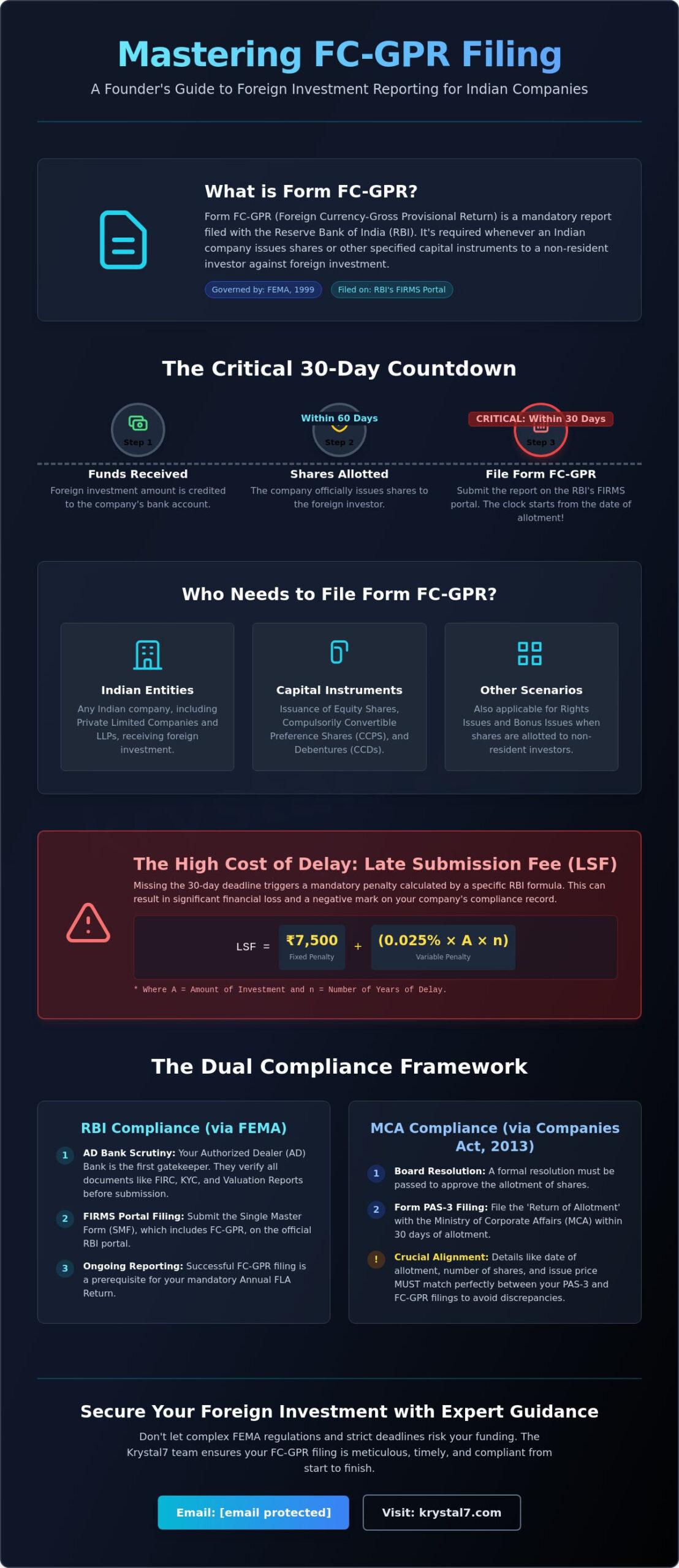
The clock starts ticking the moment you allot shares. You have exactly 30 days from the date of allotment to file Form FC-GPR. Many founders confuse this with the date they receive funds in their bank account. You actually have 60 days from the receipt of funds to complete the allotment of shares. Once that allotment happens, the 30-day reporting window is non-negotiable.
Missing the 30-day filing window triggers the Late Submission Fee (LSF) protocol. The LSF is calculated using the formula: ₹7,500 + (0.025% * A * n), where “A” is the amount and “n” is the number of years of delay. Even a small delay results in financial penalties and a mark on your compliance record. We handle these complexities so you can focus on your primary business goals.
The Regulatory Framework: FEMA Compliance and the RBI FIRMS Portal
The Foreign Exchange Management Act (FEMA), 1999, serves as the primary legislation for all capital account transactions in India. It creates a structured environment for foreign capital entry while ensuring national economic security. The Reserve Bank of India (RBI) manages this through the Foreign Investment Reporting and Management System (FIRMS) portal. This digital platform has revolutionized reporting by introducing the Single Master Form (SMF). The SMF integrates multiple reporting requirements into one interface, reducing the administrative burden on founders. It’s designed to provide visual precision for regulators and operational liberty for your business.
Your Authorized Dealer (AD) Bank acts as the first gatekeeper in this process. They don’t just forward your application; they scrutinize every document for accuracy. If your bank finds inconsistencies, they’ll reject the filing before it ever reaches the RBI. Experienced FC-GPR filing consultants ensure that your SMF submission is flawless, preventing the back-and-forth queries that often stall investment timelines. Refer to the Invest India FDI Guide for a deeper look at how these regulations protect the Indian economy while inviting growth.
Key Legislative Provisions Under the Companies Act, 2013
FEMA compliance doesn’t exist in a vacuum. It must align perfectly with the Companies Act, 2013. When you complete private limited company registration, you initiate a series of corporate actions. You must file Form PAS-3 with the Ministry of Corporate Affairs (MCA) within 30 days of allotting shares. The details in your PAS-3, such as the date of allotment and share price, must match your FC-GPR filing exactly. Any discrepancy between the board resolution and the RBI return can lead to a compliance red flag. If you’re feeling overwhelmed by these dual requirements, expert compliance advisory can help streamline the process.
FEMA Compliance: Avoiding Section 13 Penalties
Ignoring these regulations leads to severe consequences under Section 13 of FEMA. Violations can result in penalties of up to three times the sum involved. However, the RBI has simplified the process for procedural delays. Most late filings now fall under the Late Submission Fee (LSF) protocol rather than the lengthy compounding process. The LSF is a non-refundable penalty calculated based on the investment amount and the duration of the delay. Working with FC-GPR filing consultants ensures you hit every deadline, keeping your Indian subsidiary’s compliance record spotless and penalty-free.
FC-GPR vs. Other RBI Filings: Navigating the Compliance Maze
Founders often ask if a single form covers every foreign transaction. It doesn’t. Each transaction type has a specific reporting path defined in the RBI Master Direction on FEMA Reporting. Professional FC-GPR filing consultants help you identify which form applies to your specific scenario, ensuring you don’t use the wrong template for a complex capital move. Using the incorrect form is a common mistake that leads to immediate AD Bank rejection and potential late fees.
There’s also a specific requirement for DPIIT-recognized startups issuing convertible notes. If your company issues these instruments to non-residents, you must use Form CN instead of FC-GPR. This specialized reporting ensures the RBI tracks debt that might later convert into equity. Keeping these forms distinct is vital for maintaining visual precision in your corporate records.
FC-GPR vs. FC-TRS: Fresh Issue vs. Secondary Transfer
The distinction between these two forms is often the biggest source of confusion for entrepreneurs. Form FC-GPR is strictly for the fresh issuance of capital instruments by an Indian company to a person resident outside India. You have 30 days from the date of allotment to file this. In contrast, Form FC-TRS is used for the secondary transfer of shares between a resident and a non-resident. The reporting window for FC-TRS is 60 days from the date of transfer.
Consider a practical example. Imagine a foreign venture capital firm invests ₹10 crore directly into your startup for new shares; that’s an FC-GPR filing handled by the company. If that same VC later buys ₹1 crore worth of shares from an early founder, that’s an FC-TRS filing. The responsibility for FC-TRS usually lies with the resident party, whether they’re the buyer or the seller. Partnering with FC-GPR filing consultants ensures you correctly categorize these transactions to avoid compliance gaps.
The Annual Compliance Link: FLA Returns
Filing your initial return after a funding round is just the beginning of your journey. Every Indian company that has received FDI or made overseas investments must file the Foreign Liabilities and Assets (FLA) return. This is an annual requirement with a strict deadline of July 15th each year. Even if you didn’t issue any new shares during the financial year, you must still report your total foreign holdings.
The data you submit in your initial filings feeds directly into your annual compliance for private limited company. Discrepancies between your FC-GPR and your FLA return can trigger intense scrutiny from the RBI. We help you maintain a clean compliance record by ensuring your annual figures match your transactional history perfectly. This methodical approach grants you the operational liberty to scale without worrying about past reporting errors.
Step-by-Step Guide to Successful FC-GPR Filing in 2026
Starting the filing process on the FIRMS portal often feels like decoding a complex puzzle. Professional FC-GPR filing consultants bring order to this complexity by managing the technical nuances of the Reserve Bank’s digital environment. Success begins long before you log in. You must first secure the Foreign Inward Remittance Certificate (FIRC) and a specific KYC report from the investor’s bank. This KYC is the most frequent bottleneck because AD Banks require it in a very specific format before they’ll even look at your application.
Once you have your documents, the portal registration happens in two distinct phases. First, you register as an Entity User to represent the company itself. After the RBI approves this, you register as a Business User, which is the individual authorized to perform the actual filing. This methodical two-step verification ensures visual transparency for the regulator while protecting your corporate data. Finally, you file the Single Master Form (SMF), attaching a valuation certificate issued by a Chartered Accountant to justify the share price.
Mandatory Documentation Checklist
Preparation is the key to operational liberty. Missing even one document can lead to a cycle of rejections. Ensure you have these ready:
- FIRC and KYC: Obtained from the foreign investor’s bank through your AD Bank.
- Valuation Certificate: Must be compliant with FEMA (Non-Debt Instruments) Rules, 2019.
- Board Resolution: A certified copy of the resolution authorizing the allotment of shares.
- CS Certificate: A certificate from a practicing Company Secretary confirming that all Companies Act requirements are met.
Common FIRMS Portal Errors and How to Avoid Them
Even small data entry mistakes can trigger a “Resubmission” request. A common error is a mismatch between the investment amount shown on the FIRC and the total value of shares allotted. If the figures don’t align to the last decimal, the AD Bank will reject the filing. You must also be careful when selecting the “Nature of Issue” in the SMF dropdown; picking “IPO” instead of “Private Placement” is a frequent slip that causes unnecessary delays.
If you miss the 30-day window, you’ll face the Late Submission Fee (LSF). The LSF is calculated using the formula: ₹7,500 + (0.025% * A * n), where “A” is the investment amount and “n” is the number of years of delay. This fee is non-refundable and can quickly escalate, which is why founders rely on FC-GPR filing consultants to hit every deadline. If you’re ready to secure your investment’s compliance, you can start your filing process here with expert support.
Why Partner with FC-GPR Filing Consultants for Your Indian Subsidiary?
Filing a return on the FIRMS portal is more than just a data entry task; it’s a strategic alignment of your company’s records with national regulations. Professional FC-GPR filing consultants provide a meticulous pre-audit of all FDI documents before they ever reach the portal. This proactive approach identifies potential discrepancies in your FIRC or board resolutions that could lead to immediate rejection. We handle the administrative complexity so you can maintain your focus on building your product and scaling your vision.
Liaising with Authorized Dealer (AD) Banks requires a deep understanding of regulatory language and specific bank internal policies. Our team speaks the language of regulators, which helps speed up approvals and resolve queries before they become major obstacles. This partnership grants you operational liberty, ensuring your foreign investment is regularized without the stress of constant back-and-forth communication with bank officials. We also provide integrated support for GST, TDS, and company registration in India to keep your entire compliance framework robust.
Expert Advisory for Complex FDI Structures
Foreign investment often involves more than just a simple share issuance. We provide expert guidance for complex scenarios like downstream investments, where your Indian subsidiary invests in another domestic entity using foreign funds. Our advisors ensure your cap table remains FEMA-compliant through every funding round, protecting you from future valuation disputes. We also help you stay within sectoral caps, such as the 74% limit for defence under the automatic route or the 100% conditional cap for insurance.
Contact Krystal7 for Expert Compliance Management
Our Gurugram-based team offers personalized support tailored to the unique needs of startups and SMEs. We believe in visual transparency, providing clear pricing models with no hidden costs for handling Late Submission Fees (LSF) or regularisation processes. You deserve a partner who is as invested in your clean compliance record as you are. By choosing experienced FC-GPR filing consultants, you ensure your Indian subsidiary stands on a foundation of calm competence and legal security.
Mastering RBI reporting doesn’t have to be a source of anxiety for your leadership team. Contact Krystal7 Consultants today at business@krystal7.com or visit krystal7.com to secure your company’s financial future. Let us handle the complexity while you pursue your primary goals with confidence.
Secure Your Investment for Long-Term Growth
Your journey with foreign direct investment doesn’t end when the funds arrive in your bank account. Real operational liberty comes from maintaining a spotless compliance record with the RBI. By prioritizing the 30-day allotment window, you prevent the friction of bank queries and heavy penalties.
Expert FC-GPR filing consultants act as your methodical partner, bringing order to the technicalities of the FIRMS portal. Krystal7 Consultants offers specialized Gurugram-based CA expertise for foreign subsidiary compliance. We take pride in our 100% success rate in RBI regularisation cases, providing the visual precision your cap table needs for future growth.
Don’t let bureaucratic complexity stall your momentum. Secure your FDI compliance with Krystal7’s expert FC-GPR filing services today. We’re here to turn legal formalities into a foundation for your success.
Frequently Asked Questions
What is the penalty for late filing of FC-GPR in 2026?
The penalty for delayed reporting is the Late Submission Fee (LSF), which follows a specific formula: ₹7,500 + (0.025% * Investment Amount * Years of Delay). This fee is capped at 100% of the total investment amount involved. Professional FC-GPR filing consultants help you calculate this precisely to ensure your Indian subsidiary’s records are regularized without further legal friction.
Can a company file FC-GPR without a Valuation Certificate?
No, a Valuation Certificate is a mandatory attachment for every FC-GPR filing. You must obtain this from a Chartered Accountant or a SEBI-registered Merchant Banker to justify the share price under FEMA (Non-Debt Instruments) Rules. This document provides the visual transparency regulators require to confirm that shares aren’t issued below fair market value.
Is the Entity User and Business User the same person on the FIRMS portal?
These are two distinct roles on the portal, though one individual can hold both. The Entity User handles the company’s registration and master data, while the Business User is the person authorized to perform the actual filing. You must register the Entity User first, as Business User registration requires an approval letter from the company’s authorized signatory.
What is a FIRC and why is it mandatory for RBI reporting?
A Foreign Inward Remittance Certificate (FIRC) is an official document issued by your bank confirming the receipt of foreign funds. It’s mandatory because it serves as the primary proof of investment for the RBI. Without a valid FIRC and the accompanying KYC report from the investor’s bank, you cannot complete the reporting process on the FIRMS portal.
Do I need to file FC-GPR for a transfer of shares between two non-residents?
No, Form FC-GPR is strictly for the fresh issuance of capital instruments by an Indian company to a non-resident. Transfers of existing shares between two non-residents generally don’t require reporting to the RBI. However, if the transfer happens between a resident and a non-resident, you’ll need to file Form FC-TRS within 60 days of the transaction.
What happens if the AD Bank rejects my FC-GPR filing?
If your AD Bank rejects the filing, they’ll provide a specific reason for the “Resubmission” request on the portal. You must fix the errors, such as document mismatches or incorrect data entry, and refile the form promptly. Partnering with FC-GPR filing consultants helps you handle these queries effectively, ensuring your second submission meets all technical bank requirements.
Is a Chartered Accountant’s certificate mandatory for FC-GPR?
Yes, a Chartered Accountant’s certificate is essential for verifying the valuation of the shares issued to foreign investors. You’ll also typically need a certificate from a practicing Company Secretary to confirm that the allotment complies with the Companies Act, 2013. These professional certifications build trust with the RBI and ensure your compliance record remains clean.

Article by
Nihal Srivastava
Nihal Srivastava is the Co-Founder of Krystal7 Consultants, helping Indian entrepreneurs and startups navigate company registration, compliance, trademark protection, and regulatory requirements with clarity and confidence. With 6+ years of hands-on expertise in MCA filings, GST compliance, and corporate structuring, Nihal has guided 1000+ businesses across India through their legal and compliance journeys. He believes every business dream deserves crystal clear foundations, and that no founder should be held back by paperwork or red tape.