

GST Registration for Startups in Hyderabad: A Complete 2026 Guide
With Telangana recording a record-breaking ₹4,621 crore in GST collections in April 2026, it’s clear that the city’s startup ecosystem is moving at a relentless pace. You’ve likely felt the weight of this growth while worrying about potential bureaucratic delays at the local tax office or the complexity of the new GST 2.0 framework. We agree that the fear of missing a deadline shouldn’t overshadow your entrepreneurial vision. Securing GST registration for startups in Hyderabad is a vital step that transforms a regulatory requirement into a strategic asset for your business.
This expert guide provides the visual clarity you need to navigate the registration process without the usual administrative headaches. You’ll learn exactly how to fast-track your GSTIN approval, claim Input Tax Credit on your early expenses, and avoid the risks of the 2026 three-year return filing block. We’ll break down the latest turnover thresholds and compliance rules to ensure your startup remains legally compliant and investor-ready from day one.
Key Takeaways
- Learn how GST transforms your local venture into a nationally recognized entity by simplifying the tax structure across state lines.
- Determine your eligibility based on the latest 2026 turnover thresholds and discover why early GST registration for startups in Hyderabad is a strategic move for claiming tax credits.
- Streamline your application by gathering essential documents like PAN, Aadhaar, and proof of business registration before you begin the online process.
- Navigate the GST portal with confidence by following our clear, step-by-step guide to securing your GSTIN without bureaucratic delays.
- Establish a robust compliance framework to manage monthly filing deadlines and protect your startup’s financial reputation from heavy penalties.
Why GST Registration for Startups in Hyderabad is Your First Milestone
The Goods and Services Tax (GST) is a destination-based tax that applies to every stage of the supply chain where value is added. It replaced a fragmented system of multiple indirect taxes with a single, unified regime. For founders in Telangana, this means the entire country becomes a single national market. You can ship products from a warehouse in Uppal to a customer in Delhi without the friction of disparate state tax laws. Obtaining GST registration for startups in Hyderabad is your first step toward operational liberty.
Transparency is a core asset in the modern business world. A GSTIN acts as a visual symbol of trust that proves your business is legitimate and follows national standards. When you display your GST number on invoices, you aren’t just complying with the law. You’re signaling to every vendor, customer, and investor that your startup is built on a foundation of clarity. This professional standing is essential for any venture aiming to scale beyond its initial launch phase.
The Hyderabad Startup Ecosystem and Tax Compliance
Hyderabad has solidified its position as India’s fourth startup capital. In high-density hubs like T-Hub, TSIC, and the tech corridors of Gachibowli, compliance is a prerequisite for growth. Most corporate giants in HITEC City won’t sign contracts with unregistered vendors because they cannot claim Input Tax Credit (ITC) on those purchases. If your startup provides SaaS, biotech solutions, or fintech services, you’ll find that a GSTIN is your entry ticket to the corporate world.
E-commerce ventures also face specific mandates. If you plan to sell goods through online platforms across state lines, the law requires GST registration regardless of your annual turnover. Beyond legalities, having a registered GSTIN simplifies your journey when applying for state-level startup incentives. The Telangana government often prioritizes tax-compliant entities for grants and incubation programs. It’s about positioning your business to catch every available tailwind in the local ecosystem.
GST vs. Old Tax Regimes: What Changed for Founders?
Before GST, Indian business owners struggled with a “tax on tax” effect known as cascading. You might have paid VAT on raw materials and then Service Tax on the final delivery, with no way to offset the costs. The current system, managed by the Central Board of Indirect Taxes and Customs (CBIC), eliminates this inefficiency. It allows you to focus your capital on innovation rather than losing it to redundant tax layers.
The transition from the old VAT and Service Tax regimes to GST 2.0 has brought unprecedented automation. Today, the process is entirely digital and data-driven. This shift reduces the need for physical visits to tax offices and minimizes bureaucratic delays. By adopting a unified structure, the government has made it easier for visionaries to manage their finances with precision and confidence.
Eligibility Criteria: Does Your Startup Need GST Immediately?
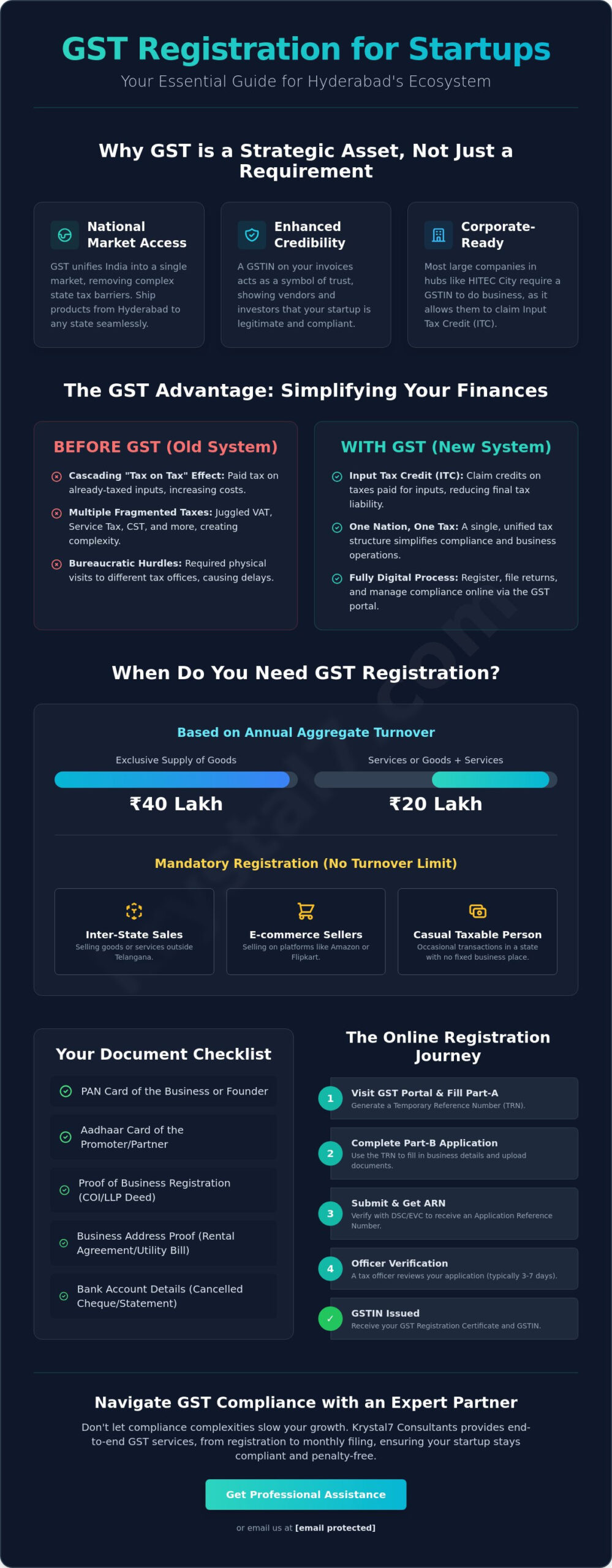
Determining when to apply for GST registration for startups in Hyderabad depends largely on your business model and annual revenue. Under the GST Act, the threshold for businesses exclusively supplying goods is an annual turnover of INR 40 Lakh. If your startup provides services, this limit drops to INR 20 Lakh. For ventures that offer a mix of both goods and services, the INR 20 Lakh threshold applies. You can monitor these limits and start your application on the official GST portal once you approach these figures.
Thresholds don’t tell the whole story. Certain scenarios trigger mandatory registration regardless of your turnover. If you’re making interstate supplies, meaning you sell to customers outside of Telangana, you must register immediately. This also applies to casual taxable persons who occasionally undertake transactions in a territory where they have no fixed place of business. Understanding these nuances early prevents costly legal friction later. If you’re unsure where your business fits, our team can help you identify the right GST filing and compliance strategy for your specific model.
Mandatory Registration for E-commerce and Tech Services
The digital economy has its own set of strict rules. Startups selling products through aggregators like Amazon or Flipkart must obtain a GSTIN from day one. There’s no turnover exemption for e-commerce sellers under the current regime. Software-as-a-Service (SaaS) firms often find themselves in a similar position. Because SaaS products are frequently sold to clients across state lines or internationally, the “Interstate Supply” rule makes registration a functional necessity for legal operations.
The Power of Voluntary GST Registration
Many founders choose to register voluntarily even before hitting the revenue milestones. This is a strategic move to unlock Input Tax Credit (ITC). When you’re in the setup phase, you’re likely spending heavily on laptops, office furniture, high-speed internet, and professional services. Without a GSTIN, the tax you pay on these expenses is a sunk cost. With registration, you can claim this tax back, effectively reducing your initial burn rate.
Voluntary registration also erases the “unregistered dealer” stigma. In the B2B world, established companies prefer working with GST-compliant vendors to ensure they can claim their own ITC. Having a GST number makes your startup “corporate-ready” and allows you to bid for larger contracts and government tenders with confidence. It transforms your business from a small-scale operation into a professional entity prepared for national growth.
Documents Required for GST Registration for Startups in Hyderabad
Organizing your paperwork is the most effective way to eliminate anxiety during the application process. Precise documentation ensures that your GST registration for startups in Hyderabad moves through the Official GST Portal without being flagged for discrepancies. You’ll need high-resolution scans of the original documents to avoid rejection by the tax officer. Preparing these files in advance transforms a complex administrative task into a streamlined, methodical process.
Every director or partner must provide their PAN card and Aadhaar card along with a recent passport-size photograph. For the business entity itself, you must upload the Certificate of Incorporation (COI) or a registered Partnership Deed. The tax department also requires proof of your financial standing, which is usually a bank statement or a cancelled cheque showing the account holder’s name and the bank’s IFSC code. These documents provide the financial openness required for a successful application.
Specific Proofs for Different Business Structures
For a Private Limited Company, founders must provide a Board Resolution or a Letter of Authorization. This document formally appoints an authorized signatory to manage the GST account. If you’re running a Limited Liability Partnership (LLP) in Telangana, ensure you have the initial LLP agreement ready. These structural documents prove that the person applying has the legal authority to represent the startup and fulfill its tax obligations.
Virtual Office vs. Physical Office Proofs
Many tech ventures in HITEC City or Madhapur operate out of co-working spaces. If you’re using a virtual or shared office, you’ll need a valid No Objection Certificate (NOC) from the property owner. It’s vital that the address on your electricity bill or rent agreement matches the details in your company registration papers exactly. Even a small typo in the door number or pincode can lead to a “Show Cause Notice” from the GST department, causing unnecessary delays.
For companies and LLPs, the application must be signed using a Class 3 Digital Signature Certificate (DSC). This electronic signature provides a layer of security and verifies the identity of the applicant. Having these files ready before you log in will help you complete the process in a single session. This meticulous preparation grants you the operational liberty to focus on your core business goals while we handle the regulatory heavy lifting.
The Step-by-Step Online GST Registration Process
The journey toward securing GST registration for startups in Hyderabad is now entirely digital, designed to offer entrepreneurs operational liberty. You begin by visiting the official GST portal and completing Part A of the registration form. This initial step requires your PAN, mobile number, and email address to generate a Temporary Reference Number (TRN). The TRN is your key to unlocking the detailed application form, known as Part B, where you’ll provide specific business and stakeholder information.
Once you log in with your TRN, you have 15 days to complete the remaining sections. You must upload the documents discussed in the previous section, such as your proof of address and bank details. After filling in all the mandatory tabs, you’ll verify the data using a Digital Signature Certificate (DSC) or an Electronic Verification Code (EVC). Upon successful submission, the system generates an Application Reference Number (ARN). This number allows you to track your approval status in real-time as it moves through the tax department’s queue.
Navigating the GST Portal (gst.gov.in)
Choosing the correct Harmonized System of Nomenclature (HSN) for goods or Service Accounting Code (SAC) for services is a critical step. Selecting the wrong code can lead to incorrect tax rates and future compliance hurdles. Identify your top five goods or services to ensure your primary business activity is accurately represented. To avoid technical glitches like session timeouts, keep all your scanned files within the size limits specified on the portal. Proper preparation ensures your session remains active and your data stays secure.
Approval Timeline and the GST Certificate
The typical turnaround time for approval in Telangana is between 3 to 7 working days. A major factor in this speed is Aadhaar authentication. Choosing this mandatory step usually bypasses the need for an immediate physical verification of your business premises. If you opt out of Aadhaar authentication, a tax officer might visit your office to verify the address before granting approval. Once the officer reviews and approves your ARN, your GST REG-06 certificate becomes available for download. This document officially grants you the ability to collect tax and claim credits across India.
If you want to ensure a rejection-free application and move straight to business operations, you can leverage our GST filing and compliance services to manage the entire process for you.
Post-Registration Compliance: Avoiding Penalties and Staying Secure
Securing your GST registration for startups in Hyderabad is a significant victory for your business. However, this milestone is just the beginning of a journey toward long-term financial openness. To maintain your operational liberty, you must adopt a methodical approach to monthly filings. Consistency is the foundation of a high compliance rating, which investors and banks now scrutinize during their due diligence processes.
You must adhere to strict monthly deadlines to avoid bureaucratic friction. GSTR-1, which contains the details of your outward supplies, is due by the 11th of every month. GSTR-3B serves as your monthly summary of supplies and tax payments and is due by the 20th. Timely TDS and GST payments are essential to keep your business secure and legally compliant within the Telangana tax framework.
Delays carry heavy costs that can quickly drain a startup’s limited capital. The late fee for filing after the deadline is INR 50 per day. Even if you have no transactions and need to file a Nil return, the penalty is INR 20 per day. These fees are accompanied by interest on the outstanding tax amount, making punctuality a critical financial necessity for every founder.
Managing Annual Compliance and Returns
Beyond monthly tasks, your vision for growth must include preparation for yearly requirements. Understanding the annual compliance for a private limited company helps you stay ahead of GSTR-9 filings. Growing startups with an aggregate turnover exceeding INR 2 crores must file this annual return by December 31st of the following financial year. Meticulous bookkeeping serves as the backbone of hassle-free audits and ensures your financial data remains transparent and accurate.
Liberate Your Growth with Krystal7 Consultants
Delegating these administrative burdens to a trusted partner grants you the freedom to focus on your core business goals. Our experts handle the meticulous details of the evolving Indian tax landscape with calm competence and professional precision. We provide visual clarity through our transparent pricing models for GST filing and compliance. This partnership allows you to navigate the complexities of GST registration for startups in Hyderabad while we secure your business against penalties and legal risks.
A long-term partnership with a dedicated advisor ensures you are always prepared for regulatory shifts like GST 2.0. We aim to be the supportive expert that alleviates your anxiety over monthly filing deadlines. By choosing to delegate compliance, you empower your startup to pursue its primary primary goals with optimism and security. Contact Krystal7 Consultants today at business@krystal7.com or visit krystal7.com to begin your journey toward total operational liberty.
Empower Your Startup with Seamless Compliance
Securing your GSTIN is more than just a legal checkbox. It’s a strategic launchpad for your business to scale across India. By obtaining this registration, you unlock the power to claim Input Tax Credit on setup costs and build immediate credibility with corporate clients in HITEC City. We’ve seen how a clear tax strategy provides the operational liberty needed to focus on innovation rather than paperwork.
Our team of expert Chartered Accountants brings deep startup experience to ensure your filing process is 100% transparent and meticulous. We’re trusted by entrepreneurs across Telangana to manage the complexities of the 2026 GST 2.0 framework. We handle every detail, from initial documentation to monthly filings, so you can pursue your primary goals with absolute confidence.
Ready to secure your GST registration for startups in Hyderabad? Contact Krystal7 Consultants at business@krystal7.com or visit krystal7.com for expert assistance today. Your vision deserves a foundation of financial clarity and professional support. Let’s build your success story together.
Frequently Asked Questions
Is GST registration mandatory for a new startup in Hyderabad?
Registration is mandatory once your annual turnover exceeds INR 40 Lakh for goods or INR 20 Lakh for service providers. You must also register regardless of turnover if you sell products through e-commerce platforms or conduct interstate transactions. Many founders choose voluntary GST registration for startups in Hyderabad early on to claim tax credits on setup expenses like IT hardware and office rent.
How much does GST registration cost for a startup in Telangana?
The Government of India doesn’t charge any fee for the online registration process on the GST portal. While the portal itself is free, many startups hire professionals to ensure the application is error-free and compliant with the latest 2026 regulations. This prevents the administrative burden of handling “Show Cause Notices” and ensures your GSTIN is approved without unnecessary bureaucratic delays.
Can I apply for GST registration in Hyderabad without a physical office?
You must provide a registered principal place of business, but it doesn’t have to be a traditional independent office. Many tech startups in Gachibowli use co-working spaces or virtual offices for their registration. You’ll need a valid No Objection Certificate (NOC) from the property owner and a recent utility bill to prove the address exists and is authorized for your use.
What is the penalty for not registering for GST when required?
Failure to register when your turnover crosses the threshold can lead to a penalty of 10% of the tax due or INR 10,000, whichever is higher. If the tax authorities find that you’re deliberately avoiding registration to evade taxes, the penalty can increase to 100% of the tax amount due. Staying compliant helps you avoid these financial drains and keeps your business investor-ready.
How long does it take to get a GST number in Hyderabad?
The approval process typically takes between 3 to 7 working days if your documents are in order and you complete Aadhaar authentication. If you don’t opt for Aadhaar-based verification, the process might take longer as a tax officer may conduct a physical site visit. Once approved, your GST certificate is immediately available for download from the official portal.
Do I need a separate GST registration for different branches in India?
GST is a state-specific registration, so you need a separate GSTIN for every state where you have a business presence. If you have multiple branches within Telangana, you can usually operate under a single registration by adding them as “additional places of business.” However, for a branch in Bengaluru or Gurgaon, a fresh application for that specific state is legally required under the GST Act.
Can a startup claim a refund of GST paid on capital goods?
Startups generally can’t claim a cash refund for GST paid on capital goods like machinery or computers, but you can claim Input Tax Credit (ITC). This credit stays in your electronic credit ledger and can be used to pay off your future output tax liability. Cash refunds are typically reserved for specific scenarios like zero-rated exports or cases of an inverted duty structure.
What happens if I make a mistake in my GST registration application?
If the tax officer finds an error, they will issue a “Show Cause Notice” (SCN) via the portal. You’ll have 7 working days to provide a clarification or upload the correct documents to resolve the query. If your response doesn’t satisfy the officer’s requirements, the application might be rejected, requiring you to start a fresh application for GST registration for startups in Hyderabad.

Article by
Nihal Srivastava
Nihal Srivastava is the Co-Founder of Krystal7 Consultants, helping Indian entrepreneurs and startups navigate company registration, compliance, trademark protection, and regulatory requirements with clarity and confidence. With 6+ years of hands-on expertise in MCA filings, GST compliance, and corporate structuring, Nihal has guided 1000+ businesses across India through their legal and compliance journeys. He believes every business dream deserves crystal clear foundations, and that no founder should be held back by paperwork or red tape.