

FPO Full Form Food: Meaning, Requirements, and Compliance Guide 2026
Last Tuesday, a local pickle manufacturer in Gujarat faced a 50,000 INR penalty simply because their team was confused about current labeling laws. Many entrepreneurs still struggle to define the fpo full form food safety standards require, leading to unnecessary anxiety over legal red tape. It’s a common hurdle: you want to focus on your recipe and growth, but the fear of statutory defaults keeps you awake at night.
We understand that handling Indian compliance can feel like a maze. You deserve a partner who brings transparency to these complex regulations so you can reclaim your freedom to focus. This guide promises to clear the fog by detailing the complete meaning of the Fruit Products Order, its mandatory requirements, and the specific steps to ensure your products meet every Indian safety standard in 2026.
You’ll gain a structured understanding of which products require the mark and how the transition to the Food Safety and Standards Act 2006 affects your daily operations. We’ve compiled the essential document checklists and penalty breakdowns to ensure your business remains secure and scalable.
Key Takeaways
- Gain clarity on the Fruit Products Order 1955 and its statutory roots within the Essential Commodities Act 1955.
- Understand that the fpo full form food industry professionals use refers to the Fruit Products Order, which is now part of unified safety standards.
- Determine if your specific products: including synthetic syrups, jams, and fruit pulps: require mandatory certification under current Indian laws.
- Master the FoSCoS portal registration process and document requirements to secure your business against legal penalties or operational disruptions.
- Transition your legacy certifications into the unified FSSAI system to embrace the One Nation, One Food Law initiative for greater ease of doing business.
Last updated on May 22, 2024
Decoding FPO: The Full Form in the Food Industry and Its Meaning
Understanding the fpo full form food industry standards is the first step toward building a compliant and successful brand. The term stands for Fruit Products Order. It represents a set of quality benchmarks that have governed Indian food processing for decades. This mark acts as a visual guarantee for consumers. It confirms that a product was manufactured in a clean and hygienic environment.
The primary purpose of this certification is to ensure the quality and safety of processed fruit and vegetable products across India. While the fpo full form food definition is straightforward, its application involves rigorous standards for ingredients and packaging. It covers everything from bottled jams to canned vegetables. This regulatory framework prevents the sale of substandard goods that could pose health risks to the public.
A product carrying this mark has undergone inspections to verify its manufacturing process. This includes checking water quality, worker hygiene, and the absence of harmful additives. By adhering to these standards, businesses demonstrate a commitment to transparency. This commitment is essential for gaining traction in a competitive retail market where safety is a top priority for families.
Talk to Krystal7 to verify if your current turnover exceeds 12,00,000 INR and requires specific food safety registrations.
Historical Context and Evolution
The Fruit Products Order, 1955, was issued under Section 3 of the Essential Commodities Act, 1955. It was designed to regulate the manufacture and distribution of fruit based products. In 2006, the mark became mandatory for all processors in the country. This shift ensured that even small scale units maintained a baseline of sanitary conditions during production.
The Ministry of Food Processing Industries originally governed this mark to protect consumers from adulteration. Accessing a detailed overview of the FPO Mark helps entrepreneurs understand its transition into the modern regulatory landscape. While the Food Safety and Standards Act, 2006, eventually consolidated various food laws, the technical specifications for jams and juices remain rooted in the original 1955 order.
Why the FPO Mark Still Matters Today
Indian consumers often look for the familiar square logo as a sign of trust and safety. It remains a vital asset for businesses targeting institutional contracts or government tenders. Many international export protocols still reference these specific processing standards during quality audits. Adhering to these benchmarks ensures your business avoids the risks associated with poor batch quality.
While the Food Safety and Standards Authority of India is now the primary regulator, the foundational standards of the original order persist. Businesses that respect these legacy standards often find the transition to modern FSSAI compliance much smoother. It provides a structured path for growth. This clarity allows entrepreneurs to focus on innovation rather than worrying about sudden legal hurdles or product recalls.
- Check your product labels to ensure the certification mark is clearly visible and meets size requirements.
- Review your manufacturing facility against the hygiene standards defined in the Fruit Products Order, 1955.
- Audit your supplier list to confirm that all raw fruit pulp providers hold valid safety certifications.
Compliance is easy when it is systematic.
Statutory Framework: Applicable Laws and Mandatory Requirements
The legal journey of fruit product regulation in India began with the Essential Commodities Act, 1955. Under Section 3 of this parent legislation, the Government of India issued the Fruit Products Order (FPO), 1955. For decades, this order set the quality and sanitary benchmarks for the industry. Industry professionals recognize the fpo full form food as the Fruit Products Order, which ensured that every jar of jam or bottle of juice met specific safety criteria.
Everything changed with the notification of the Food Safety and Standards Act, 2006. This consolidated law repealed eight older acts, including the 1955 Order, to create a single regulatory window. Since August 5, 2011, the Food Safety and Standards Authority of India (FSSAI) has served as the sole regulator. All businesses previously governed by the fpo full form food standards must now comply with FSSAI regulations to maintain their legal standing.
Applicability Thresholds for Businesses
Compliance requirements depend on your production volume and annual turnover. Petty food manufacturers with an annual turnover below ₹12,00,000 only require basic registration. If your turnover exceeds this limit, you must obtain either a State or Central License. This ensures clarity for small scale cottage industries and large commercial units alike.
Production capacity serves as a critical divider for commercial units. Units producing up to 100 kilograms or liters per day fall under the small scale category. Large scale units exceeding 2 metric tonnes per day must apply for a Central License through the FoSCoS portal. If you are unsure about your category, you can Get a compliance check to clarify your status.
Key Technical Standards
The current regulatory regime mandates strict adherence to Schedule 4 of the FSS (Licensing and Registration of Food Businesses) Regulations, 2011. Manufacturing premises must be located away from environmental pollutants and maintain a drainage system that prevents backflow. Sanitation is strictly mandatory for every processing unit.
Water used in processing must strictly comply with IS 10500 standards for potable water. Manufacturers must also follow the FSS (Food Products Standards and Food Additives) Regulations, 2011. These rules limit the use of artificial colors and chemical preservatives like sulfur dioxide or benzoic acid to specific parts per million levels. Following these standards protects your brand from legal risks and consumer health hazards.
- Verify if your current production capacity exceeds 2 metric tonnes per day to determine license type.
- Audit your water source against IS 10500 standards to ensure processing safety.
- Check your annual turnover to confirm if you need a basic registration or a formal FSSAI license.
Compliance is easy when it is systematic.
Last updated on May 22, 2024.
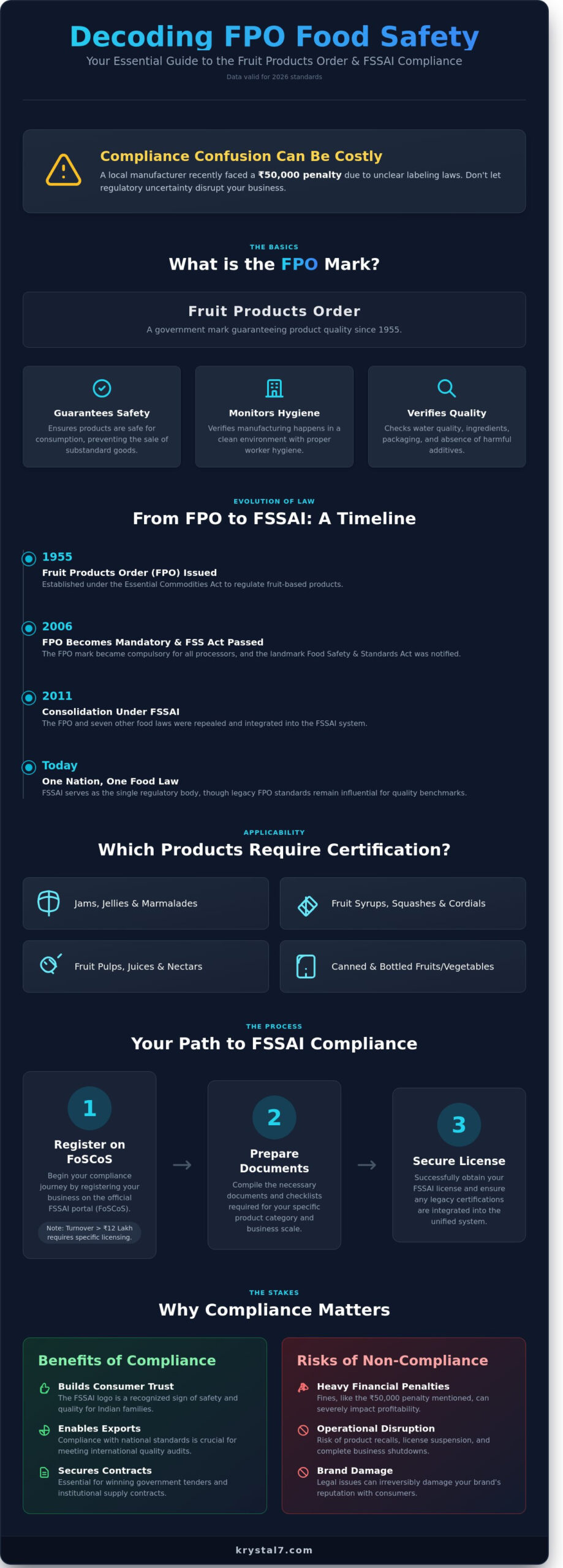
Products Requiring Certification: Is Your Business Covered?
Understanding the fpo full form food is the first step toward regulatory peace of mind. The Fruit Products Order, 1955, mandates that specific categories of processed items meet strict quality benchmarks. This statutory framework ensures that every product reaching the consumer is safe, hygienic, and accurately labelled.
- Synthetics: This group covers synthetic vinegars, syrups, and crushed beverages. These items often rely on chemical additives that require precise monitoring to ensure they don’t pose health risks.
- Fruit Derivatives: Jams, jellies, and marmalades are core products under this order. It also includes fruit pulps used as ingredients in larger manufacturing processes across India.
- Vegetable Products: Pickles and tomato ketchups must adhere to these standards. Dehydrated vegetables, which are common in modern pantry kits, also fall under this regulation.
- Beverages: Squashes, barley water, and barrelled juices are strictly monitored. These products must maintain specific nutritional and preservative levels to remain compliant with the law.
Is your product line fully compliant with current standards? Get a compliance check from our legal strategists today.
Detailed Product List
The scope of the fpo full form food extends to a wide array of retail items. Regulated products include all varieties of fruit juices and nectars. Canned and bottled fruits are also covered to prevent the risk of bacterial contamination during storage. Modern processing techniques like freezing do not exempt a business. Frozen fruit segments and vegetable portions must comply with the standards defined in the 1955 Order.
Exemptions and Special Cases
Fresh fruits that remain unprocessed don’t fall under this specific order. The law focuses on the transformation of raw produce into shelf stable goods. Products sold in loose form typically bypass these requirements. However, once an item is packaged for retail sale, it must carry the necessary certifications. Imported processed fruit products are also subject to these rules. They must meet Indian quality standards before they’re cleared for domestic distribution.
Navigating these categories can feel complex for growing ventures. Most businesses find that a systematic review of their inventory prevents costly delays. Penalties for selling uncertified products can start at INR 5,000 and escalate based on the volume of the default. Ensuring your fpo full form food compliance is clear helps you focus on scaling your brand without legal interruptions.
- Identify if your products are processed or fresh to determine applicability.
- Audit your packaging to ensure all mandatory marks are visible and accurate.
- Review your import documentation if you source processed fruits from abroad.
Compliance is easy when it is systematic.
Compliance Roadmap: Process, Documents, and Penalty Tables
Obtaining a license for fruit based processing involves a structured digital journey. While the FPO mark was the historical standard, the current fpo full form food industry compliance is managed through the Food Safety Compliance System, known as FoSCoS. This portal centralizes licensing, registration, and annual filings to ensure every business meets safety benchmarks established under the FSS Act, 2006.
The application process begins with creating a user profile on the FoSCoS portal. You must select the correct kind of business based on your production capacity. For instance, units producing up to 100 kilograms or liters per day fall under registration, while larger volumes require state or central licenses. After submitting Form B and the requisite fees, an inspection by a Food Safety Officer may occur within 30 days to verify your facility meets Schedule 4 hygiene standards.
Maintaining your license requires diligent record keeping. You must preserve production logs, raw material invoices, and sales records for at least three years or the shelf life of the product, whichever is longer. Under the FSS (Licensing and Registration of Food Businesses) Regulations, 2011, manufacturers must also conduct periodic product testing. These tests must happen twice a year through a National Accreditation Board for Testing and Calibration Laboratories, or NABL, accredited facility to confirm the absence of contaminants.
Table 1: Compliance Due Dates and Periodicity
| Compliance Type | Frequency | Due Date | Portal | Responsible Person |
|---|---|---|---|---|
| Annual Return (Form D-1) | Annual | 31st May | FoSCoS | Proprietor or Nominee |
| License Renewal | 1 to 5 Years | 180 days before expiry | FoSCoS | Authorised Signatory |
| Product Testing Report | Half Yearly | April and October | Offline/Internal | Quality Manager |
Table 2: Documents Required for Registration
| Provider | Format | Validity | Common Errors |
|---|---|---|---|
| Premises Owner | PDF (Rent Agreement) | Current | Expired lease dates |
| Technical Lead | List of Machinery | Current | Missing horsepower data |
| NABL Lab | Water Test Report | Last 6 Months | Testing for wrong parameters |
Table 3: Penalties and Interest Exposure
| Default Type | Amount | Interest | Section Reference |
|---|---|---|---|
| Operating without license | Up to INR 5,00,000 | Not Applicable | Section 63 |
| Misbranding products | Up to INR 3,00,000 | Not Applicable | Section 52 |
| Late filing of Return | INR 100 per day | Not Applicable | FSS Regulation 2.1.7 |
The fpo full form food safety standards protect your brand from legal risks. If your annual turnover exceeds INR 12,00,000, you must upgrade from a basic registration to a state license immediately to avoid the heavy penalties mentioned above. Precision in documentation is the only way to ensure your business remains audit ready at all times.
- Check your current production capacity to confirm if you need a State or Central license.
- Download your last NABL water test report to ensure it is less than six months old.
- Review your FoSCoS dashboard to verify the expiry date of your current food license.
If you are unsure about your current compliance status, Talk to Krystal7 for a professional audit of your food business documentation.
Compliance is easy when it is systematic.
Modern Compliance: Transitioning from FPO to FSSAI with Krystal7
The regulatory landscape for processed fruits changed significantly when the Food Safety and Standards Act of 2006 came into force. Before this shift, manufacturers looked for the FPO mark to ensure quality. While the fpo full form food stands for Fruit Products Order, this specific certification is no longer issued as a separate license. It has been fully integrated into the FSSAI licensing regime to simplify operations for food business operators.
The “One Nation, One Food Law” initiative replaced eight different pieces of legislation with a single unified framework. This move eliminated the need for multiple registrations across different departments and reduced administrative friction. Today, your FSSAI license covers the standards previously governed by the FPO. Transitioning to this modern system requires precise categorization based on your annual turnover. For instance, businesses with a turnover exceeding ₹20,00,00,000 must apply for a Central License via the FoSCoS portal.
The Krystal7 Advantage
Our team provides the structural clarity you need to handle these statutory shifts. We assign dedicated relationship managers to every client to manage the entire documentation flow. You won’t face the anxiety of missing deadlines or misinterpreting complex legal notifications from the FSSAI. We handle the complexity so you have the freedom to focus on your core business growth.
Transparency is a core pillar of our service. We provide upfront pricing with no hidden costs: ensuring you can plan your budget with total confidence. Our elite expertise in Indian corporate laws means we don’t just fill forms. We act as your legal strategists to protect your business legacy. We ensure every application aligns with Section 97 of the FSS Act: which repealed older orders to create a streamlined compliance path.
Talk to Krystal7 today for a seamless compliance check.
Immediate Next Steps for Your Business
The transition from older standards to current FSSAI requirements involves specific technical audits. Understanding the fpo full form food history helps in recognizing why modern standards are more rigorous regarding additives and contaminants. Krystal7 ensures your labels and processes align with the Food Safety and Standards (Packaging and Labelling) Regulations: 2011. This prevents costly penalties and protects your brand reputation in a competitive market.
- Audit your current product list to ensure every item is covered under the correct FSSAI food category code.
- Verify if your current production capacity or turnover requires a State or Central FSSAI license upgrade.
- Book a call with a Krystal7 compliance expert to review your documentation for any hidden gaps.
Compliance is easy when it is systematic.
Secure Your Food Brand’s Future Today
Navigating the transition from the old Fruit Products Order to modern FSSAI standards requires precision. You’ve learned that the fpo full form food represents a legacy of quality that now lives within the Food Safety and Standards Act 2006. Staying compliant means tracking mandatory labels, maintaining hygiene standards under Schedule 4, and filing returns on time. Ignoring these statutory requirements exposes your venture to penalties reaching 5,00,000 INR or even license cancellation. It’s about protecting your vision from unnecessary red tape.
Krystal7 brings crystal clarity to your regulatory roadmap. We’re trusted by over 500 Indian startups because we provide elite expertise in FSSAI and MCA filings. Our process ensures you have the freedom to focus on your products while we handle the paperwork. There’s a zero hidden costs guarantee: transparency is how we work.
Krystal7 Clarity Box: Next Steps
- Audit your current product labels for FSSAI logo and license number accuracy.
- Verify if your turnover exceeds the 12,0,000 INR threshold for state or central licensing.
- Organize your production records to meet the latest safety audit requirements.
Book a call with Krystal7 for your food business compliance to connect with a dedicated partner. Compliance is easy when it is systematic.
Frequently Asked Questions
What is the FPO full form in the food industry?
The fpo full form food industry refers to the Fruit Products Order. This regulatory framework was issued under Section 3 of the Essential Commodities Act 1955. It ensured that fruit and vegetable products met specific quality standards for safety and hygiene. While the FSSAI has now integrated these standards, the term remains a benchmark for quality in the processing sector.
Is the FPO mark still mandatory in India for fruit products?
No, the FPO mark is no longer a standalone mandatory requirement. Since the Food Safety and Standards Act 2006 came into effect, the FSSAI logo has replaced all previous certifications. You must comply with the Food Safety and Standards (Packaging and Labelling) Regulations 2011. Manufacturers must now display the FSSAI license number on their packaging instead of the old FPO mark.
Can I use the FPO mark if I only have an FSSAI license?
You cannot use the FPO mark as a substitute for an FSSAI license. The Food Safety and Standards Act 2006 repealed the Fruit Products Order 1955. Current regulations require businesses to display their 14 digit FSSAI license number. Using an obsolete mark without a valid FSSAI registration can lead to legal complications. It’s better to focus on current compliance standards to ensure crystal clarity for your customers.
How much is the penalty for not having the required food certification?
Operating without the required certification carries heavy penalties under Section 63 of the FSS Act 2006. You may face imprisonment for up to 6 months and a fine of up to 5,00,000 INR. For quality non compliance, Section 54 allows fines up to 5,00,000 INR. These strict measures ensure food safety across the industry. Krystal7 helps you avoid these risks by streamlining your registration process.
What is the difference between FSSAI and the FPO mark?
The primary difference lies in the scope and legal authority. The fpo full form food stands for Fruit Products Order 1955, which applied specifically to fruit and vegetable processors. FSSAI is the Food Safety and Standards Authority of India, established under the 2006 Act to consolidate multiple laws. FSSAI covers all food categories, while FPO was limited to fruit based items. FSSAI is now the single point of contact for all food compliance.
How can Krystal7 help in obtaining a food license?
Krystal7 provides crystal clarity by handling the entire documentation and filing process for you. Our experts assist with identifying the correct license type based on your turnover, such as Basic, State, or Central. We manage the online application on the FoSCoS portal and address any queries from the Food Safety Officer. This gives you the freedom to focus on growing your business while we handle the red tape.
Is FPO required for homemade pickles sold locally?
You don’t need an FPO mark, but you must have an FSSAI registration. Any food business with an annual turnover below 12,00,000 INR requires a Basic FSSAI Registration. This applies to small scale home based units selling pickles or jams. Selling food without this registration violates Section 31 of the FSS Act. We recommend getting registered early to build trust with your local customers and ensure legal security.
What are the main documents needed for FPO compliance?
For modern compliance equivalent to the old FPO standards, you need several key documents. These include a signed Form B, a list of directors or partners with contact details, and a layout plan of the processing unit. You must also provide a list of machinery and equipment used. Proof of possession of premises, such as a rent agreement or utility bill, is mandatory. Krystal7 ensures your documentation is meticulous to prevent application rejection.

Article by
Nihal Srivastava
Nihal Srivastava is the Co-Founder of Krystal7 Consultants, helping Indian entrepreneurs and startups navigate company registration, compliance, trademark protection, and regulatory requirements with clarity and confidence. With 6+ years of hands-on expertise in MCA filings, GST compliance, and corporate structuring, Nihal has guided 1000+ businesses across India through their legal and compliance journeys. He believes every business dream deserves crystal clear foundations, and that no founder should be held back by paperwork or red tape.