

LLP Registration Process in India: A Comprehensive Legal Guide
What if the difference between a rejected application and a successful business launch was just one minor clerical error on the MCA portal? You’ve likely felt the frustration of navigating complex government interfaces or worried about the potential for document rejection during the llp registration process. It’s common to feel overwhelmed by the technicalities of partner liabilities and the fear of incurring late filing penalties before your venture even begins.
At Krystal7 Consultants, we believe in providing the crystal clarity you need to build a legacy. This guide masters the complete journey of incorporation, offering you the freedom to focus on your vision while we handle the legal complexities. You’ll gain access to exhaustive document checklists, statutory citations from the Limited Liability Partnership Act, 2008, and precise compliance timelines that ensure your application is flawless from day one.
We’ll walk you through everything from securing your DPIN and DSC to understanding the specific requirements of the FiLLiP form. By the end of this article, you’ll have a clear, step by step roadmap to obtaining your incorporation certificate and establishing a compliant, growth oriented entity.
Key Takeaways
- Understand the legal foundation of Limited Liability Partnerships as body corporates under Section 3 of the LLP Act 2008 to protect your business assets.
- Master the complete digital llp registration process on the MCA V3 portal: including name reservation through RUN LLP and filing the FiLLiP incorporation form.
- Identify all essential documentation requirements: such as Digital Signature Certificates and the Designated Partner Identification Number governed by Section 7.
- Secure your business against financial loss by learning the statutory obligations for Form 11 and Form 8 to avoid penalties of INR 100 per day.
- Gain the freedom to focus on your vision by maintaining meticulous books of accounts and statutory records as mandated under Section 34.
Last updated on May 20, 2024.
Understanding the LLP Registration Process: Legal Framework and Benefits
A Limited Liability Partnership (LLP) exists as a separate legal entity from its owners. Under Section 3 of the Limited Liability Partnership Act, 2008, it’s a body corporate that possesses perpetual succession. This structure provides a hybrid model. It merges the operational flexibility of a traditional partnership with the robust security of limited liability. For modern entrepreneurs, the llp registration process creates a protective shield. Personal assets stay safe from business debts or the negligence of other partners.
The Ministry of Corporate Affairs (MCA) serves as the primary regulatory body for these entities. Unlike a private limited company, an LLP requires no minimum capital contribution. This specific feature removes a major financial barrier for new ventures. Compliance burdens remain lower than other corporate forms. For instance, statutory audits only become mandatory when annual turnover exceeds ₹40,00,000 or capital contribution exceeds ₹25,00,000 as per Rule 24 of the LLP Rules, 2009. Mastering the llp registration process allows founders to focus on growth rather than administrative weight.
Ready to secure your business future with crystal clarity?
Talk to Krystal7 today to get a compliance check for your new venture.
Applicable Laws and Regulatory Authorities
The foundational legislation governing this entity is the Limited Liability Partnership Act, 2008. Detailed procedural guidance is provided by the Limited Liability Partnership Rules, 2009. The Registrar of Companies (ROC) acts as the designated authority for the incorporation of every new entity. All filings must be submitted through the MCA portal. Every stage of the llp registration process must strictly follow these statutory rules to ensure legal validity and avoid delays.
Applicability Thresholds and Eligibility for Partners
Section 5 of the Act requires a minimum of two partners for any LLP. While there’s no maximum limit on the number of partners, the law demands at least two Designated Partners. Under Section 7, at least one of these Designated Partners must be a resident in India. A resident is defined as an individual who stayed in India for at least 120 days during the preceding financial year. This residency requirement ensures local accountability for statutory filings.
Eligibility criteria are inclusive. Any individual or body corporate can become a partner. This includes Indian companies and foreign entities. However, an individual cannot be a partner if they are of unsound mind or are an undischarged insolvent. Verifying these credentials is a critical early step in the llp registration process. Choosing partners with clear legal standing prevents future regulatory hurdles and builds a foundation of trust.
- Confirm at least two partners and verify their identity documents.
- Ensure one Designated Partner has stayed in India for 120 days or more.
- Check if any partner is a body corporate to prepare the necessary board resolutions.
Compliance is easy when it is systematic.
Pre-Requisites for LLP Formation: Documents and Digital Signatures
Last updated on May 24, 2024
Starting the llp registration process requires a foundation of verified digital identities and physical documentation. You cannot file any paperwork without a Class 3 Digital Signature Certificate (DSC). This certificate acts as your legal electronic signature for all filings on the Ministry of Corporate Affairs (MCA) portal. It ensures the authenticity of the data submitted by the Designated Partners.
Under Section 7 of the Limited Liability Partnership Act 2008, every entity must appoint at least two Designated Partners. These individuals are responsible for all compliance matters. If you are worried about the complexity of these requirements, Book a call with our experts for a streamlined document review.
Obtaining Digital Signatures and DPIN
You must apply for a Class 3 DSC through licensed Certifying Authorities. This process involves a brief video verification and submission of identity proof. These signatures usually have a validity of 2 years. You must renew them before they expire to maintain your ability to file statutory returns. Failing to renew can lead to significant delays in your annual filings.
The Designated Partner Identification Number (DPIN) is a unique number assigned to each partner. You don’t need to apply for this separately before you begin. The DPIN is now integrated into the FiLLiP form during the llp registration process. This change by the Ministry has reduced the time required to onboard new partners significantly. It allows up to two DPIN assignments within the incorporation form itself.
Mandatory Documents for Partners and Registered Office
Precision in documentation prevents the Registrar from marking your application as “Sent for Resubmission.” You must ensure that the names on all identity proofs match the PAN database exactly. Even a small spelling variation can lead to rejection. All documents must be self attested by the partners. If a partner resides outside India, the documents must be apostilled or notarized as per Rule 18 of the LLP Rules 2009.
The registered office address must be a physical location in India where the government can send official correspondence. Section 13 of the LLP Act 2008 requires you to maintain this office at all times. If the property is not owned by a partner, you must obtain a written No Objection Certificate (NOC) from the actual owner. This ensures the business has legal permission to operate from that specific premises.
| Document Type | Provider | Format | Validity | Common Errors |
|---|---|---|---|---|
| PAN Card | Income Tax Dept | PDF Scan | Permanent | Name mismatch with Aadhaar |
| Aadhaar Card | UIDAI | PDF Scan | Permanent | Mobile number not linked |
| Utility Bill | Service Provider | PDF Scan | Under 2 Months | Address differs from NOC |
| Proof of Office | Property Owner | PDF Scan | Current | Missing owner signature |
- Verify that your mobile number is linked to your Aadhaar for OTP authentication.
- Request a fresh electricity bill or gas bill that is less than 60 days old.
- Ensure all scanned copies are in color and have a minimum resolution of 200 DPI.
Compliance is easy when it is systematic.
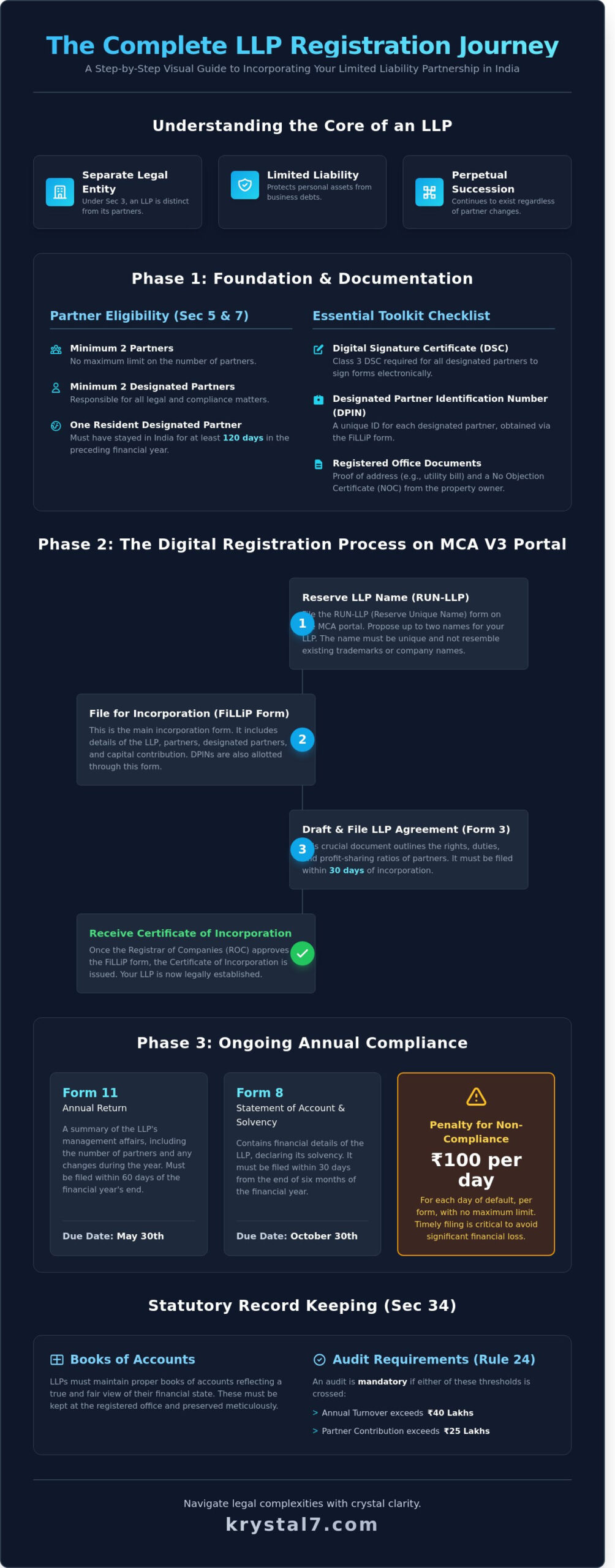
Step by Step Guide to the LLP Registration Process on the MCA V3 Portal
The llp registration process has transitioned to a fully digital workflow on the Ministry of Corporate Affairs (MCA) portal. This V3 system utilizes web based forms to ensure data accuracy and faster processing for new entrepreneurs. It eliminates the need for physical paperwork: providing a streamlined path for your business vision to take flight.
Name Reservation and RUN LLP Service
Your journey begins with the Reserve Unique Name (RUN LLP) service. Under Rule 18 of the LLP Rules 2009: the proposed name must not be identical or too similar to any existing company or trademark. The system allows you two chances for resubmission if the Registrar finds the initial name choice undesirable.
To achieve Krystal Clear brand identity: choose a name that reflects your core business activity. Avoid generic terms that might lead to rejection or confusion in the marketplace. A unique name provides the clarity you can build on: protecting your brand identity from the very first day of operations.
Filing the FiLLiP Form and LLP Agreement
The llp registration process integrates several requirements into Form FiLLiP: the Form for incorporation of Limited Liability Partnership. This single web form handles the allotment of Designated Partner Identification Numbers (DPIN) for up to two partners and the formal incorporation request. It’s a methodical way to move from a concept to a legal entity.
Once you receive the Certificate of Incorporation (COI): you must file the LLP Agreement through Form 3. This mandatory filing must occur within 30 days of the incorporation date as per Section 23 of the LLP Act 2008. Delaying this step results in statutory penalties of INR 100 per day: which can accumulate without any upper limit.
Stamp duty on the LLP Agreement varies significantly across different Indian states. For instance: Maharashtra calculates duty based on the contribution amount while Delhi follows a different slab structure. Our legal strategists ensure you pay the precise amount: avoiding any statutory defaults or unnecessary overpayments during your setup phase.
- Verify your proposed name against the MCA and Trademark registries to avoid resubmission delays.
- Obtain Class 3 Digital Signature Certificates (DSC) for all designated partners before starting the FiLLiP form.
- Draft your LLP Agreement early to ensure it’s ready for filing within the 30 day statutory window.
After filing the FiLLiP form: you’ll pay the prescribed incorporation fees and state specific stamp duty through the MCA portal. Once the Registrar of Companies (ROC) verifies the submitted documents: they issue the Certificate of Incorporation (COI). This document contains your unique LLP Identification Number (LLPIN) and marks the official legal birth of your business venture.
Compliance is easy when it is systematic.
Post Registration Compliance: Annual Filings and Due Dates
Section 34 of the Limited Liability Partnership Act 2008 mandates every entity to maintain accurate books of accounts. This obligation begins immediately after you complete the llp registration process. You must record all receipts, payments, and financial transactions on either a cash or accrual basis at the registered office.
Under Rule 24 of the LLP Rules 2009, an audit by a Chartered Accountant becomes mandatory if your annual turnover exceeds INR 4,000,000. It also applies if the partner contribution exceeds INR 2,500,000. Maintaining these records ensures your business remains transparent and ready for future growth.
Tracking these dates is essential to avoid heavy daily penalties. The following table outlines the statutory timeline for every financial year.
| Compliance Type | Frequency | Due Date | Portal | Responsible Person |
|---|---|---|---|---|
| Form 11 (Annual Return) | Annual | May 30 | MCA V3 | Designated Partners and CS |
| Form 8 (Statement of Accounts) | Annual | October 30 | MCA V3 | Designated Partners and CA |
| Income Tax Return (ITR 5) | Annual | July 31 or Sept 30 | Income Tax | Designated Partners |
Effective management of these filings gives you the freedom to focus on your core business vision. Missing these deadlines leads to a statutory penalty of INR 100 per day for each form. This amount accumulates without any upper limit, which can severely impact your venture capital or credit rating.
If you feel overwhelmed by these statutory timelines, our legal strategists provide the clarity you need to stay ahead. Get a compliance check today to secure your business legacy.
Annual Return Filing (Form 11)
Form 11 is a summary of all partners and any changes in the management structure during the year. You must file this on the MCA V3 Portal within 60 days from the closure of the financial year. The llp registration process establishes the baseline data that this form updates annually. It requires digital signatures from two Designated Partners and certification by a practicing professional.
Statement of Accounts and Solvency (Form 8)
Form 8 provides a detailed report on the financial health of your LLP. It includes a statement of assets and liabilities along with a formal declaration of solvency by the partners. The due date is October 30: exactly 30 days from the end of six months of the financial year. You must also include mandatory disclosures under the MSME Development Act 2006 regarding unpaid dues to micro or small suppliers.
- Mark May 30 and October 30 as critical deadlines in your corporate calendar.
- Reconcile all bank statements monthly to simplify the preparation of Form 8.
- Verify your MSME status to ensure accurate disclosures in statutory filings.
Compliance is easy when it is systematic.
Penalties for Non-Compliance and Record Keeping Requirements
Last updated on May 24, 2024.
The journey toward business growth does not end once you finish the llp registration process. Maintaining your entity’s active status requires strict adherence to statutory timelines and meticulous documentation. Failure to meet these obligations leads to financial strain and legal risks that can derail your entrepreneurial vision.
Financial Penalties and Interest Exposure
Section 69 of the Limited Liability Partnership Act, 2008, prescribes the financial consequences for filing delays. The standard penalty for late submission of Form 8 and Form 11 is INR 100 per day for each form. This penalty accumulates daily until the default is rectified, creating a significant burden for inactive or neglected entities.
Designated Partners must recognize that certain defaults carry no upper limit on the per day penalty. Unlike traditional company structures where caps often apply, an LLP can face penalties that far exceed the original cost of the llp registration process. This structure ensures that compliance remains a top priority for every partner involved.
Personal liability is a critical factor under Section 7 and Section 30. While an LLP offers limited liability, Section 30 removes this shield if a partner acts with intent to defraud creditors. Gross negligence in maintaining statutory records can also lead to personal assets being used to settle regulatory fines or business debts.
Persistent default triggers the ultimate regulatory action: striking off. Under Section 75, the Registrar of Companies has the authority to remove an LLP from the register if it fails to file its financial statements for two consecutive years. This action results in the immediate cessation of business operations and potential prosecution of all designated partners.
| Default Type | Penalty Amount | Consequence | Section Reference |
|---|---|---|---|
| Late filing of Form 11 (Annual Return) | INR 100 per day | No statutory cap on accumulation | Section 69 |
| Late filing of Form 8 (Solvency Statement) | INR 100 per day | No statutory cap on accumulation | Section 69 |
| Failure to maintain Books of Accounts | INR 25,000 to INR 5,00,000 | Partner fine: INR 10,000 to INR 1,00,000 | Section 34 |
Statutory Registers and Record Keeping
Your registered office serves as the legal heart of your corporate records and must be accessible for inspection. You must maintain a Register of Partners containing names, addresses, and contribution details as mandated by Section 11. Additionally, a Register of Charges is required to track all secured loans and encumbrances on business assets.
Rule 24 of the LLP Rules, 2009, establishes the retention period for financial documentation. You must preserve all accounting records for at least eight years from the date they were created. These records must provide a true and fair view of the LLP’s state of affairs and explain every transaction in crystal clarity.
Certain documents require permanent preservation to protect your business legacy. The original LLP Agreement, all subsequent amendments, and the Incorporation Certificate must be kept indefinitely. Keeping these in a secure, fireproof location ensures you are always ready for a sudden regulatory audit or a due diligence request.
- Review your LLP’s current filing status on the MCA portal to identify any pending forms.
- Digitize your permanent records, including the LLP Agreement, and store them in a secure cloud folder.
- Book a call with a Krystal7 compliance strategist to audit your statutory registers.
Protect your business vision from unnecessary red tape and mounting fines. Talk to Krystal7 today to ensure your entity remains in perfect standing with the law.
Compliance is easy when it is systematic.
Launch Your Business with Crystal Clarity
Building a successful venture starts with a precise execution of the llp registration process on the MCA V3 portal. You’ve seen how the LLP Act 2008 provides a flexible yet robust framework for your business growth. Remember that failing to file your LLP agreement within 30 days of incorporation triggers a penalty of ₹100 per day under Section 69. Staying compliant from day one protects your brand and secures your professional legacy.
Krystal7 gives you the freedom to focus on your vision while we navigate the red tape. Our legal strategists bring elite expertise in MCA V3 portal filings to ensure your application is right the first time. You’ll work with a dedicated relationship manager who knows your business inside out. We provide crystal clear transparency with upfront pricing and no hidden costs.
Talk to Krystal7 for a seamless LLP incorporation
Your entrepreneurial journey deserves a partner who values clarity as much as you do. Compliance is easy when it is systematic.
Frequently Asked Questions
What is the total cost for the LLP registration process in India?
Government fees for incorporating an LLP depend on the contribution amount. For a capital contribution up to INR 1,00,000, the filing fee for Form FiLLiP is INR 500 as per the LLP Rules 2009. Total expenses including digital signatures, name reservation via RUN LLP, and professional fees typically range between INR 7,000 and INR 15,000. Stamp duty on the LLP Agreement is an additional cost that varies based on the state where your registered office is located.
Can a single person start an LLP or are two partners mandatory?
You must have at least two partners to begin the llp registration process according to Section 5 of the Limited Liability Partnership Act 2008. Section 7 further requires that at least two individuals act as designated partners, with one being a resident of India. If the number of partners stays below two for more than six months, the remaining partner becomes personally liable for the business obligations incurred during that period under Section 6.
How long does it take to get the Certificate of Incorporation for an LLP?
The Ministry of Corporate Affairs usually issues the Certificate of Incorporation within 10 to 15 working days. This timeframe covers the preparation of Digital Signature Certificates, name approval, and the final processing of incorporation documents. Krystal7 Consultants brings clarity to this timeline by handling the technical filing, giving you the freedom to focus on your business strategy while we manage the Registrar of Companies.
Is it possible to convert an existing partnership firm into an LLP?
You can convert a traditional partnership into an LLP by following the procedure in the Second Schedule of the LLP Act 2008. This involves filing Form 17 along with your incorporation application to ensure all assets and liabilities transfer to the new entity. All partners of the existing firm must consent to the conversion and become partners in the new LLP to maintain continuity of the business venture.
What happens if the LLP Agreement is not filed within 30 days?
Failing to file the LLP Agreement in Form 3 within 30 days of incorporation results in a late fee of INR 100 for every day the delay continues. This penalty is prescribed under Section 25 of the LLP Act 2008 and does not have a maximum ceiling. It’s vital to submit this document promptly to avoid mounting financial liabilities and to ensure your compliance status remains clear with the Ministry of Corporate Affairs.
Can an NRI or foreign national be a partner in an Indian LLP?
Foreign nationals and Non Resident Indians can be partners provided they adhere to the Foreign Exchange Management Act 1999 regulations. Rule 7 of the LLP Rules 2009 mandates that at least one designated partner must be a resident of India. Foreign Direct Investment is allowed in LLPs through the automatic route in sectors where 100 percent investment is permitted for companies, providing a streamlined path for international ventures.
What are the minimum capital requirements for starting an LLP?
There’s no minimum capital amount required by law to complete the llp registration process in India. Partners can start with any contribution amount, such as INR 1,000 or INR 5,000, as specified in their agreement. Section 32 of the LLP Act 2008 allows these contributions to be in the form of cash, tangible property, or intangible assets, offering flexibility for startups at different stages of growth.
Is an audit mandatory for all LLPs every year?
An audit is mandatory only if the LLP’s annual turnover exceeds INR 40,00,000 or its capital contribution exceeds INR 25,00,000. These thresholds are defined under Rule 24 of the LLP Rules 2009. If your business doesn’t meet these specific limits, you don’t need a statutory audit by a Chartered Accountant, though you must still file annual accounts and solvency statements in Form 8 and Form 11.

Article by
Nihal Srivastava
Nihal Srivastava is the Co-Founder of Krystal7 Consultants, helping Indian entrepreneurs and startups navigate company registration, compliance, trademark protection, and regulatory requirements with clarity and confidence. With 6+ years of hands-on expertise in MCA filings, GST compliance, and corporate structuring, Nihal has guided 1000+ businesses across India through their legal and compliance journeys. He believes every business dream deserves crystal clear foundations, and that no founder should be held back by paperwork or red tape.