
NSIC Certificate: A Complete Guide for MSMEs in 2026
As an ambitious MSME owner in India, does the thought of navigating government tenders and complex compliance feel overwhelming? You’re not alone. Many entrepreneurs miss out on incredible growth opportunities simply because the path forward is buried under confusing jargon and bureaucratic red tape. This is precisely where a powerful tool like the nsic certificate can transform your business, giving you a decisive advantage in the public procurement landscape.
This is not just another article; it’s your complete, crystal-clear guide for 2025. We are here to cut through the noise and eliminate the guesswork. In the sections below, we will meticulously break down the essential benefits, help you check your eligibility with ease, and walk you through the streamlined, step-by-step registration process. Prepare to gain the confidence and clarity needed to secure your certificate, unlock new financial benefits, and give your business the freedom to truly thrive.
What is an NSIC Certificate and Why Does Your MSME Need It?
For any ambitious Micro, Small, and Medium Enterprise (MSME) in India, navigating the world of government contracts can seem daunting. The nsic certificate is the key that unlocks this powerful growth channel. But what is it, exactly? At its core, the certificate is an official registration issued by the National Small Industries Corporation (NSIC), a Government of India enterprise dedicated to fostering the growth of MSMEs.
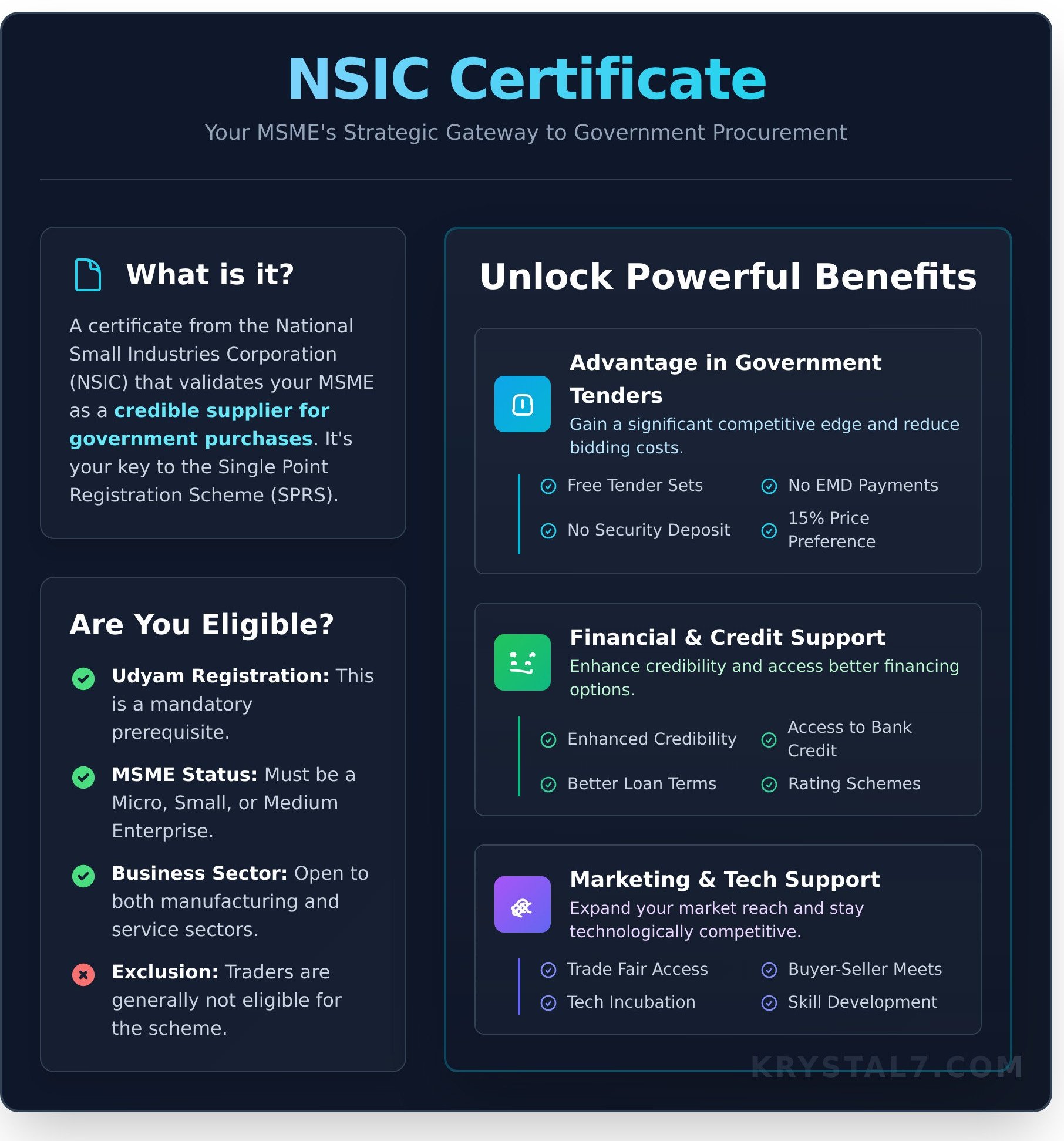
This registration is granted under the Single Point Registration Scheme (SPRS) and serves a critical purpose: it validates your business as a capable and credible supplier for government purchases. Think of it as a seal of approval that elevates your MSME from a crowd of competitors, giving you preferential access to the vast market of government tenders. It’s more than just another registration; while Udyam Registration establishes your MSME identity, the NSIC Certificate is your gateway to participating actively in the nation’s public procurement ecosystem.
Understanding the Single Point Registration Scheme (SPRS)
The Single Point Registration Scheme (SPRS) is a streamlined initiative designed to bring clarity and efficiency to the government procurement process for small businesses. Instead of the hassle of registering with numerous government departments and PSUs individually, SPRS provides a single, unified registration. This enlistment makes your enterprise a recognised and eligible vendor for supplying goods and services, a key benefit under the Public Procurement Policy for Micro & Small Enterprises (MSEs) Order, 2012.
Who is the NSIC Certificate for?
The NSIC Certificate is specifically designed to empower MSMEs that are ready to scale their operations by supplying to the government. To be eligible, your enterprise must meet a few clear criteria:
- MSME Status: You must be a Micro, Small, or Medium Enterprise.
- Udyam Prerequisite: A valid Udyam Registration Number is mandatory to begin the application process.
- Business Sector: The scheme is open to enterprises in both the manufacturing and service sectors.
- Exclusions: Generally, traders are not eligible, though specific exceptions may apply for certain products or government schemes.
Top 7 Benefits of NSIC Registration for Your Business
An NSIC certificate is more than just a registration; it’s a strategic asset designed to accelerate the growth of Micro, Small, and Medium Enterprises (MSMEs). By validating your business’s credibility, this certification unlocks a powerful suite of benefits that provide a significant competitive edge, streamline operations, and open doors to new opportunities. Think of it as your official gateway to government support systems, giving you the freedom to focus on what you do best: growing your venture.
Gain a Major Advantage in Government Tenders
For MSMEs looking to secure government contracts, the NSIC registration is a game-changer. It systematically removes financial barriers and levels the playing field, making public procurement highly accessible. Key advantages include:
- Free Tender Sets: Registered units can access tender documents free of cost, eliminating application fees and reducing the overhead of bidding.
- Exemption from Earnest Money Deposit (EMD): You are exempt from paying the hefty EMD typically required to participate in tenders. This frees up crucial working capital that can be reinvested into your business operations.
- No Security Deposit Payments: In many cases, NSIC-registered businesses are also exempt from paying performance security deposits, further reducing the financial burden of winning a contract.
- Price Preference Benefit: Under the Public Procurement Policy, if your bid is within a 15% price band of the lowest non-MSME bid (L1), you may be given the opportunity to match the L1 price and win the contract.
Unlock Financial Assistance and Credit Support
Securing timely and adequate finance is a common hurdle for MSMEs. The NSIC certificate enhances your financial credibility and provides direct access to supportive schemes. NSIC facilitates credit support from commercial banks and also runs its own schemes to finance the procurement of raw materials and assist with marketing expenses. Furthermore, its Performance and Credit Rating Scheme helps MSMEs get an independent, trusted rating, which significantly improves their ability to secure loans at more favourable interest rates. For entrepreneurs seeking additional funding opportunities, exploring the Stand Up India loan scheme for women and SC/ST entrepreneurs can provide complementary financial support for business expansion.
Access Powerful Marketing and Technology Support
Expanding your market reach and upgrading technology can be expensive. NSIC provides a robust support system to help you showcase your capabilities and innovate. It facilitates MSME participation in domestic and international trade fairs, exhibitions, and buyer-seller meets, creating invaluable networking and sales opportunities. The corporation also actively promotes MSME products and services through its own channels. Additionally, you gain access to technology incubation centres and skill development programs, ensuring your business stays competitive and future-ready.
Navigating these benefits can seem complex, but the rewards are immense. Let us help you unlock these advantages with Krystal-Clear guidance. Get expert guidance from Krystal7.
Eligibility Criteria for NSIC Certificate: Does Your Business Qualify?
Navigating government schemes can often feel complex, but determining your eligibility for an nsic certificate is a clear and structured process. We’ve broken down the requirements into a straightforward checklist to give you the clarity you need. This will help you quickly assess if your business is positioned to unlock the powerful benefits of NSIC registration.
Think of this as the foundational step. Before you can access government tenders and other advantages, your business must meet a set of core operational and financial standards. Let’s see where you stand.
Core Business Requirements
These criteria relate to the fundamental identity and operational status of your enterprise. They are the non-negotiable prerequisites for your application.
- Udyam Registration: This is the most critical requirement. Your business must possess a valid Udyam Registration Certificate. This certificate officially classifies your enterprise as a Micro, Small, or Medium Enterprise (MSME) under the Government of India’s guidelines.
- Operational Vintage: Your business should have been commercially operational for at least one year. (Note: Provisional Registration may be granted to new enterprises that have not completed one year of operation, subject to certain conditions.)
- MSE Classification: Your enterprise must fall under the Micro or Small category as per the latest MSME definition, which is based on investment in plant & machinery and annual turnover.
- Micro Enterprise: Investment up to ₹1 Crore & Turnover up to ₹5 Crore.
- Small Enterprise: Investment up to ₹10 Crore & Turnover up to ₹50 Crore.
- Nature of Business: The scheme is designed for enterprises engaged in manufacturing or service activities. Traders are generally not eligible for registration under this scheme.
Financial and Quality Standards
Beyond your business’s identity, NSIC also assesses its stability, capability, and reliability. This ensures that certified businesses are well-equipped to handle government contracts.
- Clear Financial Record with NSIC: Your enterprise must not have any outstanding dues or defaults on payments with NSIC from previous interactions.
- Audited Financial Statements: You will need to provide audited balance sheets for the previous years of operation. This demonstrates financial health and transparency.
- Infrastructure and Quality Control: The business must own the necessary machinery, raw materials, and quality control measures to maintain the standard of its products or services.
- Competence Assessment: NSIC will conduct a technical inspection of your unit to verify your commercial and technical competence to fulfill orders. This is a crucial step that validates your operational capacity.
How to Get an NSIC Certificate: The Online Registration Process
Navigating the path to your nsic certificate is a streamlined digital journey, but it demands meticulous preparation. To bring clarity to the process, we’ve broken it down into four logical phases, from gathering your documents to receiving the final certificate. Following these steps methodically will ensure a smooth and efficient application experience.
Step 1: Document Preparation and Udyam Registration
Before you even visit the NSIC portal, your first and most critical task is to secure your Udyam Registration. This is a mandatory prerequisite. Once you have your Udyam number, focus on organizing your paperwork. Scan and prepare digital copies of all necessary documents, including your PAN card, GST certificate, proof of address, and audited financial statements. Having these files ready will prevent delays and streamline your application.
Step 2: Online Application on the SPRS Portal
With your documents prepared, head to the official NSIC Single Point Registration Scheme (SPRS) portal at nsicspronline.com. You will need to create an account using your Udyam Registration Number and business PAN. The online form is comprehensive, requiring details about your business, its promoters, and the products or services you offer. Fill out each section carefully and upload your scanned documents in the specified formats.
Step 3: Fee Payment and Technical Inspection
After submitting the application, you will be prompted to pay the registration fee. This fee is calculated based on your latest audited turnover, ensuring a fair structure for businesses of all sizes. Once the payment is processed, an NSIC official will schedule a technical inspection of your business premises. The primary purpose of this visit is to verify your company’s technical capabilities and operational capacity to fulfill government tenders.
Step 4: Approval and Certificate Issuance
Following a successful technical inspection and final verification, your application will be approved. The NSIC certificate is issued digitally and can be downloaded directly from the portal. This certificate is typically valid for two years, after which it must be renewed. The entire process, from application to issuance, is designed to bring credible MSMEs into the public procurement fold.
The process can be complex, with multiple documents and compliance checks. Let Krystal7 manage your NSIC registration hassle-free, so you can focus on what you do best-running your business.
Documents Required for NSIC Certificate Application: A Complete Checklist
Navigating the documentation for government registrations can often feel like a complex puzzle. To bring you clarity and ensure a streamlined application process, we have compiled a definitive checklist. Preparing these documents in advance is the most critical step towards securing your nsic certificate without unnecessary delays or rejections. Think of this as your roadmap to a successful submission.
Identity and Business Constitution Documents
These documents establish the legal identity and structure of your enterprise. Ensure you have clear, self-attested copies ready for submission.
- Copy of PAN Card: A mandatory document for the business entity.
- Udyam Registration Certificate: Your official proof of MSME status in India.
- Proof of Business Premises: This can be a copy of the sale deed, lease deed, or a recent utility bill in the company’s name.
- Business Constitution Proof: A copy of the Partnership Deed for partnership firms or the Certificate of Incorporation, Memorandum of Association (MOA), and Articles of Association (AOA) for companies.
- KYC of Promoters: Self-attested copies of the PAN and Aadhaar cards for all directors, partners, or the proprietor.
Financial and Technical Documents
This set of documents provides a comprehensive overview of your company’s financial health and operational capabilities, assuring the authorities of your stability and competence.
- Audited Financial Statements: The Profit & Loss Account and Balance Sheet for the last three consecutive years, duly signed by a Chartered Accountant.
- Banker’s Report: A formal report from your primary banker detailing the company’s financial standing and creditworthiness.
- List of Machinery and Equipment: A detailed list of all plant, machinery, and equipment owned and used in the production process.
- Quality Control Details: Information on the quality control measures, testing facilities, and any relevant certifications (like ISO) you hold.
Performance and Ownership Proof
Finally, these documents serve as proof of your track record, ownership structure, and your attestation to the accuracy of the information provided in your nsic certificate application.
- Performance Statement: A statement detailing major contracts and orders executed in the last three years, showcasing your experience.
- BIS Licence: A copy of your Bureau of Indian Standards (BIS) licence, if your products fall under mandatory certification.
- Shareholding Declaration: A declaration signed by the directors or partners outlining the shareholding pattern of the company.
- Notarized Affidavit: A sworn affidavit on non-judicial stamp paper, signed by the proprietor, partner, or director, confirming that all information provided is true and correct.
Gathering these documents methodically is your first step toward unlocking the immense benefits of NSIC registration. If the process seems daunting, remember that expert guidance is available. The compliance strategists at Krystal7 can provide Krystal-Clear support, ensuring your application is flawless and giving you the freedom to focus on your business growth.
Secure Your Competitive Edge with an NSIC Certificate
As we’ve explored, obtaining an nsic certificate is a pivotal step for any ambitious MSME in India. It’s not merely a compliance document but a strategic key that unlocks a wealth of opportunities, from preferential treatment in government tenders and exemption from Earnest Money Deposits to easier access to credit and vital marketing support.
While the benefits are immense, the registration process can feel overwhelming. This is where Krystal7 brings crystal clarity to complexity. Our team offers chartered expertise in all business registrations, ensuring your application is accurate and complete. With a dedicated advisor who understands your venture and transparent pricing with absolutely no hidden costs, we give you the freedom to focus on your growth.
Don’t let paperwork hinder your progress. Streamline your NSIC registration with our expert help. Get started with Krystal7 today! Let us handle the red tape so you can build your legacy.
Frequently Asked Questions
What is the validity of an NSIC certificate and how is it renewed?
An NSIC certificate is valid for two years from its date of issue. To ensure your benefits continue without interruption, it is crucial to initiate the renewal process before the expiry date. Renewal requires the submission of updated financial documents and a fresh technical inspection report. A streamlined renewal process ensures your business maintains its eligibility for government procurement schemes, giving you a continuous competitive advantage and complete clarity on your compliance status.
What are the fees for obtaining an NSIC certificate?
The fees for an NSIC certificate are based on your enterprise’s turnover and category. For a micro-enterprise with a turnover of up to ₹1 crore, the fee is ₹3,000. For small enterprises, it ranges from ₹5,000 to ₹15,000, and for medium enterprises, it can go up to ₹40,000. This tiered structure ensures affordability for businesses of all sizes. These fees do not include professional charges or the cost of the third-party inspection.
How long does it take to get the NSIC certificate after applying?
The entire process, from submitting the application to receiving the final certificate, typically takes between 30 and 45 days. This timeline is dependent on the promptness of the third-party inspection of your unit and the clarity of the documents you provide. Submitting a complete and accurate application is the best way to avoid delays and streamline the approval process, giving you the freedom to focus on growing your business while we handle the compliance.
Is an NSIC certificate the same as an MSME or Udyam registration?
No, they are different but interconnected. Udyam Registration is the foundational government recognition that classifies your business as an MSME, and it is a mandatory prerequisite. The NSIC certificate, however, is a specific registration under the National Small Industries Corporation that unlocks procurement-related benefits, such as exemptions from Earnest Money Deposit (EMD) in government tenders. In simple terms, Udyam is your identity, while NSIC is a key to specific opportunities.
Can a new startup with less than one year of operation apply for an NSIC certificate?
Yes, startups and new MSMEs can apply for a Provisional NSIC Registration Certificate. This certificate is valid for one year and is issued based on the unit’s production capacity, even without a financial track record. It empowers new ventures to participate in government tenders and access key benefits right from the start. This provision is designed to support emerging businesses and help them establish a foothold in the public procurement market without delay. New entrepreneurs may also benefit from exploring government funding options through the Stand Up India loan program to secure initial capital for their ventures.
What happens if my NSIC application is rejected?
If your application is rejected, the NSIC provides specific reasons for the decision, which are often related to incomplete documentation or non-compliance with eligibility norms. This is not a permanent setback. You have the opportunity to rectify the highlighted issues and re-submit your application. A methodical approach to addressing the feedback ensures your re-application is strong, putting you back on the path to successful registration and unlocking government business opportunities.
Does the NSIC certificate guarantee that I will win government tenders?
While an NSIC certificate does not guarantee a tender win, it provides a powerful competitive advantage. It makes your bid more attractive by exempting you from paying Earnest Money Deposits (EMD) and gives you preference in certain procurement policies. This significantly lowers your bidding costs and enhances your credibility. The quality, competitiveness, and compliance of your bid are still the most critical factors for winning, but the certificate ensures you are in the strongest possible position to compete.

Article by
Nihal Srivastava
Nihal Srivastava is the Co-Founder of Krystal7 Consultants, helping Indian entrepreneurs and startups navigate company registration, compliance, trademark protection, and regulatory requirements with clarity and confidence. With 6+ years of hands-on expertise in MCA filings, GST compliance, and corporate structuring, Nihal has guided 1000+ businesses across India through their legal and compliance journeys. He believes every business dream deserves crystal clear foundations, and that no founder should be held back by paperwork or red tape.