

Company Registration: A Founder’s Guide to Starting a Business in India
Embarking on the journey of starting your own company is an exhilarating experience, filled with vision, ambition, and the promise of building something new. However, the path from a brilliant idea to a legally recognized business can seem daunting. This guide is designed to demystify the process, giving you the clarity and confidence you need. Here, you will learn the complete company registration process, understand how to choose the right business structure for your dream, and discover how to launch your venture with crystal clarity.
What is Company Registration and Why is it Essential?
In simple terms, company registration is the process of giving your business a formal, legal identity. It’s the official step that transforms your venture from a personal project into a recognized entity in the eyes of the law, governed by the Ministry of Corporate Affairs (MCA) in India. This isn’t just a bureaucratic formality; it’s a foundational pillar for growth and security.
The key benefits are significant. Registration grants your business limited liability, which is a crucial concept that protects your personal assets like your home or savings from any business debts or legal issues. It establishes credibility with customers, suppliers, and potential investors, showing that you are serious and professional. Furthermore, a registered company finds it much easier to secure funding from banks, venture capitalists, and other financial institutions. Ultimately, it builds a foundation of trust that is essential for long-term success.
Choosing the Right Business Structure in India
Your first and most critical decision as a founder is selecting the right legal structure for your company. This choice is far from trivial, as it will directly impact your personal liability, how you are taxed, the amount of compliance paperwork you’ll face, and your ability to raise capital in the future. We’ll compare the most common types below to help you make an informed decision.
Comparing Business Structures: Pvt Ltd, LLP, OPC, and More
To decide with confidence, you need a clear breakdown of the options available. As you review these structures, consider your long-term goals, funding needs, the number of partners involved, and your personal tolerance for risk. Each structure offers a different blend of protection, flexibility, and compliance requirements.
Private Limited Company (Pvt Ltd)
A Private Limited Company is the most popular and scalable business structure for startups in India, especially those planning to raise funds from external investors. It is considered a separate legal entity from its owners, which provides the crucial benefit of limited liability. To form a Pvt Ltd company, you need a minimum of two directors and two shareholders (they can be the same people).
Limited Liability Partnership (LLP)
An LLP offers a hybrid structure, blending the operational flexibility of a traditional partnership with the limited liability benefits of a company. In an LLP, partners are not personally responsible for the misconduct or negligence of other partners. It generally has fewer compliance requirements and is less complex to manage than a Private Limited Company, making it a great choice for professional service firms and small businesses.
One Person Company (OPC)
The One Person Company is a modern structure perfect for solo entrepreneurs who want the protection of limited liability without the need for a partner. In an OPC, a single person can act as both the director and the shareholder. It’s easy to manage and has significantly fewer compliance rules, offering a great way for individual founders to start their journey with a corporate structure.
Partnership Firm & Sole Proprietorship
These are the simplest business structures to start, often with minimal registration formalities. However, they come with a major drawback: unlimited liability. This means there is no legal distinction between the owner and the business. If the business incurs debt or faces legal action, the owner’s personal assets are at risk. While easy to set up, they are generally not recommended for businesses aiming for growth and security.
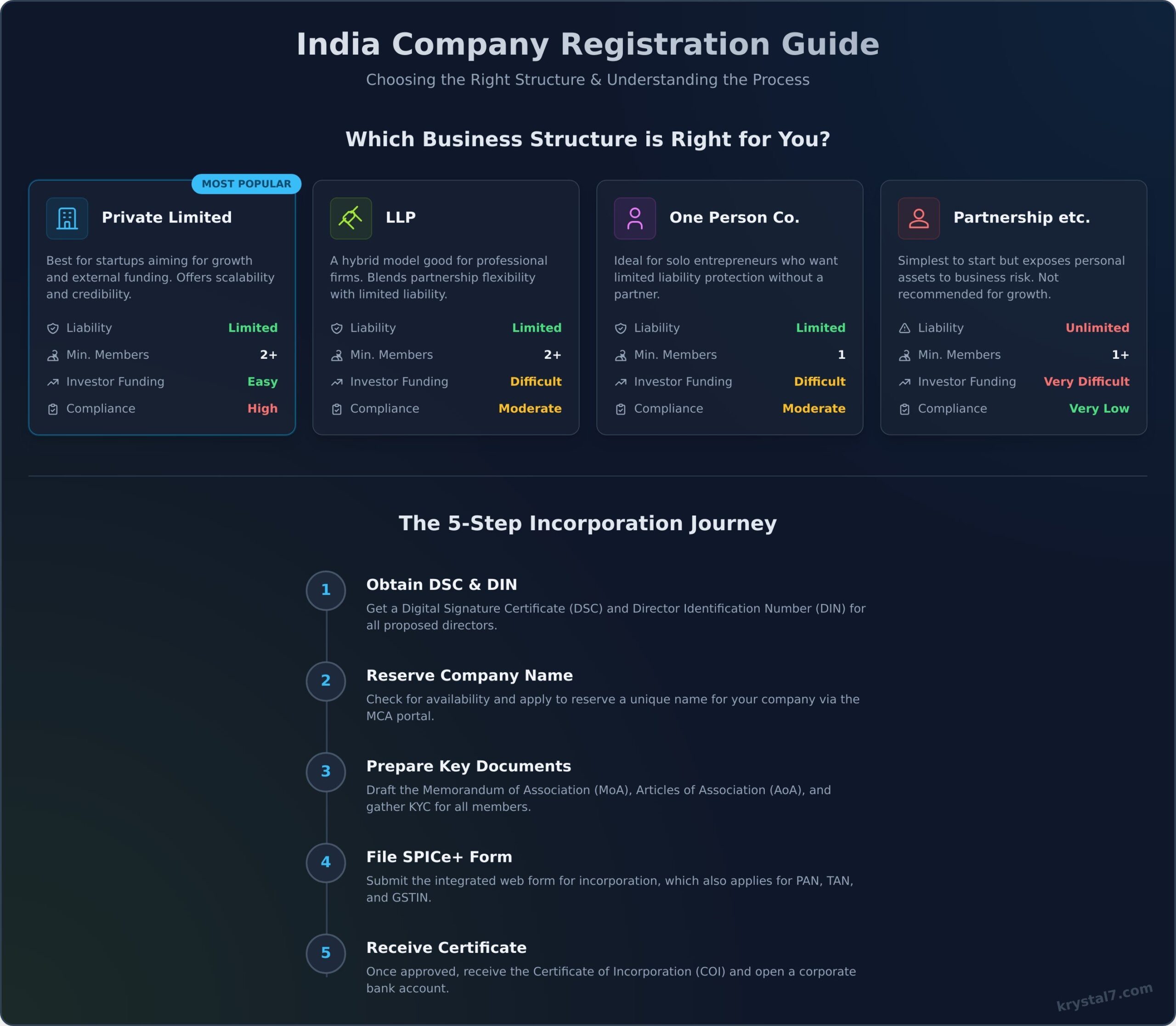
Here is a simple table to help you compare the key features:
| Feature | Private Limited (Pvt Ltd) | Limited Liability Partnership (LLP) | One Person Company (OPC) |
|---|---|---|---|
| Personal Liability | Limited | Limited | Limited |
| Minimum Members | 2 Directors, 2 Shareholders | 2 Partners | 1 Director, 1 Shareholder |
| Investor Funding | Easy to raise funds | Difficult to raise funds | Difficult to raise funds |
| Compliance Burden | High | Moderate | Moderate |
The Company Registration Process: A 5-Step Overview
While the details can be complex, the journey from idea to incorporation can be broken down into a clear, manageable series of steps. At Krystal7, we handle the complexity so you get the clarity to focus on what truly matters which is building your business. Let our experts guide you through every step. Get Started Today.
Step 1: Obtain Digital Signature Certificate (DSC) & DIN
Before any online forms can be filed, all proposed directors of the company must obtain a Digital Signature Certificate (DSC). This is the electronic equivalent of a physical signature. Alongside this, each director must apply for a Director Identification Number (DIN). These are the foundational requirements for anyone who will be on the company’s board.
Step 2: Reserve Your Company Name (RUN/SPICe+)
Choosing a unique name is a crucial step in establishing your brand identity. The proposed name must be submitted to the Ministry of Corporate Affairs for approval to ensure it is not identical or too similar to an existing company name or registered trademark. This is done through a specific web service on the MCA portal. Once your company is registered and operational, protecting your brand name through trademark registration fees in India becomes an essential next step to secure your intellectual property rights.
Step 3: Prepare Key Documents
This stage involves drafting the constitutional documents of your company: the Memorandum of Association (MoA) and the Articles of Association (AoA). The MoA defines the company’s objectives, while the AoA outlines its internal rules and regulations. You will also need to collect KYC (Know Your Customer) documents from all directors and shareholders, along with proof of the registered office address.
Step 4: File for Incorporation with SPICe+ Form
The SPICe+ (Simplified Proforma for Incorporating Company Electronically Plus) is the main application form submitted to the MCA. This integrated web form consolidates several applications into one, including name reservation, DIN allotment, and mandatory issuance of PAN, TAN, and GSTIN. This is the official step that creates your company.
Step 5: Receive Certificate of Incorporation & Open Bank Account
Once the MCA approves your application, they will issue the Certificate of Incorporation. This certificate is conclusive proof of your company’s registration and includes your unique Company Identification Number (CIN). With this certificate, you are officially in business and can proceed to open a corporate bank account in the company’s name.
Frequently Asked Questions
How much does company registration cost in India?
The cost can vary based on the type of company, the state of registration, and the authorized share capital. It typically includes government fees, stamp duty, and professional fees for the consultancy handling the process. It’s important to ask for a clear, all-inclusive quote to avoid hidden charges.
How long does the company registration process take?
With the streamlined SPICe+ process, company registration can be completed in approximately 7-10 working days, provided all documents are in order and there are no objections from the MCA. The timeline depends on the speed of document submission and government processing times.
What are the minimum documents required for company registration?
For Indian nationals, the primary documents include a PAN card, an identity proof (like an Aadhaar card or passport), and an address proof (like a recent bank statement or utility bill) for all directors and shareholders. You will also need proof of the registered office address, such as a utility bill and a No Objection Certificate (NOC) from the property owner.
Can a foreigner register a company in India?
Yes, foreign nationals can be directors and shareholders in an Indian company. They would need to provide a notarized and apostilled copy of their passport and other identity/address proofs as per regulations.
What is the difference between a Director and a Shareholder?
A director is responsible for managing the day-to-day affairs of the company. A shareholder is an owner of the company, holding shares that represent their stake. In many private limited companies, especially startups, the directors and shareholders are the same people.
What compliance is required after company registration?
After incorporation, a company must comply with several regulations, including holding board meetings, maintaining statutory registers, filing annual returns with the MCA, and filing annual income tax returns. This is where ongoing compliance services become crucial. Understanding the complete scope of annual compliance for private limited company requirements is essential for maintaining good legal standing and avoiding penalties.
Registering your company is the first official step in turning your vision into a lasting legacy. While the process involves careful planning and execution, it provides the legal foundation necessary to grow, secure funding, and operate with confidence. With a clear understanding of the structures and steps involved, you are well-equipped to begin. For ambitious entrepreneurs considering the most popular business structure, our comprehensive guide on private limited company in India provides detailed insights to help you make an informed decision. Let us provide the Krystal-Clear Transparency and expert guidance you need, giving you the freedom to focus on building your dream. Start your business with our All-in-One Company Incorporation Package and build your future on a foundation of clarity and compliance.

Article by
Nihal Srivastava
Nihal Srivastava is the Co-Founder of Krystal7 Consultants, helping Indian entrepreneurs and startups navigate company registration, compliance, trademark protection, and regulatory requirements with clarity and confidence. With 6+ years of hands-on expertise in MCA filings, GST compliance, and corporate structuring, Nihal has guided 1000+ businesses across India through their legal and compliance journeys. He believes every business dream deserves crystal clear foundations, and that no founder should be held back by paperwork or red tape.