

What Is a Limited Company? A Clear Guide for Indian Entrepreneurs
Starting a new business is an exciting journey filled with big ideas and ambitious goals. But before you can change the world, you need to build a solid legal foundation. One of the most important decisions you’ll make is choosing the right business structure. This guide will help you understand what a limited company is, its different types in India, and how it can protect your personal assets, giving you the clarity to start your business with confidence.
What a ‘Limited Company’ Means: The Core Concept
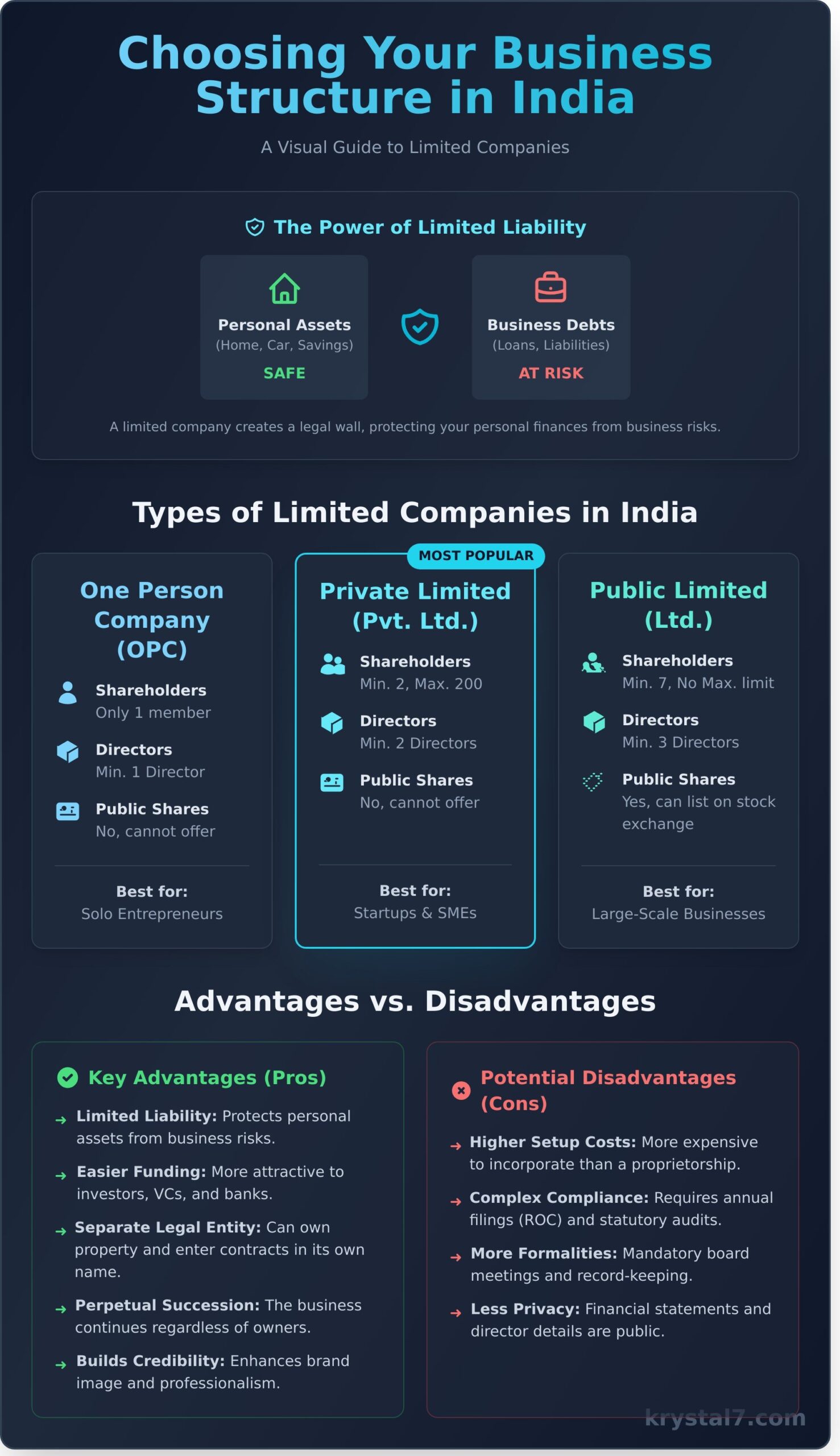
At its heart, a limited company is a type of business structure that has its own legal identity, completely separate from its owners (who are called shareholders). Think of it as creating a new legal “person.” This separation is the key to its most powerful feature: it protects your personal assets, like your home and savings, from any business debts or legal issues. This crucial benefit is known as limited liability.
Understanding Limited Liability with a Simple Example
Imagine your business takes out a loan to buy new equipment but, unfortunately, struggles to repay it. If your business is a limited company, the bank or creditors can only claim the company’s assets (like the office equipment, company bank balance, etc.) to settle the debt. They cannot legally touch your personal assets-your car, your house, or your personal savings remain safe. Your personal financial risk is limited only to the amount you invested in the company’s shares.
How is This Different from a Sole Proprietorship?
This is a stark contrast to a sole proprietorship, where you and your business are considered the same legal entity. If a proprietorship incurs debt, your personal assets are fully at risk. A limited company creates a protective legal wall between your business finances and your personal finances, giving you peace of mind as you grow your venture.
Types of Limited Companies in India (As per Companies Act, 2013)
In India, not all limited companies are the same. The right type for you depends on the scale of your business, your funding plans, and your long-term goals. Each structure has different rules for ownership and how it can raise money.
Private Limited Company (Pvt. Ltd.)
This is the most popular and widely chosen business structure for startups and small-to-medium enterprises (SMEs) in India. A Private Limited Company in India requires a minimum of two shareholders and two directors to get started. A key feature is that its shares cannot be offered to the general public, keeping ownership within a small group. This structure offers the perfect balance of liability protection, credibility, and operational flexibility.
Public Limited Company (Ltd.)
A Public Limited Company is designed for large-scale businesses that need significant capital. It can raise funds from the general public by listing its shares on a stock exchange through an Initial Public Offering (IPO). The requirements are stricter, needing a minimum of seven shareholders and three directors. These companies face more rigorous regulations and compliance requirements from bodies like SEBI and the Ministry of Corporate Affairs (MCA).
One Person Company (OPC)
The One Person Company is a modern business structure designed for solo entrepreneurs. Legally, it’s a type of private company but with only a single member or shareholder. The OPC is ideal for individual founders who want the protective benefits of limited liability without the complexity of finding a partner. It perfectly combines the simplicity of a sole proprietorship with the legal advantages of a company.
Advantages and Disadvantages of Forming a Limited Company
Choosing to form a limited company is a significant step. It’s crucial to weigh the powerful benefits against the added responsibilities to make sure it’s the right move for your business.
Key Advantages (The Pros)
- Limited Liability: This is the primary benefit. It protects your personal wealth from business risks and losses.
- Easier Funding: Investors, venture capitalists, and banks prefer to invest in and lend to limited companies due to their formal structure and transparency.
- Separate Legal Entity: The company can own property, enter into contracts, and sue or be sued in its own name, independent of its owners.
- Perpetual Succession: The business continues to exist even if the owners or directors change, ensuring stability and longevity.
- Builds Credibility: Operating as a ‘Pvt. Ltd.’ or ‘Ltd.’ enhances your brand’s image and appears more professional to clients, suppliers, and employees.
Potential Disadvantages (The Cons)
- Higher Setup Costs: The incorporation process is more detailed and generally more expensive than registering a proprietorship or partnership.
- Complex Compliance: A limited company must fulfill annual statutory requirements, such as filing financial statements and annual returns with the Registrar of Companies (ROC).
- More Formalities: The law requires companies to hold regular board meetings, maintain official records (minutes), and follow other procedural rules.
- Less Privacy: Key information, including the company’s financial statements and details of its directors, is available to the public.
Ready to Start? How to Register Your Limited Company
The registration process for a limited company involves several legal steps, from getting the company name approved to preparing legal documents and filing them with the Ministry of Corporate Affairs. Navigating this process requires professional expertise to ensure every detail is handled correctly and your business starts on a fully compliant footing. Partnering with seasoned experts can remove the guesswork and administrative burden, allowing you to focus on your business vision. Let us handle the complexity. Start your company with Krystal7.
Frequently Asked Questions
What is the main difference between a private and public limited company?
The main difference is who can own shares. A private limited company restricts the sale of shares to the public, while a public limited company can offer its shares to anyone through a stock exchange.
Can one person start a limited company in India?
Yes, a single individual can start a limited company by forming a One Person Company (OPC), which provides the benefit of limited liability to a solo entrepreneur.
What does ‘Ltd.’ or ‘Pvt. Ltd.’ after a company name mean?
‘Pvt. Ltd.’ stands for Private Limited, and ‘Ltd.’ stands for Limited (implying a Public Limited company). These suffixes are legal requirements that signify the company’s structure and the limited liability of its shareholders.
Is a limited company the same as a Limited Liability Partnership (LLP)?
No. While both offer limited liability, they are different structures. A limited company is governed by the Companies Act and has directors and shareholders, whereas an LLP is governed by the LLP Act and has partners. An LLP offers more operational flexibility but a company structure is often preferred for raising equity funding.
What are the basic annual compliance requirements for a limited company?
Basic annual compliance includes appointing an auditor, holding board and shareholder meetings, maintaining statutory registers, and filing an Annual Return (Form MGT-7) and Financial Statements (Form AOC-4) with the Registrar of Companies (ROC).
How much does it cost to register a limited company in India?
The cost varies based on factors like the authorized share capital and the state of registration. It includes government fees, stamp duty, and professional fees for handling the incorporation process.
Choosing the right business structure is a foundational step toward building a lasting enterprise. A limited company offers a powerful combination of protection, credibility, and scalability that can fuel your growth. While the process may seem complex, you don’t have to navigate it alone. Get Krystal-Clear guidance on your company registration. Talk to an expert today!

Article by
Nihal Srivastava
Nihal Srivastava is the Co-Founder of Krystal7 Consultants, helping Indian entrepreneurs and startups navigate company registration, compliance, trademark protection, and regulatory requirements with clarity and confidence. With 6+ years of hands-on expertise in MCA filings, GST compliance, and corporate structuring, Nihal has guided 1000+ businesses across India through their legal and compliance journeys. He believes every business dream deserves crystal clear foundations, and that no founder should be held back by paperwork or red tape.




![PMFME Loan Scheme: A Complete Guide for Food Entrepreneurs [2026]](https://blogs.krystal7.com/wp-content/uploads/2026/04/PMFME-Loan-Scheme-A-Complete-Guide-for-Food-Entrepreneurs-2026-Hero-Image-768x439.jpg)