

What Is a Pvt Ltd Company in India? The Complete Guide
Starting a business in India comes with many crucial decisions, and one of the very first is choosing the right legal structure. You’ve likely seen “Pvt Ltd” at the end of many company names, but what does it actually mean? This guide will help you understand the full meaning of ‘Pvt Ltd,’ its key benefits for startups, and the requirements to register one in India, giving you the clarity to build your business on a solid foundation.
What Does ‘Pvt Ltd’ Mean on a Company Name?
In simple terms, ‘Pvt Ltd’ is the abbreviation for a Private Limited Company. It signifies a specific type of business entity registered under India’s Companies Act, 2013. This structure is the most popular and trusted choice for startups and growing businesses across the country for several key reasons:
- It is a privately held business, meaning its shares are not offered to the general public on a stock exchange.
- Ownership is held by a small group of members, known as shareholders.
- It offers a perfect blend of credibility, protection, and scalability.
The Core Concept: A Separate Legal Entity
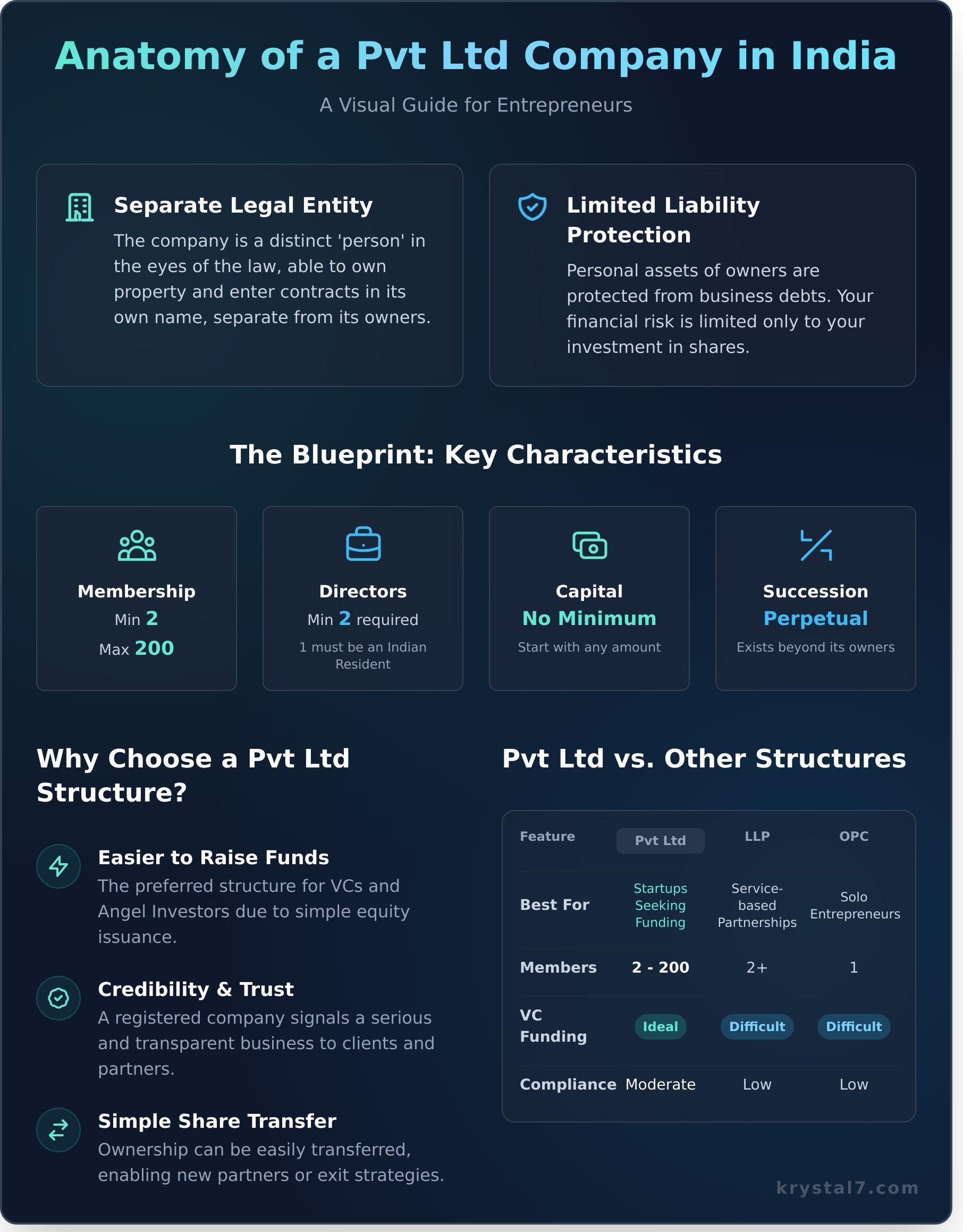
The most fundamental concept of a Private Limited Company is that it is a “separate legal entity.” This means the law views the company as a distinct “person” separate from its owners and managers. It can own property, sue or be sued, and enter into contracts entirely in its own name. This legal separation is the foundation for its most significant advantages.
Key Feature: Limited Liability Protection
Because the company is a separate entity, it provides limited liability protection to its owners. This means that the shareholders’ personal assets-like their homes, cars, or savings-are protected from any business debts or legal actions against the company. Your financial risk is limited only to the amount you have invested in the company’s shares. This provides a crucial safety net that empowers entrepreneurs to take calculated risks and build their vision with confidence.
Key Characteristics of a Private Limited Company
To fully grasp the structure, it’s essential to understand the rules that govern its ownership, management, and operation. These characteristics define what makes a Pvt Ltd company unique.
Membership: Who Can Be an Owner?
The ownership of a Pvt Ltd company is defined by its shareholders. The rules are designed to keep the ownership group relatively small and private.
- Minimum Members: A company must have at least two shareholders to start.
- Maximum Members: The number of shareholders cannot exceed 200.
- Share Trading: Shares cannot be sold or traded on a public stock exchange, and their transfer is typically restricted by the company’s articles of association.
Directors: Who Manages the Company?
While shareholders own the company, directors are responsible for managing its day-to-day affairs and making strategic decisions.
- Minimum Directors: At least two directors are required to manage the company.
- Overlap: A shareholder and a director can be the same person, which is common in startups.
- Residency Requirement: At least one of the company’s directors must be a resident of India.
Capital: Is There a Minimum Investment?
Starting a business often comes with financial hurdles, but the requirements for a Pvt Ltd company are flexible.
- No Minimum Capital: Previously, there was a minimum capital requirement, but this has been removed.
- Start with Any Amount: You can now register a Private Limited Company with any amount of capital that suits your business plan.
- Accessibility: This change makes the structure highly accessible for new and bootstrapping entrepreneurs.
Perpetual Succession: What Happens to the Company?
A Private Limited Company enjoys what is known as “perpetual succession,” which ensures long-term stability.
- Business Continuity: The company continues to exist legally even if the original owners or directors leave, change, or pass away.
- Independent Existence: Its existence is independent of its members, providing stability for employees, customers, and investors.
Why Choose a Pvt Ltd Company? Top 5 Advantages
The Private Limited structure is the preferred choice for entrepreneurs who are serious about growth, funding, and building long-term credibility. Here are the top advantages that make it so appealing.
1. Credibility and Trust
Operating as a registered Private Limited Company instantly enhances your brand’s image. It signals to clients, suppliers, and financial institutions that you are a serious and transparent business entity. This credibility can open doors to better business opportunities and partnerships.
2. Easier to Raise Funds
If you plan to seek funding from angel investors, venture capitalists (VCs), or private equity firms, the Pvt Ltd structure is non-negotiable. Investors prefer it because it allows for a clear and legally sound way to issue equity (shares) in exchange for capital. The structure clearly separates ownership from management, which is a key requirement for external investors.
3. Limited Liability and Risk Reduction
As mentioned earlier, this is perhaps the single greatest benefit. By separating your personal assets from your business liabilities, you can pursue your entrepreneurial vision without the fear of losing everything if the business faces financial trouble. This encourages innovation and healthy risk-taking.
4. Simple Share Transfer
Ownership in a Pvt Ltd company is represented by shares, which makes it easy to transfer ownership, bring on new strategic partners, or create exit strategies. While there are some restrictions, the process is far more straightforward than dissolving and reforming a partnership or proprietorship. Need guidance on what’s best for your venture? Plan your business structure with crystal clarity. Talk to an expert.
Pvt Ltd vs. Other Business Structures
Choosing the right structure is a critical first step for any founder. Here’s a quick comparison of a Private Limited Company with other common business entities in India.
Private Limited Company vs. LLP (Limited Liability Partnership)
An LLP also offers limited liability but is structured as a partnership. It generally has lower compliance requirements and costs than a Pvt Ltd company. However, the Pvt Ltd structure is far more suitable for raising external funds, as investors cannot become partners in an LLP but can easily become shareholders in a company.
Private Limited Company vs. OPC (One Person Company)
An OPC is designed for solo entrepreneurs, allowing a single person to enjoy the benefits of a corporate structure. A Pvt Ltd company, on the other hand, requires a minimum of two members (shareholders and directors). An OPC can be converted into a Pvt Ltd company once it reaches a certain scale.
Private Limited Company vs. Public Limited Company
A Public Limited Company can raise funds from the general public by listing its shares on a stock exchange. However, this comes with significantly higher compliance, disclosure, and regulatory burdens. A Pvt Ltd company is privately funded and has fewer compliance obligations, making it ideal for startups and closely-held businesses.
How to Register a Pvt Ltd Company in India
While the Ministry of Corporate Affairs (MCA) has streamlined the registration process, it still involves several precise legal steps. Partnering with professional consultants ensures a smooth, compliant, and error-free registration from start to finish.
Basic Requirements Checklist
Before you begin the process, ensure you have the following in place:
- A minimum of two directors and two shareholders.
- At least one director who is a resident of India.
- A unique company name that is not already taken or trademarked, which must be approved by the MCA.
- A registered office address located within India.
Ready to Start Your Company?
The journey from a business idea to a fully incorporated company can feel complex, with multiple forms, documents, and legal formalities to navigate. An expert partner can handle all the heavy lifting-from securing a unique name and Digital Signature Certificates (DSCs) to drafting legal documents and filing the final application-giving you the freedom to focus on what truly matters: your business dream. Explore our All-in-One Company Incorporation Package.
Frequently Asked Questions (FAQs)
What is the full form of Pvt Ltd?
The full form of Pvt Ltd is “Private Limited.” It indicates that the company is a Private Limited Company registered under the Companies Act, 2013.
Can a single person start a Private Limited Company in India?
No, a Private Limited Company requires a minimum of two shareholders and two directors. For a solo entrepreneur, the appropriate structure is a One Person Company (OPC).
Is a Pvt Ltd company a good choice for a small business?
Yes, it’s an excellent choice if the small business plans to grow, seek funding, or wants the credibility and protection of a formal corporate structure. For very small, local businesses with no plans for expansion, a proprietorship might be simpler.
What are the main disadvantages of a Private Limited Company?
The main disadvantages are higher compliance requirements (like annual filings and board meetings) and setup costs compared to an LLP or proprietorship. However, these are often outweighed by the benefits of limited liability and scalability.
How much does it cost to register a Pvt Ltd company in India?
The cost includes government fees, stamp duty (which varies by state), and professional fees for the consultant handling the process. Packages are often available that bundle all these costs for a transparent price.
Is GST registration mandatory for a Pvt Ltd company?
GST registration is not automatically mandatory upon incorporation. It becomes mandatory only if the company’s annual turnover exceeds the prescribed threshold (e.g., ₹40 lakhs for goods) or if it engages in specific types of business, like e-commerce or interstate trade.
Choosing to register as a Private Limited Company is a foundational step towards building a scalable, credible, and resilient business. It provides the legal framework to protect your personal assets, attract investment, and grow with confidence. If you’re ready to turn your vision into a legally recognized entity, ensure you have the right expert guidance to navigate the process seamlessly. Start Your Business with Crystal Clarity Today.

Article by
Nihal Srivastava
Nihal Srivastava is the Co-Founder of Krystal7 Consultants, helping Indian entrepreneurs and startups navigate company registration, compliance, trademark protection, and regulatory requirements with clarity and confidence. With 6+ years of hands-on expertise in MCA filings, GST compliance, and corporate structuring, Nihal has guided 1000+ businesses across India through their legal and compliance journeys. He believes every business dream deserves crystal clear foundations, and that no founder should be held back by paperwork or red tape.