

What Is a Pvt Ltd Company in India? A Complete Guide for Entrepreneurs
Starting a new business is an exciting journey filled with vision and ambition. But before you can change the world, you need to build a strong foundation. One of the first and most critical decisions you’ll make is choosing the right legal structure for your company. For many serious entrepreneurs in India, the Private Limited Company, or Pvt Ltd, is the structure of choice. This guide provides a complete, clear overview to help you understand what a Pvt Ltd company is, why it’s so popular, and if it’s the right fit for your business dream.
What Is a Private Limited Company? The Simple Definition
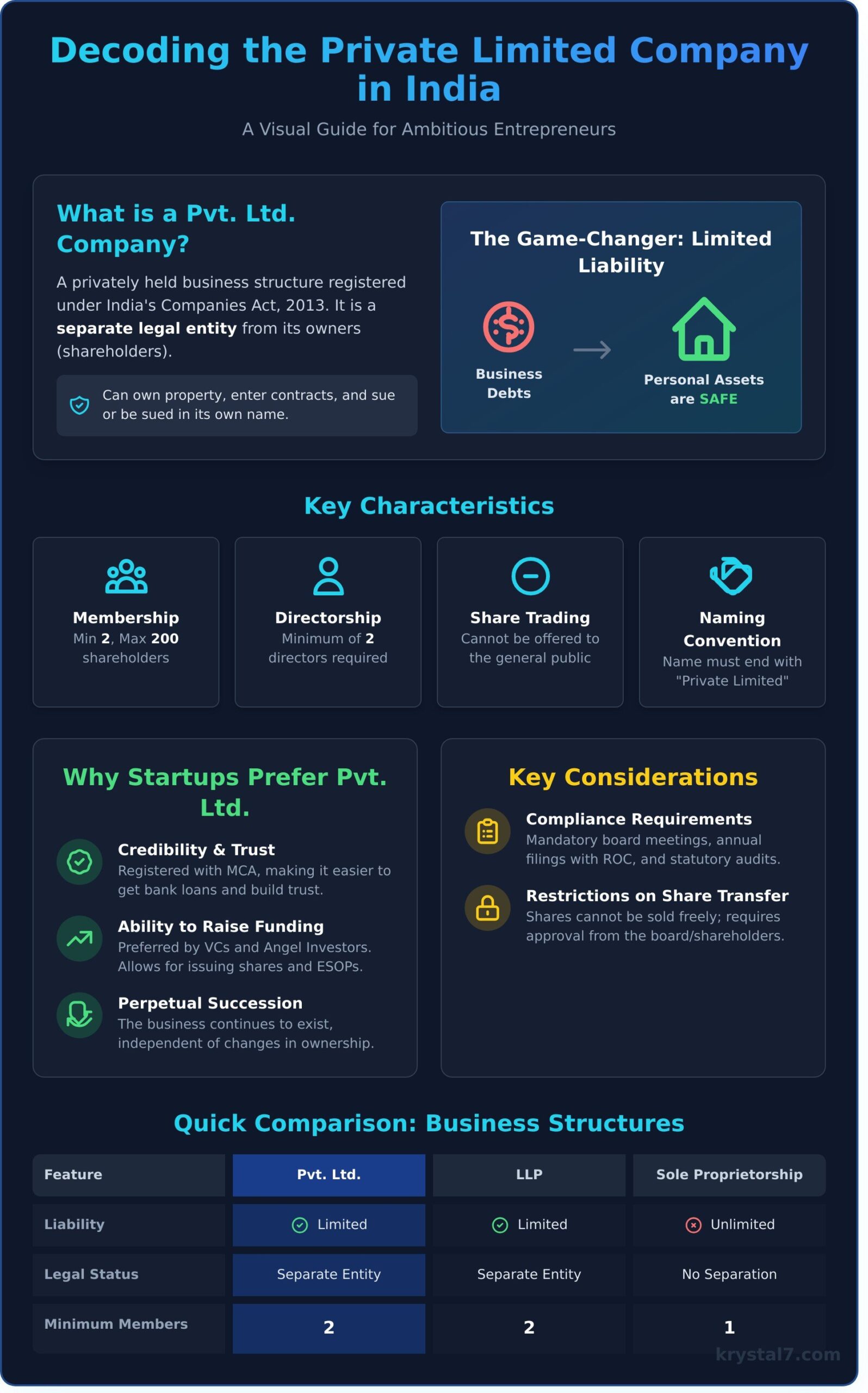
In simple terms, a Private Limited Company is a type of business entity that is privately held by a small group of people called shareholders. It is registered under India’s Companies Act, 2013, and is considered a separate legal entity from its owners. This is a crucial concept: it means the company can own property, enter into contracts, sue or be sued, and incur debts all in its own name, completely separate from the individuals who own it. The most significant benefit of this separation is that the owners have limited liability, which protects their personal assets from business risks.
Key Characteristics of a Pvt Ltd Company
Every Pvt Ltd company in India shares a few fundamental characteristics that define its structure and operation. Understanding these is the first step to getting a clear picture of this business type.
- Membership: It must have a minimum of two members (shareholders) and is restricted to a maximum of 200 members.
- Directorship: A minimum of two directors are required to manage the day-to-day affairs of the company.
- Share Trading: The company’s shares cannot be offered to the general public or traded on a public stock exchange. They are held privately.
- Naming Convention: The company’s name must legally end with the suffix “Private Limited” or the abbreviation “Pvt. Ltd.” to signify its status.
Why ‘Limited Liability’ is a Game-Changer for Entrepreneurs
The term “limited liability” is perhaps the single most important advantage of forming a Pvt Ltd company. It creates a protective wall between your business finances and your personal finances. If the business faces financial distress or incurs debt it cannot repay, creditors can only claim the company’s assets. Your personal property-your home, car, and personal savings-remains safe and untouched. This powerful feature encourages entrepreneurship by reducing personal financial risk, giving you the confidence to take calculated risks and focus on innovation and growth.
Advantages: Why Startups Prefer the Pvt Ltd Structure
The Private Limited Company is not just a legal structure; it’s a statement of intent. It is the most popular and credible option for startups and growing businesses in India because it signals a long-term vision and a professional approach to clients, employees, and investors.
Credibility and Trust
Being registered with the Ministry of Corporate Affairs (MCA) lends immediate credibility to your venture. All company details, such as its directors and financial statements, are publicly accessible on the MCA portal, which builds a foundation of transparency and trust. This official status makes it significantly easier to secure business loans from banks and financial institutions, who view Pvt Ltd companies as more stable and reliable than unregistered entities.
Ability to Raise Funding
If your business plan involves seeking investment, the Pvt Ltd structure is non-negotiable. It is the preferred, and often required, structure for venture capitalists (VCs) and angel investors. This is because it allows for the seamless issuance of shares (equity) in exchange for capital. Furthermore, it enables you to offer Employee Stock Option Plans (ESOPs), a powerful tool for attracting and retaining top talent in a competitive market.
Perpetual Succession
A Pvt Ltd company has a life of its own, independent of its owners. This concept, known as “perpetual succession,” means the company continues to exist even if the founders or shareholders change, retire, or pass away. This ensures business continuity, protects the legacy you are building, and makes the transfer of ownership as simple as selling or transferring shares to another person.
Key Considerations Before You Register
While the benefits are substantial, choosing a Pvt Ltd structure also comes with certain responsibilities. Understanding these compliance requirements from the start is key to a smooth and successful entrepreneurial journey. Think of these not as disadvantages, but as factors to plan for.
Compliance Requirements
Operating as a Pvt Ltd company involves adhering to the regulations set by the Companies Act. This includes holding regular board meetings, maintaining official records (known as minutes), and filing annual financial statements and reports with the Registrar of Companies (ROC). A statutory audit of your company’s financial accounts by a Chartered Accountant is also mandatory. While this may sound daunting, these processes ensure transparency and good governance. Professional firms can easily manage these tasks, giving you the freedom to focus on growth.
Restrictions on Share Transfer
Unlike a public company, a Pvt Ltd company’s shares cannot be freely sold to the public. The transfer of shares is restricted and typically requires the approval of the board of directors and other shareholders, as outlined in the company’s Articles of Association. This feature is designed to keep the ownership and control of the company within a close-knit group, preventing hostile takeovers and ensuring that new shareholders align with the company’s vision.
Pvt Ltd vs. Other Business Structures: A Quick Comparison
Choosing the right structure depends entirely on your long-term business goals, funding needs, and desired level of operational flexibility. Here’s a quick look at how a Private Limited Company stacks up against other popular options in India.
| Feature | Private Limited Company | LLP | OPC | Sole Proprietorship |
|---|---|---|---|---|
| Liability | Limited | Limited | Limited | Unlimited |
| Legal Status | Separate Legal Entity | Separate Legal Entity | Separate Legal Entity | No Separation |
| Minimum Members | 2 | 2 | 1 | 1 |
| Investor Friendliness | Very High (Can issue shares) | Low (No share concept) | Moderate | Very Low |
| Annual Compliance | High (ROC Filings, Audit) | Moderate (ROC Filings) | Moderate | Low (ITR Filing only) |
Pvt Ltd vs. Limited Liability Partnership (LLP)
An LLP offers a blend of partnership flexibility and limited liability. It is easier and cheaper to run in terms of annual compliance. However, the Pvt Ltd structure is far superior for raising external funds from investors, as LLPs do not have a concept of share capital.
Pvt Ltd vs. One Person Company (OPC)
An OPC is designed for a single founder, offering the benefits of limited liability without the need for a co-founder. While great for solo entrepreneurs, a Pvt Ltd company holds higher credibility and is better suited for businesses planning to scale up, add partners, or seek significant investment.
Pvt Ltd vs. Sole Proprietorship
A Sole Proprietorship is the simplest business structure to start, but it comes with a major drawback: unlimited liability. There is no legal distinction between the owner and the business, meaning your personal assets are at risk. A Pvt Ltd company provides a crucial layer of protection and is perceived as a more professional and enduring entity.
Is a Private Limited Company Right for You?
This structure is the ideal choice for entrepreneurs who have a clear vision for growth and are serious about building a scalable, credible, and fundable business. You should strongly consider forming a Pvt Ltd company if your venture falls into one of these categories.
Startups Planning to Raise Capital
If your roadmap includes approaching venture capitalists, angel investors, or incubators for funding, the Pvt Ltd structure is the universally accepted standard. It provides the legal framework necessary for equity investment.
Businesses Seeking High Credibility
For businesses that aim to work with large corporate clients, government tenders, or international partners, being a registered Private Limited Company is essential. It signals stability, transparency, and a commitment to professional governance.
Founders Who Want to Protect Personal Assets
If you want to build your dream without risking your family’s financial security, the limited liability protection offered by a Pvt Ltd company is invaluable. It provides a clear and legally sound separation between your business and personal life.
Ready to Start? Get Krystal-Clear Guidance
The company registration process in India involves several steps, from obtaining a Digital Signature Certificate (DSC) and Director Identification Number (DIN) to getting your company name approved and filing incorporation documents. While it can seem complex, it doesn’t have to be a hassle. Our all-in-one incorporation package is designed to handle every legal formality, allowing you to launch your business with confidence and clarity. Start your company registration online today.
Frequently Asked Questions
What is the minimum capital required to start a Pvt Ltd company in India?
Previously, there was a minimum paid-up capital requirement. However, the Ministry of Corporate Affairs has removed this rule. Now, you can register a Private Limited Company with any amount of capital, even a nominal sum like ₹10,000.
Can a single person start a private limited company?
No, a Private Limited Company requires a minimum of two members (shareholders) and two directors. If you are a solo founder, the One Person Company (OPC) is the appropriate structure for you.
Can an NRI or a foreign national be a director in an Indian Pvt Ltd company?
Yes, absolutely. An NRI or a foreign national can be a director in an Indian Pvt Ltd company. However, the law requires that at least one director on the board must be a resident of India (who has stayed in India for at least 182 days in the previous calendar year).
Do I need a physical office address to register a company?
Yes, you must provide a registered office address in India for your company. This address will be used for all official communication from the MCA and other government bodies. You can use a commercial space or even your residential address as the registered office, provided you have the necessary documents (like a No Objection Certificate from the owner).
How long does it take to register a private limited company?
With streamlined online processes, a company can typically be registered within 7-10 working days, provided all documents are in order and there are no delays in government approvals for the name and other forms.
What are the annual compliance requirements for a Pvt Ltd company?
The key annual compliances include filing an Annual Return (Form MGT-7/7A), filing Financial Statements (Form AOC-4), holding board and shareholder meetings, maintaining statutory registers, and conducting a statutory audit.
Choosing the right legal structure is a foundational step in your entrepreneurial journey. A Private Limited Company offers the perfect blend of liability protection, credibility, and scalability to help your vision thrive. While the process involves legal steps and ongoing compliance, you don’t have to navigate it alone. With the right expert guidance, you can ensure your business is built on a solid, compliant, and growth-ready foundation from day one.
Ready to turn your business dream into a legal reality? Start your business with crystal clarity. Explore our Company Incorporation Package.

Article by
Nihal Srivastava
Nihal Srivastava is the Co-Founder of Krystal7 Consultants, helping Indian entrepreneurs and startups navigate company registration, compliance, trademark protection, and regulatory requirements with clarity and confidence. With 6+ years of hands-on expertise in MCA filings, GST compliance, and corporate structuring, Nihal has guided 1000+ businesses across India through their legal and compliance journeys. He believes every business dream deserves crystal clear foundations, and that no founder should be held back by paperwork or red tape.