

How to Register a Company: A Step-by-Step Guide for Entrepreneurs
The path from a brilliant business idea to a legally recognized entity in India can feel overwhelming. It’s a journey often clouded by complex legal jargon, confusing choices between business structures, and the nagging fear of a misstep that could cost you dearly down the line. If you’re feeling lost in the red tape, you are not alone. But learning how to register a company shouldn’t be a barrier to your ambition; it should be the strong foundation upon which you build your legacy.
This comprehensive guide is designed to bring you absolute clarity. We will walk you through every essential step, from choosing the right structure-be it a Private Limited, LLP, or OPC-to preparing your documents and understanding the real costs, with no surprises. By the end, you’ll have an actionable checklist and the confidence to establish your venture correctly, giving you the freedom to focus on what you do best: turning your vision into a thriving reality.
Step 1: Making Key Foundational Decisions for Your Business
Before you dive into paperwork, the first step in understanding how to register a company is to lay a solid strategic foundation. These initial choices are far more than just formalities; they are the architectural plans for your entire venture, directly impacting your personal liability, tax obligations, and your ability to attract investment. Formal registration transforms your idea into a credible, legal entity, providing a crucial shield for your personal assets.
This process, known as incorporation, establishes your business as a distinct legal personality. To fully grasp what it means to incorporate, it’s helpful to see it as giving your business its own legal life. Getting these decisions right from the start provides the clarity you need to build and scale with confidence.
Choosing the Right Business Structure
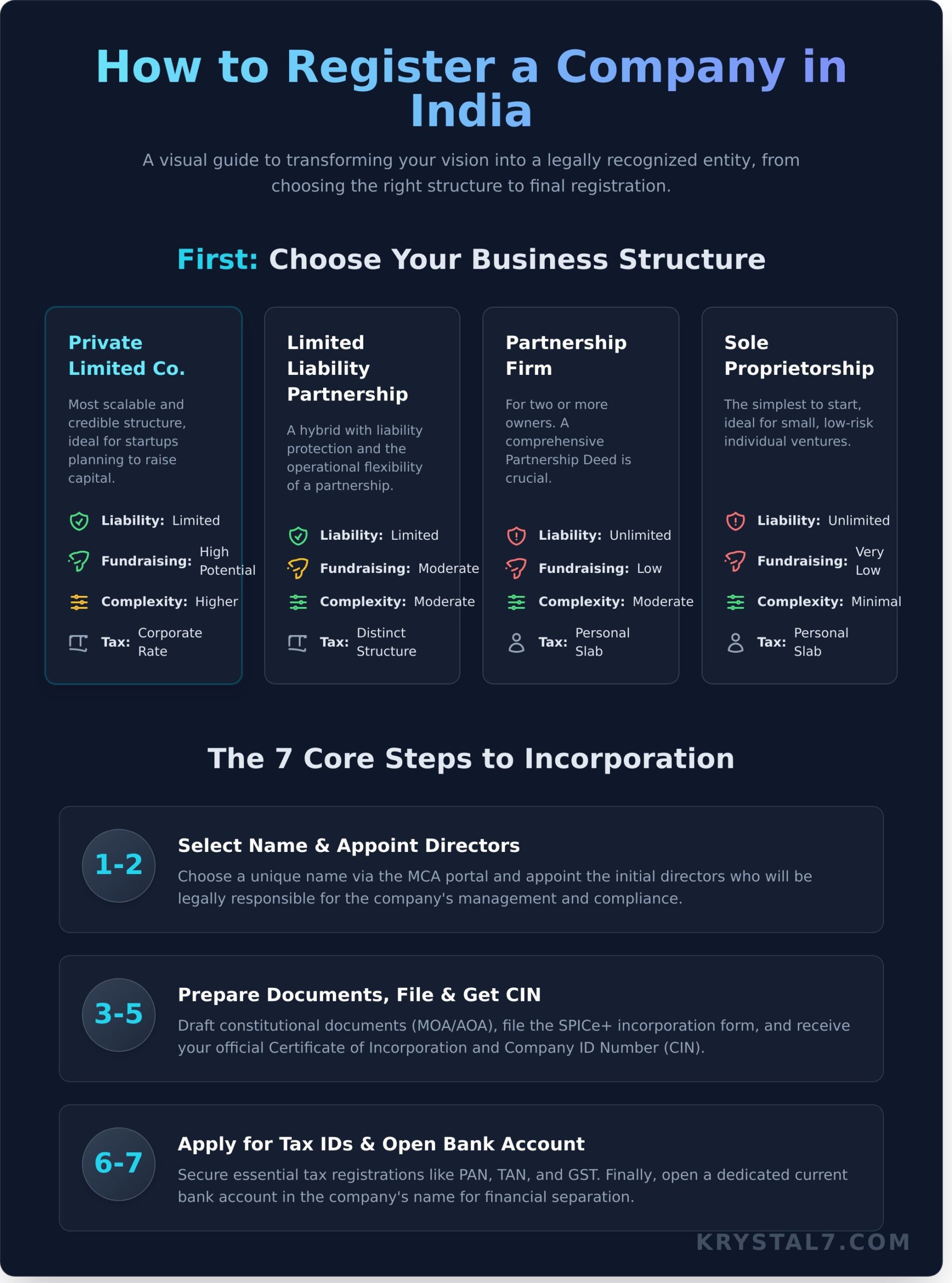
Selecting the correct legal structure is the most critical decision you’ll make at this stage. Each option offers a different balance of protection, compliance, and flexibility. For Indian entrepreneurs, the most common choices are Sole Proprietorship, Partnership, Limited Liability Partnership (LLP), and Private Limited Company (Pvt. Ltd.).
| Feature | Sole Proprietorship | LLP | Private Limited Company |
|---|---|---|---|
| Liability | Unlimited | Limited to Contribution | Limited to Share Value |
| Compliance | Minimal | Moderate | High |
| Fundraising | Difficult | Moderate | Easy (ESOPs, VCs) |
A Private Limited Company is often the preferred structure for startups with a vision for growth, as it offers limited liability and makes it significantly easier to raise funds from investors.
Selecting a Unique and Compliant Company Name
Your company name is your brand’s identity and a legal requirement. It must be unique and adhere to the naming guidelines set by the Ministry of Corporate Affairs (MCA). Before finalizing a name, you must check its availability on the MCA portal to ensure it is not identical or too similar to an existing company or trademark. Avoid names that are offensive, misleading, or use restricted words like “Bank” or “National” without approval. A quick trademark search is also a wise step to prevent future legal hassles.
Defining Your Directors and Registered Office Address
For a Private Limited Company, you are required to appoint a minimum of two directors. These individuals will be responsible for managing the company’s affairs. You must also provide a physical registered office address in India. This address will be used for all official communications from government bodies like the MCA and the Income Tax Department. While it must be a physical location, it doesn’t have to be a commercial space initially; a residential address can be used, provided you have the necessary No Objection Certificate (NOC) from the property owner.
Step 2: Preparing and Assembling Your Registration Documents
With your foundational decisions made, the next phase in how to register a company involves meticulous preparation. This is where your business vision begins to take legal shape, and accuracy is paramount. A single error in your documentation can lead to significant delays or even rejection from the Registrar of Companies (RoC), creating unnecessary hassle. This process involves gathering both personal identification for the directors and creating the foundational documents that will define your company’s legal identity and purpose. Getting this right provides the clarity you can build on for future growth.
Obtaining Director Identification and Digital Signatures
Before any forms can be filed, every proposed director must secure their credentials. This is a non-negotiable first step in the compliance journey.
- Director Identification Number (DIN): This is a unique 8-digit identification number assigned by the Ministry of Corporate Affairs (MCA) to any individual intending to become a director. It is a mandatory, lifetime ID.
- Digital Signature Certificate (DSC): A Class 3 DSC is the digital equivalent of a physical signature. It is an encrypted digital key required to sign electronic documents securely for all online filings with the MCA.
To obtain these, directors will need to provide self-attested copies of their PAN card, Aadhaar card (for identity and address proof), and a recent passport-sized photograph.
Drafting the Memorandum & Articles of Association (MoA & AoA)
These two documents are the constitutional backbone of your company. While they may seem like complex legal jargon, their purpose is straightforward. The Memorandum of Association (MoA) defines your company’s charter. It outlines the ‘what’ and ‘why’ of your business-its name, objectives, and the scope of its operations. The Articles of Association (AoA) are the internal rulebook, detailing the ‘how.’ It governs internal management, from director powers to shareholder meetings. Professionally drafted MoA and AoA are critical for streamlined operations and preventing future disputes.
Gathering Proof of Registered Office
Your company needs a legitimate physical address in India to receive official correspondence. You must provide valid proof of this registered office. While the specific documents like the MoA and AoA are unique to Indian company law, the fundamental principle of assembling foundational paperwork is universal. For instance, the official government registration steps in other jurisdictions also emphasize gathering key business information upfront. Acceptable documents in India include:
- A recent utility bill (electricity, telephone) in the owner’s name, not older than two months.
- A notarized rental or lease agreement.
- Proof of ownership, such as a conveyance or sale deed.
If the property is rented, a No Objection Certificate (NOC) from the property owner is mandatory, granting permission to use the premises as the company’s registered office.
Step 3: The Official Filing Process with the Registrar
With your documents prepared and your business structure defined, you’ve reached the pivotal stage: the official filing. This is where your vision transitions from a plan into a legally recognised entity. The process of how to register a company has been significantly streamlined in India, moving from cumbersome paperwork to efficient digital submission through the Ministry of Corporate Affairs (MCA) portal.
Completing the Incorporation Form (e.g., SPICe+)
Modern governance has simplified company registration through integrated e-forms. In India, this is primarily done via the SPICe+ (Simplified Proforma for Incorporating Company electronically Plus) form. This single, consolidated application intelligently bundles several critical registrations, freeing you from the hassle of multiple applications. Key services integrated into this form include:
- Name reservation and company incorporation
- Director Identification Number (DIN) allotment
- PAN and TAN allotment
- GSTIN, EPFO, and ESIC registration
You will need to meticulously enter core details like the approved company name, registered office address, director and shareholder information, and the authorised capital structure. Double-checking every entry is non-negotiable, as even minor errors can lead to rejection and delays, disrupting your launch timeline.
Paying Government Fees and Stamp Duty
Official incorporation involves statutory government fees and stamp duty. The registration fee is calculated based on your company’s authorised share capital-the higher the capital, the higher the fee. Stamp duty is a state-level tax levied on key incorporation documents, and its rates vary significantly from one state to another. Navigating these costs can be complex, but professional services provide a Krystal-Clear breakdown, ensuring you have complete transparency with no hidden charges.
Receiving the Certificate of Incorporation
Upon successful verification of your application and payment of all fees, the Registrar of Companies (RoC) will issue the Certificate of Incorporation (COI). This document is the official birth certificate of your company, bringing it into legal existence. It contains your unique Company Identification Number (CIN) and the date of incorporation. This final step is the culmination of the process, and having a clear understanding of each stage, as detailed in a practical step-by-step guide from trusted sources, is crucial for a smooth journey. With the COI in hand, your company is officially ready to operate, open bank accounts, and thrive.
Step 4: Critical Post-Registration Actions for Your New Company
Congratulations on receiving your Certificate of Incorporation! While this is a monumental achievement, understanding how to register a company is only the first phase. The steps you take immediately after incorporation are critical for establishing your business’s legal and financial framework, ensuring you are fully operational and compliant from day one. Overlooking these actions can lead to unnecessary penalties and operational hurdles, turning your initial momentum into a struggle with red tape.
Think of registration as the foundation. Now, it’s time to build the structure that will support your company’s growth and success.
Open a Corporate Bank Account
Separating your personal and business finances is non-negotiable. A dedicated corporate bank account provides Krystal-Clear financial transparency, protects your personal assets under the limited liability structure, and is essential for receiving investments or managing revenue. Banks in India will typically require the following documents to open your account:
- Certificate of Incorporation (COI)
- Memorandum of Association (MoA) and Articles of Association (AoA)
- The company’s Permanent Account Number (PAN) card
- A Board Resolution authorising the opening of the bank account
Secure Necessary Tax and Business Licenses
While your company PAN is issued during the incorporation process, your journey with tax compliance is just beginning. The most immediate registration for most businesses is the Goods and Services Tax (GST). You must register for GST if your annual turnover exceeds the prescribed threshold or if you are involved in inter-state trade. Beyond taxes, your industry may require specific licenses to operate legally, such as an FSSAI license for a food business or a Shop and Establishment license for a physical office or storefront.
Fulfill Initial Statutory Compliances
The Companies Act, 2013, mandates several initial actions to formalise your corporate governance. You must conduct your first Board of Directors meeting within 30 days of incorporation to discuss business plans and appoint auditors. Following this, you are required to issue share certificates to the initial subscribers of the MoA. These initial steps set the precedent for your company’s ongoing annual compliance, a critical aspect of maintaining your active status and avoiding penalties.
Navigating these first steps can feel overwhelming, but they are crucial for a strong start. Don’t get lost in compliance. Explore our Annual Compliance Packages.
DIY Registration vs. Hiring a Professional: A Clear Comparison
When learning how to register a company, one of the first major decisions you’ll face is whether to manage the process yourself or partner with an expert. Both paths have distinct advantages, and the right choice depends entirely on your budget, available time, and comfort with navigating India’s legal and compliance frameworks. This comparison is designed to give you the clarity needed to make an informed decision for your venture.
The Do-It-Yourself (DIY) Route
The primary benefit of the DIY approach is the lower initial cost, as you only pay for government fees. However, this path can be deceptively expensive. The process is time-consuming, requires meticulous attention to detail, and the risk of errors is high. A single mistake on a form can lead to application rejection, significant delays, and potential penalties costing thousands of rupees. The true hidden cost is your time-every hour spent deciphering regulations is an hour you aren’t spending on strategy, product development, or customer acquisition.
Working with a Professional Firm
Partnering with a professional firm transforms company registration from a complex hurdle into a streamlined, predictable process. While this involves a higher upfront investment, the value is returned through expertise, speed, and guaranteed accuracy. Professionals navigate the intricate rules of the Ministry of Corporate Affairs (MCA) effortlessly, ensuring your registration is smooth, compliant, and error-free. This approach provides more than just a service; it gives you invaluable peace of mind and the Freedom to Focus on building your business vision from day one.
What to Look for in a Registration Service
Choosing the right expert is crucial. Look for a genuine partner who offers more than just form-filling. Key indicators of a quality service include:
- Krystal-Clear Pricing: Demand a transparent fee structure with no hidden charges. All government fees and professional charges should be explained upfront.
- Expert Team: Ensure the firm has a dedicated team of Chartered Accountants (CAs), Company Secretaries (CSs), and legal professionals who can handle any complexity.
- Dedicated Support: A single point of contact who understands your business journey is invaluable. You should never feel like just another ticket number.
- Comprehensive Packages: The best services cover everything from name approval and digital signatures to post-incorporation compliance, like bank account opening support.
For entrepreneurs who value their time and want to start their venture on a solid foundation of compliance, partnering with a professional firm is the clear path to success.
Your Journey to a Registered Company Starts Now
You now have a clear roadmap for your entrepreneurial journey in India. Registering your company is a significant milestone, involving critical foundational decisions, meticulous document preparation, and vital post-registration compliance. Understanding these stages removes the guesswork and empowers you to move forward with confidence.
While this guide clarifies the process of how to register a company, navigating the legal and financial nuances can still be a complex undertaking. This is where having an expert partner gives you the freedom to focus on what you do best: building your business. At Krystal7, our team of Chartered Accountants and Legal Strategists ensures your registration is seamless and compliant from day one. With a Dedicated Relationship Manager for every client and our Krystal-Clear Transparent Pricing, you’ll never face hidden costs or confusion.
Start Your Business with Crystal Clarity. Explore Our Incorporation Packages.
Your vision deserves a strong legal foundation. Take the next step today and turn your business dream into a registered reality.
Frequently Asked Questions
How long does it take to register a company?
Understanding the timeline is a key part of learning how to register a company. In India, the process is now significantly faster, typically taking 10-15 working days with the streamlined SPICe+ form. This assumes all documents are correct and there are no government delays. The timeline covers obtaining Director Identification Numbers (DINs), Digital Signature Certificates (DSCs), name approval, and final filing. Our expert guidance ensures you navigate each step efficiently, avoiding common pitfalls for a smooth registration.
What is the average cost to register a private limited company in India?
The cost can vary based on the state of registration and authorised capital. On average, you can expect the total cost to be between ₹6,000 and ₹15,000. This includes government fees like stamp duty and ROC filing fees, as well as professional fees for expert assistance with documentation and filing. At Krystal7, we provide a Krystal-Clear breakdown of all costs upfront, ensuring complete transparency with no hidden charges, giving you financial clarity from day one.
Do I need a physical office to register my company?
Yes, a registered office address in India is a mandatory requirement for company incorporation. However, you do not need a commercial or physical office space to get started. You can use a residential address as your registered office, provided you have a No Objection Certificate (NOC) from the property owner. This flexibility is a great advantage for startups and entrepreneurs, allowing you to launch your venture without the immediate overhead of leasing a commercial property.
What is the difference between a Director and a Shareholder?
Think of Directors as the managers and Shareholders as the owners of the company. Directors are appointed by shareholders to manage the company’s day-to-day operations and strategic decisions. Shareholders, on the other hand, own the company by holding shares and have voting rights on major decisions, like appointing directors. In many private limited companies, especially startups, the same individuals often serve as both directors and shareholders, aligning ownership with management.
Can a foreign national be a director in an Indian company?
Absolutely. A foreign national can be a director in an Indian private limited company. The key statutory requirement under the Companies Act, 2013, is that the company must have at least one director who is a resident of India. A resident is defined as a person who has stayed in India for a total period of not less than 182 days during the previous calendar year. This ensures local accountability while allowing for global expertise on your board.
What happens if my proposed company name is rejected?
If your proposed company name is rejected by the Ministry of Corporate Affairs (MCA), don’t worry. This usually happens if the name is too similar to an existing company or trademark, or if it’s considered undesirable. The process allows for resubmission, giving you the opportunity to apply again with new name options. Our team helps you conduct a thorough name search beforehand to minimize the chances of rejection, ensuring a smoother registration journey for your venture.
What is ‘Authorised Capital’ and how much do I need?
Authorised Capital is the maximum amount of share capital that a company is legally permitted to issue to its shareholders. It’s a figure stated in the company’s charter documents. While there is no longer a minimum requirement, most startups begin with an Authorised Capital of ₹1,00,000. This amount can be increased later by paying additional government fees as your business grows. It’s a strategic decision that gives your company room for future investment and expansion.

Article by
Nihal Srivastava
Nihal Srivastava is the Co-Founder of Krystal7 Consultants, helping Indian entrepreneurs and startups navigate company registration, compliance, trademark protection, and regulatory requirements with clarity and confidence. With 6+ years of hands-on expertise in MCA filings, GST compliance, and corporate structuring, Nihal has guided 1000+ businesses across India through their legal and compliance journeys. He believes every business dream deserves crystal clear foundations, and that no founder should be held back by paperwork or red tape.