

How to Register My US LLC in India: A Complete 2026 Guide for Founders
What if your expansion into the US market didn’t have to trigger a nightmare of notices from the Indian Income Tax Department? You’ve likely heard that setting up a Delaware or Wyoming entity is the key to global scaling. However, the fear of double taxation and FEMA violations often stops founders in their tracks. It’s frustrating to feel like your global vision is trapped by red tape and complex RBI regulations. This guide simplifies exactly how to register my US LLC in India while maintaining crystal-clear compliance on both sides of the ocean.
We’ll show you how to master the dual-compliance process to ensure your personal assets stay protected and your US dollars arrive legally in your Indian bank account. You’ll get a clear roadmap for foreign subsidiary registration that satisfies both the IRS and the Ministry of Corporate Affairs. We’ll preview the specific 2026 requirements for tax treaties and the mandatory filings you need to avoid heavy penalties. This is your path to freedom to focus on your vision while we handle the statutory complexity.
Key Takeaways
- Understand the US LLC structure as a pass-through entity and learn why establishing a foreign subsidiary is the most effective route for local operations.
- Identify how to select business-friendly states like Delaware or Wyoming and manage the essential documentation required for Indian registration.
- Master complex tax hurdles including the ‘Place of Effective Management’ (POEM) and GST obligations for cross-border service imports.
- Discover the step-by-step roadmap for how to register my US LLC in India while ensuring full compliance with MCA and RBI regulations.
- Learn how to leverage expert advisory to handle intricate statutory filings, giving you the freedom to focus on scaling your global business vision.
Understanding the US LLC Structure for Indian Entrepreneurs
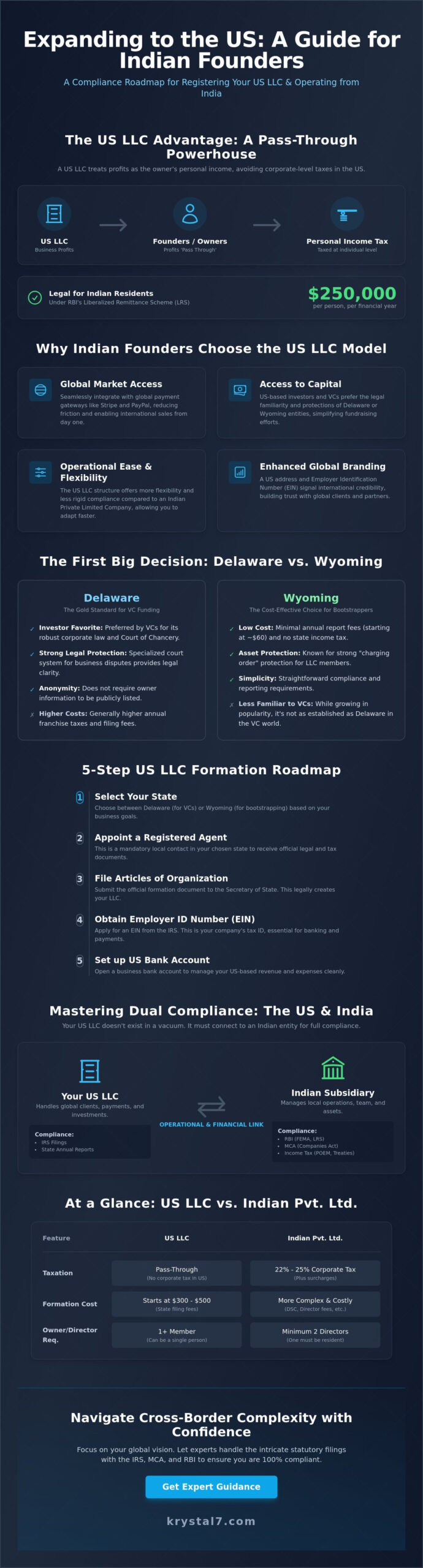
A US Limited Liability Company (LLC) operates as a pass-through entity. This means the business profits flow directly to the owners without being taxed at the corporate level in the United States. For Indian founders, this structure provides a shield for personal assets while allowing them to tap into the American ecosystem. If you’re asking how to register my US LLC in India, it’s vital to understand that you aren’t simply moving a US company. Instead, you’re likely establishing a Foreign Subsidiary or a Branch Office to remain compliant with the Indian Companies Act, 2013.
Ownership of a foreign entity is legal for Indian residents under the Liberalized Remittance Scheme (LRS). As of 2024, the Reserve Bank of India (RBI) allows individuals to remit up to $250,000 per financial year for permitted current or capital account transactions. This includes investing in the equity of a foreign company. Establishing a US entity offers an immediate credibility boost. It’s especially effective for SaaS and global consulting firms that need to build trust with international clients.
Why Indian Founders Choose the US LLC Model
Accessing global markets requires the right tools. A US LLC grants you seamless entry to payment gateways like Stripe and PayPal. These platforms often have lower transaction friction and better integration options than their domestic counterparts. You’ll find it much easier to scale when your payment infrastructure is global from day one.
- Capital Access: US based investors and syndicates prefer funding Delaware or Wyoming LLCs due to legal familiarity.
- Operational Ease: The US model offers a level of flexibility that’s hard to find in the rigid structures of an Indian Private Limited Company.
- Global Branding: A US address and EIN (Employer Identification Number) signal to the world that your business is ready for international trade.
How to Register My US LLC in India: Comparing Structures
Choosing between a US LLC and an Indian Private Limited Company involves looking at the long term vision. Formation costs for a US LLC typically start around $300 to $500 for state filing fees, depending on the state. In contrast, an Indian Private Limited company requires a minimum of two directors and specific digital signature certificates. The US pass-through tax model avoids double taxation, whereas Indian companies face a flat corporate tax rate of 22% or 25% plus applicable surcharges depending on their turnover and regime choice.
Krystal7 provides the clarity you need to handle these cross border complexities. We take over the statutory red tape so you have the freedom to focus on your product. Our team ensures your foreign entity disclosures match the requirements of the Income Tax Act, 1961. We help you thrive by turning complex compliance into a streamlined growth strategy.
Step-by-Step Guide to Forming Your US LLC from India
Starting a venture in the US while based in Bangalore or Gurgaon is now a streamlined reality. If you’re wondering how to register my US LLC in India, the process is efficient when you follow a structured roadmap. You don’t need a US visa to own a company there, but you must ensure your international structure remains robust and compliant with Indian regulations like FEMA.
Selecting the Right State: How to Register My US LLC in India for Growth
Most Indian founders choose between Delaware and Wyoming. Delaware is the gold standard if you plan to raise venture capital. Its Court of Chancery provides specialized legal protection that global investors trust. According to the World Bank’s Doing Business report, choosing a jurisdiction with stable legal frameworks is vital for long-term scalability.
Wyoming offers a more cost-effective route for bootstrapped startups. It features lower annual report fees, starting at approximately $60, and zero state income tax for non-residents. This choice impacts your annual compliance for a private limited company sibling structure back in India, as it dictates your global tax reporting requirements.
Next, you’ll appoint a Registered Agent. This person or entity must have a physical address in your chosen state to receive official government correspondence. They act as your local point of contact, ensuring you never miss a legal deadline or a state notice.
You’ll then file your Articles of Organization with the Secretary of State. This document officially births your LLC in the eyes of the US government. For Indian residents, it’s crucial to draft an Operating Agreement that accounts for cross-border ownership. This agreement helps clarify how profits are distributed to avoid double taxation issues under Indian Income Tax laws.
Obtaining Your EIN and US Bank Account: How to Register My US LLC in India Remotely
An Employer Identification Number (EIN) is your business’s tax ID. You’ll file Form SS-4 with the IRS to obtain this. Since most Indian founders don’t have a US Social Security Number, this process usually takes 4 to 8 weeks via fax or mail. You can’t open a bank account or hire employees without this number.
Once you have your EIN, you can open a US business bank account remotely. Digital banking platforms like Mercury or Relay allow Indian residents to manage US dollars without traveling abroad. These platforms are designed for startups and offer seamless integration with accounting software. You’ll need a physical US mailing address to meet banking KYC requirements, which many Registered Agent services provide.
If you’re feeling overwhelmed by the paperwork, our team can provide clarity on your US-India structure. We help you manage the transition from an Indian idea to a global entity. This methodical approach ensures your business dream finds the security it deserves from day one.
Registering the Indian Arm: Setting Up a Foreign Subsidiary
Registering your US business in India requires a structured approach through the Ministry of Corporate Affairs (MCA). Most founders find that the most effective way to understand how to register my US LLC in India is by incorporating a Private Limited Company as a Wholly Owned Subsidiary (WOS). This entity acts as the Indian face of your US parent company, allowing you to hire employees, sign local contracts, and generate revenue legally within the country.
The process begins with obtaining Digital Signature Certificates (DSC) for the proposed Indian directors. You’ll then file the SPICe+ form on the MCA portal. You must provide apostilled copies of your US LLC’s incorporation documents, such as the Certificate of Formation and the Operating Agreement. Since India follows the Hague Convention, these documents must be verified by the Secretary of State where your LLC is registered to be valid for company registration in India.
Entry Strategies: Subsidiary, Branch, or Liaison Office
Choosing the right structure is vital for your long-term growth. A Liaison Office is limited to promotional activities and can’t earn income in India. Most tech startups choose the WOS model because it offers full operational capability and 100% foreign direct investment (FDI) under the automatic route for most sectors. We ensure Krystal-Clear transparency when reporting your initial share capital to the RBI to prevent future regulatory hurdles.
FEMA Compliance and RBI Reporting (FC-GPR)
Foreign investment is governed by the Foreign Exchange Management Act (FEMA). Once your US LLC sends the equity capital to the Indian bank account, you have a strict 30-day window to file Form FC-GPR with the Reserve Bank of India (RBI). This filing notifies the regulator about the issuance of shares to a foreign entity. You’ll need a valuation certificate from a practicing Chartered Accountant to prove the shares were issued at fair value.
Don’t ignore these timelines. Missing the 30-day deadline for FC-GPR can lead to compounding penalties under FEMA rules. It’s much easier to maintain compliance from day one than to resolve late-filing issues with the RBI later. Knowing how to register my US LLC in India involves more than just MCA filings; it requires a disciplined approach to foreign exchange reporting. Our team handles these complexities so you have the freedom to focus on your product and your team.
Essential Tax and Compliance Requirements in India
Managing the tax landscape is the most vital step after you understand how to register my US LLC in India. The Indian Income Tax Act uses the Place of Effective Management (POEM) rules to determine residency. If your board meetings or key commercial decisions happen within Indian borders, the tax department may treat your US LLC as an Indian tax resident. This could subject your entire global income to Indian corporate tax rates, which often reach 40% for foreign companies. It’s a high stake scenario that requires meticulous planning to ensure your US entity remains a foreign resident for tax purposes.
GST Registration and Cross-Border Service Rules
When your US LLC provides services to your Indian operations, the GST department views this as an import of services. You must pay GST under the Reverse Charge Mechanism (RCM). This means the Indian entity pays the 18% tax directly to the government instead of the US supplier. If you’re running a SaaS model, you’ll need to secure an Import Export Code (IEC) from the DGFT portal to keep your digital trade legitimate. Compliance doesn’t stop at taxes; you must also manage Annual Compliance for Private Limited Company structures if you’ve set up a subsidiary. This includes filing forms like AOC-4 and MGT-7 with the Ministry of Corporate Affairs (MCA) to avoid penalties that can reach INR 100 per day for delays.
Navigating the DTAA (Double Taxation Avoidance Agreement)
You don’t have to pay tax twice on the same income. The India-US Double Taxation Avoidance Agreement (DTAA) provides relief through tax credits or lower withholding rates. To claim these benefits, you’ll need a Tax Residency Certificate (TRC) issued by the US IRS. When the Indian entity sends payments to the US LLC, it must deduct Tax Deducted at Source (TDS) under Section 195 of the Income Tax Act. Without a TRC, you might face a flat 20% TDS rate; however, with proper documentation, this can often drop to 10% or 15% depending on the nature of the payment.
Keep these 2026 deadlines on your calendar to avoid heavy interest and legal friction:
- July 31, 2026: Deadline for individual founders to file ITR for foreign-sourced income for non-audit cases.
- October 31, 2026: Deadline for corporate tax filings and audit reports for the 2025-26 fiscal year.
- Monthly/Quarterly: GST returns like GSTR-1 and GSTR-3B must be filed by the 11th and 20th of each month.
When you’re figuring out how to register my US LLC in India, remember that the Indian government tracks foreign assets closely through the Schedule FA in your income tax returns. Failing to disclose your US LLC ownership can lead to a penalty of INR 10 lakh under the Black Money Act. We handle these complexities so you can focus on building your vision without the fear of red tape.
Navigating Cross-Border Legalities with Krystal7 Consultants
Establishing a global business structure requires more than just filling out digital forms; it demands a deep understanding of two distinct legal systems. Krystal7 Consultants provides a streamlined, one-stop solution for founders figuring out how to register my US LLC in India without the usual administrative stress. Our Gurgaon-based team of Chartered Accountants and legal strategists handles the heavy lifting on both the MCA and RBI portals. We give you the Freedom to Focus on your product while we manage the complex red tape of international expansion.
Our approach is built on Krystal-Clear Transparency. We don’t just process papers; we act as your dedicated partner in India. By bridging the gap between US corporate requirements and Indian statutory demands, we ensure your venture stays compliant from day one. Whether you’re a solo founder or a scaling startup, our elite expertise removes the guesswork from cross-border structuring.
Professional Foreign Subsidiary Registration Services
Our team manages the end-to-end documentation for Indian MCA and US state filings. We handle the technicalities of obtaining Digital Signature Certificates (DSC) and Director Identification Numbers (DIN) for your foreign directors. If you need structural context on why a subsidiary is the right choice, our Private Limited Company India guide explains the benefits of this entity type. We also provide customized advisory for startups looking to flip their structure to the US to attract venture capital. Our process ensures that your Indian entity is perfectly aligned with your US parent company’s goals.
Ongoing Annual Compliance and Cross-Border Advisory
Compliance doesn’t end once the certificate of incorporation arrives. We manage recurring MCA filings, monthly GST returns, and US state franchise tax reminders to keep your business in good standing. Our experts provide strategic advice on Transfer Pricing and arm’s length transactions between your US and Indian entities. This is vital to avoid scrutiny under the Income Tax Act and FEMA regulations. We offer a methodical approach to:
- Quarterly and annual statutory audits by experienced CAs.
- TDS and TCS compliance for cross-border payments.
- RBI reporting requirements, including FC-GPR filings for foreign investment.
- Dedicated relationship management to answer your queries instantly.
Don’t let the complexity of dual-country filings slow your growth. Krystal7 simplifies the journey of how to register my US LLC in India by providing the clarity you can build on. Our goal is to protect your legacy while you chase your vision.
Ready to bring your business dream to India with total confidence? Contact Krystal7 Consultants today at business@krystal7.com or visit krystal7.com to schedule your expert consultation.
Empower Your Global Vision with Krystal-Clear Compliance
Expanding your startup across borders is a bold move that demands a meticulous legal strategy. You’ve learned that bridging the gap between Delaware and Delhi involves more than just a digital signature. It requires strict adherence to FEMA regulations and the Companies Act to ensure your foreign subsidiary remains in good standing with the MCA. Missing these statutory requirements can stall your growth and lead to avoidable legal hurdles.
Determining how to register my US LLC in India shouldn’t feel like a burden that pulls you away from your core product. Our team provides chartered expertise in cross-border compliances to give you the freedom to focus on your vision. We provide every founder with a dedicated relationship manager and maintain krystal-clear, upfront pricing with no hidden costs. We’ll handle the complex paperwork while you build your legacy.
Ready to take your business global? Contact Krystal7 Consultants today at business@krystal7.com for expert assistance with your US-India registration. We’re here to turn your international aspirations into a secure reality.
Frequently Asked Questions
Can an Indian resident legally register a US LLC in 2026?
Yes, Indian residents can legally register a US LLC under the Liberalized Remittance Scheme (LRS) which allows for investments up to $250,000 per financial year. You must comply with RBI guidelines and ensure the business doesn’t violate Overseas Direct Investment (ODI) regulations. Our team ensures your cross-border structure remains fully compliant with the Foreign Exchange Management Act (FEMA).
Do I need to travel to the USA to register my company?
You don’t need to travel to the United States to register your business. The entire process of how to register my US LLC in India is handled digitally through state portals like Delaware or Wyoming. We manage the documentation and filings remotely so you can focus on your business growth from your home office in India.
How much does it cost to register a US LLC from India including Indian compliance?
Total costs vary based on the state of incorporation, but Delaware state filing fees are approximately $90 as of 2024 data. In India, you’ll need to budget for professional fees for FEMA compliance and RBI reporting. Since these costs involve both US state fees and Indian statutory filings, it’s best to consult our experts for a transparent breakdown that avoids hidden charges.
What is the difference between a Foreign Subsidiary and a Branch Office in India?
A Foreign Subsidiary is a separate legal entity where the US parent company holds 51% or more of the shares, usually incorporated as a Private Limited company. A Branch Office is an extension of the US company and requires specific RBI approval under the Companies Act 2013. Most founders choose the subsidiary route because it offers limited liability and easier GST registration for Indian operations.
What are the annual compliance requirements for a US LLC owned by an Indian?
You must file US federal tax returns and state annual reports while also meeting Indian disclosure requirements. Under the Income Tax Act 1961, you must report foreign assets in your ITR and file Form ODI if you’ve made overseas investments. Missing the July 31 deadline for individual tax filings or corporate deadlines can lead to penalties starting at 10,000 INR per default.
How do I avoid paying tax in both the US and India?
You can avoid double taxation by utilizing the Double Taxation Avoidance Agreement (DTAA) between India and the US. This treaty allows you to claim a Foreign Tax Credit (FTC) in India for taxes already paid in the US. Our tax strategists help you navigate these complex treaties to ensure you don’t lose your hard-earned profits to redundant tax claims.
Is an EIN mandatory for my US LLC if I operate from India?
Yes, an Employer Identification Number (EIN) is mandatory to open a US business bank account and file federal taxes. Even if you’re learning how to register my US LLC in India for a digital service, the IRS requires this 9-digit number for identification. We help you secure your EIN through Form SS-4 without requiring a US Social Security Number.
How can Krystal7 Consultants help with my cross-border registration?
Krystal7 Consultants provides crystal-clear transparency for your global expansion by handling both US formation and Indian statutory compliance. We manage your MCA filings, GST registration, and FEMA reporting so you have the freedom to focus on your vision. Our team of Chartered Accountants and legal experts ensures your venture starts on a solid, legal foundation.
For expert assistance with your cross-border registration and compliance, contact Krystal7 Consultants at business@krystal7.com or visit krystal7.com today.

Article by
Nihal Srivastava
Nihal Srivastava is the Co-Founder of Krystal7 Consultants, helping Indian entrepreneurs and startups navigate company registration, compliance, trademark protection, and regulatory requirements with clarity and confidence. With 6+ years of hands-on expertise in MCA filings, GST compliance, and corporate structuring, Nihal has guided 1000+ businesses across India through their legal and compliance journeys. He believes every business dream deserves crystal clear foundations, and that no founder should be held back by paperwork or red tape.