

Compliance Calendar for Startups 2026: The Complete Indian Roadmap
What if a single missed notification from the MCA portal could cost your startup ₹50,000 in penalties before you’ve even cleared your morning inbox? It’s a harsh reality for many Indian founders who find themselves buried under a mountain of paperwork instead of building their vision. This compliance calendar for startups 2026 provides the clarity you need to stay ahead of every regulatory curve.
We understand that managing GST filings, TDS returns, and annual MCA audits feels like a constant struggle against the clock. You want to focus on scaling your product, not memorizing the ever-changing Tax Calendar. Our team believes you deserve the freedom to focus on growth while we handle the complexity of the Companies Act and GST regulations.
This guide promises to transform your 2026 financial year into a zero-penalty success story. We’ve mapped out a month-by-month roadmap of every critical deadline, from quarterly returns to annual filings. You’ll gain a bird’s eye view of your statutory obligations so you can lead your venture with complete confidence.
Key Takeaways
- Unlock the roadmap to statutory compliance in 2026, ensuring your startup remains investor-ready and built on a foundation of trust.
- Gain absolute clarity on recurring GST and TDS deadlines to safeguard your business from the “red tape” of late fees and interest.
- Master the Ministry of Corporate Affairs (MCA) annual return cycle for the 2026 financial year to keep your Private Limited company in good standing.
- Leverage this compliance calendar for startups 2026 to manage employee-linked deposits like EPFO and ESIC without the stress of guesswork.
- Learn how a structured approach to legal formalities provides you the freedom to focus on innovation while we handle the complexity.
Why a Compliance Calendar for Startups 2026 is Your Best Growth Tool
Statutory compliance in the 2026 Indian startup ecosystem refers to the mandatory legal framework your business must follow to remain operational and avoid litigation. It involves adhering to rules set by the Companies Act 2013, the Income Tax Act 1961, and various GST regulations. Maintaining a compliance calendar for startups 2026 ensures you never miss a deadline. This proactive approach builds immense brand trust and signals to the market that your venture is built on a foundation of integrity. When your records are transparent, you create a sense of security for your employees, vendors, and customers alike.
Staying compliant is the fastest way to achieve investor readiness. Founders often underestimate how much a clean track record influences a valuation. By outsourcing complex paperwork to experts like Krystal7, you gain the Freedom to Focus on your core product and market expansion. We handle the intricate details while you lead your vision. The primary regulatory bodies you will interact with include the Ministry of Corporate Affairs (MCA) for company matters, the Income Tax Department for direct taxes, and the GSTN for indirect tax filings. Every filing requirement stems from the broader framework of Indian Company Law, which dictates how businesses must operate within the country.
The Cost of Non-Compliance in India
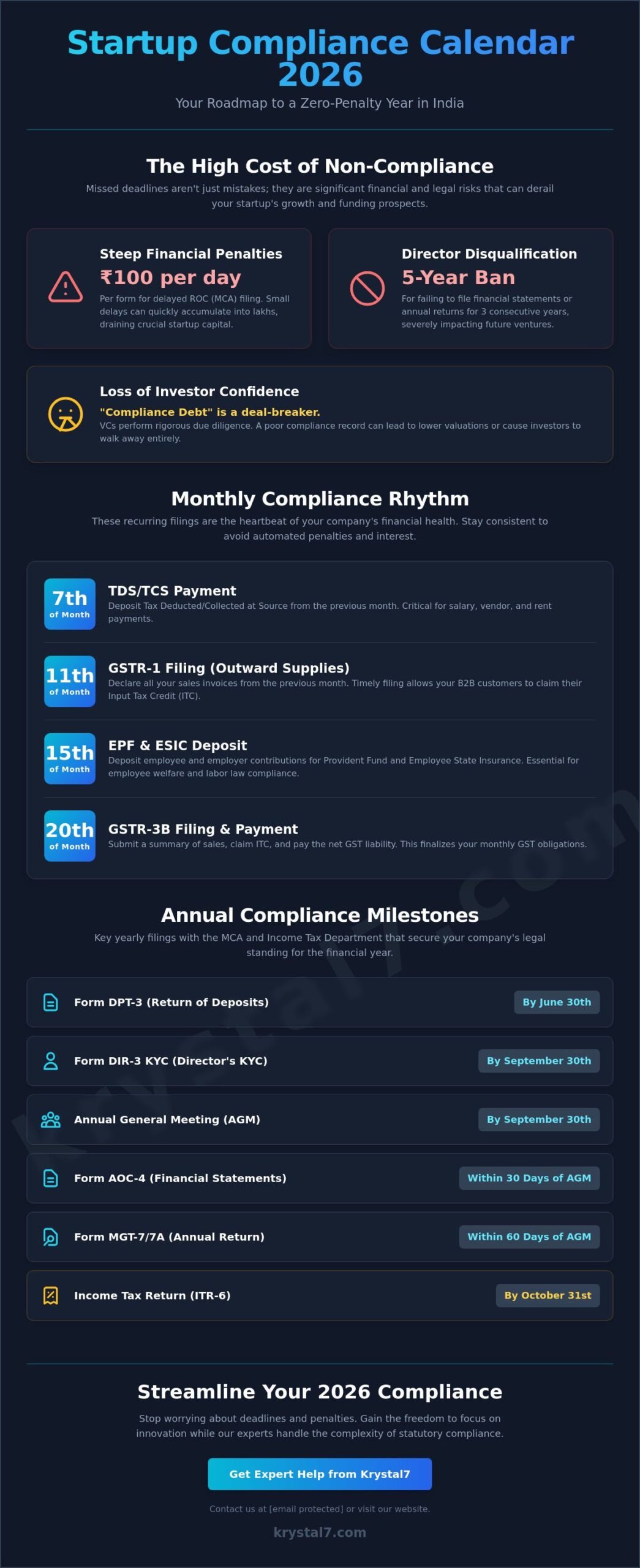
The financial penalties for missing deadlines are steep and accumulate quickly. For instance, a delay in ROC filing attracts a per-day penalty of ₹100 per form, which can balloon into lakhs if left unchecked. Beyond money, the legal stakes are higher. Under Section 164 of the Companies Act, failing to file financial statements or annual returns for three consecutive years leads to the disqualification of directors for five years. Such a mark on your record can halt your ability to obtain future business licenses or even complete a fresh company registration for new ventures. It’s a risk that no serious founder should take.
Investor Due Diligence and Compliance
During Series A or B funding rounds, Venture Capitalists perform rigorous due diligence. They look for any hidden liabilities that could jeopardize their investment. A robust compliance calendar for startups 2026 acts as a shield during these audits. If your filings are erratic, VCs may walk away or demand a lower valuation to compensate for the risk. Compliance Debt is the accumulated legal risk and financial liability resulting from missed or delayed regulatory filings. In the competitive Indian market, this debt is often a total deal-breaker for top-tier investors who prioritize governance as much as growth.
Contact Krystal7 Consultants at business@krystal7.com or visit krystal7.com for expert assistance with your startup’s compliance needs.
Monthly and Quarterly Recurring Deadlines: GST and TDS
Maintaining a steady rhythm in your monthly operations ensures your venture stays healthy and audit-ready. For every private limited company in India, these recurring GST and TDS deadlines are non-negotiable. Missing even one date triggers automated late fees and interest under the GST Act and Income Tax Act. Your compliance calendar for startups 2026 should prioritize these cycles to achieve Krystal-Clear financial health and avoid the friction of government notices.
GST Filing Deadlines for 2026
The official GST portal serves as the primary hub for your monthly tax journey. If your startup’s annual turnover exceeds 5 crore INR, you’ll follow a standard monthly filing cycle. This ensures transparency in your supply chain and allows your customers to claim their tax credits on time.
- 11th of every month: This is the deadline for GSTR-1. This return records your outward supplies or sales. Timely filing here is vital because it allows your B2B customers to see the credit in their GSTR-2B.
- 20th of every month: This is the deadline for GSTR-3B payments. You’ll summarize your sales, claim Input Tax Credit (ITC), and pay the net tax due to the government.
Smaller startups can opt for the QRMP (Quarterly Return Monthly Payment) scheme, which is often discussed as a benefit on the Startup India portal. Under QRMP, you file returns quarterly but must still deposit taxes monthly using the PMT-06 challan by the 25th of the succeeding month. This structure provides the freedom to focus on growth while staying within the legal framework.
TDS Return Filing and Payment Schedule
Tax Deducted at Source (TDS) requires absolute precision. You must deposit the tax deducted from payments like salaries, professional fees, or rent by the 7th of the following month. For instance, TDS deducted in June 2026 must reach the government by July 7, 2026. The only exception is March deductions, which are due by April 30 to align with the financial year-end.
Beyond monthly payments, you must file quarterly returns on the TRACES portal. These filings reconcile the taxes you’ve deposited with the specific PANs of your vendors and employees. The deadlines for 2026 are:
- Q1 (April to June): July 31, 2026
- Q2 (July to September): October 31, 2026
- Q3 (October to December): January 31, 2027
- Q4 (January to March): May 31, 2027
Issuing Form 16 to employees and Form 16A to vendors within 15 days of these filing dates is a statutory requirement. It builds trust and ensures your team can file their personal income tax returns without hurdles. If you’re feeling overwhelmed by these cycles, managing your monthly tax filings with professional help can simplify the process. Following a strict compliance calendar for startups 2026 prevents the 200 INR per day late filing fee mandated under Section 234E of the Income Tax Act.
Annual Compliance for Private Limited Companies in 2026
The financial year ending March 31, 2026, serves as the baseline for all your annual disclosures. This date is not just a closing of books; it is the trigger for a series of statutory obligations that define your company’s standing with the government. Staying ahead of your compliance calendar for startups 2026 ensures you avoid heavy penalties and maintain your company’s active status on the MCA portal. We provide the crystal clarity you need to manage these filings without the stress of last minute rushes.
Every Private Limited Company must complete its annual filing cycle with the Ministry of Corporate Affairs (MCA) to report its financial health and shareholding structure. This process begins immediately after the fiscal year closes. You can refer to our annual compliance for private limited company guide for a granular breakdown of every task involved in this journey.
A vital part of this cycle is the mandatory appointment of a statutory auditor. You must file Form ADT-1 to inform the Registrar of Companies (ROC) about the auditor’s appointment, typically for a five year term. This ensures your accounts are vetted by a professional, keeping your business transparent and investor ready. We handle the complexity of these filings so you have the freedom to focus on your core vision.
The ROC Filing Trio: AOC-4, MGT-7, and ADT-1
The Ministry of Corporate Affairs requires three primary forms to be filed annually to keep your company in good standing. These filings provide transparency to stakeholders and regulators alike. This compliance calendar for startups 2026 helps you track these milestones well in advance.
- Form AOC-4: This contains your financial statements, including the balance sheet and profit and loss account. It must be filed within 30 days of your AGM.
- Form MGT-7: This is your Annual Return containing shareholder details and transfer of shares, due within 60 days of your AGM.
- Form ADT-1: This is used to communicate the appointment of your statutory auditor to the ROC.
For the 2026 cycle, you must hold your Annual General Meeting (AGM) by September 30, 2026. If your AGM occurs on this deadline, your AOC-4 is due by October 30, 2026, and MGT-7 by November 29, 2026. Delaying these filings results in a penalty of INR 100 per day for each form, which can disrupt your startup’s cash flow.
Income Tax Returns (ITR) for Startups
The Income Tax Department mandates that all companies file their returns annually to report income, expenses, and taxes paid. For companies requiring a Tax Audit, the deadline is September 30, 2026. Under Section 44AB of the Income Tax Act, a Tax Audit is mandatory if your business turnover exceeds INR 1 Crore during the financial year.
Your auditor will issue Form 3CD, which is a comprehensive Audit Report detailing various tax compliance aspects. Even if you are registered under the Startup India initiative and qualify for tax exemptions, filing your ITR remains a non negotiable requirement. Clear tax records are essential for securing future funding and maintaining a clean legal legacy for your venture.
Labor Law and Event-Based Compliance Requirements
Managing a startup in India means tracking more than just annual dates. Your compliance calendar for startups 2026 must account for triggers like hiring your 10th employee or closing a seed round. These are event-based requirements. They don’t have a fixed date like April 1st. Instead, they require action within a specific window after a business action occurs.
Labor laws often depend on your headcount. Once you reach specific thresholds, usually 10 or 20 employees, new registrations become mandatory. Professional Tax (PT) is another state-specific layer you can’t ignore. For instance, if your office is in Gurgaon, you must follow Haryana’s specific PT slabs and filing cycles. Each state has different rules for registration and payment frequency.
EPF and ESI Monthly Deposits
The 15th of every month is a non-negotiable deadline for Employee Provident Fund (EPF) and Employee State Insurance (ESI) contributions. You’ll use the official EPFO and ESIC portals to manage these payroll-related statutory deposits. Timely payments are vital for your tax health and employee morale.
If you delay the employer’s contribution, you lose the ability to claim it as a business expense under the Income Tax Act. This directly increases your taxable income. For employees, these social security benefits are a safety net. Missing a deposit can lead to legal disputes and a loss of trust within your team.
Common Event-Based ROC Filings
The Ministry of Corporate Affairs (MCA) requires transparency whenever your company structure changes. Most of these filings have a strict 30-day window from the date of the event. Your compliance calendar for startups 2026 should prioritize these triggers to avoid heavy per-day penalties.
- Form DIR-12: File this within 30 days whenever you appoint a new director or a director resigns from the board.
- Form INC-22: This is mandatory if you change your registered office address to a new location.
- Form PAS-3: You must file this return of allotment every time you issue fresh shares during a funding round.
Keeping these records updated ensures your startup remains attractive to investors. Meticulous event-based filing proves that your business is disciplined and transparent. It removes the friction often found during due diligence processes before a merger or acquisition.
Secure your startup’s future with expert guidance from Krystal7.
Streamlining Your 2026 Compliance with Krystal7 Consultants
Managing the compliance calendar for startups 2026 requires more than just a list of dates. It demands a partner who brings clarity to your daily business operations. Krystal7 serves as a dedicated relationship partner for Indian founders, moving beyond transactional services to offer genuine strategic support.
Our Annual Compliance Package acts as your one-stop solution for the entire 2026 financial year. We oversee your journey from the initial days of incorporation to your eventual growth as a legacy brand. By handling MCA filings, GST returns, and Income Tax audits, we ensure your startup remains in good standing with Indian regulators at all times.
- End-to-End Filing: We manage AOC-4, MGT-7, and all essential statutory registers.
- Tax Management: Our team ensures accurate TDS deductions and timely GST payments through the official portals.
- Expert Advisory: You gain direct access to CAs and CSs who understand the specific hurdles of the Indian startup ecosystem.
Clarity isn’t just a goal for us; it’s our operational standard. We translate complex sections of the Companies Act and Income Tax Act into actionable steps for your team. This proactive approach prevents the 100 INR per day penalties that often drain startup capital.
Why Gurgaon Startups Trust Krystal7
We possess deep local expertise in the Haryana and NCR region. This allows us to provide specific guidance on state-level registrations and local compliance nuances that global firms might overlook. Our commitment to Krystal-Clear Transparency means you never face hidden costs or surprise invoices during your filing cycles.
Our team consists of elite Chartered Accountants and Company Secretaries with years of experience in Indian corporate law. We don’t just file forms; we build structures that protect your business interests and intellectual property. This methodical approach is why hundreds of NCR founders rely on us for their statutory needs.
Get Started with Your 2026 Compliance Strategy
Don’t wait for a penalty notice to start thinking about your compliance calendar for startups 2026. We invite you for a free initial consultation to assess your specific business requirements for the upcoming year. We will identify potential risks in your current structure and suggest a streamlined path forward.
Our promise is simple: we provide you the Freedom to Focus on your vision. While you build your product and scale your team, we handle the complex paperwork and regulatory red tape. Contact us at business@krystal7.com or visit krystal7.com to secure your startup’s future and ensure a smooth 2026.
Secure Your Growth with Krystal-Clear Compliance
Staying ahead of MCA filings and GST deadlines isn’t just about avoiding penalties. It’s about building a foundation for your vision. Your compliance calendar for startups 2026 ensures you never miss a TDS return or an AOC-4 filing date required by the Companies Act 2013. These regular milestones protect your company’s legal standing and investor trust.
You don’t have to navigate the complex web of Indian statutory requirements alone. Krystal7 Consultants provides elite expertise through top-tier Chartered Accountants and Legal Strategists. We offer transparent, upfront pricing with no hidden fees so you can plan your budget with confidence. Every client works with a dedicated relationship manager who knows your business inside out.
Don’t let red tape slow down your vision. Contact Krystal7 Consultants today at business@krystal7.com for a personalized 2026 compliance roadmap. Give yourself the freedom to focus on what you do best. Your business dream deserves crystal clarity and a partner who cares about your legacy. Your growth is our priority.
Frequently Asked Questions
What is the most important compliance date for an Indian startup in 2026?
The most critical date on your compliance calendar for startups 2026 is September 30, 2026. This is the final deadline to hold your Annual General Meeting (AGM) for the financial year ending March 31, 2026. Missing this date triggers heavy penalties under the Companies Act 2013 and can jeopardize your company’s active status on the MCA portal.
Can a startup file its own GST and TDS returns without a consultant?
You can legally file your own GST and TDS returns through the official GST portal and TRACES website. However, most founders find the monthly GSTR-2B reconciliation and TDS challan mapping difficult to manage alone. Professional oversight ensures you claim the correct Input Tax Credit (ITC) and avoid the 200 INR per day late fee for TDS defaults.
What are the penalties for missing the ROC filing deadline in 2026?
If you miss the ROC filing deadlines for Form AOC-4 or MGT-7 in 2026, the MCA imposes an additional fee of 100 INR per day for each day of delay. These penalties are cumulative and have no upper limit. Directors also face the risk of disqualification if the company fails to file financial returns for three consecutive years.
Is a Tax Audit mandatory for all new startups in India?
A Tax Audit isn’t mandatory for every new startup unless your annual turnover exceeds 10 crore INR, provided 95 percent of your transactions are digital. If your cash transactions exceed 5 percent of your total turnover, the audit limit drops to 1 crore INR. Section 44AB of the Income Tax Act governs these specific requirements for the 2025-26 assessment year.
How does the 2026 compliance calendar differ for an LLP vs. a Private Limited Company?
The compliance calendar for startups 2026 differs because LLPs only file Form 11 by May 30 and Form 8 by October 30. Private Limited companies face more rigorous requirements, including a mandatory statutory audit regardless of their turnover. Companies must also file annual returns and financial statements within 30 to 60 days of their AGM.
What is the deadline for holding the Annual General Meeting (AGM) in 2026?
Your startup must hold its Annual General Meeting by September 30, 2026, for the financial year 2025-26. This meeting must take place within six months from the closing date of the financial year on March 31. It’s a vital step to approve financial statements and director reports before filing them with the Registrar of Companies.
How can I track “event-based” compliances for my growing team?
You can track event-based compliances like director appointments or share transfers by maintaining a statutory register or using a digital compliance tracker. These specific events require filings like Form DIR-12 or PAS-3 within 30 days of the occurrence. Our team at Krystal7 helps you monitor these triggers so you never miss a critical 30-day window as your team expands.
What happens if a startup remains non-compliant for more than two years?
If a startup fails to file its annual returns for two consecutive years, the Registrar of Companies can strike off the company name from the official register. Directors of such non-compliant companies face disqualification from being appointed in any other company for five years. This status also leads to frozen bank accounts and the total halt of business operations.
For expert assistance with your company’s filings, contact Krystal7 Consultants at business@krystal7.com or visit krystal7.com to secure your business future.

Article by
Nihal Srivastava
Nihal Srivastava is the Co-Founder of Krystal7 Consultants, helping Indian entrepreneurs and startups navigate company registration, compliance, trademark protection, and regulatory requirements with clarity and confidence. With 6+ years of hands-on expertise in MCA filings, GST compliance, and corporate structuring, Nihal has guided 1000+ businesses across India through their legal and compliance journeys. He believes every business dream deserves crystal clear foundations, and that no founder should be held back by paperwork or red tape.