

What is Form ADT-1 for Auditor Appointment? A Krystal-Clear Guide for 2026
Last September, a Gurgaon-based entrepreneur celebrated a successful Annual General Meeting only to realize they missed the 15-day filing window for their statutory auditor. This small oversight led to daily penalties under Section 139 of the Companies Act, 2013, causing unnecessary stress for an otherwise thriving business. Understanding what is form adt-1 for auditor appointment is essential for every Private Limited company to avoid these steep ROC fines and keep their compliance status active.
We know that managing MCA portal technicalities can feel overwhelming when you’re focused on scaling your vision. You deserve the freedom to focus on your core business goals without worrying about the fine print of legal filings or the fear of a non-compliance notice.
This guide provides crystal clarity on the filing process, mandatory documents, and the specific timelines you must follow in 2026. We’ll walk you through the difference between first and subsequent auditor rules and provide a checklist to ensure your next filing is error-free and seamless.
Key Takeaways
- Understand the statutory obligation of the company to notify the Registrar of Companies (ROC) and why the filing responsibility lies with the board, not the auditor.
- Master the strict “15-Day Rule” and specific timelines for subsequent appointments and casual vacancies to protect your company from heavy MCA penalties.
- Identify the essential documentation and Digital Signature Certificate (DSC) requirements needed for a successful submission on the MCA V3 portal.
- Gain a krystal-clear understanding of what is form adt-1 for auditor appointment to ensure your business remains fully compliant with the Companies Act, 2013.
- Discover how professional compliance advisory grants you the freedom to focus on your core growth while experts manage your entire annual filing cycle.
Understanding Form ADT-1: The Statutory Pulse of Your Company
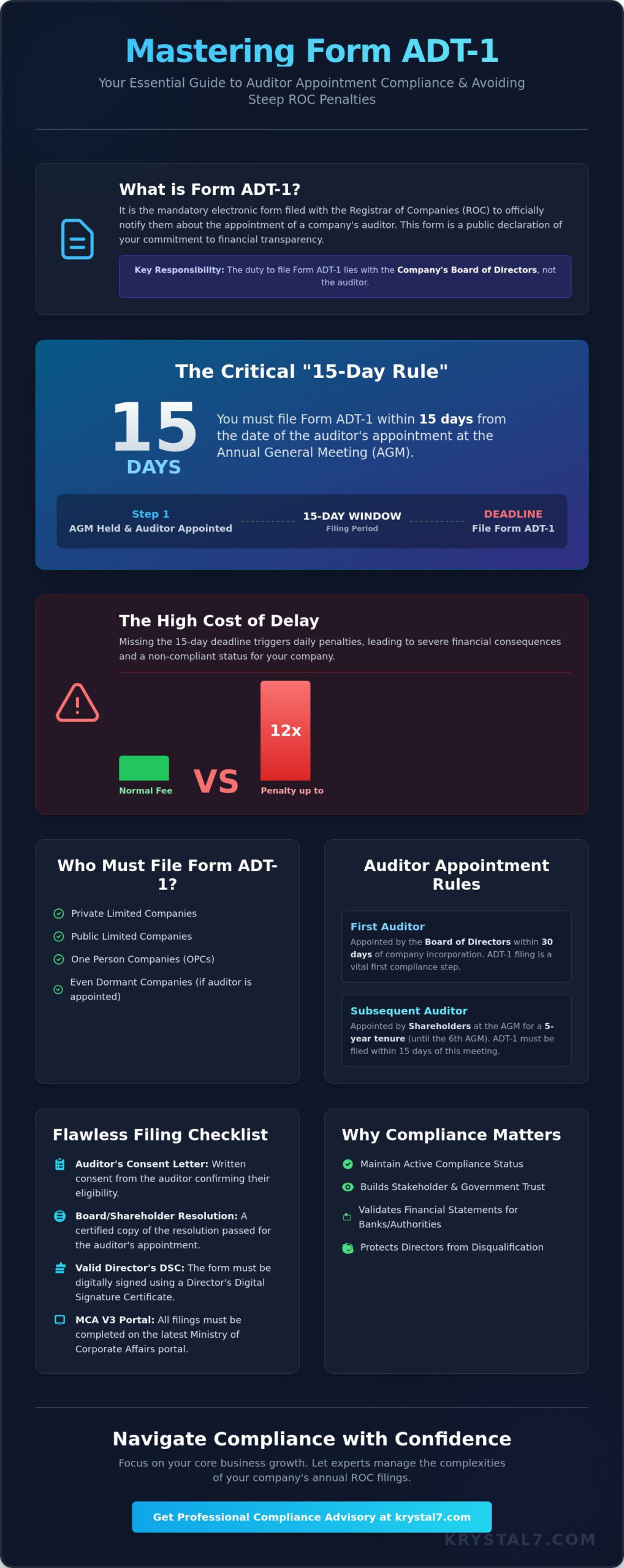
Form ADT-1 is the official communication your company sends to the Registrar of Companies (ROC) to announce the appointment of a new auditor. It’s vital to understand what is form adt-1 for auditor appointment because the legal responsibility for filing lies entirely with the company. While your auditor provides the consent letter, your board is responsible for ensuring the Ministry of Corporate Affairs (MCA) receives this information on time.
Transparency is the cornerstone of a Krystal-clear business legacy in India. Filing this form on the MCA portal isn’t just a checkbox exercise; it’s a declaration of your commitment to financial integrity. This filing fits seamlessly into the broader annual compliance for private limited company requirements that protect your directors from disqualification and keep your venture’s status active.
When you file ADT-1, you’re telling the government and your stakeholders that your books are under expert supervision. It eliminates ambiguity and ensures your company remains a trustworthy entity in the Indian market. This simple digital step provides you with the freedom to focus on growth while Krystal7 handles the technical heavy lifting.
The Legal Backbone: Section 139 of the Companies Act, 2013
Section 139(1) of the Companies Act, 2013, dictates the rules for appointing a Statutory Auditor. The law mandates that every company must appoint an auditor at its first Annual General Meeting (AGM) to hold office until the conclusion of the sixth AGM. The MCA insists on this specific digital filing to maintain a transparent, real-time database of who is auditing which company.
The link between this filing and your financial statements is inseparable. Without a valid ADT-1 record on the ROC portal, your audited balance sheets and profit and loss accounts may be questioned by banks or tax authorities. It’s the legal seal that validates your auditor’s authority to sign off on your company’s financial health.
Who Must File Form ADT-1?
The requirement to file applies to Private Limited Companies, One Person Companies (OPCs), and Public Limited Companies. While listed entities have additional disclosure norms, unlisted companies must be equally diligent to avoid heavy late fees. Even if your company is a small startup, the ROC expects this filing within 15 days of the appointment date.
Understanding what is form adt-1 for auditor appointment helps you realize that even dormant companies aren’t exempt if they’ve appointed an auditor in an AGM. Form ADT-1 is the mandatory bridge between an AGM resolution and ROC records. Failing to cross this bridge can lead to penalties that scale daily, making prompt action essential for every founder.
If you’re unsure about your current filing status or need assistance with MCA compliance, Krystal7 is here to help. Contact us at business@krystal7.com or visit krystal7.com for expert guidance on your statutory requirements.
Filing Timelines and Deadlines: Avoiding the ROC Penalty Trap
Missing a deadline with the Registrar of Companies (ROC) is an expensive mistake that can lead to compounding fines. The core of understanding what is form adt-1 for auditor appointment lies in the “15-Day Rule.” You must file this form within 15 days of the Annual General Meeting (AGM) where the auditor was appointed. For 2026, the MCA has tightened digital signature (DSC) verification protocols. You shouldn’t leave filing to the last minute. A pending DSC renewal or an expired token can trigger late fees that accumulate at a rate of up to 12 times the normal filing fee. Your compliance journey actually begins with your company registration documents. These papers establish your initial fiscal year and set the clock for your first filing cycle.
First Auditor vs. Subsequent Auditor: Does the Rule Change?
According to Section 139 of the Companies Act, 2013, the rules for the first auditor differ from subsequent appointments. The Board usually appoints the first auditor within 30 days of incorporation. While some founders overlook it, filing ADT-1 for the first auditor is a vital step to ensure your MCA profile remains transparent. Subsequent auditors are appointed for a 5-year tenure at an AGM. You must file the form every time a new 5-year term begins. This remains true even if you are re-appointing the same firm, as the ROC requires a fresh record of the appointment period and the auditor’s consent.
Casual Vacancy: Handling Unexpected Auditor Resignations
A casual vacancy happens when an auditor resigns, passes away, or faces disqualification before their term ends. This creates a compliance gap that needs immediate attention to avoid a “stop-work” situation for your statutory audits. The Board of Directors has a strict 30-day window to fill this vacancy. If the vacancy arises from a resignation, you also need shareholder approval within 3 months of the Board’s recommendation. You still need to understand what is form adt-1 for auditor appointment in this context, as the filing deadline remains 15 days from the date the new auditor accepts the position. Managing these tight windows is easier when you have a dedicated compliance partner to track the statutory dates for you.
- First Auditor: Appointed within 30 days of incorporation; filing ADT-1 is highly recommended.
- Subsequent Auditor: Appointed at the AGM for a 5-year term; ADT-1 filing is mandatory within 15 days.
- Casual Vacancy: Board fills the gap within 30 days; ADT-1 must follow within 15 days of the appointment.
- Rotation: After 10 years (for firms) or 5 years (for individuals), a new auditor must be appointed and reported via ADT-1.
Proactive digital signature management is no longer optional in 2026. Because the MCA V3 portal requires real-time validation, any mismatch in DSC details can delay your filing past the 15-day mark. We’ve seen companies face penalties exceeding INR 10,000 just for a two-week delay. Keeping your records streamlined from the moment of incorporation ensures you never fall into these avoidable penalty traps.
Essential Documentation and Information for a Flawless Filing
Preparing your paperwork before you log into the MCA V3 portal saves hours of frustration. Filing errors often lead to “Resubmission” status, which delays your compliance timeline. Understanding what is form adt-1 for auditor appointment requires you to look beyond the digital screen and focus on the underlying legal documents. You’ll need a valid Class 3 Digital Signature Certificate (DSC) for the authorized Director to sign the form electronically. Without a registered DSC on the MCA portal, the filing cannot proceed.
Krystal7 provides “Crystal Clarity” during this stage by performing a rigorous pre-check of your data. We verify the Auditor’s PAN, Membership Number, and Firm Registration Number (FRN) against the ICAI database. This meticulous verification prevents 99% of common rejection reasons. Our team ensures that every detail, from the date of the appointment to the tenure, matches your internal records perfectly.
- Auditor Details: You must have the PAN and the 6-digit Membership Number for individual auditors or the FRN for audit firms.
- Company Records: Keep your Corporate Identification Number (CIN) and registered office address handy.
- Digital Signature: Ensure the Director’s DSC is active and not expired.
The Auditor’s Consent and Eligibility Certificate
The auditor must provide a written consent letter and a certificate of eligibility before the appointment. This document confirms the auditor is not disqualified under Section 141 of the Companies Act, 2013. It also includes a declaration that the auditor hasn’t exceeded the statutory limit of 20 company audits. Krystal7 reviews these certificates to ensure they meet the specific language required by the Ministry of Corporate Affairs, giving you the freedom to focus on your business growth.
The Board Resolution: Crafting the Foundation
The Board Resolution or the minutes of the Annual General Meeting (AGM) serve as the primary attachment for the filing. This document must clearly state the auditor’s name and the specific tenure of the appointment. For a first auditor, the tenure lasts until the conclusion of the first AGM; for subsequent auditors, it typically spans from the conclusion of one AGM to the sixth following AGM. When you are determining what is form adt-1 for auditor appointment requirements, remember that all PDF attachments must be legible and ideally under 2MB to ensure portal compatibility. We help you format these resolutions to avoid technical glitches during the upload process.
Step-by-Step Guide: Filing Form ADT-1 on the MCA V3 Portal
The transition to the MCA V3 portal has made the compliance journey more digital and structured. Understanding what is form adt-1 for auditor appointment involves knowing the specific steps required to notify the Registrar of Companies (ROC) about your choice. You’ll start by logging into your V3 account and selecting the ADT-1 e-form from the ‘Company e-Filing’ menu.
First, enter your company’s Corporate Identity Number (CIN) and click the ‘Pre-fill’ button. This action automatically populates your company’s name, registered office address, and email ID. You’ll then enter the auditor’s details, including their PAN, membership number, and firm registration number. Ensure you have three mandatory documents ready for upload in PDF format:
- The written consent from the auditor to accept the appointment.
- A certificate from the auditor stating they aren’t disqualified under the Companies Act 2013.
- A certified true copy of the Board or General Meeting resolution.
Navigating the Technicalities of MCA V3
Technical glitches often occur during the PDF upload or DSC (Digital Signature Certificate) association. Always use the ‘Check Form’ button to validate the data entered before proceeding to the final submission. Once the form passes the internal validation, click ‘Pre-scrutiny’ to ensure the system accepts the file. After a successful upload, the portal generates a Service Request Number (SRN). You’ll need this number to track your application status or handle any future queries from the ROC.
Fee Structure and Late Filing Penalties
The filing fee for Form ADT-1 isn’t fixed. It depends entirely on your company’s nominal share capital. For companies with a share capital of less than INR 1,00,000, the fee is approximately INR 200. This amount increases in slabs, reaching up to INR 600 for companies with a share capital of INR 1 crore or more. Small companies and OPCs often enjoy lower fee structures to promote ease of doing business.
Late filings attract heavy penalties that escalate based on the duration of the delay. These additional fees range from 2 times to 12 times the original filing fee. It’s a costly mistake that’s easily avoided with timely action. Delays beyond 300 days can lead to compoundable offenses for directors, which might involve legal proceedings or significant personal fines. Staying compliant ensures you keep the freedom to focus on your business goals.
Strategic Compliance: Why Professional Advisory is Your Growth Engine
Compliance often feels like a hurdle, but it’s actually the foundation of a scalable business. When you move away from the stress of “red tape,” you gain the freedom to focus on your core entrepreneurial goals. Krystal7 transforms this process by managing the entire annual compliance for private limited company cycles. We don’t just process papers; we provide a dedicated relationship manager who understands your business operations from the inside out. This personalized approach ensures your company remains investor-ready at all times. A clean track record on the MCA portal is a powerful asset during funding rounds or bank loan applications.
- Eliminate Guesswork: Stop searching for deadlines and let experts track them for you.
- Investor Confidence: Maintain a 100% perfect compliance record to attract top-tier venture capital.
- Cost Efficiency: Professional management prevents the heavy late fees that drain startup capital.
- Strategic Insight: Use compliance data to make better financial decisions for 2026 and beyond.
Beyond ADT-1: The Holistic Compliance Roadmap
Understanding what is form adt-1 for auditor appointment is vital, but it’s only one piece of the puzzle. Strategic growth requires integrating your auditor’s role with GST filings, TDS returns, and Income Tax planning. Our Chartered Accountancy expertise provides Gurgaon startups with crystal clarity in these legal matters. We synchronize your statutory filings so that your financial health is visible across all government portals. This holistic view prevents discrepancies that often trigger unwanted tax notices or scrutiny.
Conclusion: Securing Your Business Future
Filing Form ADT-1 is a non-negotiable step for maintaining your company’s statutory health. It establishes the transparency that the Ministry of Corporate Affairs demands from every Indian venture. Remember, the 15-day deadline is strict. Missing it results in an additional fee of INR 100 per day of delay, which can escalate into thousands of unnecessary outgoings. By prioritizing this filing, you protect your company from litigation and keep your focus on innovation. If you’re still unsure about what is form adt-1 for auditor appointment or need a partner to handle your 2026 filings, we’re here to help. Contact Krystal7 Consultants today at business@krystal7.com or visit krystal7.com to secure your business future with expert guidance.
Secure Your Company’s Future with Seamless Compliance
Filing Form ADT-1 isn’t just a routine checkbox; it’s a vital legal requirement under Section 139 of the Companies Act, 2013. Missing the 15 day deadline after your Annual General Meeting can trigger substantial daily penalties on the MCA V3 portal. Understanding what is form adt-1 for auditor appointment ensures your Private Limited company stays protected from unnecessary litigation and maintains its statutory health.
At Krystal7, we provide the freedom to focus on your core business while we handle the technical red tape. Our elite team of Chartered Accountants and Company Secretaries delivers krystal-clear transparency with absolutely no hidden costs. Every client benefits from a dedicated relationship manager who understands your specific growth trajectory and keeps you ahead of every regulatory shift.
Stop worrying about MCA deadlines and focus on your growth. Contact Krystal7 Consultants at business@krystal7.com or visit krystal7.com to streamline your annual compliance today. We’re here to help your business dream find total clarity and the security it needs to thrive.
Frequently Asked Questions
Is Form ADT-1 mandatory for the first auditor appointed after incorporation?
No, filing Form ADT-1 isn’t strictly mandatory for the first auditor appointed by the Board of Directors within 30 days of incorporation. Section 139(6) of the Companies Act, 2013 governs this initial appointment, and the law only mandates the filing for auditors appointed at an Annual General Meeting. Many founders still choose to file it to ensure their company’s master data on the MCA portal is fully updated.
What is the government fee for filing Form ADT-1 in 2026?
The government fee is based on the company’s nominal share capital and follows a fixed slab system. For companies with a share capital of less than INR 1,00,000, the fee is INR 200. This fee increases to INR 300 for capital up to INR 4,99,999, INR 400 for capital up to INR 24,99,999, and reaches INR 600 for companies with capital of INR 1 Crore or more.
What happens if a company fails to file Form ADT-1 within 15 days?
Missing the 15-day deadline results in statutory late fees that multiply based on the duration of the delay. A delay of up to 30 days attracts a penalty of 2 times the normal filing fee. If the delay exceeds 180 days, the company must pay 12 times the original fee. Understanding what is form adt-1 for auditor appointment helps you track these deadlines to avoid unnecessary financial drains.
Can an auditor file Form ADT-1 on behalf of the company?
No, the responsibility to file this form lies entirely with the company management and not the auditor. A director or an authorized officer of the company must sign the form using their Digital Signature Certificate (DSC). The auditor’s role is limited to providing the written consent and eligibility certificate that the company attaches to the filing.
Is Form ADT-1 required for the reappointment of the same auditor?
Yes, you must file a fresh Form ADT-1 even if you’re reappointing the same auditor for another term. Each appointment or reappointment made at an Annual General Meeting is a distinct legal event that requires notification to the Registrar of Companies. This process ensures the MCA records accurately reflect the auditor’s current tenure and the company’s compliance status.
What documents are mandatory to attach with Form ADT-1?
You must attach three primary documents in PDF format to the e-form. These are the certified true copy of the Board or AGM resolution, the auditor’s written consent letter, and a certificate from the auditor stating they aren’t disqualified under Section 141. Without these attachments, the MCA portal will reject the submission or mark it as defective during processing.
Does a casual vacancy in the auditor position require a new ADT-1 filing?
Yes, a casual vacancy caused by resignation, death, or removal requires a new filing once the Board appoints a replacement. The Board must fill this vacancy within 30 days, and the company is then required to file Form ADT-1 within 15 days of that appointment. This ensures the regulator knows exactly who is responsible for the company’s statutory audit at all times.
Can Form ADT-1 be revised once it is submitted on the MCA portal?
No, the MCA system doesn’t allow for the revision or correction of Form ADT-1 once it’s successfully uploaded. If you’ve entered incorrect data, you’ll need to file a fresh form with the correct details and pay the government fees again. Knowing what is form adt-1 for auditor appointment and double-checking your data prevents these costly administrative errors.
For expert assistance with your company’s compliance and auditor appointments, contact Krystal7 Consultants at business@krystal7.com or visit krystal7.com.

Article by
Nihal Srivastava
Nihal Srivastava is the Co-Founder of Krystal7 Consultants, helping Indian entrepreneurs and startups navigate company registration, compliance, trademark protection, and regulatory requirements with clarity and confidence. With 6+ years of hands-on expertise in MCA filings, GST compliance, and corporate structuring, Nihal has guided 1000+ businesses across India through their legal and compliance journeys. He believes every business dream deserves crystal clear foundations, and that no founder should be held back by paperwork or red tape.