

Input Tax Credit Explained Simply: The 2026 Guide for Indian Business Owners
What if the GST your business pays on every purchase was actually a strategic asset rather than a sunk cost? With national GST collections reaching a record ₹2.43 lakh crore in April 2026, the government’s focus on compliance has never been sharper. This guide provides the input tax credit explained simply to help you reclaim your money without getting lost in technical jargon. At Krystal7 Consultants, we believe every founder deserves the clarity to build their dream without the fear of legal hurdles.
We know how exhausting it’s to watch your profit margins shrink just because a supplier failed to file their returns on time. It’s frustrating to manage the constant anxiety of potential GST notices while you’re trying to scale your startup in Gurgaon. You need the freedom to focus on your vision while maintaining 100% compliance with the latest statutory requirements.
This article promises to demystify the 2026 rules, including the mandatory GSTR-2B reconciliation and the critical November 30 deadline for claims. You’ll learn how to navigate the 180-day payment rule and use the latest e-invoicing standards to legally reduce your tax liability. Let’s transform your tax process into a streamlined engine for business growth.
Key Takeaways
- Understand how ITC acts as a strategic “tax discount” on your business expenses, effectively removing the burden of double taxation from your profit margins.
- Learn the five non-negotiable conditions for 2026, including the strict requirement that all credits must appear in your auto-generated GSTR-2B statement to be eligible.
- Identify which specific business costs fall under “Blocked Credits” in Section 17(5) of the GST Act to prevent common filing errors and avoid government notices.
- Discover why this input tax credit explained simply approach is vital for managing the 180-day supplier payment rule and meeting the crucial November 30 annual deadline.
- Gain a practical, step-by-step walkthrough for calculating your monthly tax liability, ensuring your Private Limited or LLP stays 100% compliant while legally reducing outgoings.
What is Input Tax Credit (ITC) in GST? Input Tax Credit Explained Simply
Think of ITC as a strategic tax discount on your business expenses. This input tax credit explained simply guide shows you how to reclaim the GST you pay on purchases. When you buy raw materials, office equipment, or professional services for your business, you pay GST to your suppliers. Instead of this being a dead cost, the government allows you to subtract this amount from the tax you collect on your sales.
What is Input Tax Credit (ITC) in GST? effectively prevents the cascading “tax on tax” effect that plagued the old Indian tax regime. Before GST, taxes like Excise and VAT often overlapped, leading to higher prices for consumers and lower margins for manufacturers. By allowing you to deduct the tax already paid on purchases from the tax you collect on sales, the government ensures you only pay for the value you’ve actually added at each stage of production.
For a Private Limited Company or an LLP, tracking every rupee of ITC is a matter of survival. This is a core part of your annual compliance for a private limited company, directly impacting your cash flow and profit margins. Failing to claim valid credit is like leaving your hard earned money on the table. It reduces your total tax liability legally and keeps your business competitive in the Indian market.
The Concept of Value Added Tax and Input Tax Credit Explained Simply
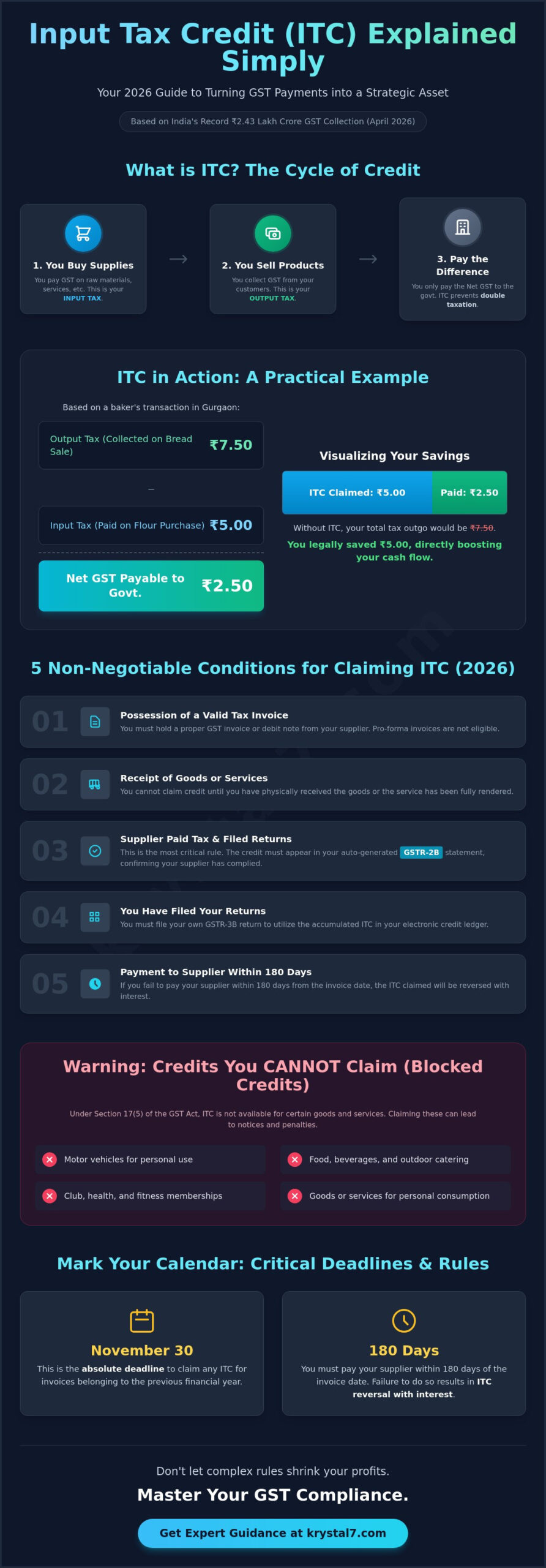
GST is a consumption tax based on value addition. Imagine a baker in Gurgaon buys flour for ₹100 and pays ₹5 GST. He then bakes bread and sells it for ₹150, collecting ₹7.50 GST from the customer. The “value added” here is the ₹50 worth of labor and skill the baker provided.
Instead of paying the full ₹7.50 to the government, the baker uses the ₹5 already paid as a credit. He only pays the net ₹2.50. This system makes Indian products more competitive globally because it removes hidden tax costs from the supply chain. It ensures that tax is only levied on the actual profit or value created by the business owner.
Input Tax vs. Output Tax
Understanding the difference between these two terms is the first step toward krystal-clear compliance. Input Tax is the GST you pay to your vendors, service providers, or for business imports. It’s an asset sitting in your electronic credit ledger on the GST portal until you use it.
Output Tax is the GST you collect from your customers on behalf of the government when you sell goods or services. You are essentially a custodian of this money. Your goal is to pay only the net difference to the government after reconciling your records with your auto-generated GSTR-2B statement.
Managing this balance ensures you don’t overpay or face unnecessary scrutiny from the authorities. It’s a collaborative strategy between you and your suppliers to maintain a healthy business ecosystem. Proper tracking of these credits allows you to reinvest saved capital back into your business growth rather than losing it to inefficient tax management.
How to Claim Input Tax Credit: 5 Essential Conditions for 2026
Claiming your credit isn’t a “set and forget” process. Under Section 16 of the CGST Act, you must satisfy specific non-negotiable conditions to ensure your input tax credit explained simply strategy actually works. If you miss even one of these requirements, you risk receiving a GST notice and being forced to reverse the credit with a heavy 18% interest penalty. Compliance is the only way to protect your profit margins from unnecessary leaks.
- Condition 1: Possession of a valid tax invoice or debit note. You cannot claim ITC based on a proforma invoice or a delivery challan. You must hold a proper GST invoice issued by a registered supplier.
- Condition 2: Actual receipt of goods or services. The “delivery rule” means you can’t claim credit just because you paid the bill. You must have physically received the items or the service must have been rendered.
- Condition 3: Tax actually paid to the government. This is the most challenging rule. Your supplier must have deposited the tax they collected from you with the government. If they default, the authorities may come after your credit.
- Condition 4: Filing of GST returns. You must file your monthly GSTR-3B return to officially claim the credit in your electronic credit ledger.
- Condition 5: The GSTR-2B Match. As of 2026, the credit must appear in your auto-generated GSTR-2B statement to be eligible for a claim.
Meeting these conditions ensures your input tax credit explained simply approach stays compliant with the latest 2026 updates. If you find these rules overwhelming, our team provides expert GST Filing & Compliance services to handle the heavy lifting for you.
The Critical Role of GSTR-2B Reconciliation
The facility to claim provisional ITC has been completely discontinued in 2026. You can now only claim credit that is visible in your GSTR-2B statement, which the portal auto-generates on the 14th of every month. This makes monthly reconciliation a mandatory ritual for every Indian business owner. If a supplier is unresponsive or forgets to file their GSTR-1, their invoice won’t show up in your 2B, and your credit will be blocked. You must proactively follow up with vendors to ensure they file on time, or you will end up paying the tax twice.
Possession of Valid Documents
A valid GST invoice in 2026 must be krystal-clear and contain specific details like the supplier’s GSTIN, a unique invoice number, and correct HSN codes. Even a small typo in your GSTIN can lead to the credit being attributed to someone else. Since April 2026, e-invoicing is mandatory for all businesses with a turnover exceeding ₹5 crore. If your supplier falls into this category but gives you a manual invoice without a valid Invoice Reference Number (IRN) and QR code, that document is legally invalid for claiming ITC. Always verify that your digital documents meet the latest statutory standards to avoid compliance hurdles.
Understanding Blocked Credits Under Section 17(5)
While previous sections focused on how to unlock your credits, it’s equally vital to know where the door is locked. Section 17(5) of the CGST Act 2017 outlines specific scenarios where you cannot claim credit, even if you have a valid invoice. This input tax credit explained simply segment helps you avoid the common mistake of over-claiming, which often leads to scrutiny from tax officers. Understanding these boundaries gives you the clarity you need to file with confidence and precision.
The government blocks these credits primarily to prevent personal expenses from being disguised as business costs. Think of it as a “business purpose” test. If an expense is essentially a personal perk for you or your employees, the tax authorities won’t let you use that GST to reduce your liability. This rule ensures that only expenses directly contributing to your taxable output are rewarded with credit. This distinction is what keeps the Indian tax system fair and transparent for all entrepreneurs.
Common traps for new founders often involve food, beverages, and outdoor catering. If you buy lunch for your team or host a business dinner, you generally can’t claim the GST back. These are considered personal consumption items under the law. Unless you’re in the business of providing these specific services yourself, that GST becomes a final cost to your company. Knowing this upfront helps you budget more accurately and avoids unnecessary “guesswork” during your monthly filings.
Common Business Expenses You Cannot Claim
Many founders are surprised to learn that GST paid on motor vehicles with a seating capacity of 13 people or fewer is generally blocked. This restriction also extends to the insurance, repairs, and maintenance of these specific vehicles. You also cannot claim credit for memberships in clubs, health centers, or fitness facilities. Similarly, travel benefits extended to your employees for vacation purposes, such as Leave Travel Allowance (LTA), are strictly ineligible for ITC under current statutory rules.
Exceptions to the Blocked Credit Rule
There are specific “escape clauses” where these blocked credits become available to your business. For example, if your Private Limited company uses motor vehicles for the transportation of goods, the credit is fully accessible. You can also claim ITC on food and beverages if your business involves making a further supply of those same goods. For instance, a catering company can claim ITC on the ingredients they buy to serve their clients.
When it comes to construction, you cannot claim ITC on goods or services used for the construction of immovable property on your own account. However, there is a vital exception for “plant and machinery.” If you are building a specialized foundation for a specific piece of factory equipment, that GST is usually claimable. Staying aware of these nuances ensures your compliance is krystal-clear and your business remains audit-ready at all times.
Calculating and Filing Your ITC: A Practical Example
Understanding the theory is the first step, but seeing the numbers in action provides the clarity you need to manage your business. This input tax credit explained simply walkthrough demonstrates how ITC directly impacts your bank balance. Proper calculation is a cornerstone of annual compliance for a private limited company, ensuring you don’t overpay the government or understate your liability.
You must also account for the Reverse Charge Mechanism (RCM). In RCM scenarios, the responsibility to pay tax shifts from the supplier to you, the buyer. You pay this tax in cash to the GST portal and then claim it back as ITC in the same month. It’s a “wash” transaction, but failing to record it correctly can lead to compliance gaps and unwanted notices.
Remember that you can only claim credit for goods or services used to make taxable sales. If your business provides exempt supplies, you must reverse a proportionate amount of your ITC. This prevents businesses from claiming tax benefits on activities that don’t contribute to the government’s tax pool. Managing these nuances is what gives you the freedom to focus on your core growth.
A Simple INR Calculation for Founders
Let’s look at a typical monthly scenario for a Gurgaon based startup. Suppose your total sales for the month are ₹10,00,000, and you charge your customers 18% GST. This creates an Output Tax liability of ₹1,80,000 that you owe to the government.
During the same month, you purchased raw materials and professional services worth ₹6,00,000, paying 18% GST to your vendors. This gives you an Input Tax Credit of ₹1,08,000. Your final tax payment is calculated as follows:
- Output Tax (Tax on Sales): ₹1,80,000
- Input Tax Credit (Tax on Purchases): ₹1,08,000
- Net GST Payable: ₹1,80,000 – ₹1,08,000 = ₹72,000
If you want to ensure your calculations are accurate and audit-ready, explore our GST Filing & Compliance services today.
Time Limits and Deadlines to Remember
The government doesn’t allow you to claim old credits indefinitely. For any invoice from the 2025-26 financial year, the absolute last date to claim ITC is November 30, 2026. If you miss this window, that credit is lost forever, effectively becoming a permanent expense for your business. This deadline is strictly enforced through the GST portal’s auto-blocking mechanisms.
Wrongful ITC claims carry heavy penalties under Section 50 of the CGST Act. You’ll face an interest rate of 18% per annum on the wrongly claimed amount from the date of the claim until the date of reversal. If the authorities find that the claim was made with intent to evade tax, the interest can jump to 24%. Your company registration date also matters; you can only claim ITC on stock held on the day before your registration was granted, provided you apply within 30 days of becoming liable.
Streamlining Your GST Compliance with Krystal7 Consultants
Managing your GST shouldn’t feel like a second full-time job. Many entrepreneurs spend hours every month battling manual spreadsheets and chasing unresponsive vendors. This input tax credit explained simply approach moves your business from guesswork to “Krystal-Clear” tax advisory. The team at Krystal7 Consultants acts as your personal compliance department, handling the tedious supplier follow-ups to ensure your GSTR-2B is always accurate.
Founders across the NCR region choose us for comprehensive Private Limited Company India support. We believe in transparency, which is why we offer upfront pricing with no hidden costs. You get elite chartered expertise that scales with your business dreams. Our methodical process ensures that your tax filings are not just another task, but a strategic asset for your cash flow.
The Freedom to Focus on Your Growth
Letting our top-tier Chartered Accountants handle your complex GSTR-2B reconciliations gives you back your time. We meticulously match your purchase registers with the GST portal to identify missing invoices before they become a problem. You won’t have to worry about missing the November 30 deadline or paying an unnecessary 18% interest penalty under Section 50 of the GST Act.
Our team also provides customized tax planning to maximize your legal ITC pool. We analyze your blocked credits and RCM liabilities to ensure you’re not leaving money on the table. This professional guidance from Krystal7 Consultants transforms tax filing from a monthly hurdle into a streamlined engine for business growth.
Expert Guidance Just a Call Away
Local expertise in Haryana and Gurgaon is invaluable when it comes to GST audits and statutory inquiries. We understand the specific nuances of the local tax offices and provide a supportive human touch that software alone can’t offer. You aren’t just a client to us; you’re a visionary partner, and we’re here to protect your legacy.
Compliance is the foundation of a healthy business. Having a genuine partner who knows your ledger inside out lets you pursue your passion with total confidence. We handle the red tape so you can focus on building your empire and achieving your long-term vision.
This input tax credit explained simply guide is just the beginning of your compliance journey. For a comprehensive GST health check or to automate your monthly filings, contact Krystal7 Consultants today. Reach out to our experts at business@krystal7.com or visit krystal7.com to get started on your path to krystal-clear compliance.
Secure Your Business Cash Flow with Expert GST Management
Mastering the rules of 2026 ensures your business stays liquid and audit-ready. You now understand that GSTR-2B reconciliation is the heartbeat of your monthly filing. Missing the November 30 deadline for previous year claims or ignoring Section 17(5) blocked credits can lead to permanent financial losses. This input tax credit explained simply resource gives you the foundation to protect your profit margins from common compliance traps.
Don’t let complex compliance slow you down. As Gurgaon’s leading startup compliance partner, we help you navigate the red tape with ease. Our team of top-tier Chartered Accountants maintains a zero-penalty track record for 100+ clients; ensuring your business dream finds crystal clarity. We handle the technical guesswork so you can focus on scaling your vision.
Take the next step toward worry-free growth today. Get expert GST assistance from Krystal7 Consultants today or reach out to us at business@krystal7.com. Your journey toward streamlined, krystal-clear compliance starts with a single call.
Frequently Asked Questions
Can I claim Input Tax Credit on a laptop bought for my business?
Yes, you can claim ITC on a laptop as it is considered capital goods used for business growth. However, you must choose between claiming the credit or including the tax amount in your depreciation schedule. Under the Income Tax Act, you cannot claim both depreciation and ITC on the same GST component of the purchase price.
What happens if my supplier does not upload the invoice on the GST portal?
You cannot claim the credit if the invoice is missing from your auto-generated GSTR-2B statement. As of 2026, the government has removed the facility for provisional ITC claims entirely. Your only option is to follow up with the supplier and ensure they file their GSTR-1 so the invoice reflects in your portal for the next month.
Is there a time limit to claim Input Tax Credit for a specific invoice?
The absolute deadline to claim ITC for any invoice from a financial year is November 30 of the following year. For an invoice dated March 2026, you must claim it by November 30, 2026, or the date you file your GSTR-9 annual return, whichever comes first. This input tax credit explained simply rule ensures that old tax credits don’t remain open indefinitely.
Can I claim ITC on petrol or diesel used for business vehicles?
No, you cannot claim ITC on petrol, diesel, or aviation turbine fuel because these products are currently outside the GST net. These fuels are still subject to State VAT and Central Excise duty rather than GST. Since no GST is charged on the purchase, there is no input tax available to credit against your output liability.
What is the difference between eligible and ineligible ITC?
Eligible ITC refers to tax paid on goods or services used for business growth that meet all Section 16 requirements. Ineligible ITC, often called “blocked credit” under Section 17(5), includes expenses like staff insurance, food, or personal vehicle repairs. This input tax credit explained simply distinction is vital to prevent tax notices and ensure your filings remain krystal-clear and compliant.
Can a composition dealer claim Input Tax Credit?
No, a taxpayer registered under the GST Composition Scheme is strictly prohibited from claiming any input tax credit. Composition dealers pay a lower, fixed percentage of their turnover as tax and cannot collect GST from their customers. This trade-off simplifies their compliance but means all GST paid on their purchases becomes a final business expense.
How do I reverse ITC if I return goods to a supplier?
You must reverse the credit by recording a Credit Note issued by your supplier in your monthly GSTR-3B filing. This reversal reduces your available ITC pool for that month to reflect the returned goods. If you’ve already utilized the credit, you’ll need to pay back the amount; potentially with interest if the reversal is delayed beyond the statutory timelines.
Can I claim ITC on office rent paid in Gurgaon?
Yes, you can claim the full GST paid on commercial office rent provided you have a valid GST invoice from the landlord. This is a common claim for startups in Gurgaon’s business hubs like Cyber City or Golf Course Road. Ensure the rental agreement is in the name of your Private Limited company or LLP to satisfy the “business use” requirement.

Article by
Nihal Srivastava
Nihal Srivastava is the Co-Founder of Krystal7 Consultants, helping Indian entrepreneurs and startups navigate company registration, compliance, trademark protection, and regulatory requirements with clarity and confidence. With 6+ years of hands-on expertise in MCA filings, GST compliance, and corporate structuring, Nihal has guided 1000+ businesses across India through their legal and compliance journeys. He believes every business dream deserves crystal clear foundations, and that no founder should be held back by paperwork or red tape.