

DIY Company Registration vs. Hiring a Professional: The 2026 Founder’s Guide
Saving a few thousand rupees by handling your own incorporation might seem like a smart startup move, but it often leads to a cycle of technical rejections and mounting MCA penalties. When weighing diy company registration vs hiring a professional, many founders focus on the immediate cost rather than the long-term compliance debt. You want to launch your Private Limited company quickly and start building your product without getting bogged down in SPICe+ forms or DIN applications. It’s frustrating to spend your energy deciphering technical jargon instead of closing your first deal.
We understand that as a visionary, your time is your most valuable asset. This guide will reveal the hidden costs and legal risks of the DIY route compared to the strategic peace of mind that comes with professional consultancy. We’ll break down the 2026 registration landscape, from DSC requirements to avoiding the common mistakes that trigger Registrar of Companies (ROC) red flags. By the end, you’ll know exactly how to secure your CIN and build a legally compliant foundation for your Indian startup without the stress of bureaucratic obstacles.
Key Takeaways
- Understand the fundamental differences between independent MCA portal navigation and end-to-end professional incorporation to choose the right path for your vision.
- Identify the technical hurdles of the SPICe+ form and Digital Signature Certificates (DSC) that often lead to application rejections for first-time founders.
- Analyze the hidden financial and time costs of diy company registration vs hiring a professional to protect your focus on product development.
- Secure strategic advice on capital structure and shareholding to ensure your Private Limited company has a legally sound foundation from day one.
- Learn how professional delegation eliminates the risk of heavy MCA penalties and sets a standard for operational liberty within your startup.
Understanding DIY Company Registration vs. Hiring a Professional in India
Starting a new business in India has never felt more accessible, yet the administrative path remains a meticulous process. When you choose between diy company registration vs hiring a professional, you are essentially deciding between managing the Ministry of Corporate Affairs (MCA) portal yourself or delegating the task to an expert. DIY registration involves a founder creating a user ID on the MCA V3 portal and filling out all electronic forms independently. Professional registration means partnering with a Chartered Accountant or a consultant who handles the drafting, filing, and certification from start to finish.
The 2026 push for the “Ease of Doing Business” initiative has streamlined many digital workflows, making the DIY route look tempting for those on a tight budget. However, while the portal is open to everyone, the real challenge lies in the technical legal drafting of the Memorandum of Association (MOA) and Articles of Association (AOA). A single error in these documents can lead to multiple rejections from the Registrar of Companies (ROC), causing delays that could stall your launch. For a deep dive into the basics, you can review our comprehensive guide on company registration in India.
The Rise of Digital India and Self-Registration
The evolution from the old MCA V2 system to the current V3 portal represents a significant shift toward a more user friendly interface. Central to this change is the SPICe+ (Simplified Proforma for Incorporating Company Electronically Plus) form. This integrated form unifies several applications, including name reservation, DIN allotment, and even GST registration, into one digital journey. The government’s clear intent is to reduce incorporation time for startups, sometimes aiming for approval within a few business days. This evolution makes the debate of diy company registration vs hiring a professional more relevant than ever for tech-savvy entrepreneurs.
The Role of Professionals (CA/CS) in the Modern Ecosystem
Even with advanced portals, certain parts of the incorporation process still require professional certification. For instance, form INC-8 requires a declaration from a CA, CS, or advocate to verify that all requirements of the Companies Act, 2013, have been met. This ensures that the company’s foundation is legally sound and follows all statutory norms.
For the 2026 founder, hiring a professional isn’t just about filing forms; it’s about strategic “Expertise over Execution.” A consultant acts as a vital shield against complex ROC queries. They ensure your corporate structure is scalable and compliant from day one. This allows you to focus on your primary business goals without the constant fear of bureaucratic obstacles or legal oversight.
The Reality of DIY Company Registration on the MCA Portal
The digital interface of the Indian government suggests a simplified journey, but the technical execution remains a high stakes endeavor. When evaluating diy company registration vs hiring a professional, it’s vital to look past the initial login screen. While the portal is accessible, the workflow requires a deep understanding of corporate law and digital security protocols. A single mismatch in data across multiple forms can trigger an immediate rejection, forcing you to start the process from scratch.
The first hurdle every founder faces is the Digital Signature Certificate (DSC). For 2026, a Class 3 DSC is mandatory for all proposed directors to sign electronic documents. This isn’t just a simple file; it involves identity verification through a certifying authority. Without a valid DSC, you cannot even begin the filing process on the Ministry of Corporate Affairs (MCA) portal. If these technicalities feel like a distraction from your product roadmap, considering a professional incorporation package can provide the clarity you need.
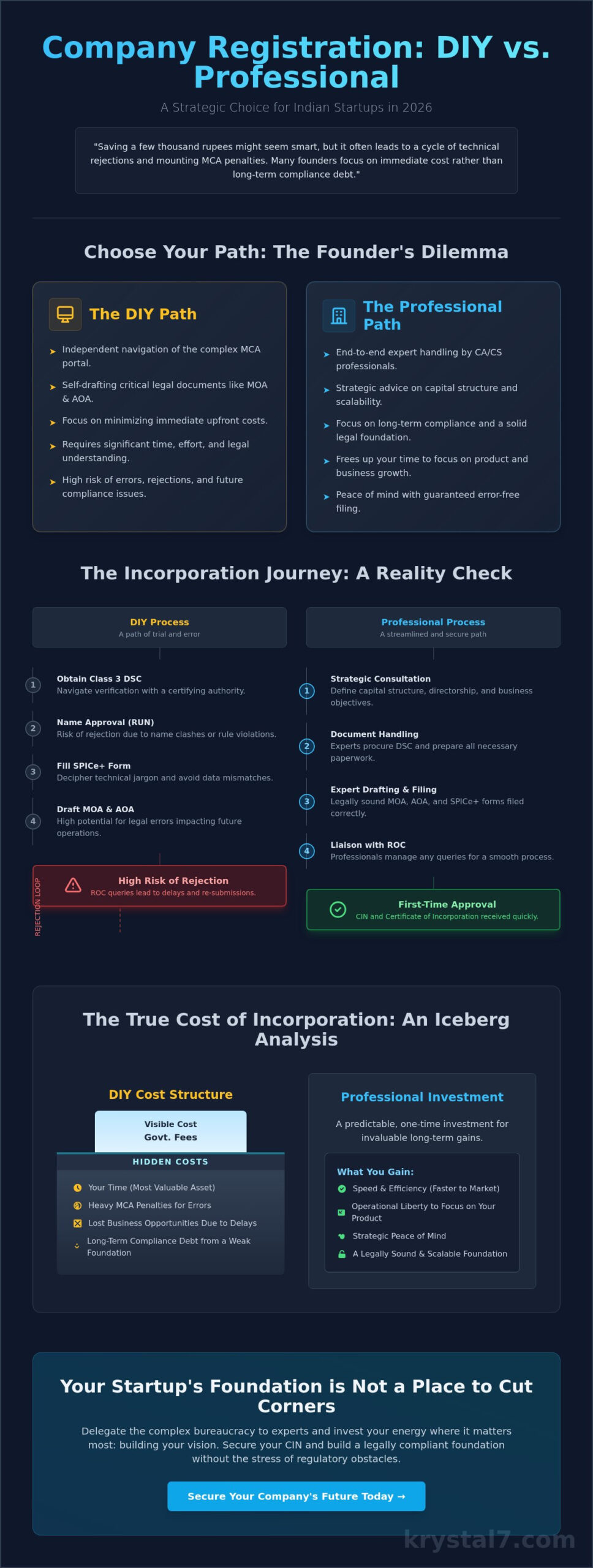
Step-by-Step DIY Incorporation Workflow
- Step 1: Obtaining Class 3 DSC: You must procure these for all proposed directors. This involves submitting PAN and Aadhaar details to a licensed Certifying Authority.
- Step 2: Name Approval via RUN: You’ll use the Reserve Unique Name (RUN) service. You must ensure the name isn’t identical to existing companies and doesn’t infringe on registered trademarks, which requires a thorough search of the IP India database.
- Step 3: Filing SPICe+ Forms: This is the core of the application. You must complete Part B of the SPICe+ form, along with AGILE-PRO-S for GST and EPFO registration, and the electronic MOA and AOA.
Common Pitfalls of the DIY Approach
One of the most frequent errors involves selecting incorrect National Industrial Classification (NIC) codes. These codes define your business activities and determine your regulatory requirements. Choosing the wrong code can lead to the ROC questioning your business model or rejecting the form entirely.
Drafting the “Objects of the Company” in the Memorandum of Association (MOA) is another major pain point. If the language is too narrow, you might find yourself unable to expand your business activities later without expensive legal amendments. Most DIY applicants struggle with “Resubmission” notices. The MCA typically allows only two chances to correct errors before the government fees are forfeited, creating unnecessary financial pressure and delaying your official launch.
Why Founders Hire Professionals for Private Limited Company Registration
Professional consultancy transforms a clerical task into a strategic launchpad for your business. When you evaluate diy company registration vs hiring a professional, remember that the goal isn’t just to get a certificate; it’s to build a scalable entity. Experts analyze your shareholding patterns to ensure they align with your long-term growth plans. They help you navigate the complexities of the Companies Act, 2013, ensuring every clause in your charter documents protects your vision.
The SPICe+ form allows for integrated registrations, but the technical data required for GST, EPFO, and ESIC can be overwhelming. A Chartered Accountant ensures that your registered office address matches the utility bills perfectly, preventing immediate rejections. While you might follow a step-by-step guide to company registration, the professional ensures that your ‘Objects’ clause is wide enough to cover future pivots. This level of detail provides the relief and security founders need during the high-pressure incorporation phase.
Expert Drafting of Constitutional Documents
A standard AOA template is rarely sufficient for a startup aiming for venture capital. Professionals draft custom clauses that govern director appointments and share transfers, providing a clear roadmap for future governance. They also ensure your MOA includes ancillary activities, saving you from the hassle of special resolutions and MCA filings later. You can learn more about these essential components in our Private Limited Company in India: The Ultimate Guide for Founders.
Navigating ROC Queries and Compliance
The Registrar of Companies (ROC) maintains high standards for document clarity. If a query arises regarding your director’s address or company name, a professional consultant manages the response and resubmission. They ensure that form INC-22 for registered office verification is filed with precise geo-tagging data as required by current norms. By establishing this meticulous foundation, you’re already ahead on your Annual Compliance for Private Limited Company. This delegation allows you to pursue your primary goals with calm competence.
DIY vs. Professional: A Comparative Analysis of Costs, Risks, and Timelines
Choosing between diy company registration vs hiring a professional isn’t just about the initial invoice you pay. Every founder must account for mandatory government outlays that remain constant regardless of the path chosen. These include the cost of a Class 3 Digital Signature Certificate (DSC), which typically ranges from ₹1,000 to ₹3,000 per director, and state-specific stamp duties. While the government fee for a company with nominal share capital up to ₹1,00,000 is only ₹200, the technical complexity of the filing often creates hidden expenses.
The “Risk Cost” is perhaps the most significant factor for serious entrepreneurs. If the MCA rejects your application due to a naming conflict or incorrect NIC codes, you risk forfeiting your government fees after the second resubmission attempt. You also need to ensure you’re accounting for Trademark Registration Fees in India early on. Overlooking a trademark search during name reservation can lead to expensive legal disputes later, turning a “cheap” DIY project into a financial burden.
The Cost Breakdown (INR)
- Mandatory Fees: These include DSC procurement, ROC filing fees, and state-level stamp duty on the MOA and AOA.
- The False Economy: Founders often spend 40+ hours researching technicalities, which is time better spent on product development.
- Tax Benefits: Professional fees paid for incorporation are often treated as preliminary expenses, allowing for tax deductions over a five year period under Section 35D of the Income Tax Act.
Timeline and Efficiency Comparison
A typical DIY attempt can take 15 to 30 days. This timeline accounts for the steep learning curve of the MCA V3 portal and the likely event of a resubmission notice. In contrast, a professional timeline is usually 7 to 10 days. Our team at Krystal7 uses a methodical approach to ensure your application is “first time right.”
Delayed incorporation stalls your entire business cycle. You cannot open a corporate bank account, sign official vendor contracts, or issue offer letters to key hires without a valid Certificate of Incorporation (COI). If you want to avoid these bureaucratic obstacles, you can explore our company incorporation package to secure your operational liberty immediately.
Making the Choice: Why Professional Support is a Strategic Investment
Deciding between diy company registration vs hiring a professional is your first major test as a CEO. It’s a choice between spending your valuable energy on administrative technicalities or focusing on your core product. While the law allows you to file independently, a strategic investment in professional support ensures your corporate foundation is built for scale from day one.
Choosing a professional partner is an act of delegation that sets the tone for your leadership. It moves you from a state of uncertainty to one of operational liberty. By trusting experts with your Company Registration, you ensure that your first step into the Indian market is both confident and compliant.
Beyond Registration: The Compliance Lifecycle
Incorporation is merely the starting line of your legal journey. A professional consultant ensures you hold your first Board Meeting within 30 days as mandated by the Companies Act, 2013. We also manage the critical filing of Form INC-20A for the Commencement of Business. Failing to file this within 180 days leads to a ₹50,000 penalty for the company and ₹1,000 per day for directors. Professional setup prevents these heavy MCA penalties and keeps your record clean for future investors.
The Strategic Advantage: DIY Company Registration vs. Hiring a Professional
Krystal7 Consultants provides a “Krystal-Clear” path to business ownership by handling the meticulous details of bureaucracy. Our partnership extends beyond the initial certificate to include your recurring GST and TDS filings. We act as your dedicated advisors, humanizing complex expertise to alleviate the anxiety of administrative burdens. This long-term partnership ensures you never face a compliance deadline alone. Just as we support Indian entrepreneurs, those expanding into the Australian market can rely on a small business accountant melbourne for expert local tax and business advisory services.
Final Verdict: DIY Company Registration vs. Hiring a Professional
The debate over diy company registration vs hiring a professional ultimately defines how quickly you can start closing deals. You can spend weeks navigating the MCA V3 portal or launch with a legally sound structure in just a few days. Don’t let bureaucratic obstacles slow your momentum. Let our experts handle the formalities so you can pursue your visionary goals with calm competence. Contact Krystal7 Consultants at business@krystal7.com or visit krystal7.com for expert assistance.
Secure Your Corporate Foundation and Focus on Growth
The choice between diy company registration vs hiring a professional is ultimately a decision about your startup’s momentum. While the digital portal is open to all, the technical precision required to avoid MCA rejections and future compliance debt is significant. Delegating this complex task ensures your Private Limited company is legally sound, allowing you to focus on product development and market entry.
Professional support provides more than just a certificate; it offers a strategic roadmap for your shareholding and long-term governance. With expertise in MCA V3 portal navigation and end-to-end GST integration, we ensure your launch is seamless and transparent. You deserve the operational liberty to lead your vision without being bogged down by bureaucratic obstacles.
Launch your business the right way with Krystal7 Consultants. Our team provides meticulous guidance with transparent pricing to help you build with confidence. Contact Krystal7 Consultants at business@krystal7.com or visit krystal7.com for expert assistance. Your entrepreneurial journey is just beginning; let’s make sure it starts on solid ground.
Frequently Asked Questions
Can I register a Private Limited Company in India entirely on my own?
You can technically register a Private Limited Company independently through the Ministry of Corporate Affairs (MCA) V3 portal. The government designed the integrated SPICe+ form to be accessible to all citizens. However, the technical drafting of the Memorandum of Association (MOA) and Articles of Association (AOA) remains a significant barrier for those without legal training.
What are the mandatory government fees for company registration in 2026?
Government fees for company registration depend on your authorized share capital. For a nominal capital up to ₹1,00,000, the ROC filing fee is ₹200. You must also budget for Class 3 Digital Signature Certificate (DSC) costs, which range from ₹1,000 to ₹3,000 per person, and state-specific stamp duty on your incorporation documents.
Is a Chartered Accountant (CA) required for company incorporation?
A Chartered Accountant or a qualified professional is mandatory for the certification of incorporation documents. Form INC-8 specifically requires a declaration from a CA, CS, or Advocate. This certification ensures that the company follows all provisions of the Companies Act, 2013, before the Registrar issues the certificate.
What happens if my DIY company registration application is rejected by the ROC?
The Registrar of Companies (ROC) typically allows two chances for resubmission to correct defects in your application. If you fail to rectify the errors within these attempts, the MCA will reject the form entirely. You then forfeit the government fees paid and must start the diy company registration vs hiring a professional evaluation again from scratch.
How much time does it take to register a company through a professional vs DIY?
Professional registration usually takes 7 to 10 business days once all documents are ready. A DIY approach often extends to 15 or 30 days because of the steep learning curve associated with the MCA portal. Professionals use streamlined workflows to avoid the common technical rejections that often stall independent attempts.
Can I change my company structure later if I make a mistake during DIY registration?
You can modify your company structure later, but this involves additional legal filings and mandatory MCA fees. For example, changing your authorized capital requires filing Form SH-7 and paying the differential stamp duty. It is always more cost effective to get the structure right during the initial diy company registration vs hiring a professional phase.
What documents do I need to provide to a professional for registration?
You need to provide basic identity and address proofs for all directors and the registered office. This includes PAN cards, Aadhaar cards, and recent utility bills like electricity or water bills not older than two months. You also need a No Objection Certificate (NOC) from the property owner where the office is located.
Is the cost of hiring a professional for registration tax-deductible?
Professional fees for company incorporation are tax-deductible under Section 35D of the Income Tax Act. These are classified as preliminary expenses and can be amortized over a period of five years. This deduction helps reduce your taxable income once your startup begins generating profits in the Indian market.

Article by
Nihal Srivastava
Nihal Srivastava is the Co-Founder of Krystal7 Consultants, helping Indian entrepreneurs and startups navigate company registration, compliance, trademark protection, and regulatory requirements with clarity and confidence. With 6+ years of hands-on expertise in MCA filings, GST compliance, and corporate structuring, Nihal has guided 1000+ businesses across India through their legal and compliance journeys. He believes every business dream deserves crystal clear foundations, and that no founder should be held back by paperwork or red tape.