

Cross Border Tax Advisory in India: A Founder’s Guide to Global Growth (2026)
What if the biggest hurdle to your company’s global expansion isn’t your product’s market fit, but a hidden compliance trap within the new Income-tax Act, 2025? We know that for many Indian founders, the dream of scaling abroad often feels overshadowed by the fear of heavy RBI penalties or the complexity of Foreign Subsidiary Registration. You’ve built a visionary business, and you shouldn’t let the intricacies of cross border tax advisory India keep you anchored to a single market.
This guide is designed to replace that anxiety with a clear roadmap for your international journey. You’ll learn how to master international taxation to create a tax-efficient global structure that protects your bottom line and ensures a zero-penalty compliance record. Our goal is to provide the transparency you need to make informed decisions without getting lost in technical jargon.
We’ll explore the strategic use of Double Taxation Avoidance Agreements (DTAA), the benefits of the new 14% MAT rate, and the precise steps for seamless fund transfers. You’re about to gain the clarity needed to lead your business across borders with total operational liberty and professional confidence.
Key Takeaways
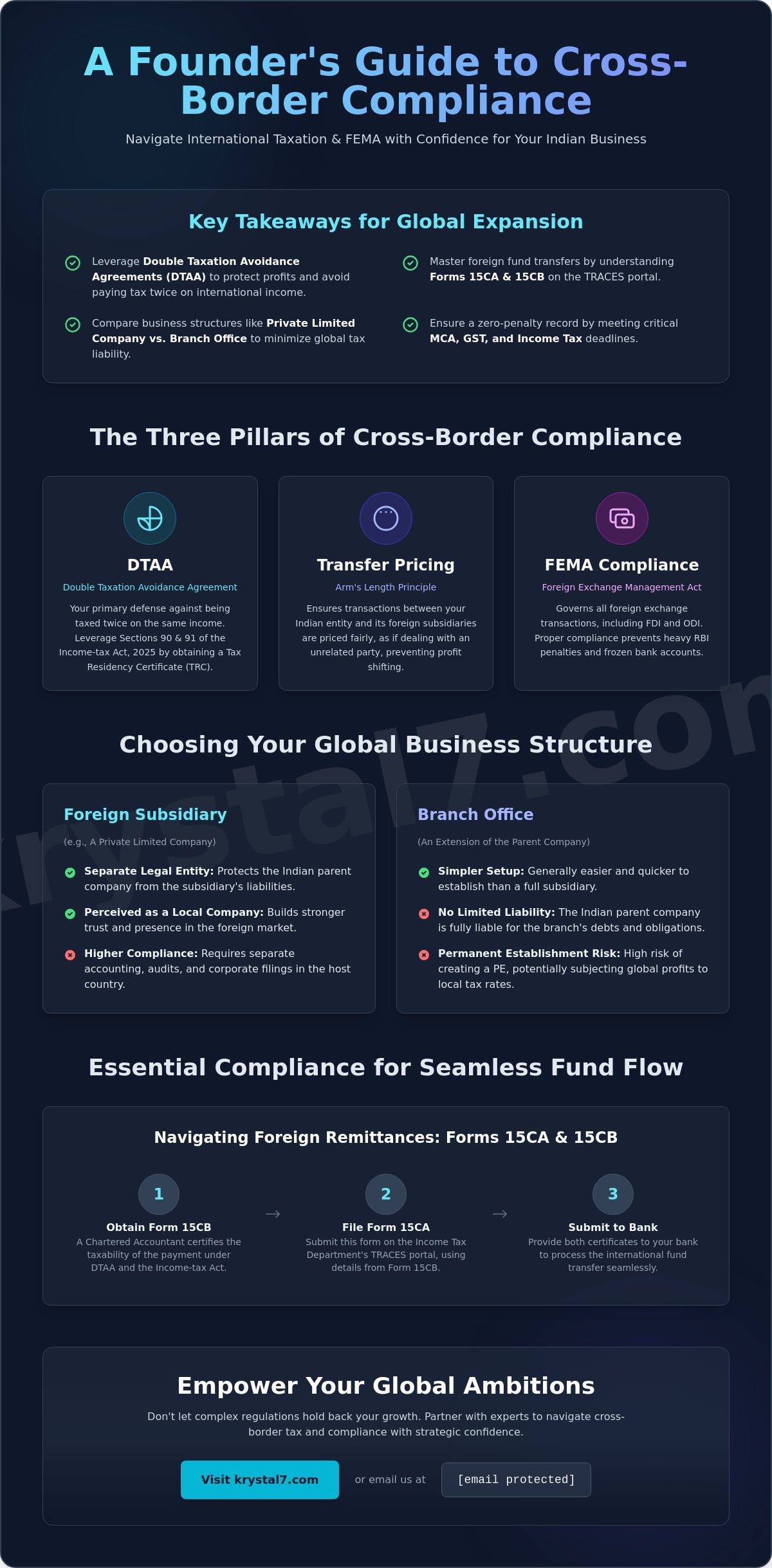
- Learn how to leverage Double Taxation Avoidance Agreements (DTAA) to protect your INR profits and eliminate the risk of paying tax twice on international income.
- Compare the tax efficiency of a Private Limited Company versus a branch office to choose a structure that minimizes your global tax liability.
- Discover how professional cross border tax advisory India simplifies compliance with the new Income-tax Act, 2025 and helps you avoid steep RBI penalties.
- Master the process of foreign fund transfers by understanding the requirements for 15CA and 15CB certificates via the TRACES portal.
- Identify critical MCA and GST deadlines to ensure your business maintains a flawless compliance record as you expand into new international markets.
What is Cross Border Tax Advisory in India and Why Does it Matter?
Cross border tax advisory is the strategic management of your tax liabilities when your business transactions span multiple countries. It’s about ensuring your global growth doesn’t come at the cost of double taxation or non-compliance. In the Indian context, this field has seen a massive shift with the implementation of the Income-tax Act, 2025, which replaced the decades-old 1961 Act on April 1, 2026. This new legislation requires a meticulous approach to how you handle money moving in and out of the country.
Founders often view international tax as a bureaucratic maze. However, clear cross border tax advisory India acts as a “transparency bridge.” When your global dealings are transparent, you gain true operational liberty. You won’t have to worry about the Income Tax Department questioning your transfers or the RBI freezing your accounts due to FEMA violations. Without expert guidance, many startups face heavy compounding fees that can drain their INR reserves and stall expansion plans.
The Scope of International Taxation for Indian Startups
Expanding globally involves managing both Foreign Direct Investment (FDI) coming into India and Overseas Direct Investment (ODI) going out. If you’re exporting digital services or software, you must navigate complex GST rules and withholding tax requirements. One of the most significant threats to your margins is “Permanent Establishment” (PE) risk. This occurs when a foreign government determines your business has a fixed presence in their country, potentially subjecting your global profits to their local tax rates. Utilizing a Double Taxation Avoidance Agreement (DTAA) is essential to mitigate these risks and ensure you only pay tax where it’s legally due.
The Reassuring Role of a Tax Advisor
A dependable advisor shifts your mindset from administrative anxiety to strategic optimism. Instead of struggling with the TRACES portal for 15CA and 15CB certificates, you can delegate these tasks to experts who understand the nuances of the law. They manage your MCA filings for foreign subsidiaries with precision, ensuring every deadline is met. Having a partner who speaks the technical language of the regulatory authorities allows you to focus on your primary goal: building a world-class company from your base in India.
The Three Pillars of Cross Border Compliance: DTAA, Transfer Pricing, and FEMA
Successful international expansion relies on three distinct yet interconnected regulatory frameworks. When you engage in cross border tax advisory India, you must align your strategy with DTAA, Transfer Pricing, and FEMA. These pillars ensure your INR profits stay protected while you maintain a clean compliance record with both the Income Tax Department and the RBI. Ignoring any single pillar can destabilize your entire global structure.
These regulations don’t work in isolation. A decision made for tax efficiency under a treaty might trigger a reporting requirement under foreign exchange laws. Understanding how these laws interact is the first step toward achieving operational liberty. It allows you to move funds across borders without the constant fear of administrative scrutiny or frozen bank accounts.
Leveraging DTAA for Tax Efficiency
Double Taxation Avoidance Agreements (DTAA) are your primary defense against being taxed twice on the same income. Under the Income-tax Act, 2025, Section 90 allows the Indian government to enter into agreements with other nations to provide relief. If no agreement exists with a specific country, Section 91 provides unilateral relief to ensure you aren’t unfairly burdened by global tax obligations.
To claim these benefits, you must obtain a Tax Residency Certificate (TRC) from the relevant tax authority. For instance, if your Gurgaon-based firm provides software consulting to a US client, a valid TRC allows you to pay tax at a lower treaty rate. This prevents the US from withholding a high percentage of your invoice value while India also taxes the same profit. It’s a vital tool for maintaining healthy cash flows during global growth.
Transfer Pricing: More Than Just Paperwork
Transfer pricing ensures that transactions between your Indian entity and its foreign subsidiaries happen at an “Arm’s Length” price. This means the price charged should be the same as if you were dealing with an unrelated third party. The Income Tax Department increasingly follows the OECD Transfer Pricing Guidelines to identify and prevent artificial profit shifting.
Failing to maintain a proper Transfer Pricing Study can lead to penalties as high as 200% on tax adjustments. For startups and SMEs, the 2026 regulations have increased safe harbor thresholds to ₹2,000 crore. This change makes it easier for smaller players to stay compliant without incurring excessive administrative costs. Using professional cross border tax advisory India helps you document these transactions correctly from day one.
FEMA and RBI Reporting Requirements
The Foreign Exchange Management Act (FEMA) governs how currency moves across Indian borders. The RBI monitors every dollar to maintain national economic stability and prevent unauthorized capital flight. If you receive foreign investment, you must file Form FC-GPR within 30 days of issuing shares to remain compliant with the law.
Individual founders using the Liberalized Remittance Scheme (LRS) to fund overseas ventures must also be mindful of strict annual limits. Missing an RBI reporting deadline is a non-negotiable risk that often leads to expensive compounding fees and legal hurdles. To keep your global operations running smoothly, it’s wise to consider an annual compliance package that covers these critical regulatory filings.
Strategic Business Structures: Foreign Subsidiaries vs. Branch Offices
Choosing the right legal vehicle is a foundational decision for any global founder. While several options exist, the Private Limited Company remains the gold standard for foreign subsidiaries in India. This structure provides a distinct legal identity and grants founders the operational liberty to scale without the restrictive oversight associated with representative models. It allows your business to own property, enter contracts, and build a local brand with full commercial rights.
Tax efficiency is a major driver in this structural choice. Domestic companies, including foreign-owned subsidiaries, enjoy lower base tax rates of 25% or 30% depending on turnover. In contrast, foreign companies operating through branch offices face a higher base tax rate of 35% under the Income-tax Act, 2025. When you factor in the 4% health and education cess and applicable surcharges, the effective tax rate for a branch can reach 38.22%. Professional cross border tax advisory India helps you analyze these figures to ensure your structure supports long-term profitability.
A subsidiary must follow the Companies Act 2013, which involves annual filings with the MCA and maintaining statutory audits. While the compliance burden is higher than a liaison office, the trade-off is the ability to generate revenue and repatriate profits. You gain the freedom to focus on your core business while your advisors handle the meticulous details of corporate governance.
Foreign Subsidiary Registration in India
Registration happens via the integrated SPICe+ form on the MCA portal. This single window handles the name reservation, incorporation, and allotment of PAN and TAN. Non-resident directors must first obtain Digital Signature Certificates (DSC) to sign electronic documents. For a deeper dive into the setup process, read our Private Limited Company in India: The Ultimate Guide.
The Branch Office/Liaison Office Alternative
Branch offices are often used for specific project-based entries where the foreign parent company wants direct control over operations. However, liaison offices face strict restrictions and cannot earn any income or engage in commercial activities in India. They serve only as a communication link between the foreign head office and Indian entities. Taxation for foreign branches remains high, with an effective rate exceeding 36% even for smaller income brackets. Effective cross border tax advisory India ensures you don’t accidentally trigger these higher rates through an inefficient setup.
Navigating Compliance Deadlines and Regulatory Filings
Managing a global business requires a methodical approach to the Indian compliance calendar. Missing a single filing date can trigger administrative burdens that distract you from your core vision. Professional cross border tax advisory India brings order to these complex schedules, ensuring you maintain a zero-penalty record throughout the tax year.
The transition to the Income-tax Act, 2025, has introduced specific timelines for Tax Year 2026-27 that founders must track. You must pay your first installment of Advance Tax by June 15, 2026. For companies subject to audit, the ITR filing deadline is October 31, 2026, while Transfer Pricing reports are due by November 30, 2026. Staying ahead of these dates grants you the operational liberty to scale without the fear of receiving notices from the Income Tax Department.
The 15CA and 15CB Process Simplified
When you send money abroad to pay foreign vendors or repatriate profits, the bank requires proof of tax clearance. Form 15CB is a certificate issued by a Chartered Accountant verifying that you’ve deducted the correct TDS under the appropriate DTAA. You then use this certificate to file Form 15CA on the e-filing portal. This process ensures transparency in your international transactions and prevents future legal obstacles. For a complete list of filing requirements, see our Annual Compliance for a Private Limited Company: The Ultimate 2026 Guide.
GST and Cross-Border Transactions
Exporting services from India offers significant tax advantages if you follow the correct procedures on the GST portal. You can opt for a “zero-rated supply” by filing a Letter of Undertaking (LUT) at the start of the financial year. This allows you to export services without paying IGST upfront, which preserves your INR cash flow for growth. You can also claim refunds on input tax credits for business expenses like office rent and software tools.
However, importing services often triggers the Reverse Charge Mechanism (RCM). In this scenario, your Indian entity must pay the GST on behalf of the foreign vendor. Professional GST filing India services help you navigate these nuances to avoid interest and late fees. Our team handles the meticulous details of cross border tax advisory India so you can focus on building your global brand. Secure your compliance today with our expert advisory services.
Empowering Your Global Ambitions with Krystal7 Consultants
Scaling a business across borders requires more than just ambition; it demands a partner who brings order to administrative complexity. Krystal7 Consultants provides elite cross border tax advisory India to help you build a robust financial foundation for your international journey. Our methodical approach ensures that your global structure remains efficient, transparent, and fully compliant with Indian laws.
We operate on a core promise of visual precision. You’ll never find yourself guessing about costs or the status of your filings. Our transparent pricing models and step-by-step process management grant you the operational liberty to focus on your primary business goals while we manage the bureaucratic obstacles. We describe handling the complexity so you can pursue your primary vision with absolute security.
Why Founders Trust Krystal7 for Cross Border Tax Advisory India
Our team in Gurgaon possesses deep institutional knowledge of the Income-tax Act, 2025, and the latest FEMA regulations. We simplify the daunting task of Foreign Subsidiary Registration and handle your annual compliance package with meticulous care. By delegating these technical burdens to us, you eliminate the risk of frozen accounts or costly RBI compounding fees that often plague unadvised startups.
We act as your one-stop solution for everything from GST filing India to complex TDS on foreign payments via the TRACES portal. Our advisors speak the language of the Income Tax Department, providing a reassuring bridge between your visionary goals and regulatory requirements. This humanized expertise ensures you always have a supportive expert available to guide your decisions with polished, professional confidence.
Ready to Scale Globally?
The first step toward international success is a comprehensive diagnostic of your planned global structure. We analyze your specific needs to determine if a Private Limited Company or a specialized project office offers the best tax efficiency for your INR profits. This strategic foresight prevents expensive structural changes later in your growth cycle and keeps your compliance record spotless.
Krystal7 builds the compliant bridge your business needs to enter the international market with confidence. We handle the complexity so you can pursue the freedom of global expansion. Master the intricacies of cross border tax advisory India by partnering with a firm that values your success as much as you do. Contact Krystal7 Consultants at business@krystal7.com or visit krystal7.com for expert assistance today.
Take Your Business Beyond Borders Today
Global growth is a testament to your vision as a founder. By mastering the transition to the Income-tax Act, 2025, and leveraging DTAA benefits, you protect your hard-earned INR profits from the risk of double taxation. Choosing a Private Limited structure for your foreign subsidiary provides the operational liberty needed to scale without unnecessary administrative anxiety. You now have the roadmap to navigate complex TRACES filings and RBI reporting with total clarity.
Expert cross border tax advisory India ensures your journey remains transparent and secure. We bring calm competence to your expansion by managing the meticulous details of Foreign Subsidiary Registration and FEMA compliance. Our firm acts as your one-stop partner for all MCA, GST, and Income Tax filings. This methodical support allows you to dedicate your energy to innovation while we handle the regulatory complexity.
Scale your business globally with confidence. Contact Krystal7 Consultants at business@krystal7.com or visit krystal7.com for expert guidance. Your international success story deserves a compliant and resilient foundation.
Frequently Asked Questions
What is the difference between Section 90 and Section 91 for cross-border tax relief?
Section 90 applies when India has a formal tax treaty or DTAA with another country to prevent double taxation. Section 91 provides unilateral relief to Indian residents if no such treaty exists with the foreign nation. Both sections under the Income-tax Act, 2025, ensure you don’t pay tax twice on the same income.
How can an Indian startup avoid double taxation when expanding to the US?
You can avoid double taxation by leveraging the India-US DTAA and claiming a Foreign Tax Credit (FTC) in India. This process allows you to subtract the taxes paid in the US from your total Indian tax liability. Utilizing professional cross border tax advisory India ensures you obtain the necessary Tax Residency Certificate to claim these benefits.
Is it mandatory to file Form 15CA and 15CB for every foreign payment?
No, these forms are only mandatory for payments to non-residents that are taxable in India and exceed ₹5 lakh in a financial year. You must get Form 15CB certified by a Chartered Accountant before filing Form 15CA on the e-filing portal. Certain payments like personal remittances or specific exempt categories don’t require these filings.
What are the penalties for missing FEMA reporting deadlines for FDI?
Penalties for FEMA violations can be up to three times the amount involved if the sum is quantifiable. If the amount isn’t quantifiable, the penalty is up to ₹2 lakh. For delayed filings like Form FC-GPR, the RBI also imposes a Late Submission Fee (LSF) based on the duration of the delay.
Can a foreign national be a director in an Indian Private Limited Company?
Yes, a foreign national can definitely be a director in an Indian company. However, the Companies Act, 2013, requires at least one director on the board to be a resident of India. This means one director must have stayed in India for at least 182 days during the previous financial year.
How does Transfer Pricing affect a small Indian IT services company?
Transfer pricing ensures that services provided to your foreign entities are billed at a fair “Arm’s Length” price. For Tax Year 2026-27, small firms benefit from a safe harbor threshold of ₹2,000 crore. This allows you to maintain a 15.5% operating profit margin to simplify cross border tax advisory India and avoid intense scrutiny.
What is a Tax Residency Certificate (TRC) and how do I get one?
A TRC is an official document that confirms your status as a tax resident of India. You can obtain it by submitting Form 10FA to the Income Tax Department. This certificate is mandatory if you want to claim lower withholding tax rates under various international tax treaties.
Do I need a separate GST registration for exporting services from India?
You don’t need a separate GST registration to export services. You can use your existing GSTIN but must file a Letter of Undertaking (LUT) on the GST portal at the start of every financial year. This allows you to export services without paying IGST upfront, keeping your INR cash flow healthy.

Article by
Nihal Srivastava
Nihal Srivastava is the Co-Founder of Krystal7 Consultants, helping Indian entrepreneurs and startups navigate company registration, compliance, trademark protection, and regulatory requirements with clarity and confidence. With 6+ years of hands-on expertise in MCA filings, GST compliance, and corporate structuring, Nihal has guided 1000+ businesses across India through their legal and compliance journeys. He believes every business dream deserves crystal clear foundations, and that no founder should be held back by paperwork or red tape.