

Pvt Ltd vs LLP: Which is Better for Your Startup in India? (2026 Guide)
Pvt Ltd vs LLP: Which is Better for Your Startup in India? (2025 Guide)
You have the vision and the drive to launch your venture in India. But one of the first, most critical decisions you’ll make is choosing your business structure. The question of pvt ltd vs llp which is better for startup is more than just a legal formality; it’s a strategic choice that will define your company’s future, from fundraising potential to compliance burdens. This decision can feel overwhelming, clouded by complex regulations and the fear of making a costly mistake right from the start.
This is where the guesswork ends. Our comprehensive 2025 guide is designed to cut through the noise and bring you crystal-clear guidance. We will break down the complexities, comparing a Private Limited Company and an LLP based on what truly matters to your vision: funding goals, compliance ease, operational flexibility, and long-term scalability. Forget the hassle and confusion. By the end of this article, you will have the clarity and confidence to choose the right legal foundation to build your thriving business upon.
At a Glance: Quick Comparison of Pvt Ltd Company vs LLP
Choosing the right business structure is one of the most critical decisions for any founder. For most entrepreneurs in India, the choice often comes down to two powerful options. Understanding the core differences when evaluating pvt ltd vs llp which is better for startup ventures is the first step toward building a solid legal foundation for your vision. This quick comparison table gives you the clarity you need to start.
| Parameter | Private Limited (Pvt Ltd) Company | Limited Liability Partnership (LLP) |
|---|---|---|
| Liability | Limited to the unpaid value of shares held by shareholders. Personal assets are protected. | Limited to the capital contribution of partners. Personal assets are protected. |
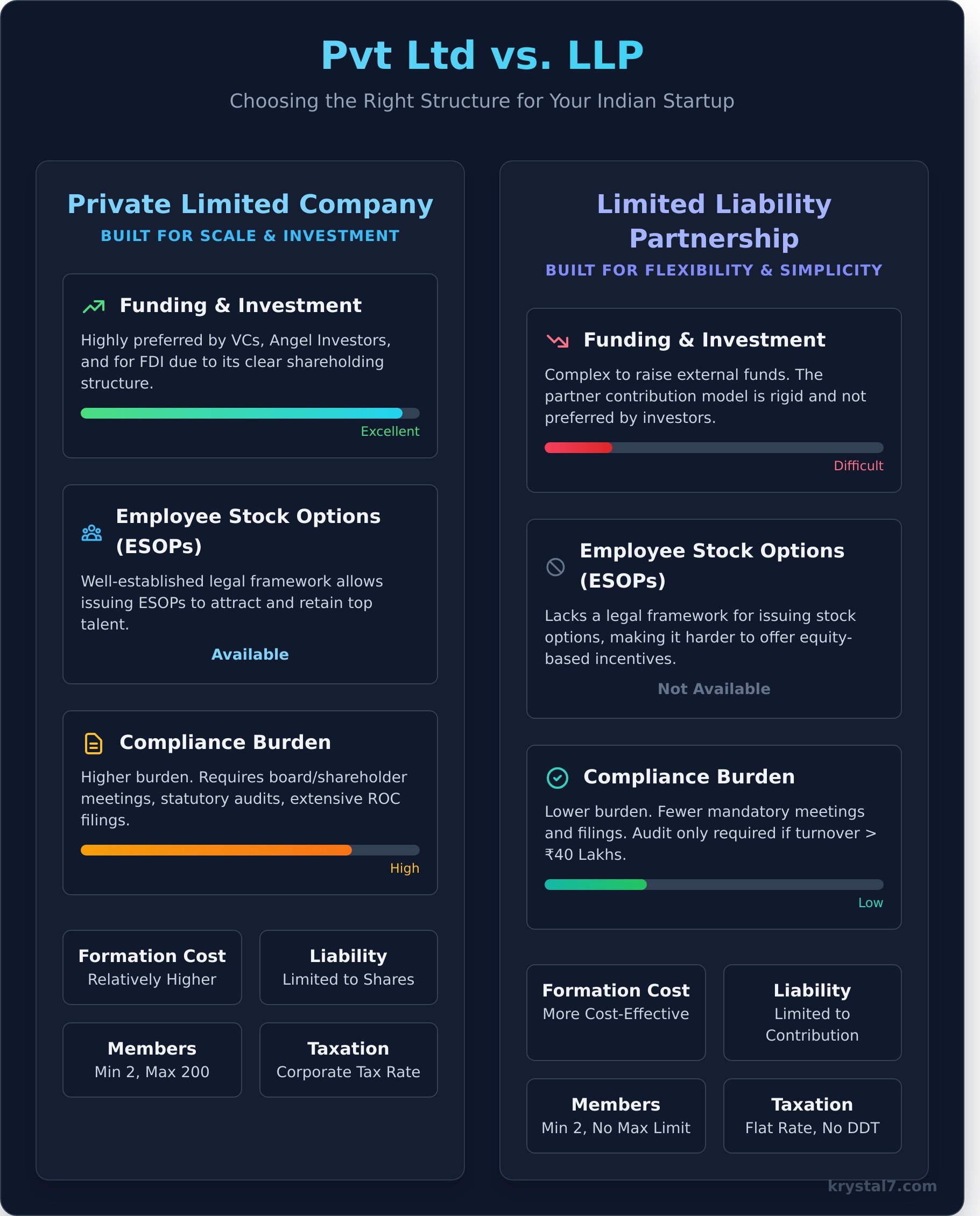
| Funding & Investment | Highly preferred by VCs, Angel Investors, and for FDI due to its clear shareholding structure. | Raising external funds is more complex. Investors generally prefer the company structure. |
| Compliance Burden | Higher. Requires board meetings, shareholder meetings, statutory audits, and extensive ROC filings. | Lower. Fewer mandatory meetings and filings. Audit is required only if turnover exceeds ₹40 Lakhs. |
| Formation Cost | Relatively higher due to more complex legal formalities and documentation. | More cost-effective and simpler to set up. |
| Members Required | Minimum 2 Directors & 2 Shareholders (can be the same people). Maximum 200 shareholders. | Minimum 2 Partners (Designated Partners). No upper limit on the number of partners. |
| Taxation | Taxed at a separate corporate tax rate. Subject to Dividend Distribution Tax (DDT). | Taxed at a flat rate. Profits distributed to partners are not taxed in their hands. |
The fundamental difference is simple: A Private Limited Company is structured for scalability and external funding, while an LLP offers greater operational flexibility and lower compliance. Your long-term business goals will determine the right path.
What is a Private Limited Company?
A Private Limited Company is a formal business structure registered under the Companies Act, 2013. It is treated as a distinct legal entity, separate from its owners (shareholders). This separation means the shareholders’ liability is limited to their investment in shares, safeguarding their personal assets. This structure is widely recognized and perceived as highly credible by investors, banks, and clients, making it the ideal choice for startups with ambitions for significant growth and equity funding.
What is a Limited Liability Partnership (LLP)?
An LLP is a modern, hybrid business structure governed by the LLP Act, 2008. It combines the operational flexibility of a traditional partnership with the crucial advantage of limited liability found in a company. In an LLP, partners are not personally liable for the business’s debts or the misconduct of other partners. This structure, a well-established global concept for a Limited Liability Partnership (LLP), is perfect for professional firms and businesses that prioritize ease of management and lower compliance overhead.
Funding and Investment: Which Structure Attracts More Capital?
For an ambitious startup with a vision for rapid growth, the choice of business structure is not just a legal formality-it’s a strategic decision that directly impacts your ability to raise capital. When considering the pvt ltd vs llp which is better for startup funding, the answer is overwhelmingly in favour of the Private Limited Company. This structure is designed for growth and is the established, trusted path for securing external investment from serious investors.
Venture Capital (VC) and Angel Investors
Institutional investors like VCs and angel investors invest in exchange for equity-or shares-in your company. This is the cornerstone of startup funding, and it’s where the Pvt Ltd model shines. A company’s ownership is divided into shares, which can be easily valued, allotted, and transferred. This streamlined process allows for:
- Clear Valuation: Determining a startup’s worth and issuing shares accordingly.
- Flexible Share Classes: Creating different types of shares, such as preference shares, to offer investors special rights and protections.
- Standardised Agreements: Using well-understood legal documents like Share Subscription Agreements (SSA) and Shareholders’ Agreements (SHA).
An LLP, on the other hand, does not have the concept of share capital. Ownership is based on partner contributions, a structure that is rigid and ill-suited for multiple funding rounds. The structural differences are a key reason investors avoid LLPs; a detailed ClearTax LLP vs Pvt Ltd Comparison further explains how this lack of equity framework makes LLPs a non-starter for most VCs. Similarly, Foreign Direct Investment (FDI) is permitted under the automatic route for a Pvt Ltd company, making it seamless for foreign investors to inject capital.
Employee Stock Options (ESOPs)
Attracting and retaining top talent is critical for any startup. Employee Stock Options (ESOPs) are a powerful tool to achieve this, offering key employees a stake in the company’s success. This is a well-established mechanism under the Companies Act, 2013, but it is exclusively available to companies. LLPs lack a legal framework to issue stock options, putting them at a significant disadvantage in the competitive talent market.
Bank Loans and Financial Credibility
While both structures can secure bank loans, a Pvt Ltd company often enjoys greater credibility with lenders. This is due to its stringent compliance requirements with the Ministry of Corporate Affairs (MCA), which mandates the public filing of annual financial statements and reports. This transparency provides banks with a clear, verifiable financial history, often leading to a smoother loan approval process. LLPs, while still able to get loans, may face more detailed scrutiny from financial institutions.
Compliance and Administration: The Burden of Paperwork
For any entrepreneur, the question of pvt ltd vs llp which is better for startup often comes down to the day-to-day operational reality. This is where compliance and administration enter the picture. While paperwork can feel like a burden, think of it as the framework that builds trust with investors, banks, and the government. It’s the proof that your venture is credible and well-managed. However, the intensity of this framework differs dramatically between a Private Limited Company and an LLP, directly impacting your time and costs.
Pvt Ltd Company Compliance Checklist
A Pvt Ltd company is held to a higher standard of regulatory scrutiny, reflecting its ability to raise equity capital. This means a more rigorous, non-negotiable compliance calendar. Giving you clarity, the key requirements include:
- Mandatory Auditor Appointment: You must appoint a statutory auditor within 30 days of incorporation.
- Annual Filings: Every year, you must file your financial statements (Form AOC-4) and an annual return (Form MGT-7/7A) with the Registrar of Companies (ROC).
- Regular Meetings: The law mandates a minimum of four Board of Directors meetings each year, plus one Annual General Meeting (AGM) for shareholders.
- Statutory Registers: Maintaining meticulous records is crucial, including minutes of meetings, a register of members, a register of directors, and more.
LLP Compliance Checklist
The LLP structure offers a significantly streamlined approach to compliance, making it a popular choice for startups focused on operational simplicity. The streamlined compliance for an LLP is a direct benefit of its governing law, the Limited Liability Partnership Act, 2008. The responsibilities for Designated Partners are fewer but just as important:
- Key Annual Filings: The two primary forms are the Annual Return (Form 11) and the Statement of Account & Solvency (Form 8).
- Conditional Audit: A statutory audit is only mandatory if the LLP’s annual turnover exceeds ₹40 lakh or its capital contribution surpasses ₹25 lakh.
- No Mandatory Meetings: There is no legal requirement to hold regular board meetings or maintain complex statutory registers like a company.
The Bottom Line on Compliance Costs
The difference in regulatory requirements translates directly to your bottom line. Annual compliance for an LLP is significantly cheaper, often costing less than half of what it takes to maintain a Pvt Ltd company. The primary driver for the higher cost in a Pvt Ltd is the mandatory statutory audit, along with professional fees for managing board meetings and extensive record-keeping.
This cost-benefit analysis is a critical factor when deciding pvt ltd vs llp which is better for startup success in the early stages. Don’t let compliance red tape slow down your vision. Let us handle your annual compliance, so you can focus on growth.
Ownership, Management, and Flexibility
Beyond legal status and compliance, the day-to-day reality of running your business is shaped by its internal structure. How you own, manage, and adapt your venture is fundamentally different in a Private Limited Company versus a Limited Liability Partnership. This distinction is critical when deciding pvt ltd vs llp which is better for startup founders with a specific vision for growth and control.
In a Pvt Ltd, ownership is held by shareholders, while management is handled by a Board of Directors. In an LLP, the owners are the partners, who are typically also responsible for managing the business. This core difference creates significant ripples in terms of operational freedom and long-term strategy.
Transfer of Ownership: Planning Your Exit Strategy
For many startups, the endgame involves an acquisition or bringing on new investors. Here, the choice of structure has profound implications.
- Private Limited Company: Ownership is represented by shares. Transferring ownership is a streamlined process of selling or allotting these shares. This makes it incredibly easy to bring in venture capital, issue Employee Stock Ownership Plans (ESOPs), or sell the company. The business continues seamlessly, even with a complete change in ownership.
- Limited Liability Partnership: Ownership is tied to the partners themselves. To transfer ownership or add a new partner, you must amend the LLP Agreement, a process that requires the consent of all existing partners. This can be cumbersome and less appealing to investors seeking a quick and clean transaction.
The Verdict: A Pvt Ltd company offers far superior ease and flexibility for ownership transfer, making it the clear choice for startups planning to raise funds or aim for a future acquisition.
Management Structure and Decision Making
How your team makes critical decisions is another area where these two structures diverge significantly, offering a classic trade-off between formal governance and operational agility.
A Pvt Ltd operates under a more rigid, statutory framework defined by the Companies Act, 2013. The Board of Directors manages daily affairs, but major decisions (like altering company objectives or structure) require formal resolutions passed by shareholders in officially convened meetings. This creates clear lines of authority and a predictable governance model, which investors prefer.
Conversely, an LLP offers immense flexibility. The entire management structure, profit-sharing ratios, partner responsibilities, and decision-making processes are defined by the LLP Agreement. This is a private contract between partners, allowing you to create a completely customized governance framework that suits your team’s unique dynamics. This operational freedom is a key reason why many service-based and professional firms choose the LLP model.
Ultimately, the debate over pvt ltd vs llp which is better for startup often comes down to this: a Pvt Ltd provides a globally recognized, structured framework built for scale, while an LLP provides unparalleled internal flexibility for its partners.
Taxation and Profit Distribution
Understanding the tax implications is one of the most critical steps in the pvt ltd vs llp which is better for startup analysis. How your business is taxed and how you can withdraw profits directly impacts your financial runway and personal earnings. This is where moving with clarity is not just an advantage-it’s essential for sustainable growth.
Income Tax Rates
The primary tax liability for your business entity is the corporate income tax. The structures for a Private Limited Company and an LLP are distinctly different, a factor that requires careful consideration based on your projected revenue.
- Limited Liability Partnership (LLP): An LLP is taxed at a straightforward, flat rate of 30% on its net profits, plus a 4% health and education cess. This predictability can be beneficial for financial planning.
- Private Limited Company: A company offers more flexibility. For the Financial Year 2024-25, domestic companies with a turnover of up to ₹400 crores in FY 2022-23 are taxed at a lower rate of 25% (plus cess). Furthermore, companies can opt for a concessional flat rate of 22% if they forgo certain tax deductions and exemptions.
Tax on Profit Distribution
This is where the choice between a Pvt Ltd and an LLP has the most significant impact on a founder’s take-home income. Withdrawing profits from the business is handled very differently in each structure, making the LLP a highly efficient model for many entrepreneurs.
In an LLP, once the partnership has paid its income tax, any subsequent distribution of profits to the partners is completely tax-exempt in the hands of the partners. This streamlined, single-taxation system ensures that there is no further tax leakage when you decide to take money out of the business.
Conversely, when a Private Limited Company distributes profits to its shareholders, it is treated as a ‘dividend’. This dividend income is added to the total income of the shareholders and taxed according to their individual income tax slab rates. For founders in the higher tax brackets, this can result in a significant additional tax burden, effectively taxing the same profit twice-once at the corporate level and again at the personal level.
Ultimately, when deciding pvt ltd vs llp which is better for startup, if your primary goal is to regularly withdraw profits for personal use, the tax efficiency of an LLP is a powerful argument in its favour. Navigating these statutory complexities is our expertise, giving you the freedom to focus on your vision. For a detailed analysis of your specific needs, our team at krystal7.com is always ready to provide clarity.
The Final Verdict: Which is Better for YOUR Startup?
After comparing compliance, funding, taxation, and flexibility, the answer to the question of pvt ltd vs llp which is better for startup comes down to a single, critical factor: your vision. There is no universally “better” option, only the structure that best aligns with your immediate needs and long-term ambitions. This final verdict is designed to give you the clarity to choose with confidence.
To simplify your decision, consider which of the following two scenarios most accurately reflects your startup’s journey.
Choose a Private Limited Company if…
A Pvt Ltd is the structure of ambition, designed for high-growth ventures aiming for significant scale. It is the preferred choice for entrepreneurs with a clear roadmap for external investment and rapid expansion.
- Your primary goal is to raise funding from Venture Capitalists (VCs), angel investors, or private equity firms. Investors overwhelmingly prefer the well-defined shareholding structure of a company.
- You plan to offer ESOPs (Employee Stock Ownership Plans) to attract and retain top talent, a feature not available to LLPs.
- You aim for high scalability with an eye on a future acquisition, merger, or even an Initial Public Offering (IPO).
- You need a strong corporate image to win large enterprise contracts, secure significant loans, or attract foreign investment.
Choose a Limited Liability Partnership if…
An LLP offers a modern, flexible, and cost-effective structure, ideal for businesses that are service-oriented, bootstrapped, or value operational simplicity over corporate complexity.
- You are starting a professional service or consultancy firm (e.g., legal, design, architectural, or advisory services) where partner involvement is key.
- Your priority is low compliance costs and minimal administrative hassle. An LLP has fewer statutory requirements than a Pvt Ltd.
- You do not plan to seek external equity funding in the near future and will rely on internal capital or debt.
- You need a flexible management structure that can be easily defined and altered through a simple partnership agreement.
Remember, your initial choice is not set in stone. The journey of a startup is dynamic. It is a common and strategically sound path to begin as an LLP to leverage its simplicity and low costs, and then convert to a Private Limited Company when your venture is ready to seek institutional funding. This allows you to match your legal structure to your business’s stage of evolution.
Ultimately, making the right decision between a Pvt Ltd vs LLP is about aligning your legal foundation with your business blueprint. If you need help charting the right course for your venture, the experts at Krystal7 are here to provide the Krystal-Clear guidance your vision deserves.
Your Next Step: Building Your Venture with Clarity
Choosing your business structure is the first critical step in building a lasting legacy. As we’ve seen, a Private Limited Company is the superior choice for startups with ambitious growth plans seeking equity funding. Conversely, a Limited Liability Partnership offers greater operational flexibility and a lighter compliance load, making it ideal for professional services and bootstrapped ventures. Ultimately, the debate of pvt ltd vs llp which is better for startup depends entirely on your long-term vision and business model.
This decision can feel complex, but you don’t have to face the red tape alone. At Krystal7, our team of expert Chartered Accountants and Company Secretaries provides the clarity you need. We offer all-in-one packages for registration and annual compliance, backed by transparent pricing with no hidden costs. Eliminate the guesswork and gain the freedom to focus on what truly matters: growing your business. Get Krystal-Clear guidance on your business structure. Talk to our experts!
Frequently Asked Questions
Can an LLP be converted into a Private Limited Company later?
Yes, absolutely. The Companies Act, 2013, provides a clear pathway for converting an LLP into a Private Limited Company. This is a common strategy for startups that initially value an LLP’s flexibility but later need a Pvt Ltd structure to raise equity funding from venture capitalists or angel investors. The process involves meeting specific requirements, such as gaining the consent of all partners and completing the necessary filings with the Registrar of Companies (ROC), ensuring a smooth transition for your growing venture.
Which structure is cheaper to register and maintain annually?
An LLP is generally more cost-effective for both registration and annual maintenance. The initial government fees are typically lower, and its compliance burden is significantly lighter. A Pvt Ltd company has mandatory requirements like board meetings, an Annual General Meeting (AGM), and more extensive ROC filings, leading to higher annual professional costs. In contrast, an LLP’s annual compliance primarily involves filing an Annual Return and a Statement of Account and Solvency, making it a more budget-friendly option.
What are the minimum member requirements for a Pvt Ltd company vs an LLP?
The requirements are quite distinct and offer different levels of flexibility. A Private Limited Company requires a minimum of two directors and two shareholders, who can be the same individuals. On the other hand, a Limited Liability Partnership (LLP) requires a minimum of two designated partners. While a Pvt Ltd company is capped at 200 shareholders, an LLP has no upper limit on the number of partners, offering greater scalability in terms of partnership size.
Can a single person start an LLP or a Private Limited Company?
A single individual cannot start an LLP, as it legally mandates a minimum of two partners. However, a solo entrepreneur can establish a company through a structure called a One Person Company (OPC), which is a specific type of private limited company. The OPC is designed to provide the benefits of limited liability and a separate legal entity to a single founder. This is a crucial factor when considering `pvt ltd vs llp which is better for startup` as a solo visionary.
Is Foreign Direct Investment (FDI) allowed in an LLP?
Yes, Foreign Direct Investment (FDI) is permitted in LLPs through the automatic route in sectors where 100% FDI is allowed without performance-linked conditions. However, the process is often more streamlined and familiar for a Private Limited Company. Most foreign investors prefer the clear equity-based framework of a Pvt Ltd company, making it the more established and trusted path if attracting significant overseas capital is a key part of your business strategy.
Which business structure has more credibility in the market?
A Private Limited Company generally holds greater credibility with investors, banks, and large corporate clients. Its rigorous compliance framework, statutory audit requirements, and transparent shareholding structure signal a well-governed and serious enterprise. While LLPs are a respected and valid structure, the “Pvt Ltd” status often projects a higher degree of stability and readiness for significant funding, making it the preferred choice for startups aiming to scale rapidly and attract institutional investment.

Article by
Nihal Srivastava
Nihal Srivastava is the Co-Founder of Krystal7 Consultants, helping Indian entrepreneurs and startups navigate company registration, compliance, trademark protection, and regulatory requirements with clarity and confidence. With 6+ years of hands-on expertise in MCA filings, GST compliance, and corporate structuring, Nihal has guided 1000+ businesses across India through their legal and compliance journeys. He believes every business dream deserves crystal clear foundations, and that no founder should be held back by paperwork or red tape.