
Trademark Registration Process in India: Your Complete Step-by-Step Guide
Your brand is your vision, your promise to the world. But protecting that vision through the trademark registration process in India can feel like navigating a maze. The fear of complex forms, confusing classifications, and potential rejection is enough to make any entrepreneur feel overwhelmed. Add the uncertainty around costs and timelines, and the entire task can seem daunting, pulling your focus away from what truly matters: growing your business.
This is where clarity becomes your greatest asset. This comprehensive guide is designed to cut through the red tape and demystify every stage. We provide a crystal-clear, step-by-step roadmap to successfully secure your brand’s legal identity. You’ll gain a confident understanding of the required documents, costs, and timelines involved, transforming legal guesswork into an empowered, strategic move for your venture. Let’s begin the journey to protect your legacy.
Phase 1: Before You File – Crucial Preparation for Success
A successful brand journey begins with a solid foundation. This initial preparation phase is the most critical part of the entire trademark registration process in India. Investing time here provides crystal clarity, helps you avoid common objections from the Trademark Registry, and ultimately saves you significant time and money. Proper groundwork ensures you choose a mark that is not only unique to your vision but also legally protectable, setting your business up for long-term success and security.
Conducting a Thorough Trademark Search
Before you invest in your brand, you must ensure your chosen name or logo is available. The primary purpose of a trademark search is to check the official Indian Trademark Registry database for identical or deceptively similar marks. It’s crucial to look beyond exact matches and consider phonetic (sounds alike), visual (looks alike), and conceptual similarities. While a preliminary search can be done online, a professional, in-depth search provides the comprehensive insight needed to proceed with confidence and avoid future legal hassles.
Choosing a Strong and Distinctive Mark
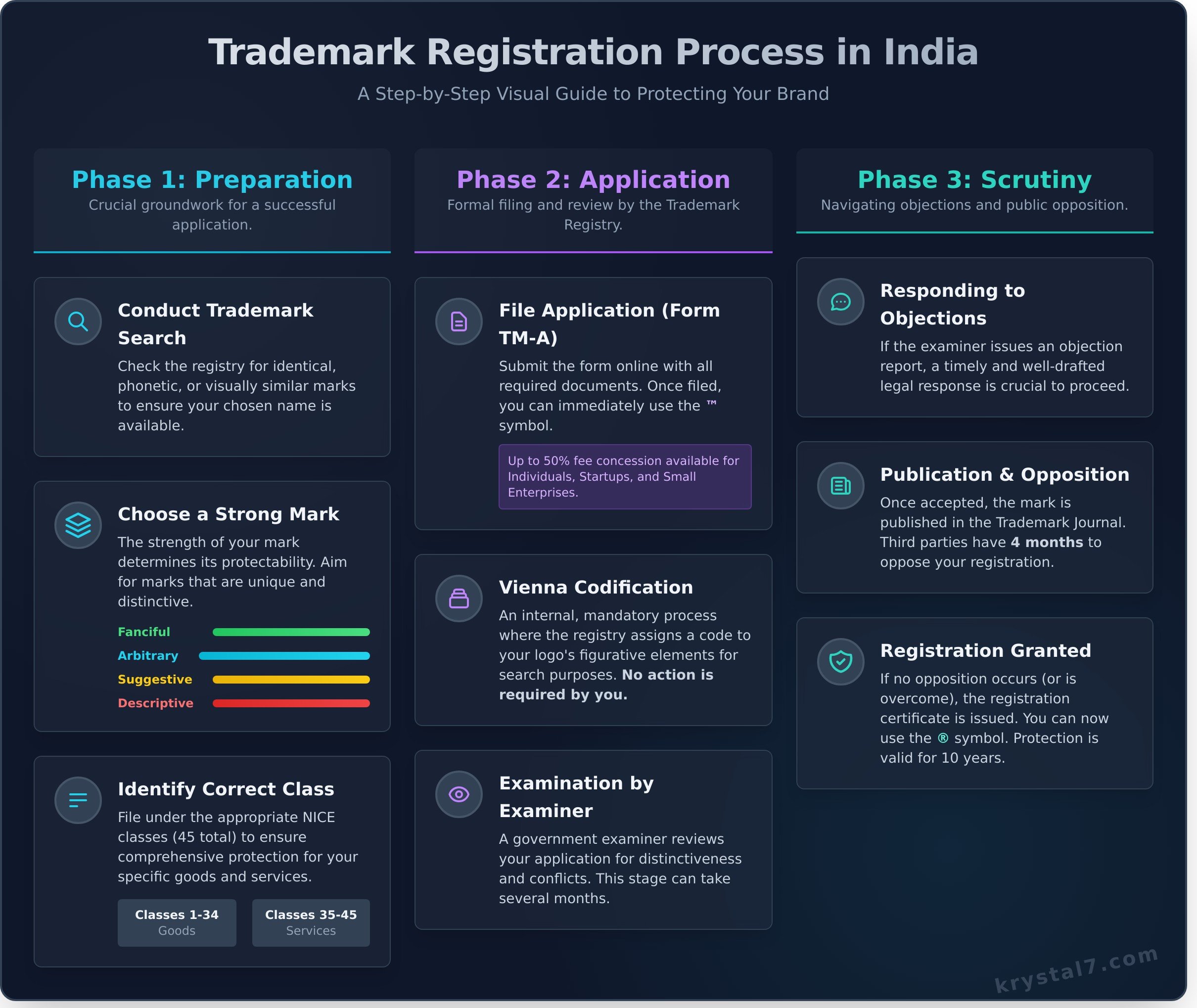
The strength of your trademark directly impacts its ability to be registered and defended. The spectrum of trademark strength is a core concept within Indian Trademark Law and is generally categorized as follows:
- Fanciful: Coined words with no dictionary meaning (e.g., Kodak, Xerox). These are the strongest.
- Arbitrary: Real words with no connection to the product (e.g., Apple for computers).
- Suggestive: Marks that hint at a product’s quality without directly describing it (e.g., Netflix for internet-based movie streaming).
- Descriptive: Words that directly describe the product or service (e.g., “Creamy Ice Cream”). These are weak and often difficult to register.
Aim for a fanciful, arbitrary, or suggestive mark to streamline your registration and build a more defensible brand.
Identifying the Correct Trademark Class
Trademarks are registered for specific goods or services under the NICE Classification system, which is an international standard. This system is divided into 45 classes: Classes 1-34 cover goods, and Classes 35-45 cover services. You must file your application in every class relevant to your business operations to ensure comprehensive protection. For example, a business that manufactures and sells clothing would file under Class 25 (Apparel), but if they also operate retail stores, they would need to file under Class 35 (Retail Services) as well.
Phase 2: The Application Journey – Filing and Examination
Once your comprehensive trademark search gives you the green light, you are ready to begin the formal application. This phase is where your brand identity moves from a concept to a documented legal claim, setting in motion the official trademark registration process in India. Your application is filed with the Office of the Controller General of Patents, Designs and Trade Marks. The government filing fees are structured to support growth, offering significant concessions (up to 50% off) for individuals, startups, and small enterprises compared to larger companies.
Step 1: Filing the Application (Form TM-A)
This is the foundational step where your claim is officially staked. The application is submitted using Form TM-A, which can be done online through the official Intellectual Property India portal. Providing meticulous and accurate details is critical for a smooth journey. Key requirements include:
- Applicant Details: Full name, address, and legal status (e.g., individual, LLP, Private Limited Company).
- The Mark: A clear, high-resolution image of the logo or device, or the exact wordmark.
- Class and Description: The specific NICE class(es) of goods or services your mark protects, along with a precise description.
- Supporting Documents: Proof of identity and address, the logo file (if applicable), and a User Affidavit if claiming prior use.
If your brand has been in use before the filing date, it is vital to claim a ‘date of first use’ and support it with evidence. This can significantly strengthen your application. Once your form is submitted and an application number is generated, you can immediately begin using the ™ symbol with your brand, signaling your ownership claim to the world.
Step 2: Vienna Codification
If your trademark includes a logo, symbol, or any figurative element, it will undergo Vienna Codification. This is a mandatory, internal procedure managed by the Trademark Registry and requires no action from you. It involves assigning a specific international code to the visual components of your mark. This standardized classification system is essential as it helps the examiner conduct more thorough and accurate searches for graphically similar marks, ensuring your unique visual identity is properly vetted.
Step 3: Examination by the Trademark Examiner
After filing, your application enters the critical examination stage. A government Trademark Examiner is assigned to review your submission for compliance with the Trade Marks Act, 1999. The examiner’s review focuses on two key areas: distinctiveness (is the mark capable of distinguishing your goods/services?) and potential conflicts with existing or pending trademarks. This meticulous stage can take several months. The outcome is either a straightforward acceptance for publication or the issuance of an Examination Report detailing objections that must be professionally addressed within a specific timeframe.
Phase 3: Navigating Objections, Publication, and Opposition
Once your trademark application passes the initial formalities check, it enters a critical phase of scrutiny. This stage tests the legal strength of your mark and is a vital part of the complete trademark registration process in India. While receiving an objection or opposition can seem like a setback, these are common hurdles. With a clear strategy and expert guidance, they are entirely manageable. The goal here is to provide the Trademark Registry with compelling reasons why your brand deserves legal protection.
Success in this phase hinges on timely, well-drafted responses that address the government examiner’s and the public’s concerns with legal precision. This is where professional expertise brings clarity to complexity, ensuring your application stays on track.
Responding to an Examination Report (Objection)
After a detailed review, the Trademark Examiner may issue an Examination Report citing objections. This is not a rejection but a request for clarification. The most common grounds for objection include:
- Absolute Grounds: The examiner believes the mark is descriptive of the goods/services (e.g., “SWEET” for sugar) or lacks distinctiveness.
- Relative Grounds: The mark is found to be identical or confusingly similar to an existing registered trademark.
A formal reply, presenting strong legal arguments and supporting evidence to counter these objections, must be filed within 30 days of the report’s issuance. If the examiner is not satisfied with the written reply, a hearing may be scheduled to present the case in person.
Publication in the Trademark Journal
If the examiner is satisfied with your application or your reply to an objection, your trademark is approved for publication. It will be advertised in the official Trademarks Journal, which is published weekly. This step makes your claim public, inviting anyone who believes your mark could harm their own business or rights to oppose it. The journal is accessible to everyone via the Official IP India Portal, ensuring a transparent process.
Handling a Third-Party Opposition
Following publication, any third party has a four-month window to file a notice of opposition against your registration. This initiates a formal legal proceeding. As the applicant, you are required to file a counter-statement within two months of receiving the opposition notice. This process is more complex than an objection, often involving the submission of evidence and attending hearings. It requires meticulous legal handling to defend your mark’s validity. Navigating this adversarial stage without expert support can be overwhelming. Let our experts handle complex objections and oppositions for you, giving you the freedom to focus on your business.
Phase 4: Registration and Beyond – Maintaining Your Trademark
Congratulations! Reaching this final stage means you have successfully navigated the complexities of the examination and publication phases. Completing the trademark registration process in India is a monumental step in protecting your brand’s identity. Your mark is no longer just an idea; it is a legally recognised and valuable business asset. However, securing the registration is the beginning, not the end, of your brand protection journey. Maintaining your trademark requires ongoing diligence to ensure its continued validity and strength.
Receiving the Registration Certificate
Once your application clears all objections and oppositions, the Trademark Registry issues the final registration certificate. This is your official proof of ownership, providing you with crystal-clear legal authority over your brand. The certificate is now issued digitally and can be downloaded directly from the official portal.
- Legal Proof: The certificate formally confirms your ownership and the validity of your trademark across India.
- Use of the ® Symbol: You can now legally use the registered trademark symbol (®) next to your brand name or logo, signalling to competitors that your mark is protected by law.
- Validity Period: Your trademark registration is valid for a period of 10 years, calculated from the original date of your application.
The Trademark Renewal Process
Trademark rights are not granted in perpetuity. To keep your brand’s legal protection active, you must renew your trademark every 10 years. This is a critical step to prevent your rights from lapsing. The renewal application (Form TM-R) can be filed within one year before the expiry date of the registration. Failing to renew on time can lead to the removal of your mark from the Trademark Register. While restoration is possible for a limited period after expiry, it is a more complex and significantly costlier process. Proactive renewal is the most streamlined and cost-effective approach.
Protecting Your Brand from Infringement
Your registration certificate is your shield and sword in the marketplace. It provides the legal foundation to defend your brand against unauthorized use. Active brand protection involves monitoring the market for potential infringements-competitors using a mark that is confusingly similar to yours. If you identify an infringement, your registered status empowers you to:
- Send a formal Cease and Desist notice to the infringing party.
- File a lawsuit for trademark infringement to seek damages and an injunction.
Vigilance ensures that the value and integrity you’ve built into your brand remain exclusively yours. For a hassle-free approach to renewals and infringement monitoring, the expert team at Krystal7 provides dedicated support, giving you the freedom to focus on your business growth.
From Vision to Valuable Asset: Finalizing Your Trademark Registration
Navigating the trademark registration process in India is a journey of diligence. From the crucial initial search and preparation to filing the application and managing potential objections, each step is vital in transforming your brand name into a legally protected asset. This guide has shown that with a clear strategy, securing your trademark is an achievable and essential goal for any serious business vision.
While the path is clear, it doesn’t have to be complex. Krystal7 is here to provide the clarity you need. With a dedicated advisor managing your application, you get expert guidance from Chartered Accountants and legal strategists every step of the way. Our commitment to Krystal-Clear pricing means no hidden costs-just a streamlined, hassle-free experience that gives you the freedom to focus on your vision.
Your brand is your legacy; don’t leave its protection to chance. Secure your brand’s future. Start your trademark registration with Krystal7 today!
Frequently Asked Questions
How long does the entire trademark registration process take in India?
The entire trademark registration process in India is a multi-stage journey that typically takes between 8 to 12 months, provided there are no objections or oppositions. After filing, the initial examination can take 2-4 months. This is followed by a mandatory 4-month journal publication period for public opposition. Our streamlined approach ensures every step is handled efficiently, giving you clarity on the timeline and minimizing potential delays for your brand’s protection.
What is the difference between the ™ and ® symbols?
The ™ symbol can be used as soon as you start using your brand name or logo in commerce, even before filing an application. It signals your claim of ownership over an unregistered mark. In contrast, the ® symbol signifies official registration and can only be used after the Trademark Registry has issued the registration certificate. Using the ® symbol for an unregistered mark is illegal in India and carries penalties. It represents the highest level of legal protection.
Can I register a trademark myself without a lawyer or agent?
While it is technically possible for an individual to file a trademark application directly through the government’s online portal, the process can be complex. It involves nuanced steps like conducting a comprehensive search, selecting the correct class, and drafting a legally sound response to any objections from the examiner. Engaging an expert ensures these critical steps are handled correctly, saving you time and avoiding common pitfalls that could jeopardize your application and your brand’s future.
What are the government fees for trademark registration in India?
The government fees for trademark registration in India are structured to support smaller ventures. For individuals, startups, and small enterprises (MSMEs), the e-filing fee is ₹4,500 per class. For all other applicants, including companies and LLPs, the government fee is ₹9,000 per class. It is crucial to select the correct applicant type to ensure compliance and avoid any issues with your filing. These are statutory fees and do not include professional service charges.
What happens if my trademark application is rejected?
An objection from the Trademark Registry is not a final rejection. You will have an opportunity to file a formal reply to the examination report, presenting legal arguments to overcome the objection. If the reply is not sufficient, a hearing may be scheduled. In cases of third-party opposition, a more formal legal process begins. Having expert legal strategists on your side is critical at this stage to build a strong case and secure your brand’s registration.
Can I register a trademark for my business name and my logo in one application?
Your business name (wordmark) and your logo (device mark) are treated as separate intellectual assets and require separate trademark applications. You cannot combine them into a single filing. Registering your wordmark protects the name itself in any font or style, while registering the logo protects its specific visual design. For the most robust brand protection, we often advise clients to secure both, creating a comprehensive shield for their brand identity.
How can I check the status of my trademark application online?
You can track the status of your trademark application with complete transparency through the official IP India public search portal. Simply enter your unique application number to view the current stage of the process, from examination to publication and registration. While the portal is accessible to everyone, our team proactively monitors your application status, ensuring that any required actions are taken promptly, giving you the freedom to focus on your business without worry.

Article by
Nihal Srivastava
Nihal Srivastava is the Co-Founder of Krystal7 Consultants, helping Indian entrepreneurs and startups navigate company registration, compliance, trademark protection, and regulatory requirements with clarity and confidence. With 6+ years of hands-on expertise in MCA filings, GST compliance, and corporate structuring, Nihal has guided 1000+ businesses across India through their legal and compliance journeys. He believes every business dream deserves crystal clear foundations, and that no founder should be held back by paperwork or red tape.