

Key Clauses in a Shareholders Agreement: A Krystal-Clear Guide for Indian Founders (2026)
What if your dream venture is suddenly derailed because a co-founder decides to exit with half your equity after just six months of operations? For many Indian entrepreneurs, the fear of losing control to investors or being ousted by partners is a constant source of anxiety. It’s understandable to feel overwhelmed when trying to distinguish between your Articles of Association and the specific key clauses in a shareholders agreement that actually protect your interests under the Companies Act, 2013.
We agree that you shouldn’t have to be a legal expert to safeguard your life’s work. Our promise is to help you master these essential legal safeguards, providing the freedom to focus on your business growth without the constant worry of dilution or board disputes. You deserve to build your legacy on a foundation of absolute clarity and professional security.
This guide offers a clear roadmap of your rights and obligations as a founder navigating the 2026 business landscape. We will walk you through the protective mechanisms that ensure long term stability, from vesting schedules to exit rights, so you can scale your Private Limited company with total confidence.
Key Takeaways
- Discover how to layer a private Shareholders Agreement over your public Articles of Association to create a custom legal shield for your Indian startup.
- Master the key clauses in a shareholders agreement that empower founders to maintain governance control and board seats regardless of shareholding percentages.
- Protect your cap table from unwanted competitors by implementing Right of First Refusal (ROFR) and other strategic share transfer restrictions.
- Safeguard your ownership stake during future funding rounds with anti-dilution and pre-emptive rights specifically tailored for the Indian market.
- Learn high-stakes deadlock resolution techniques to ensure your business never grinds to a halt during 50/50 shareholder disagreements.
What is a Shareholders Agreement and Why is it Essential in India?
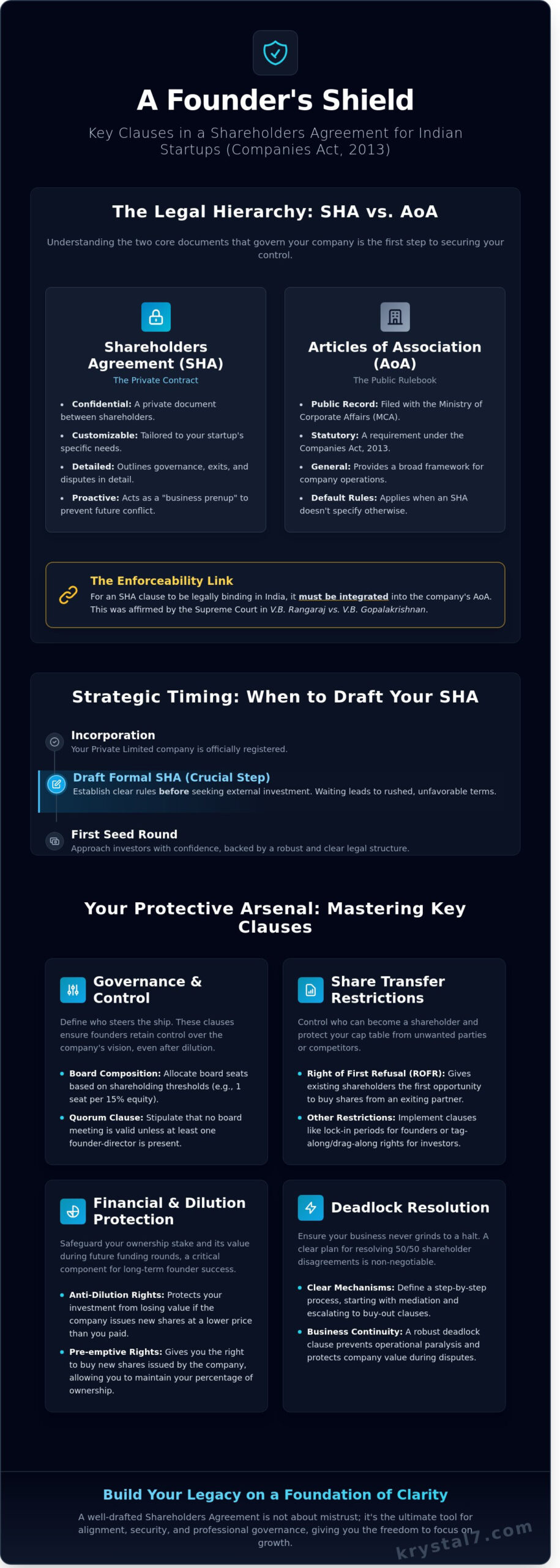
A Shareholders Agreement (SHA) is your company’s roadmap for internal governance. While the Companies Act, 2013 provides a broad legal framework, it often lacks the granular detail required for complex founder-investor dynamics. Think of the SHA as a private contract that defines how your company is managed and how decisions are made. It acts as a business prenup, outlining exit strategies and dispute resolution paths before emotions run high. By defining key clauses in a shareholders agreement early on, you secure the transparency needed to attract serious capital.
This document supplements your statutory filings. It provides specific protections that standard government templates don’t offer. Without a clear SHA, you’re relying on the default provisions of Indian law, which might not align with your long-term vision. Transparency isn’t just a word for us; it’s the foundation of your business legacy. We handle the complexity so you can pursue your passion with confidence.
SHA vs. Articles of Association (AoA): The Hierarchy
Your Articles of Association (AoA) are public documents filed on the Ministry of Corporate Affairs (MCA) portal. Anyone can download them for a small fee. In contrast, the SHA remains a confidential document between parties. In India, the legal hierarchy is strict. The Supreme Court of India ruled in the V.B. Rangaraj vs. V.B. Gopalakrishnan case (1992) that any restriction in an SHA is only enforceable if it’s also part of the AoA. To ensure your agreement has teeth, you must amend your AoA to reflect these private terms. This step eliminates the red tape that often stalls future funding rounds.
When Should You Draft Your SHA?
Timing is everything for Indian founders. You should draft your SHA immediately after incorporation but before your first external seed round in INR. Waiting until an investor is at the door often leads to rushed decisions and lopsided terms. A simple Founders Agreement works for the initial months, but a formal SHA is needed as soon as equity starts shifting. Early drafting removes the guesswork from your relationship. It prevents co-founder disputes that could otherwise derail your venture. Setting clear expectations now gives you the freedom to focus on scaling your business.
An effective SHA provides several layers of security for your startup:
- Protects minority shareholders from being sidelined during major decisions.
- Defines clear exit routes for founders and investors to avoid legal deadlocks.
- Establishes a methodical process for share transfers and valuation.
- Ensures key clauses in a shareholders agreement are legally binding through AoA alignment.
Establishing these rules early creates a culture of accountability. It shows potential investors that your startup is built on a foundation of crystal clarity. When your legal house is in order, you can pitch with the assurance that your internal structure is robust and ready for growth.
Governance and Decision-Making: Maintaining Control
Governance defines who steers your startup when the stakes get high. It separates day-to-day operations managed by the Board from fundamental shifts decided by shareholders. These key clauses in a shareholders agreement ensure that founders don’t lose their grip on the company’s vision as they scale and bring in external capital.
A vital safeguard is the “Quorum” clause. In India, the Companies Act 2013 requires a minimum number of directors to be present for a valid meeting. You should stipulate that no meeting is valid unless at least one founder is present. This prevents investors from holding “surprise” meetings to pass resolutions in your absence.
Maintaining a voice after dilution requires foresight. Even if your equity drops below 51%, specific contractual rights can keep you in the driver’s seat. You can work with a legal strategist to draft protective provisions that keep your vision intact during every funding round.
Board Composition and Appointing Directors
Your agreement should clearly state how many seats exist on the Board. Usually, founders and lead investors nominate directors based on specific shareholding thresholds. For example, you might grant one board seat for every 10% or 15% of equity held. This creates a balanced power structure between capital and execution.
Removing a director can become a legal hassle under Section 169 of the Companies Act. To avoid this, include a clause that allows a shareholder to remove their own nominee without needing a full shareholder vote. Many early-stage Indian investors also request “Observer” seats. These individuals attend meetings but don’t have voting rights; they provide transparency without cluttering the decision-making process.
Veto Rights and Reserved Matters
Reserved matters are the “red button” issues that require your explicit consent or a super-majority vote. These key clauses in a shareholders agreement protect the company from unilateral decisions by any single dominant party. Common reserved matters in the Indian context include:
- Changing the primary line of business or entering entirely new sectors.
- Taking on debt or loans exceeding a specific INR limit, such as 50 Lakhs.
- Amending the Articles of Association (AoA) or Memorandum of Association (MoA).
- Appointing or firing “Key Managerial Personnel” like the CEO or CFO.
The goal is a delicate balance. You need the freedom to focus on growth while giving minority investors enough transparency to feel secure. Setting these boundaries early prevents future friction and keeps the focus on building a lasting legacy.
Share Transfer Restrictions: Right of First Refusal and More
Founders often worry about an unwanted partner entering their business without consent. Share transfer restrictions ensure you maintain control over who sits at your table. You don’t want your equity falling into a competitor’s hands because a disgruntled partner decided to exit. These provisions are among the most vital key clauses in a shareholders agreement for maintaining long term stability.
ROFR and ROFO: The First Line of Defense
The Right of First Refusal (ROFR) and Right of First Offer (ROFO) are your primary tools for internal control. Under ROFR, if a shareholder receives an external offer, they must first offer those shares to existing partners at the same price. ROFO works differently; the seller must offer the shares to you before they even approach an outside buyer. This gives you the chance to consolidate ownership before the market gets involved.
- Valuation mechanisms: We recommend using a Chartered Accountant to perform a Fair Market Value assessment in INR. This ensures the price is grounded in reality and complies with the Companies Act, 2013.
- Timeline requirements: Agreements should specify a strict response period, typically 30 days. If partners don’t respond within this window, the seller is free to proceed with the external buyer.
- Compliance: These transfers must align with the Articles of Association (AoA) to be legally binding under Indian law.
Tag-Along and Drag-Along: Exit Clarity
Exit rights define how everyone leaves the business, whether it’s a partial sale or a total buyout. Tag-along rights protect the “little guy” by allowing minority shareholders to join a sale initiated by a majority holder. If a founder sells their 40% stake, the minority shareholder can insist their shares are bought on the same terms. This prevents smaller partners from being trapped with a new, unknown majority owner they didn’t choose.
Drag-along clauses are essential for any Private Limited Company India seeking a 100% exit via M&A. Most acquirers want total control and won’t buy a company if a 2% shareholder refuses to sell. A drag-along clause allows the majority to “drag” the minority into the deal. To ensure fairness, we always include a “Floor Price.” This serves as a financial safety net, ensuring founders aren’t forced to sell their equity at a price that doesn’t reflect the company’s true value. Including these key clauses in a shareholders agreement provides the clarity you need to scale without fear of internal roadblocks during an exit.
Financial Protections and Restrictive Covenants
Protecting your equity isn’t just about the initial valuation. It’s about how your stake behaves when the market shifts or new investors enter. These key clauses in a shareholders agreement act as a financial shield for founders, ensuring your hard work translates into long-term value. Without these protections, your ownership could vanish during complex funding cycles.
Anti-Dilution: Full Ratchet vs. Weighted Average
Down rounds occur when a startup raises funds at a lower valuation than the previous round. A “Full Ratchet” clause is aggressive. It resets the investor’s share price to the new lower price regardless of how much capital was actually raised. This can severely dilute founder equity. We recommend seeking a “Broad-based Weighted Average” for most Indian startups. This method uses a mathematical formula to account for the total shares outstanding, making the impact on your cap table much fairer. You’ll need elite expertise to negotiate these terms with VC firms to ensure you don’t lose control of your vision.
- Full Ratchet: Adjusts the conversion price to the lowest price in any subsequent round.
- Weighted Average: Considers the number of shares issued and the price, providing a balanced adjustment.
- Pre-emptive Rights: These grant you the right to participate in future equity issuances to maintain your current percentage.
Enforceability of Non-Compete Clauses in India
Founders must understand the legal boundaries of restrictive covenants under Indian law. Section 27 of the Indian Contract Act, 1872, generally prohibits agreements that restrain someone from exercising a lawful profession or trade. Indian courts typically find post-termination non-compete clauses void and unenforceable. However, non-compete restrictions “during employment” are valid and strictly enforced. To bypass legal red tape, we focus on drafting robust “Non-solicitation” clauses for employees and clients.
These clauses prevent former partners from poaching your talent or customer base for a specific period, often 12 to 24 months. By securing your intellectual property through these mechanisms, you gain the freedom to focus on growth without fearing internal betrayal. It’s a vital part of the key clauses in a shareholders agreement that keeps the company’s core assets secure.
Profit sharing also requires transparency. Your agreement should define how dividends are declared after meeting statutory reserves under the Companies Act, 2013. While most growth-stage startups reinvest profits, a clear policy prevents future disputes between majority and minority shareholders. This methodical approach brings the clarity you need to build a lasting legacy.
Confused about how these protections affect your cap table? Get expert financial advisory to secure your founder rights today.
Dispute Resolution and Deadlock Mechanics
Business partners don’t always see eye to eye. When two founders hold an equal 50% stake, a single disagreement can paralyze the entire company. This is why dispute resolution ranks among the most critical key clauses in a shareholders agreement. Without a clear roadmap, a deadlock can lead to frozen bank accounts and missed payroll deadlines.
Standard escalation paths provide a structured way to breathe. Most agreements start with a mandatory “Good Faith Discussion” period of 15 to 30 days. If the founders can’t reach a consensus, the matter moves to formal mediation. A neutral third party helps find middle ground before the situation turns into an expensive legal battle.
Deadlock Resolution: The “Shotgun” Clause
The “Shotgun” clause, also known as “Russian Roulette,” is a high-stakes exit strategy. Shareholder A offers to buy Shareholder B’s stake at a specific price. Shareholder B then has two choices. They can either sell their shares at that price or turn around and buy Shareholder A’s shares at that exact same valuation.
This mechanism forces both parties to propose a Krystal-Clear fair price. You won’t suggest a lowball figure if you might be forced to sell your own shares at that same low price. It’s a definitive way to end a deadlock, though it usually results in one founder leaving the company. For smaller operational ties, you might prefer a “Chairman’s Casting Vote” where one designated director has the final say to keep the business moving.
Arbitration and Governing Law
Indian civil courts are famous for backlogs that can last over a decade. Krystal7 recommends avoiding traditional litigation entirely. Instead, specify arbitration under the Arbitration and Conciliation Act, 1996. This ensures your disputes are handled by experts in a private, time-bound setting.
You must clearly define the “Seat” and “Venue” of arbitration in your document. Many NCR-based startups choose Gurugram or Delhi because of the proximity to the Punjab and Haryana High Court or the Delhi High Court. Having a local seat reduces travel costs and provides access to top-tier legal strategists. This level of planning gives you the freedom to focus on scaling your venture while your interests remain protected.
Drafting these key clauses in a shareholders agreement requires a methodical approach to protect your legacy. To ensure your founders’ agreement is robust and compliant with the Companies Act, 2013, contact the experts at Krystal7 Consultants. Reach out to us at business@krystal7.com or visit krystal7.com to secure your business future today.
Secure Your Startup Legacy with a Krystal-Clear SHA
Building a successful Private Limited company in India requires more than just a great product. It demands a robust legal framework that protects your equity and defines how your venture navigates growth or internal conflict. By mastering the key clauses in a shareholders agreement, you ensure that governance, share transfers, and deadlock mechanics are handled with precision under the Companies Act 2013.
These legal safeguards prevent expensive litigation in Indian courts and provide the transparency that institutional investors demand. You’ve worked hard to build your vision; don’t let it be derailed by avoidable disputes or vague verbal agreements. A solid SHA gives you the freedom to focus on what matters most, which is scaling your business.
Don’t leave your business dream to chance. Krystal7 Consultants provides specialized advisory for Indian startups and SMEs through a team of top-tier Chartered Accountants and legal strategists. We offer transparent, upfront pricing with no hidden costs to ensure your compliance is seamless and stress-free.
For expert assistance in drafting a Krystal-clear SHA, contact Krystal7 Consultants at business@krystal7.com or visit krystal7.com today. Your journey toward a secure and scalable future starts with the right partner by your side.
Frequently Asked Questions
Is a Shareholders Agreement mandatory for a Private Limited Company in India?
A Shareholders Agreement is not legally mandatory under the Companies Act 2013. While the Articles of Association (AoA) are compulsory for every company, the SHA is a private contract that provides krystal-clear transparency on internal management. Most Indian startups use an SHA to define specific rights like exit options and board representation that the standard AoA might not cover.
Can an SHA override the Companies Act, 2013?
No, a Shareholders Agreement cannot override the statutory provisions of the Companies Act 2013. Section 6 of the Act states that the law prevails over any agreement or company charter. If any of the key clauses in a shareholders agreement contradict the Act, those specific provisions become legally void and unenforceable in Indian courts.
What is the difference between a Founders Agreement and an SHA?
A Founders Agreement is a preliminary document signed during the early stages to outline initial roles and equity splits among the core team. An SHA is a comprehensive document usually signed when external investors join the company. The key clauses in a shareholders agreement focus on long term governance, protective provisions, and detailed exit rights for all stakeholders.
How much stamp duty is required for a Shareholders Agreement in Haryana?
In Haryana, a Shareholders Agreement is typically executed on non-judicial stamp paper of INR 100 under the Indian Stamp Act as applicable to the state. If the agreement includes a transfer of shares or property, the duty might vary based on the transaction value. You should ensure the document is properly stamped to make it admissible as evidence in court during a dispute.
What happens if a shareholder breaches the agreement?
If a shareholder breaches the agreement, the non-defaulting parties can seek legal remedies like monetary damages, injunctions, or specific performance. Many Indian SHAs include a “Call Option” or “Buy-Back” clause that forces the breaching party to sell their shares at a discounted price. These penalties help maintain discipline and protect the company’s vision from internal disruptions.
Can we change the key clauses in a shareholders agreement after it is signed?
Yes, you can modify any clause in the agreement through a written amendment or a supplementary deed. All parties who signed the original document must provide their written consent for these changes to take effect. After signing the amendment, it’s essential to update the company’s Articles of Association to ensure the new terms are consistent with the company’s charter.
Does the SHA need to be registered with the Registrar of Companies (ROC)?
You don’t need to file the actual Shareholders Agreement with the ROC or the Ministry of Corporate Affairs (MCA). However, you must incorporate the relevant clauses into the company’s Articles of Association and file Form MGT-14 on the MCA portal within 30 days. This step is critical because Indian courts often rule that clauses not included in the AoA aren’t binding on the company.
For expert assistance with your company compliance and legal documentation, contact Krystal7 Consultants at business@krystal7.com or visit krystal7.com today.

Article by
Nihal Srivastava
Nihal Srivastava is the Co-Founder of Krystal7 Consultants, helping Indian entrepreneurs and startups navigate company registration, compliance, trademark protection, and regulatory requirements with clarity and confidence. With 6+ years of hands-on expertise in MCA filings, GST compliance, and corporate structuring, Nihal has guided 1000+ businesses across India through their legal and compliance journeys. He believes every business dream deserves crystal clear foundations, and that no founder should be held back by paperwork or red tape.