

Penalty for Late Filing of Form ADT-1: A Complete 2026 Compliance Guide
On October 16, 2026, a Gurgaon-based tech founder logged into the MCA V3 portal only to find a penalty for late filing of form adt-1 that had quadrupled overnight. This scenario is becoming increasingly common as the Ministry of Corporate Affairs automates its compliance checks. You didn’t start your business to spend your nights deciphering statutory fee slabs or worrying about non-compliance flags on your master data.
We agree that the shift from optional to mandatory filings in 2025 has added a layer of complexity that feels like a distraction from your core mission. You deserve the freedom to focus on scaling your venture without the constant fear of heavy compounding fines. This guide promises to show you exactly how to calculate your late fees and navigate the technicalities of the MCA V3 portal with confidence.
We will explore the specific 2026 filing timelines, the slab-wise penalty structures, and the long-term impact of non-compliance on your business credibility. By the end of this article, you will have a clear roadmap to regularize your filings and secure your company’s status.
Key Takeaways
- Understand why Form ADT-1 is the legal foundation of your company’s financial transparency under Section 139(1) of the Companies Act.
- Master the “15-Day Rule” to ensure you file before the penalty clock starts ticking after your AGM or Board Meeting.
- Learn how to calculate the exact penalty for late filing of form adt-1 based on your share capital and the duration of the delay.
- Discover how a missing ADT-1 filing can block your Annual Returns and lead to additional fines of up to ₹5,00,000 under Section 147.
- Find out how to regularize back-dated filings through the MCA V3 portal to restore your company’s “Active” compliance status.
Understanding Form ADT-1 and the Requirement for Auditor Appointment
Form ADT-1 is the official communication your company sends to the Registrar of Companies (ROC) to announce the appointment of a statutory auditor. Under Section 139(1) of the Companies Act, 2013, every company must inform the government who is responsible for verifying their financial health. While your auditor provides the consent letter and eligibility certificate, the legal burden to file this form rests solely on the company directors. If you miss the deadline, your business faces a steep penalty for late filing of form adt-1 which increases with every month of delay. Since the launch of the MCA V3 portal, these filings are processed with automated checks that flag non-compliance instantly.
Is Form ADT-1 Mandatory for Every Indian Company?
Many founders mistakenly believe that “Small Companies” or One Person Companies (OPCs) are exempt from this requirement. This is a risky misconception. Whether you run a massive Public Limited firm or a two-director Private Limited startup, filing ADT-1 is mandatory. The Companies (Audit and Auditors) Amendment Rules, 2025, which took effect on July 14, 2025, clarified that the appointment of the very first auditor must be reported. You must file this form every time you appoint an auditor for a five-year term or fill a casual vacancy. There are no exemptions based on turnover or paid-up capital for this specific compliance.
Why the Ministry of Corporate Affairs Tracks This Form
The Ministry of Corporate Affairs (MCA) tracks this form to ensure every registered entity maintains financial accountability through independent oversight. By requiring a digital filing within 15 days of the appointment, the MCA prevents companies from back-dating auditor selections to cover up financial discrepancies. Once filed, the auditor’s details appear on your company’s public Master Data. This transparency is vital for building trust with banks, vendors, and investors. Failing to keep this record updated doesn’t just lead to a penalty for late filing of form adt-1; it can also block you from filing your annual financial statements (AOC-4). This effectively freezes your compliance status and makes your business look unreliable to external stakeholders during due diligence.
Filing Timelines: When Does the Penalty Clock Start Ticking?
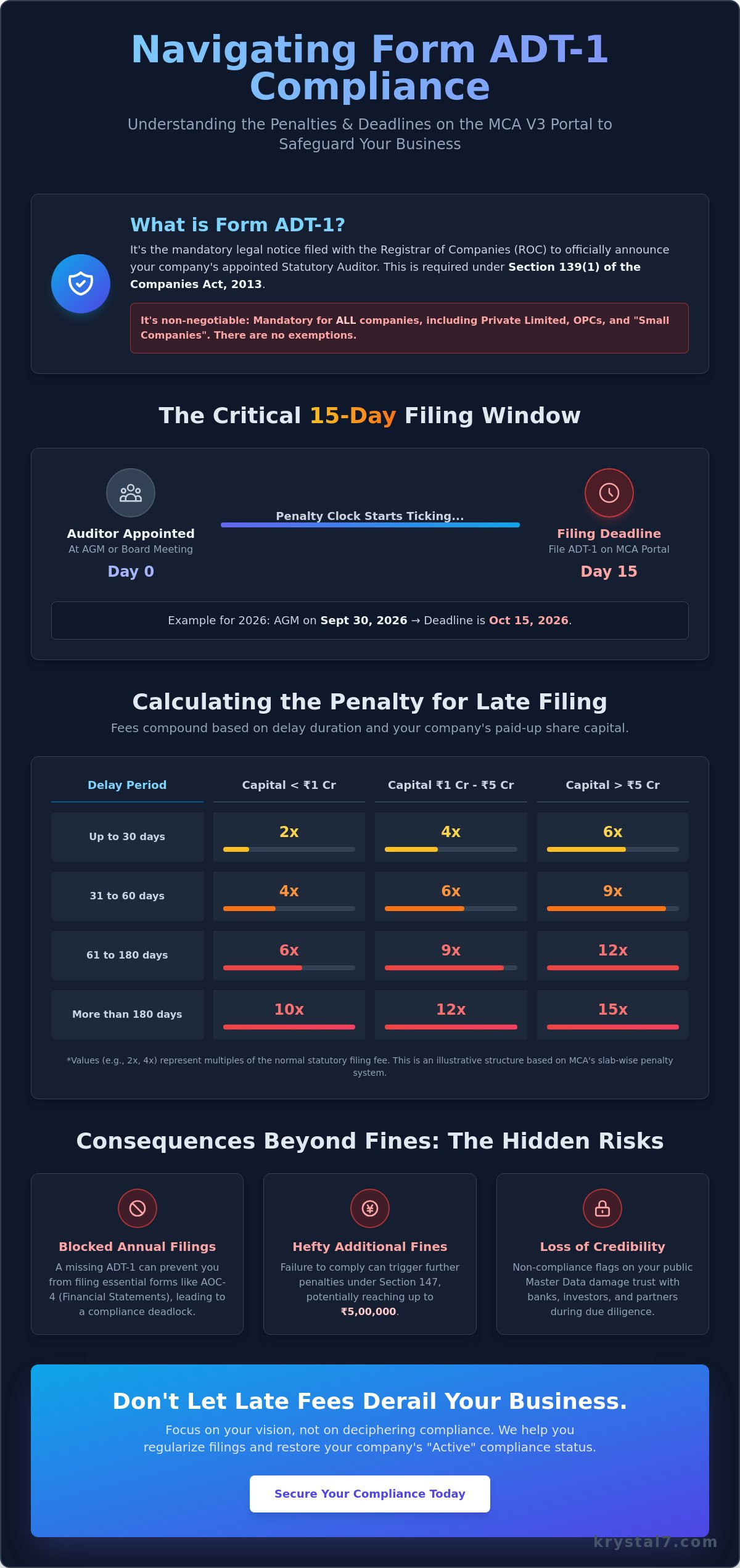
The 15 day countdown is the most critical window in your annual compliance calendar. The clock starts the moment the resolution to appoint or re-appoint your auditor is passed. For most Indian companies, the Ministry of Corporate Affairs (MCA) mandates that Form ADT-1 must be filed within 15 days of the meeting where the appointment occurred. If your company’s Annual General Meeting (AGM) concludes on September 30, 2026, your digital filing must be completed by October 15, 2026. Failing to meet this deadline triggers an automatic penalty for late filing of form adt-1, which scales upward based on the duration of the delay.
Managing these dates requires precision because the MCA V3 portal doesn’t grant extensions for local holidays or weekends if they fall at the end of your 15 day window. It’s always safer to file within the first week of appointment to account for potential portal downtime or technical glitches. If you find the portal’s technicalities confusing, our team offers streamlined compliance support to keep your corporate records spotless and stress-free.
The Difference Between First and Subsequent Auditor Filing
The timeline for a newly incorporated company differs slightly from an established one. For a new venture, the Board of Directors must appoint the first auditor within 30 days of registration. Once that Board Meeting concludes, you have exactly 15 days to file Form ADT-1. For subsequent auditors, the appointment happens at the AGM. While the first auditor stays in office until the conclusion of the first AGM, subsequent auditors are usually appointed for a five year term. Missing that initial 15 day window after the AGM immediately labels your filing as “Late,” leading to avoidable costs.
Calculating Your Deadline for 2026
For the 2026 filing season, most companies with a March 31, 2026, year-end will hold their AGMs by September 30, 2026. This makes October 15, 2026, the most common deadline for Indian entrepreneurs. The “date of appointment” is the legal trigger for the 15 day countdown, regardless of when the auditor actually signs the engagement letter. If the MCA portal experiences significant outages, the government occasionally issues circulars to extend deadlines, but you shouldn’t rely on these rare exceptions. A proactive approach is the only way to avoid the penalty for late filing of form adt-1 and maintain your company’s “Active” status in the government database.
Calculating the Penalty for Late Filing of Form ADT-1
Understanding the math behind MCA fines is the first step toward regaining control over your company’s compliance health. The Ministry of Corporate Affairs distinguishes between two types of payments: the “Normal Filing Fee” and the “Additional Fee.” While the normal fee is a small administrative charge, the additional fee represents the actual penalty for late filing of form adt-1. This penalty isn’t a fixed fine; it’s a multiplier that grows heavier the longer you wait to rectify the delay.
For most entrepreneurs, the shock comes from how quickly these costs compound. The MCA V3 portal calculates these fees automatically the moment you upload your documents. Because these are statutory fees, there’s no room for negotiation or manual waivers once the delay occurs. Knowing your authorized share capital is essential, as it determines your base cost before any multipliers are applied.
MCA Normal Filing Fee Structure (INR)
The standard government filing fee depends on the size of your company, measured by its authorized share capital. For the 2026 filing cycle, the base rates remain structured to support smaller ventures. Here is the breakdown of what you would pay if you filed within the 15 day window:
- Authorized Capital up to ₹1,00,000: ₹200.
- Authorized Capital from ₹1,00,000 to ₹4,99,999: ₹300.
- Authorized Capital from ₹5,00,000 to ₹24,99,999: ₹400.
- Authorized Capital of ₹1 Crore and above: ₹600.
Slab-Wise Additional Fees for 2026
If you miss the 15 day deadline, the government applies an “Additional Fee” based on the duration of the delay. This is where the penalty for late filing of form adt-1 becomes expensive. The multiplier is applied to the normal fee mentioned above. For example, if your normal fee is ₹300 and you are 45 days late, your total payment will include the normal fee plus 4 times that amount as a penalty.
- Delay up to 30 days: 2 times the normal filing fee.
- Delay between 30 to 60 days: 4 times the normal filing fee.
- Delay between 60 to 90 days: 6 times the normal filing fee.
- Delay between 90 to 180 days: 10 times the normal filing fee.
- Delay exceeding 180 days: 12 times the normal filing fee.
It’s vital to note that for delays reaching 360 days or more, the financial burden doesn’t just stop at the 12x multiplier. Prolonged non-compliance can lead to compounding interest and separate fines under Section 147 of the Companies Act. By addressing the filing today, you stop the clock and prevent these multipliers from draining your business capital.
Consequences Beyond Fines: Risks of Non-Compliance
While the financial penalty for late filing of form adt-1 is frustrating, the operational paralysis it causes is far more dangerous. The MCA V3 portal operates on a linked logic where one missing link breaks the entire chain. If you haven’t filed ADT-1 to record your auditor’s appointment, the system will physically block you from submitting your Annual Financial Statements (AOC-4) and Annual Returns (MGT-7). This creates a compliance bottleneck that can lead to your company being flagged as “Non-compliant” in public records.
Maintaining a clean record is a core part of your Annual Compliance for Private Limited Company obligations. Beyond the system blocks, Section 147 of the Companies Act imposes heavy personal burdens on the leadership. The company faces fines ranging from ₹25,000 to ₹5,00,000, while every officer in default can be personally fined between ₹10,000 and ₹1,00,000. These aren’t just corporate expenses; they are legal stains on a director’s professional history that don’t just disappear after payment.
Impact on Funding and Business Credibility
Investors and venture capitalists perform rigorous due diligence before signing a term sheet. They look for “Krystal-Clear” transparency in your MCA Master Data. If they see a history of missed filings or a “Non-compliant” status, it signals poor governance and high risk. Similarly, banks will often reject loan applications or credit line renewals if your statutory filings aren’t up to date. A single missed form can derail a multi-crore funding round or a vital business expansion because it suggests the founders lack the meticulous nature required to scale safely.
Compounding of Offences and Prosecution
If a delay persists, the Registrar of Companies (ROC) may issue a Show Cause Notice. This is a formal legal warning demanding an explanation for the non-compliance. Ignoring the penalty for late filing of form adt-1 can eventually escalate into prosecution in special courts. To avoid this, companies must undergo a process called “Compounding of Offences,” which involves admitting the lapse and paying a settlement fee. It’s a methodical legal process that requires expert guidance to navigate successfully. Dealing with these issues early is always more cost-effective than fighting a protracted legal battle with the ROC.
If your company is currently facing portal blocks or needs to regularize back-dated filings, contact our compliance experts to restore your “Active” status immediately.
How Krystal7 Consultants Resolves Your Filing Delays
At Krystal7 Consultants, we believe that compliance shouldn’t be a source of anxiety for visionaries. Our “Freedom to Focus” approach ensures that your administrative burdens are handled by elite legal strategists and Chartered Accountants. If you’re already facing a penalty for late filing of form adt-1, we move quickly to regularize your records and restore your company’s “Active” status on the MCA V3 portal. We handle the technical glitches and paperwork so you can return to scaling your business venture.
Our expertise extends beyond just individual forms. We provide comprehensive support for every stage of your business journey, as detailed in our guide to Private Limited Company India. This holistic view allows us to spot potential compliance gaps before they become expensive legal issues. We treat your business as a legacy in the making, ensuring every statutory requirement is met with methodical precision.
Our Streamlined Compliance Process
We don’t just file forms; we build a foundation of crystal-clear transparency. Our methodical process is designed to eliminate guesswork and provide you with immediate relief from the pressures of non-compliance. We follow a structured path to get your filings back on track:
- Step 1: Comprehensive Audit: We perform a deep-dive scan of your current MCA filing status to identify any missed deadlines or pending forms.
- Step 2: Documentation Support: Our team drafts all necessary Board Resolutions, Consent Letters from auditors, and eligibility certificates required for a valid filing.
- Step 3: Secure E-filing: We manage the entire submission on the MCA V3 portal using secure Digital Signature Certificates (DSC) with expert verification to ensure zero errors.
Why Choose Gurgaon’s Leading Compliance Partner?
Krystal7 Consultants is more than a service provider; we are a genuine partner in your entrepreneurial journey. We offer transparent pricing with no hidden costs, ensuring you know exactly what you’re paying for from day one. Our relationship managers know your business vision inside out and provide the personalized advisory that a generic portal cannot offer. We handle the red tape so you can thrive in a competitive market.
Don’t let the penalty for late filing of form adt-1 drain your resources or damage your credibility with investors. Our top-tier team is ready to bring clarity to your compliance needs. Contact Krystal7 Consultants today at business@krystal7.com or visit krystal7.com for a clarity-driven consultation. Let us handle the complexity while you pursue your passion.
Secure Your Company’s Future with Seamless Compliance
Transitioning from the anxiety of technical portal glitches to the security of full compliance is a vital step for every Indian founder. By acting on the insights shared in this guide, you move beyond the risk of a penalty for late filing of form adt-1 and establish a reputation for meticulous corporate governance. This clarity doesn’t just satisfy the ROC; it builds a foundation of trust that attracts the partners and capital your venture needs to grow.
Our team at Krystal7 Consultants provides the elite Chartered Accountancy expertise and transparent upfront pricing required to maintain this high standard of excellence. We act as your dedicated compliance strategists in Gurgaon, handling the heavy lifting of statutory filings so you have the freedom to focus on your passion. We don’t just solve filing problems; we build long-term relationships based on honesty and professional precision.
Get expert help with your ADT-1 filing and avoid heavy penalties; contact Krystal7 Consultants today.
Your business dream deserves a clear path forward, and we’re here to ensure your compliance journey is smooth and secure.
Frequently Asked Questions
Can I file Form ADT-1 after the 15-day deadline has passed?
Yes, you can still file the form, but the MCA V3 portal will automatically apply an additional fee. This penalty for late filing of form adt-1 scales based on the duration of your delay, starting from 2 times the normal fee. It’s vital to file as soon as possible to stop the daily accumulation of fines and clear your company’s compliance record. Leaving the form unfiled can lead to a “Non-compliant” status on the government portal.
Is Form ADT-1 required to be filed every year for the same auditor?
No, you don’t need to file this form annually if the auditor is appointed for a standard five-year term. Under Section 139(1) of the Companies Act, an auditor typically holds office from the conclusion of one AGM until the sixth AGM. You only file a new Form ADT-1 when that five-year term expires and the auditor is re-appointed, or if you appoint a new auditor to fill a vacancy.
What documents are required to file Form ADT-1 on the MCA V3 portal?
You must prepare three primary documents in PDF format: the auditor’s written consent letter, a certificate of eligibility, and a copy of the Board or AGM resolution. The consent letter confirms the auditor is willing to accept the role. The eligibility certificate proves they aren’t disqualified under Section 141. You will also need the auditor’s PAN, membership number, and firm registration number to complete the digital entry on the portal.
Is there a penalty for late filing of ADT-1 for a One Person Company (OPC)?
Yes, One Person Companies must follow the same auditor appointment rules as Private Limited companies. There are no exemptions for OPCs or small companies regarding the filing of Form ADT-1. If an OPC misses the 15-day window, the standard penalty for late filing of form adt-1 applies. This ensures that even the smallest corporate entities maintain a transparent and verified digital trail of their statutory auditors.
Can a company change its auditor before the 5-year term expires?
Yes, but you must follow a strict legal procedure that involves more than just filing a new form. The company must first file Form ADT-2 to obtain approval from the Central Government. After receiving approval, you have 60 days to pass a special resolution in a general meeting. Only after these legal steps are completed can you appoint a new auditor and update the MCA records with a fresh ADT-1 filing.
What happens if the auditor resigns before filing Form ADT-1?
The resigning auditor is legally required to file Form ADT-3 within 30 days to explain their reasons for leaving. The company must then fill this casual vacancy by appointing a new auditor at a Board Meeting within 30 days. Once the new appointment is finalized, the company must file a fresh Form ADT-1 within 15 days. This keeps the company’s master data updated and ensures continuous financial oversight.
How much is the maximum penalty for late filing of Form ADT-1?
The maximum additional fee for the form itself is 12 times the normal filing fee for delays exceeding 180 days. However, the total financial risk is much higher due to Section 147 of the Companies Act. The company can face separate fines up to ₹5,00,000, while individual directors in default face personal penalties up to ₹1,00,000. These compounding costs make timely filing a critical priority for business owners.
Do I need a Digital Signature Certificate (DSC) to file Form ADT-1?
Yes, a valid Class 3 Digital Signature Certificate is mandatory for the director authorized to sign the form. The MCA V3 portal requires the director’s DSC to be registered and mapped to their profile before the filing can be completed. While the auditor’s digital signature isn’t required on the form itself, their scanned consent letter must be attached. Ensure your director’s DSC is active and not expired to avoid technical filing failures.

Article by
Nihal Srivastava
Nihal Srivastava is the Co-Founder of Krystal7 Consultants, helping Indian entrepreneurs and startups navigate company registration, compliance, trademark protection, and regulatory requirements with clarity and confidence. With 6+ years of hands-on expertise in MCA filings, GST compliance, and corporate structuring, Nihal has guided 1000+ businesses across India through their legal and compliance journeys. He believes every business dream deserves crystal clear foundations, and that no founder should be held back by paperwork or red tape.