

Form 3CEB Filing: A Complete Guide to Transfer Pricing Compliance in India (2026)
Would you risk 2% of your entire international transaction value on a single administrative oversight? For many Indian founders, the pressure of maintaining transparency with foreign parent companies while meeting strict tax mandates feels like a constant weight. You likely understand that Form 3CEB filing is mandatory, but the fear of a ₹1,00,000 penalty for late submission or massive fines for inaccurate data can be overwhelming.
We believe compliance should grant you freedom, not create a bottleneck. This guide will help you master the complexities of transfer pricing audits and ensure your international transactions remain fully compliant with the latest Indian tax laws. You’ll gain total clarity on Arm’s Length Price (ALP) calculations and the documentation needed to secure your business before the October 31, 2026 deadline.
We’ll explore the ₹20 crore threshold for domestic transactions, audit requirements under the new Income Tax Act framework, and practical steps to achieve a seamless filing experience.
Key Takeaways
- Understand how Section 92E of the Income Tax Act mandates a Chartered Accountant’s certification to keep your international transactions transparent and compliant.
- Determine if your business triggers the ₹20 crore threshold for domestic transactions or requires a mandatory Form 3CEB filing for any cross-border activities.
- Identify the Most Appropriate Method (MAM) for calculating Arm’s Length Prices to protect your company from aggressive tax scrutiny.
- Secure your filing before the October 31, 2026 deadline to avoid a ₹1,00,000 penalty and protect your capital from 2% transaction-value fines.
- Transform your transfer pricing audit from a bureaucratic burden into a clear roadmap for global growth and operational security.
What is Form 3CEB Filing and Why is it Critical for Your Global Business?
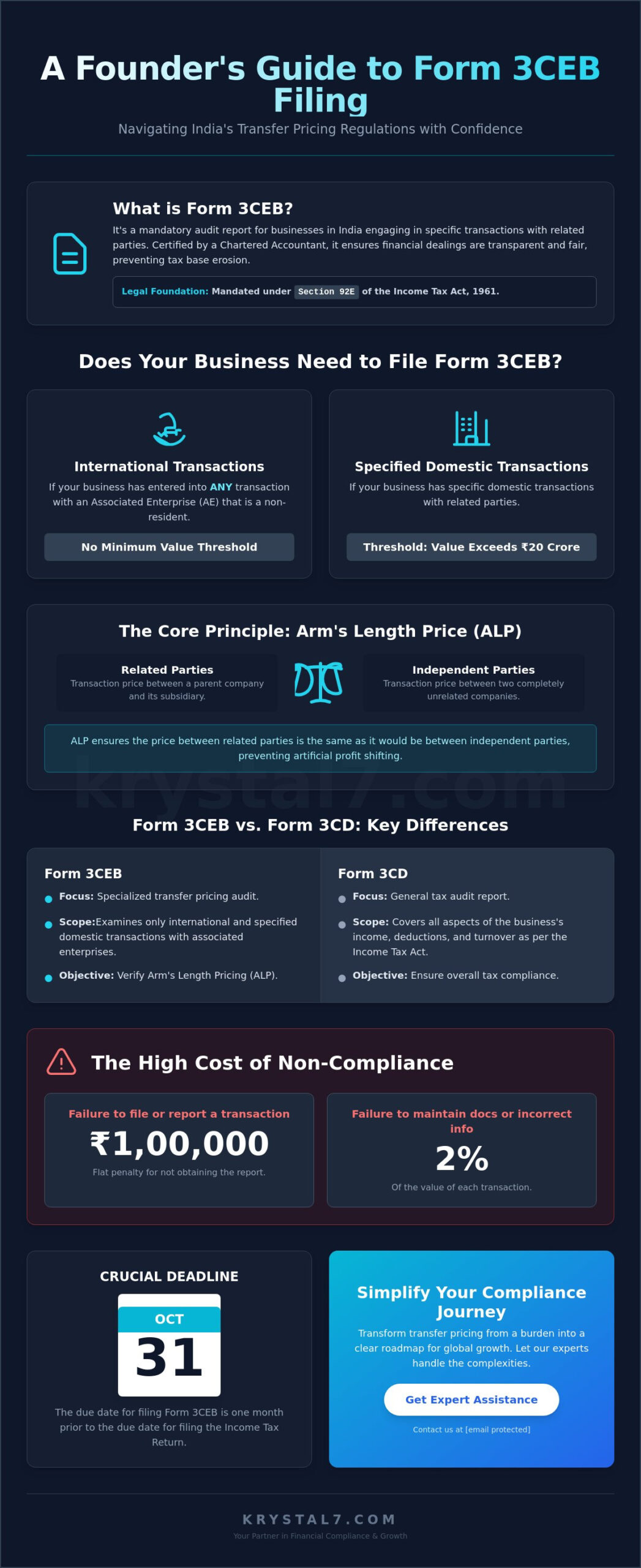
Your Form 3CEB filing is much more than a routine administrative task; it’s a vital transparency tool that protects your global brand from aggressive tax litigation. Under Section 92E of the Income Tax Act, 1961, any person entering into international transactions or specified domestic transactions with an associated enterprise must obtain an audit report from a Chartered Accountant. This professional certification proves that your inter-company dealings are conducted with integrity and financial precision. It provides the visual clarity that tax authorities require to verify that profits aren’t being shifted out of India unfairly.
The core objective of this audit is to confirm that every transaction is recorded at an Arm’s Length Price (ALP). This concept ensures that the price paid between related entities is exactly what it would be if the parties were completely independent. What is Transfer Pricing? In simple terms, it’s the accounting practice that prevents a foreign parent company from overcharging its Indian subsidiary for services to reduce local taxable income. Mastering this is a cornerstone of annual compliance for private limited company entities operating across borders.
The Legal Foundation: Section 92E Explained
The Indian government tracks cross-border transactions with extreme care to prevent tax base erosion. Section 92E mandates that an independent, qualified professional conduct a methodical review of your books. This isn’t just about checking boxes. It’s an empowering process that confirms your business is operating within the law. By documenting your pricing strategies through a Form 3CEB filing, you eliminate the uncertainty that often leads to stressful tax audits. It turns a complex legal requirement into a demonstration of your company’s commitment to financial openness.
Form 3CEB vs. Form 3CD: Knowing the Difference
Founders often confuse these two reports, but they serve very different purposes. Form 3CD is a general tax audit report that focuses on your business’s overall income, deductions, and turnover. In contrast, Form 3CEB is a specialized transfer pricing audit that looks specifically at related-party transactions. If you manage a private limited company india with international links, you’ll likely need to file both. Maintaining absolute consistency between these reports and your MCA filings is critical. Discrepancies can trigger unwanted attention from the tax department, while a unified reporting approach offers you peace of mind and operational liberty.
Determining Applicability: Does Your Business Need to File Form 3CEB?
Identifying your reporting requirements starts with understanding your corporate relationships. You must pursue a Form 3CEB filing if you engage in international transactions with Associated Enterprises (AE) or cross the specific threshold for domestic deals. Section 92A defines an AE quite broadly; it isn’t limited to simple parent-subsidiary structures. It includes entities linked by 26% or more shareholding, common management control, or even a heavy dependency on another firm’s intellectual property. Understanding these Form 3CEB Reporting Obligations early prevents costly surprises during the audit season.
For international transactions, there is no minimum value trigger. Even a small payment for software development or marketing services to a non-resident AE requires formal reporting. This meticulous approach ensures that your cross-border operations remain airtight and transparent from day one. Failing to identify these relationships early can lead to the very penalties we discussed earlier.
What Qualifies as an International Transaction?
These transactions involve at least one non-resident party and cover a wide range of business activities. Common examples include the purchase of raw materials, sale of finished goods, or provision of IT and management support services. Inter-company loans and corporate guarantees are also included. Every transaction must reflect a fair market value to satisfy Indian tax authorities and maintain your operational liberty.
Specified Domestic Transactions (SDT) for 2026
Indian entities under common control must also stay vigilant regarding their domestic dealings. You only need to report domestic transactions if their aggregate value exceeds INR 20 Crore in a financial year. This rule primarily affects companies claiming tax holidays under Section 80-IA or those involved in business transfers between different tax-incentivized units. If your domestic turnover is growing rapidly, you can consult our experts to monitor your threshold limits and stay ahead of the October deadline.
Small startups often fall into audit traps by assuming low-value deals are exempt from scrutiny. While the INR 20 Crore limit provides significant relief for domestic deals, international transactions have no such floor. A single invoice to a foreign subsidiary can trigger the need for a professional Form 3CEB filing. We recommend a methodical review of all inter-company agreements to ensure you don’t overlook a mandatory filing requirement that could impact your financial standing.
The Reporting Framework: Key Disclosures in a Transfer Pricing Audit
Preparing for a Form 3CEB filing doesn’t have to be a source of anxiety. It’s a methodical process that, when handled correctly, provides a clear window into your company’s global operations. Your first step involves gathering every inter-company agreement, service invoice, and debit note related to your associated enterprises. This documentation forms the bedrock of your audit and ensures your financial narrative is consistent across all platforms. We recommend founders start this collection process at least two months before the deadline to avoid the stress of missing paperwork.
Once your data is organized, your Chartered Accountant will identify the Most Appropriate Method (MAM) to determine the Arm’s Length Price. This choice is critical because it justifies your pricing strategy to the Income Tax Department. While staying current with the New Transfer Pricing Reporting Regime is essential, the core principles of benchmarking against market data remain the standard for 2026. This comparison proves that your transactions match what independent businesses would pay in a free market, granting you long-term operational security.
Methods for Calculating Arm’s Length Price
Tax authorities allow several methods to calculate ALP, and choosing the right one depends on your specific business model. The Comparable Uncontrolled Price (CUP) method is ideal for standardized goods where market prices are easily verified. Service-based startups often prefer the Transactional Net Margin Method (TNMM), which compares net profit margins of similar companies. If you manufacture goods for a parent entity, the Cost Plus Method (CPM) ensures you earn a fair markup over your production costs. This selection process brings order to your financial reporting and protects your margins from arbitrary adjustments.
Documentation Checklist for Founders
To ensure a swift audit, founders should keep these specific documents ready for their professional advisor. Having these records at your fingertips eliminates bureaucratic obstacles and speeds up the certification process:
- Signed Inter-company Agreements: These contracts define the scope of services, intellectual property rights, and payment terms.
- Transfer Pricing Policy: A formal document from your foreign parent company that explains their global pricing logic and cost-allocation models.
- Foreign Entity Financials: Audited balance sheets and P&L statements of the associated enterprise involved in the transaction.
- Invoices and Bank Advice: Clear proof of actual payments made or received, ensuring every entry in your books matches your bank statements.
The final phase of your Form 3CEB filing is the digital certification of the audit report. Your Chartered Accountant will upload the completed form to the Income Tax e-filing portal using their Class 3 Digital Signature Certificate (DSC). You must then log in to the corporate portal to verify and approve the submission. This two-step verification process ensures that your data is accurate, authorized, and legally binding before it reaches the tax authorities.
Important Deadlines and the Heavy Cost of Non-Compliance in 2026
Missing the October 31, 2026 deadline for your Form 3CEB filing is a risk you simply cannot afford. For the Assessment Year 2026-27, the Income Tax Department maintains a zero-tolerance policy for late submissions. Failing to furnish this report by the due date triggers an immediate penalty of INR 1,00,000 under Section 271BA of the Income Tax Act.
While the flat fine is significant, the cost of incorrect or incomplete reporting is often much higher. Tax authorities can impose a penalty equal to 2% of the total transaction value if they discover undisclosed or inaccurately reported international dealings. If your cross-border transactions total INR 5 Crore, a simple reporting error could cost your business INR 10 Lakh in penalties alone.
Beyond these financial drains, you risk a “best judgment assessment” by the tax department. In this scenario, the assessing officer determines your tax liability based on their own estimates rather than your internal records. This often results in much higher tax demands and years of expensive litigation. You can avoid these pitfalls by choosing an Annual Compliance Package that prioritizes precision and punctuality.
Timeline for a Stress-Free Filing
A methodical approach is the best way to handle the pressure of the October deadline. From April to June, you should map all international transactions and gather supporting invoices from your foreign parent. Between July and September, your advisor will conduct the benchmarking and ALP analysis to ensure your pricing is defensible. Finally, October should be reserved for the final review and digital filing on the Income Tax portal.
Consequences Beyond Monetary Fines
Non-compliance creates a digital footprint that attracts increased scrutiny for years to come. Your business will likely face regular tax audits and detailed inspections of every future transaction. This constant oversight can damage your director’s reputation and complicate your company registration status during investor due diligence or funding rounds.
Future growth also depends on your compliance history. Banks and government bodies often require tax clearance certificates for various licenses or cross-border expansions. A history of late or inaccurate Form 3CEB filing can lead to the denial of these essential documents. Maintaining a clean record ensures you keep your operational liberty and professional standing in the global market.
Simplifying Your Compliance Journey with Krystal7 Consultants
Krystal7 Consultants brings order to the often chaotic world of cross-border tax regulations. We provide the visual transparency you need to understand every entry in your audit report. Our team handles the heavy lifting on the TRACES and MCA portals, granting you the operational liberty to focus on scaling your vision. We believe a successful Form 3CEB filing is the result of a methodical, year-round partnership rather than a last-minute scramble.
Our approach is specifically designed for the unique needs of startups and SMEs. We translate complex technical terminology into actionable guidance that makes sense for your business model. Whether you’re managing a US-based parent company or a European subsidiary, we ensure your financial data remains airtight. We handle the complexity so you can pursue your primary goals with total peace of mind.
Why Gurgaon Founders Trust Krystal7
Being based in Gurgaon, we have deep roots in the local Haryana and Delhi NCR business ecosystem. We understand the specific challenges of operating in India’s leading corporate hub. Our advisors possess deep institutional knowledge of cross-border compliance for foreign subsidiaries. We combine elite professional designations with a human touch that ensures you’re never just another file in a cabinet.
Take the Next Step Toward Compliance
Securing your business for the 2026 assessment year starts with a proactive review of your transactions. If you’re just starting out, our how to register guide provides a clear foundation for your journey. Once your entity is live, we step in to manage the ongoing intricacies of transfer pricing and annual audits. A single error in your Form 3CEB filing can lead to years of litigation, but our meticulous oversight keeps your record clean.
Don’t let bureaucratic obstacles slow down your global ambitions. Contact Krystal7 Consultants today to schedule a comprehensive consultation for your transfer pricing needs. Reach out to our expert team at business@krystal7.com or visit krystal7.com to explore our Annual Compliance Package and Foreign Subsidiary Registration services. We’re here to be your trusted partner in every step of your growth journey.
Securing Your Global Growth with Confident Compliance
Mastering your Form 3CEB filing ensures that your international transactions remain a source of strength rather than a legal liability. By maintaining precise documentation and meeting the October 31, 2026 deadline, you protect your capital from aggressive 2% penalties and secure your operational liberty. This methodical approach demonstrates financial openness to tax authorities while providing you with the visual clarity needed to lead your business forward with confidence.
For expert assistance with your transfer pricing compliance, contact Krystal7 Consultants at business@krystal7.com or visit krystal7.com. Our Gurgaon based Chartered Accountants specialize in foreign subsidiary compliance and offer transparent, fixed fee pricing models to eliminate financial uncertainty. We handle the administrative complexity so you can focus on your primary visionary goals. Your journey toward long term growth is safer when you have a dependable partner by your side.
Frequently Asked Questions
What is the turnover limit for Form 3CEB filing in 2026?
There’s no minimum turnover limit for international transactions involving a non-resident associated enterprise; even a single transaction requires reporting. For Specified Domestic Transactions, the requirement is triggered only if the aggregate value exceeds ₹20 crore in the financial year. It’s vital to track these thresholds closely because failing to report domestic deals above this limit carries the same heavy penalties as international ones.
Can I file Form 3CEB after the deadline of October 31st?
You can file after the October 31st deadline, but you’ll face an immediate penalty of ₹1,00,000 under Section 271BA. Late Form 3CEB filing also increases the risk of your business being flagged for a detailed scrutiny audit in future years. We recommend starting your benchmarking process by July to ensure your Chartered Accountant has enough time to certify the report before the portal becomes congested.
Is Form 3CEB mandatory for an LLP with foreign partners?
Yes, an LLP is required to file if it engages in international transactions with associated enterprises. The Income Tax Act applies transfer pricing regulations to all “persons,” which includes Private Limited companies, LLPs, and partnership firms. If your foreign partners are involved in the management or capital of the LLP, their transactions with the entity must be reported at an Arm’s Length Price to ensure compliance.
What happens if I miss reporting a small transaction in Form 3CEB?
Missing even a minor transaction can lead to a penalty of 2% of that specific transaction’s value under Section 271G. Tax authorities view any non-reporting as a lack of transparency, which can trigger a broader investigation into your entire transfer pricing policy. It’s always safer to disclose every inter-company payment, regardless of the amount, to maintain total visual clarity in your financial records.
Who is authorized to sign the Form 3CEB audit report?
A practicing Chartered Accountant is the only professional authorized to audit your transactions and sign the Form 3CEB report. They must review your inter-company agreements and benchmarking data before certifying that the prices match market standards. Once the report is ready, the CA uploads it to the Income Tax portal using their Digital Signature Certificate, after which the business owner must digitally approve it.
Is Form 3CEB required if the company has no taxable income in India?
Yes, the filing requirement is based on the occurrence of transactions, not your company’s profitability. Even if your startup is in its early stages and hasn’t generated taxable income in India, you must still report related-party dealings. This ensures that the tax department can verify your expenses and pricing strategies from the very beginning, preventing profit shifting to lower-tax jurisdictions abroad.
How is the Arm’s Length Price determined for IT services?
The Transactional Net Margin Method (TNMM) is the most effective way to determine the Arm’s Length Price for IT services. This method compares your company’s net profit margin with the margins of comparable, independent service providers in India. It’s particularly useful for service firms because it accounts for differences in operational expenses, providing a fair and defensible benchmark for your inter-company service fees.
Do I need Form 3CEB for transactions with a branch office abroad?
Yes, dealings between an Indian entity and its foreign branch office are classified as international transactions under transfer pricing laws. You must ensure these transactions are conducted at market rates and documented through a formal Form 3CEB filing. This rule prevents companies from moving funds or expenses between branches to artificially reduce their tax liability in India, helping you maintain a clean compliance record.

Article by
Nihal Srivastava
Nihal Srivastava is the Co-Founder of Krystal7 Consultants, helping Indian entrepreneurs and startups navigate company registration, compliance, trademark protection, and regulatory requirements with clarity and confidence. With 6+ years of hands-on expertise in MCA filings, GST compliance, and corporate structuring, Nihal has guided 1000+ businesses across India through their legal and compliance journeys. He believes every business dream deserves crystal clear foundations, and that no founder should be held back by paperwork or red tape.