

80 IAC Registration: A Step-by-Step Guide for Startup Tax Exemption (2026)
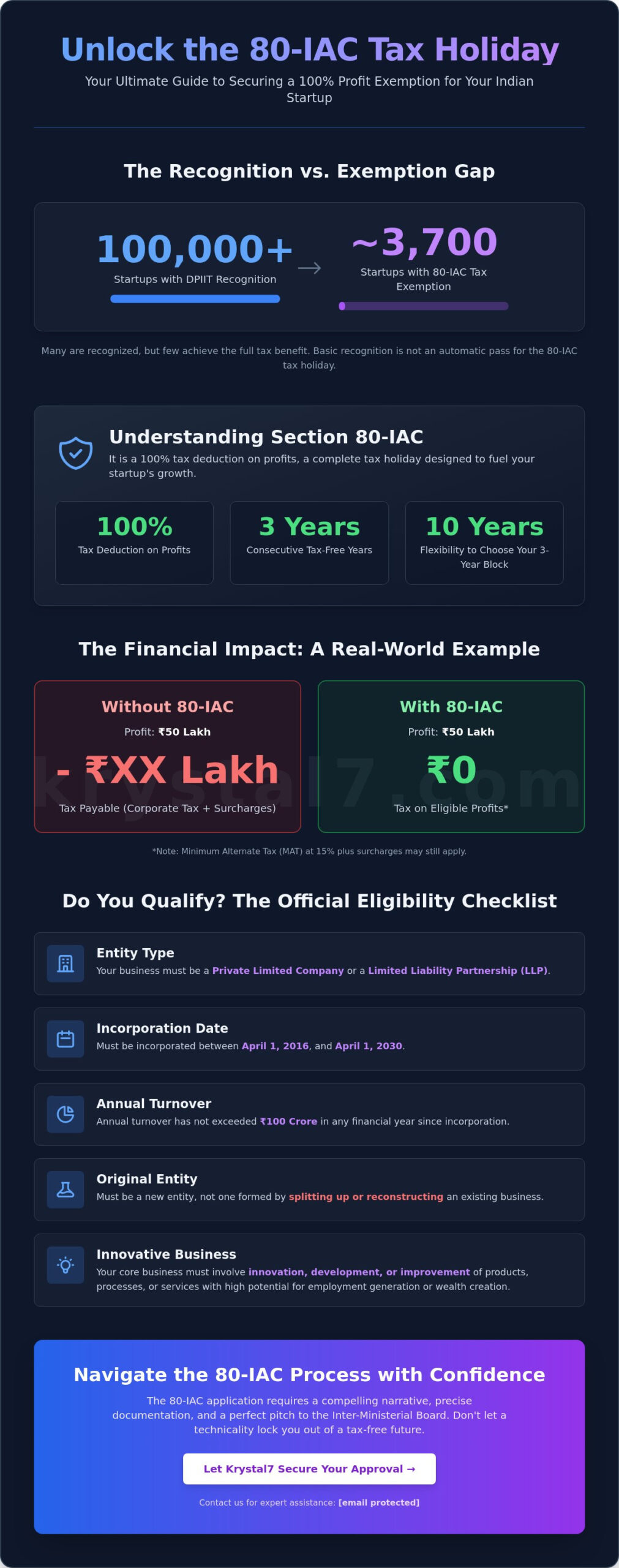
Did you know that as of April 30, 2025, only about 3,700 startups had successfully secured their tax exemptions despite tens of thousands being DPIIT recognized? This gap exists because many founders mistake basic recognition for 80 iac registration eligibility. It’s a high-stakes narrative challenge where your innovation must be “sold” to the Inter-Ministerial Board through precise documentation and a compelling pitch deck.
We understand the anxiety of facing complex regulatory hurdles while trying to scale your vision. You’ve worked hard to build your Private Limited company or LLP, and the last thing you need is a rejection letter due to a technicality in your video presentation or financial projections. It’s frustrating to feel that your tax-free future is locked behind a wall of bureaucratic confusion and high rejection rates.
This guide provides the clarity you need to unlock a 100% tax holiday for three consecutive years within your first decade of operations. You’ll learn the exact steps to navigate the latest evaluation framework and ensure your application stands out to the IMB. Let’s explore how to transform your compliance burden into a strategic financial advantage for your startup.
Key Takeaways
- Secure a 100% tax deduction on your startup profits for three consecutive years within your first decade of operations.
- Confirm if your Private Limited Company or LLP qualifies under the strict incorporation and turnover rules set by the Income Tax Act.
- Master the 80 iac registration process on the Startup India portal with our detailed, step-by-step walkthrough.
- Perfect your pitch deck and innovation narrative to overcome high rejection rates and prove your business’s scalability to the Inter-Ministerial Board.
- Delegate the administrative burden to experts who handle complex documentation and ensure your application remains compliant with the latest 2026 regulations.
Understanding Section 80-IAC: The 100% Tax Holiday for Startups
Section 80-IAC of the Income Tax Act, 1961, stands as the “Holy Grail” of benefits for Indian founders. It offers a 100% tax deduction on your profits for three consecutive financial years. This isn’t just a minor rebate; it’s a complete tax holiday that grants you the operational liberty to reinvest every rupee back into your growth. You have the freedom to choose this three-year block anytime within your first ten years of incorporation.
This benefit is the cornerstone of the Startup India initiative, designed to fuel domestic innovation. However, getting your 80 iac registration isn’t automatic. It requires a meticulous application to the Inter-Ministerial Board (IMB) to prove your business model is truly innovative. With the government recently extending the incorporation deadline to April 1, 2030, the window for eligibility remains wide open for new visionaries.
Why DPIIT Recognition is Not Enough
Many entrepreneurs celebrate after receiving their DPIIT certificate, thinking the tax benefits will flow immediately. This is a common misconception. While over 1 lakh startups have obtained DPIIT recognition, only a small fraction successfully secure the 80-IAC exemption. The IMB maintains a much higher standard of scrutiny than the initial recognition process.
To even apply, your entity must be registered as an LLP or a private limited company india. The board looks beyond basic registration to evaluate your “innovation narrative.” They want to see how you’re solving unique problems or creating significant employment. This transparency in your business model is what separates a standard business from an 80-IAC eligible startup.
The Financial Impact: Calculating Your Savings
The savings from a successful 80 iac registration can be transformative for your cash flow. Imagine your startup generates a net profit of ₹50 lakh in a financial year. Without this exemption, you’d face a corporate tax rate plus applicable surcharges and cess. With 80-IAC, that tax liability on eligible business profits drops to zero.
It’s important to remember that Minimum Alternate Tax (MAT) still applies at 15% plus surcharges. However, the 100% deduction on base corporate tax provides a massive buffer. This capital stays in your bank account, allowing you to hire elite talent or expand your infrastructure without the burden of heavy tax outflows. We handle the complexity of these filings so you can focus on pursuing your primary goals.
Eligibility Criteria for 80 IAC Registration: Do You Qualify?
Getting your 80 iac registration requires more than just a good idea. You must meet specific structural and operational benchmarks set by the Department for Promotion of Industry and Internal Trade (DPIIT). Your entity must be incorporated between April 1, 2016, and April 1, 2030, to stay within the current eligibility window. This extended timeline provides a massive opportunity for new founders to build tax-efficient businesses from the ground up.
Only Private Limited Companies and Limited Liability Partnerships (LLPs) can apply for this tax holiday. If you’re running a traditional partnership or a sole proprietorship, you’ll need to convert your business structure first. Additionally, your annual turnover must not have exceeded ₹100 crore in any financial year since your incorporation. Staying under this threshold is vital for maintaining your “eligible startup” status in the eyes of the Income Tax Department.
The “New Entity” Rule: Avoiding Disqualification
The Inter-Ministerial Board (IMB) is very strict about how a startup is formed. Your business cannot be formed by splitting up or reconstructing an existing business. This rule prevents established companies from simply rebranding to dodge taxes. It’s a common pitfall for family businesses trying to modernize without fresh incorporation.
There’s also a technical trap regarding assets. You can’t use more than 20% of previously used plant and machinery in your new startup. If you’re unsure about your asset valuation or history, our accounting and bookkeeping experts can help review your balance sheet before you apply. A methodical review now prevents a painful rejection later.
Defining “Eligible Business” for the IMB
Innovation is the heartbeat of this exemption. The IMB doesn’t grant approvals to standard service businesses that don’t offer something new to the market. You must demonstrate that you’re improving existing products or creating entirely new processes. Scalability is equally important; they want to see high potential for wealth creation or employment generation.
Section 80-IAC of the Income Tax Act defines “eligible business” as a business carried out by an eligible startup engaged in innovation, development or improvement of products or processes or services, or a scalable business model with a high potential of employment generation or wealth creation. If your model is just a digital version of a traditional store without a unique technological edge, you might face rejection. Focus on showing how your technology scales efficiently as your user base grows.
Step-by-Step Process for 80 IAC Registration on the Startup India Portal
Your journey toward a tax holiday begins on the official Startup India portal. Once you have secured your DPIIT recognition, you can proceed with the 80 iac registration process. This transition from basic recognition to tax exemption is a methodical climb that requires absolute precision in documentation.
Step 1: Log in to the Startup India portal using your existing DPIIT credentials. Ensure your profile is 100% complete before proceeding. Any missing information in your basic profile can cause technical glitches during the exemption filing.
Step 2: Navigate to the “Exemption” section on your dashboard. From the available options, select Form 80-IAC. This is the specific application that triggers the Inter-Ministerial Board (IMB) review process.
Step 3: Upload your mandatory corporate documents. This includes your Memorandum of Association (MoA) and Articles of Association (AoA). Your financial statements must be clear and professionally scanned to ensure the board can verify your turnover limits easily.
Step 4: Submit your innovation narrative. This is the most critical stage where you provide a link to your pitch deck and a video explaining your product. The video should focus on how your solution improves existing processes or creates a scalable business model.
Step 5: Track your application status through the portal. The IMB typically reviews complete applications within 120 days. Use this time to prepare for potential queries by keeping your technical documentation ready for inspection.
Mandatory Documentation Checklist
Accuracy in your paperwork is the foundation of a successful application. You must provide Income Tax Returns (ITRs) for the last three financial years, or for every year since incorporation if your startup is younger. A certified Shareholding Pattern and a formal Board Resolution authorizing the application are also mandatory.
Before you begin, verify that your annual compliance for private limited company is fully up to date. The IMB cross-references your application with MCA records. Any discrepancies in your annual filings or registered office details can lead to an immediate administrative rejection.
Handling IMB Clarifications
Receiving a query from the IMB is a common part of the 80 iac registration process. The board often asks for “additional details” to better understand your technological edge or market impact. Don’t view these queries as a setback; they are an invitation to clarify your vision.
Draft your responses with professional rigor and technical depth. Use data to support your claims about scalability and wealth creation potential. You must respond within the deadline mentioned in the query, which is usually 15 to 30 days. Failure to provide a timely response will result in the closure of your application, forcing you to start the process from scratch.
Avoiding Rejections: Common Pitfalls in Pitch Decks and Videos
The Inter-Ministerial Board (IMB) maintains a high bar for approval. In the 80th meeting held on April 30, 2025, only 187 startups were approved for the exemption. This selective nature means your 80 iac registration success depends on the narrative you build in your pitch deck and video. You must move beyond being a profitable entity to proving you’re an “eligible startup” under the Income Tax Act.
Many founders confuse novelty with innovation. Novelty means your product is simply new, but innovation implies it creates a significant improvement in cost, quality, or efficiency. The Board looks for a “scalable” model. If your revenue growth requires an equal increase in manpower or physical assets, they might label you a standard service business. Avoid heavy technical jargon. Focus on the real-world impact of your technology.
Crafting the Perfect Startup Video
Keep your video under two minutes. The Board doesn’t want a high-budget commercial or a “talking head” video of you sitting in an office. They want to see your product in action. If you’ve built software, show a screen recording of the core features. If it’s a physical product, record a functional demo. Ensure the link you provide is public on YouTube or Google Drive. A “private” or “permission required” link leads to an immediate rejection of your 80 iac registration application.
Pitch Deck Essentials for Tax Approval
Your pitch deck should highlight three specific outcomes: social impact, wealth creation, and employment generation potential. These are the benchmarks the IMB uses to justify a 100% tax holiday. Show clear evidence of brand protection. Mentioning your Intellectual Property or providing details of your trademark application adds immense credibility to your claim of innovation. You can check the latest trademark registration fees to plan your brand security budget alongside your tax application.
Building a narrative that satisfies the IMB requires a meticulous approach. If you’re struggling to articulate your innovation, our team can help you draft a compelling pitch deck that aligns with regulatory expectations.
How Krystal7 Consultants Secures Your 80 IAC Approval
Securing a 100% tax holiday is a defining milestone for any visionary founder. At Krystal7 Consultants, we don’t just fill out forms; we act as your strategic partner in the 80 iac registration journey. Our approach begins with a comprehensive review of your business model to identify the specific technological edges that the Inter-Ministerial Board values most. We bridge the gap between your technical brilliance and the rigorous requirements of the Income Tax Act.
The team at Krystal7 Consultants ensures that your foundational company registration details are perfectly synchronized with your tax exemption application. Discrepancies in shareholding patterns or director details often trigger immediate rejections. We eliminate these risks by conducting a methodical audit of your MCA filings and DPIIT profile before submission. This precision creates a foundation of reliability that builds confidence with the IMB reviewers.
Why Choose Krystal7 Consultants for Your Tax Holiday
We bring a track record of calm competence to a process that often overwhelms entrepreneurs. Our advisors specialize in drafting the innovation narrative and perfecting the pitch deck to meet the latest 2026 standards. Unlike generic providers, Krystal7 Consultants provides end-to-end management of the Startup India portal and handles all IMB interactions on your behalf. If the Board raises technical queries, we draft the professional responses needed to keep your application moving forward.
Get Started with Your 80 IAC Registration Today
Unlocking three years of tax-free profits provides the capital you need to scale without the constant pressure of external funding. This operational liberty allows you to focus on your primary goals while we handle the administrative complexity. Don’t let your tax holiday slip away due to documentation errors or a weak innovation narrative. Delegate the burden to experts who understand the nuances of Indian tax legislation and the specific expectations of the Inter-Ministerial Board.
Take the first step toward securing your startup’s financial future and achieving a successful 80 iac registration. Contact Krystal7 Consultants at business@krystal7.com or visit krystal7.com for a preliminary eligibility check and expert assistance. We’re ready to help you pursue your primary goals with absolute financial clarity.
Secure Your Startup’s Financial Future Today
Securing a three-year tax holiday is a transformative step that grants your business the operational liberty to scale without financial friction. Success depends on more than just meeting turnover limits; it requires a compelling innovation narrative that satisfies the Inter-Ministerial Board. By focusing on your scalable business model and protecting your intellectual property, you position your startup for long-term wealth creation.
The journey toward 80 iac registration is complex, but you don’t have to navigate it alone. As Gurugram-based CA experts and DPIIT Recognition Partners, Krystal7 Consultants specializes in bringing order to the documentation process. Our team acts as IMB Query Resolution Specialists, ensuring that every clarification request is handled with meticulous professional rigor. We manage the technical details so you can focus on your primary vision.
Don’t let administrative burdens stand in the way of your 100% tax deduction. We’re ready to help you pursue your goals with absolute financial clarity and confidence. Contact Krystal7 Consultants at business@krystal7.com or visit krystal7.com for expert assistance.
Secure your 100% Tax Holiday—Contact Krystal7 Consultants for 80 IAC Registration today
Frequently Asked Questions
Can an LLP apply for 80 IAC registration?
Yes, Limited Liability Partnerships (LLPs) are fully eligible to apply for this tax exemption. Along with Private Limited Companies, they’re the only entity types recognized for the 80 iac registration process. Traditional partnership firms and sole proprietorships don’t qualify and must convert to a registered corporate structure first.
What happens if my 80 IAC application is rejected by the IMB?
If your application is rejected, you can usually re-apply after addressing the specific reasons cited by the Inter-Ministerial Board. The IMB often issues queries or “additional details” requests before an outright rejection. Responding to these with technical depth and data-backed innovation narratives is the best way to secure approval on your next attempt.
Is there a deadline to apply for the 80-IAC tax exemption?
Your startup must be incorporated between April 1, 2016, and April 1, 2030, to be eligible for the exemption. While there’s no fixed daily deadline to file the application, you must apply while your entity is still within its first ten years of incorporation. It’s best to apply once you’ve achieved profitability to maximize the benefit of the three-year tax holiday.
How long does the 80 IAC registration process take?
The Inter-Ministerial Board typically reviews and processes complete applications within 120 days. This timeline can extend if they raise queries regarding your business model or pitch deck. We recommend tracking your status regularly on the Startup India portal to ensure you don’t miss any time-sensitive clarification requests regarding your 80 iac registration.
Do I need to be a part of the Startup India Hub to apply?
Yes, obtaining DPIIT recognition through the Startup India portal is a mandatory prerequisite. You use your DPIIT credentials to log in and access the tax exemption application form. Without this initial recognition, the system won’t permit you to view or submit Form 80-IAC.
Can I choose any 3 years for the tax holiday?
You can choose any three consecutive financial years for the tax deduction within the first ten years of your startup’s incorporation. This flexibility allows you to wait until your venture becomes highly profitable before claiming the 100% deduction. Most founders select a block where they expect the highest net profit to save the maximum amount in corporate taxes.
What is the “innovation” requirement for 80 IAC?
The startup must be working toward the innovation, development, or improvement of products, processes, or services. Alternatively, you must prove a scalable business model with high potential for employment or wealth creation. The IMB looks for a technological edge that distinguishes your business from traditional service providers or retail models.
Is the 80-IAC exemption applicable to MAT?
No, the 80-IAC exemption only applies to the base corporate income tax. You’re still required to pay Minimum Alternate Tax (MAT) under Section 115JB of the Income Tax Act. However, MAT is generally lower than standard corporate tax rates, and you can carry forward MAT credit to future years when the tax holiday ends.

Article by
Nihal Srivastava
Nihal Srivastava is the Co-Founder of Krystal7 Consultants, helping Indian entrepreneurs and startups navigate company registration, compliance, trademark protection, and regulatory requirements with clarity and confidence. With 6+ years of hands-on expertise in MCA filings, GST compliance, and corporate structuring, Nihal has guided 1000+ businesses across India through their legal and compliance journeys. He believes every business dream deserves crystal clear foundations, and that no founder should be held back by paperwork or red tape.