

Foreign Subsidiary Compliance India: The Complete 2026 Guide
What if the regulatory complexity of the Indian market wasn’t a barrier to your growth, but actually your greatest competitive advantage? You likely feel the constant pressure of the MCA and RBI’s strict oversight; it’s exhausting to worry about penalties that can hit ₹3 lakh or the maze of GST and TDS filings. Managing foreign subsidiary compliance India shouldn’t feel like a full-time job that pulls you away from your vision.
We understand that without a local presence, these administrative hurdles feel insurmountable. This guide changes that by offering a clear, expert roadmap for 2026 to help you achieve total operational freedom. You’ll gain a complete checklist of deadlines, insights into the 2026 Amnesty Scheme (CCFS), and the transparent pricing models you need for confident planning.
We’ll break down everything from resident director requirements to the latest corporate tax rates for manufacturing subsidiaries. By the end, you’ll have the clarity to scale your Indian operations with absolute security and precision.
Key Takeaways
- Master the Three Pillars of Indian regulation, MCA, FEMA, and Taxation, to ensure your entity remains in good standing with all local authorities.
- Access a comprehensive 2026 calendar for foreign subsidiary compliance India, including critical filing dates for Form AOC-4, MGT-7, and quarterly TDS returns.
- Understand the compounding financial penalties under Section 450 of the Companies Act and learn how to protect your leadership from the risk of director disqualification.
- Identify how to leverage the 2026 Amnesty Scheme (CCFS) to clear historical backlogs with a 90% waiver on additional fees.
- Discover how professional handling of administrative noise and physical representation in Gurgaon can grant your team the freedom to focus on core business growth.
Understanding Foreign Subsidiary Compliance in India (2026)
A foreign subsidiary is an Indian entity where more than 50% of the share capital is held by a foreign body corporate. It is essentially an Indian company with international roots that must follow local laws. The Indian government monitors these entities closely through the Ministry of Corporate Affairs (MCA) and the Reserve Bank of India (RBI). This oversight ensures that Foreign Direct Investment in India follows established economic goals and stays within sectoral caps. By staying compliant, you signal to the market that your business is built on a foundation of integrity and long-term vision.
Two primary laws govern your daily operations and long-term strategy. The Companies Act, 2013 handles your corporate structure, board meetings, and internal governance. Meanwhile, the Foreign Exchange Management Act (FEMA), 1999 regulates how money moves across borders, including share issuances to foreign parents. While these rules are strict, they aren’t meant to stifle your growth. They provide a transparent framework that becomes a foundation for your operational liberty when managed by experts.
Why Compliance is Non-Negotiable for Global Founders
Founders often view paperwork as a distraction, but in the Indian context, it’s a strategic asset. Maintaining a clean legal record is vital if you plan to seek future funding or execute an exit strategy. Most institutional investors look for “compliance hygiene” as a prerequisite for any term sheet. Additionally, accurate foreign subsidiary compliance India is the only way to ensure the smooth repatriation of profits back to your parent company. Without proper filings, moving dividends out of India can become a bureaucratic nightmare. Transparent filings also build immense trust with local vendors and customers who see your commitment to the Indian market.
The Role of the Registrar of Companies (RoC)
The RoC acts as the primary watchdog for every activity your company undertakes. It functions under the MCA and maintains a public record of your directors, shareholders, and financial health. Every entity receives a unique 21-digit Corporate Identity Number (CIN) upon incorporation. You must use this CIN on all official correspondence and government filings to maintain your legal standing. Understanding the RoC’s expectations is a core part of managing a private limited company india. We ensure your records are always precise and updated on the MCA portal, giving you the peace of mind to focus on scaling your vision.
The Three Pillars of Indian Regulatory Compliance
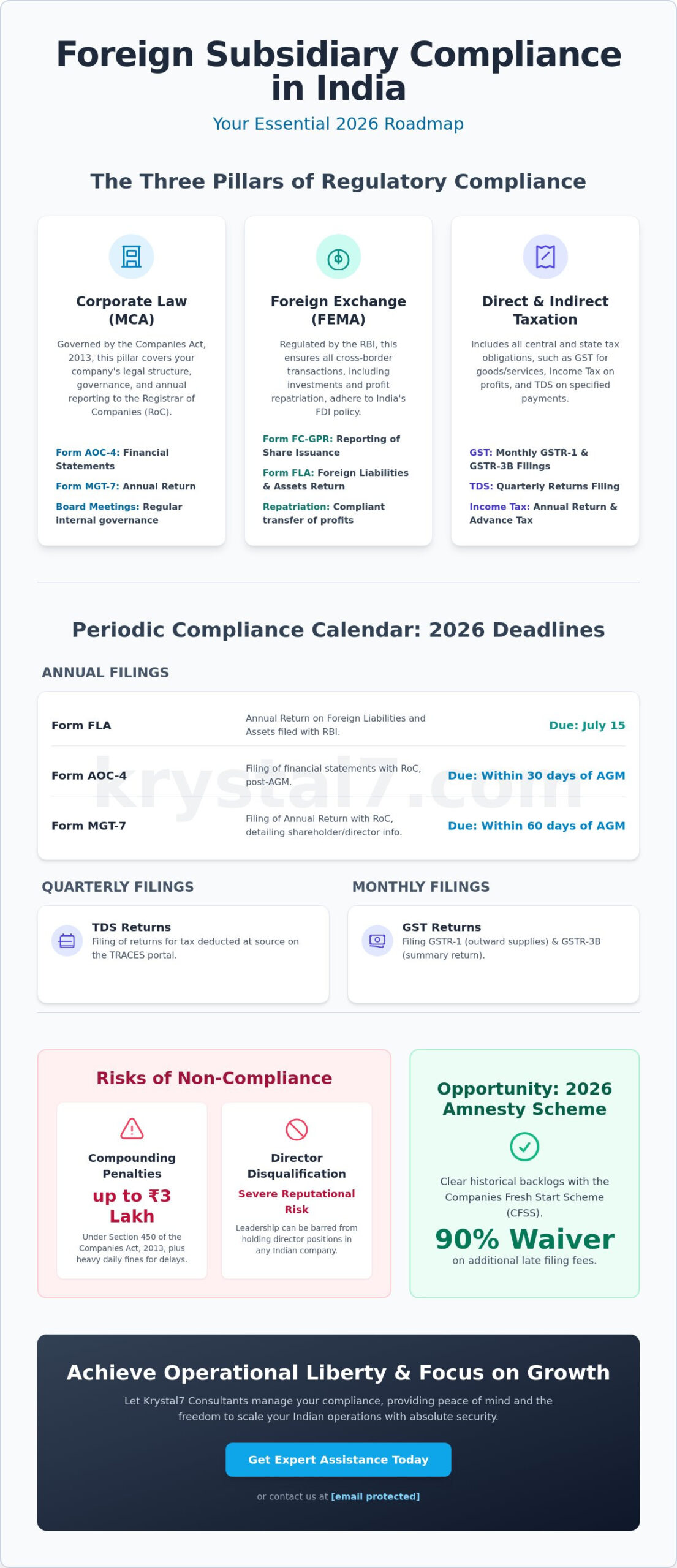
Managing a business across borders requires a structured approach to the law. We categorize foreign subsidiary compliance India into three distinct pillars: Corporate Law (MCA), Foreign Exchange (FEMA), and Taxation. In 2026, the transition to 100% digital filings across all portals means precision is more critical than ever. Krystal7 serves as your single point of contact, unifying these complex systems into one clear roadmap for your peace of mind.
MCA & Companies Act Requirements
The Ministry of Corporate Affairs (MCA) oversees your company’s legal existence. You must file Form AOC-4 for financial statements within 30 days of your Annual General Meeting (AGM). Form MGT-7, which covers your annual return, is due within 60 days of the AGM. For the 2026 cycle, ensure your records for the financial year ending March 31 are meticulously prepared. Missing these deadlines can lead to heavy daily penalties and risks your standing as a compliant entity.
FEMA and RBI Compliance for Foreign Funds
When foreign capital enters your Indian entity, the Reserve Bank of India (RBI) requires immediate reporting. Following India’s FDI Policy, you must file Form FC-GPR through the FIRMS portal within 30 days of issuing shares. Additionally, the Annual Return on Foreign Liabilities and Assets (FLA) must be submitted by July 15 every year. These filings on the Single Master Form (SMF) ensure your investment stays legally protected and your profit repatriation remains smooth.
Taxation: GST, Income Tax, and TDS
Your tax obligations involve a mix of monthly, quarterly, and annual tasks. Working with an expert gst consultant helps you manage monthly GSTR-1 and GSTR-3B filings without errors. You also need to handle Tax Deducted at Source (TDS) returns on the TRACES portal every quarter to avoid interest on late payments. If you engage in transactions with your parent company, a Transfer Pricing audit ensures your pricing aligns with Indian “arm’s length” standards. You can explore our Annual Compliance Package to see how we streamline these requirements for you.
Your Periodic Compliance Calendar: 2026 Deadlines You Cannot Miss
Staying ahead of foreign subsidiary compliance India means moving beyond a reactive mindset. You need a chronological strategy that aligns with the Indian financial year, which spans from April 1 to March 31. Many global founders struggle because they treat compliance as a one-time event rather than a recurring cycle. This leads to the stressful March-April rush, where mistakes happen and penalties in INR begin to compound daily. We provide a methodical approach that ensures you always see what’s coming next on your regulatory horizon.
Monthly and Quarterly Recurring Tasks
Monthly tasks act as the heartbeat of your Indian operations. You must file GST returns, specifically GSTR-1 and GSTR-3B, and ensure TDS deposits reach the government by the 7th of every month. On a quarterly basis, you’ll transition to filing TDS returns on the TRACES portal and documenting your mandatory board meeting minutes. These recurring requirements are essential to maintain the transparency expected under the official FDI policy framework. Krystal7 simplifies this by providing automated reminders and status updates, removing the administrative noise from your daily schedule.
Annual Filings and Statutory Audits
The annual phase is where your long-term legal standing is solidified. Every foreign subsidiary must undergo a statutory audit by an Indian Chartered Accountant. This isn’t just a formality; it’s a critical verification of your financial integrity for the MCA. You must also file the FLA return with the RBI by July 15 to report your foreign liabilities and assets. Following the audit, filing the ITR-6 income tax return becomes your next priority. For a granular breakdown of these specific steps, explore our detailed resource on annual compliance for private limited company.
Event-based tasks, such as reporting changes in directors or share capital, must be handled within 30 days to avoid heavy fines. These penalties aren’t just financial; they can lead to the disqualification of your directors or even the freezing of your bank accounts. By establishing a proactive calendar, you gain the operational liberty to scale without the fear of regulatory interruptions. Our team in Gurgaon acts as your local eyes and ears, ensuring every deadline is met with precision and every filing is transparent.
Navigating Penalties and Risks of Non-Compliance
Managing foreign subsidiary compliance India requires more than just knowing the rules; it requires understanding the high cost of silence. Regulatory bodies like the MCA and RBI don’t just issue warnings. They impose strict financial and operational consequences that can halt your business growth. We focus on providing the transparency you need to avoid these pitfalls and maintain your operational liberty.
Under Section 450 of the Companies Act, 2013, if no specific penalty is provided for a violation, the fine can reach ₹10,000. If the default continues, an additional ₹1,000 per day is added, creating a financial burden that compounds quickly. Beyond the company, your leadership is also at risk. Section 164(2) of the Act states that failing to file financial statements or annual returns for three consecutive years leads to “Director Disqualification.” This prevents your directors from serving on any Indian board for five years, damaging both personal and corporate reputations.
Financial Penalties and Daily Fines
Late filing of mandatory MCA forms like AOC-4 or MGT-7 attracts an additional fee of ₹100 per day for each form. Consider a scenario where you miss these two deadlines by just 90 days. You’ll face an immediate additional liability of ₹18,000 in fees alone. Taxation delays are even more expensive. Delayed GST payments carry an 18% annual interest rate, while late TDS deposits attract 1.5% interest per month. These costs drain your resources and complicate your financial reporting.
Operational Risks and Blacklisting
The Registrar of Companies (RoC) can mark your entity as “Inactive” if you fail to file your returns. This status is a red flag for banks and can lead to the freezing of your accounts. It also blocks your ability to repatriate dividends to your parent company, as the RBI requires a clean compliance record for cross-border transfers. If you’ve fallen behind, we specialize in restoring your foreign subsidiary compliance India standing through meticulous “compliance cleanup” for all overdue filings.
FEMA violations carry their own set of risks, often leading to “compounding of offenses” where you must admit the lapse and pay a significant penalty to avoid legal proceedings. Our team ensures your CIN remains in “Active” status and your records stay pristine on all government portals. Secure your company’s future and achieve total peace of mind with our Annual Compliance Package.
Achieving Operational Liberty with Krystal7 Consultants
Operational liberty isn’t a luxury for global founders; it’s a strategic necessity. We believe that foreign subsidiary compliance India should never be the bottleneck that slows your expansion. By delegating the heavy lifting to our elite team, you transform a potential legal liability into a foundation for growth. We handle the administrative noise so you can focus on your core product and market fit.
Our firm operates on a philosophy of visual transparency and methodical precision. We eliminate the anxiety associated with bureaucratic obstacles by providing a clear view of your regulatory standing at all times. You gain the freedom to lead your vision while we ensure every filing meets the highest standards of accuracy. This partnership allows you to pursue your primary goals with feelings of relief and security.
The Krystal7 Advantage for Global Subsidiaries
We offer a single-window solution that unifies your MCA, RBI, and Tax filings into one streamlined workflow. Our Gurgaon-based expertise provides the essential physical representation required for many Indian regulatory interactions. You won’t have to navigate multiple portals or coordinate between different consultants. We act as your trusted local partner, managing everything from your Annual Compliance Package to complex cross-border reporting.
Our advisors speak the language of entrepreneurs, not just technical jargon. We provide real-time updates on legislative changes in the Indian Parliament that might impact your subsidiary. Our transparent pricing model is a core pillar of our service, designed to eliminate hidden “bureaucracy costs.” You’ll always know exactly what you’re paying for, with no surprises in your professional fee structure.
- Expert management of foreign subsidiary compliance India across all government portals.
- Dedicated Chartered Accountants with deep institutional knowledge of the Companies Act and FEMA.
- Meticulous accounting and bookkeeping tailored for international reporting standards.
- Proactive reminders for all event-based and periodic deadlines.
Start Your Compliance Journey Today
The 2026 outlook for the Indian economy is one of continued liberalization and digital transformation. India is open for business, provided you follow the established rules with precision. Compliance is the only reliable path to operational freedom, ensuring your ability to repatriate profits and attract investors remains protected. We invite you to delegate your administrative burdens to our supportive experts.
Don’t let the fear of heavy MCA penalties or complex GST laws hinder your progress. You can achieve total regulatory peace of mind by partnering with a firm that values your success as much as you do. Contact Krystal7 Consultants today at business@krystal7.com or visit krystal7.com to secure your expert 2026 compliance roadmap.
Secure Your Indian Legacy and Operational Liberty
Mastering foreign subsidiary compliance India is the most effective way to turn regulatory requirements into a strategic advantage. By prioritizing timely MCA filings and RBI reporting, you safeguard your entity against the daily compounding fines of the Companies Act. This proactive stance ensures your profit repatriation remains smooth and your standing with local vendors stays strong.
Our team provides elite CA expertise from Gurgaon, utilizing a 100% digital and secure filing process to keep your data safe. We believe in financial openness, which is why we offer transparent INR pricing with no hidden fees or bureaucracy costs. We’re committed to bringing order to your administrative processes so you can focus on scaling your vision.
Achieve total operational liberty today. Contact our expert team at business@krystal7.com or visit krystal7.com for a personalized compliance roadmap. Your journey toward a secure and successful Indian subsidiary starts with a single, confident step.
Frequently Asked Questions
What is the first compliance step after incorporating a foreign subsidiary in India?
The first step is opening a corporate bank account to receive the share subscription money from the foreign parent. You must then file Form FC-GPR on the RBI’s FIRMS portal within 30 days of issuing shares. This reports the Foreign Direct Investment (FDI) inflow and ensures your foreign subsidiary compliance India starts on a transparent legal footing.
Can a foreign director manage Indian compliance remotely?
Yes, foreign directors can manage most filings remotely using a Class 3 Digital Signature Certificate (DSC). However, Indian law requires at least one director to be a resident who has stayed in India for 182 days or more during the financial year. While you can oversee strategy from abroad, your resident director handles local physical representation and specific bank KYC requirements.
How much are the penalties for late filing of Form FC-4 in 2026?
Form FC-4 is specifically for the annual returns of foreign companies with branch offices in India. For a locally incorporated subsidiary, you must file Form MGT-7 instead. The additional fee for late filing of these MCA forms is ₹100 per day per form. Delays can also lead to much heavier penalties under Section 450 of the Companies Act, 2013, ranging up to ₹3 lakh.
Is a statutory audit mandatory for a foreign subsidiary even with no revenue?
Yes, every company registered under the Companies Act, 2013 must undergo a statutory audit by an Indian Chartered Accountant. This is a mandatory requirement regardless of your turnover, profit, or business activity level. Even a “dormant” subsidiary with zero revenue must file audited financial statements with the RoC every year to stay in active status.
What is the difference between FLA return and FC-GPR?
Form FC-GPR is an event-based filing used only when you issue shares to a foreign investor. In contrast, the Foreign Liabilities and Assets (FLA) return is an annual requirement due by July 15 each year. The FLA return reports your total foreign investments and assets to the RBI, whereas FC-GPR specifically tracks the initial inflow of capital.
How does GST compliance work for a subsidiary providing services to its parent company?
Providing services to a foreign parent is generally classified as an “Export of Service” under the GST Act. These services are zero-rated, meaning you don’t pay tax if you receive payment in convertible foreign currency and file a Letter of Undertaking (LUT). You must still file monthly GSTR-1 and GSTR-3B returns on the GST portal to report these transactions accurately.
What are the deadlines for filing annual returns for the 2025-26 financial year?
You must hold your Annual General Meeting (AGM) on or before September 30, 2026. Following the AGM, you have 30 days to file Form AOC-4 (Financial Statements) and 60 days to file Form MGT-7 (Annual Return). Missing these deadlines triggers the daily ₹100 penalty and risks the disqualification of your directors if filings are ignored for three years.
Can Krystal7 Consultants help with compounding of FEMA offenses?
Yes, our team specializes in regularizing past lapses through the RBI’s compounding process. We prepare the detailed compounding application, calculate the potential penalty, and represent your company before the Reserve Bank of India. This process allows you to admit a compliance error and pay a settled fine, effectively cleaning your record for foreign subsidiary compliance India.

Article by
Nihal Srivastava
Nihal Srivastava is the Co-Founder of Krystal7 Consultants, helping Indian entrepreneurs and startups navigate company registration, compliance, trademark protection, and regulatory requirements with clarity and confidence. With 6+ years of hands-on expertise in MCA filings, GST compliance, and corporate structuring, Nihal has guided 1000+ businesses across India through their legal and compliance journeys. He believes every business dream deserves crystal clear foundations, and that no founder should be held back by paperwork or red tape.