

India Entry Strategy for Foreign Companies: A Comprehensive 2026 Guide
What if you could bypass the confusion of Indian bureaucracy and launch your venture with absolute clarity? Every visionary entrepreneur seeks a robust India entry strategy foreign companies plan to tap into the world’s fastest-growing major economy. You likely feel the weight of complex RBI regulations and MCA filings, but these hurdles don’t have to stall your progress.
We agree that the administrative burden feels overwhelming when you just want to focus on your core business goals. This comprehensive India entry strategy foreign companies guide promises to simplify the legal, regulatory, and operational steps required for a successful launch. You’ll master everything from subsidiary registration to long-term compliance with our expert guidance.
We provide a clear 5-step plan to help you select the right legal entity and manage predictable compliance costs. This India entry strategy foreign companies roadmap explores the digital SPICe+ ecosystem and critical FEMA deadlines. Let’s transform your administrative stress into operational liberty.
Key Takeaways
- Understand why a Wholly Owned Subsidiary (WOS) is the most effective legal structure for maintaining full control and operational flexibility in the Indian market.
- Develop a compliant India entry strategy for foreign companies by leveraging the MCA digital ecosystem for efficient, centralized business registration.
- Identify critical post-incorporation deadlines, such as reporting capital infusion to the RBI within 30 days, to ensure total adherence to FEMA regulations.
- Gain clarity on the 2026-27 corporate tax rates and predictable compliance costs to secure your venture’s long-term financial health.
- Discover how delegating administrative complexity to methodical local experts like Krystal7 Consultants grants you the operational liberty to focus on your core growth.
Table of Contents
- Navigating the Indian Market: Opportunities and Regulatory Realities in 2026
- Choosing the Right Legal Structure: Your India Entry Strategy Foreign Companies Guide
- Step-by-Step Process for Foreign Subsidiary Registration in India
- Understanding Post-Incorporation Compliance and Tax Obligations
- Strategic Execution: How Krystal7 Simplifies Your Entry into India
Navigating the Indian Market: Opportunities and Regulatory Realities in 2026
International firms invested over US$11 billion in India’s financial sector by March 2026. This influx of capital proves that global founders see massive potential in the local market. Your India entry strategy foreign companies plan must prioritize compliance to succeed in this fast-paced landscape.
The Ministry of Corporate Affairs (MCA) primarily governs the regulatory framework for your business. You must also align your operations with the Foreign Exchange Management Act (FEMA) guidelines. This Foreign Direct Investment in India overview provides a deep dive into how these policies evolved.
The 2026 Outlook for Foreign Investment
The Indian government recently liberalized FDI in the space sector. It now allows 100% investment under the automatic route for satellite component manufacturing. Your India entry strategy foreign companies roadmap should also consider the March 2026 amendments for investments from countries sharing land borders.
Key Regulatory Bodies Every Foreign Founder Should Know
The Registrar of Companies (ROC) oversees your business’s legal standing and daily filings. Simultaneously, the Reserve Bank of India (RBI) monitors all foreign capital entering the country. These bodies work together to ensure transparency in the corporate sector.
A successful India entry strategy foreign companies approach balances these central mandates with state-level incentives. We handle these complexities so you can focus on your primary growth objectives. Our Gurugram-based team provides the methodical guidance you need to navigate this environment.
Choosing the Right Legal Structure: Your India Entry Strategy Foreign Companies Guide
Your business vehicle choice dictates your tax liability and operational scope. Most international investors prioritize structures that offer a balance between control and tax efficiency. You can find specific details on the official Indian FDI regulations to see which sectors allow 100% equity.
If you feel uncertain about these paths, consult with our team to evaluate your specific needs. We help you navigate the nuances of the Companies Act, 2013 to ensure your structure matches your long-term vision. Selecting the right entity now prevents costly restructuring later.
Wholly Owned Subsidiary: The Gold Standard for India Entry Strategy Foreign Companies
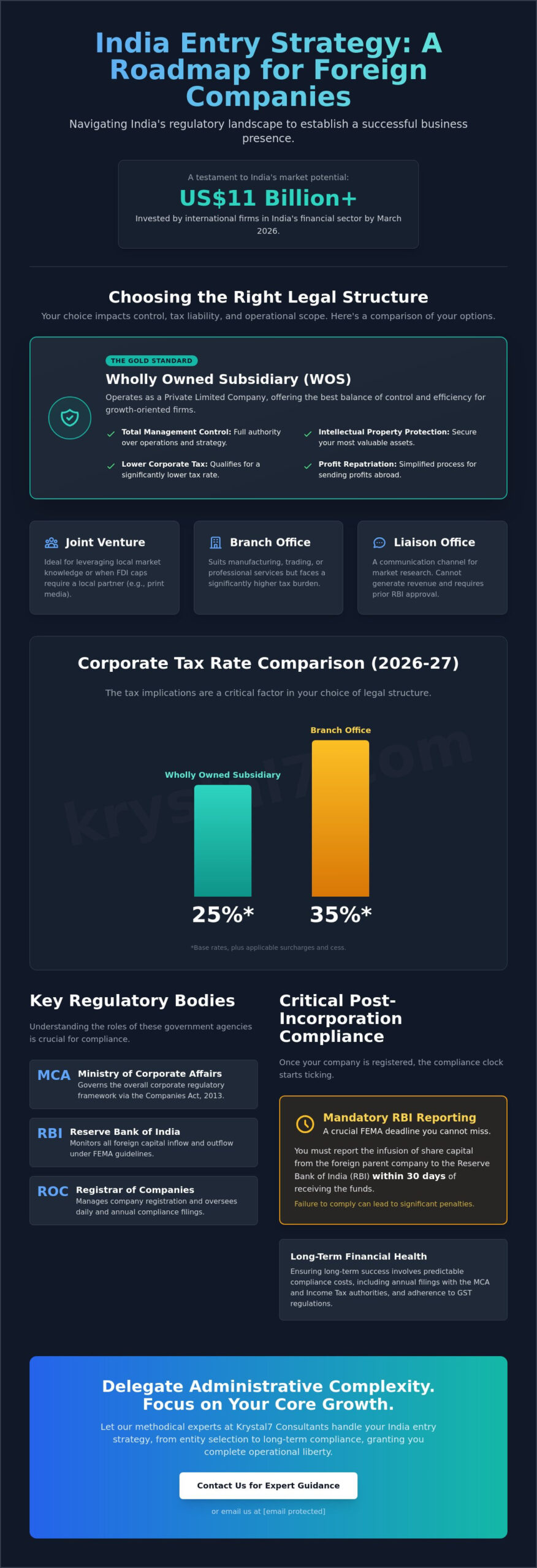
A Wholly Owned Subsidiary (WOS) operates as a Private Limited Company India. This structure grants the parent company total management control and protects intellectual property. It also qualifies for a lower corporate tax rate of 25% compared to the rates applied to foreign branches.
Joint Ventures work well when you need local market knowledge or established distribution networks. Certain sectors, like print media, still require a local partner due to FDI caps. Shareholder agreements under the Companies Act, 2013 govern these partnerships and define the exit strategy for each party.
Liaison and Branch Offices: Limited Entry Options
Liaison Offices act as a communication channel and cannot generate revenue. They function as cost centers for market research and technical collaborations. You must obtain prior approval from the Reserve Bank of India (RBI) before setting one up.
Branch Offices suit foreign manufacturing or trading firms looking to perform professional services. These offices face a higher base tax rate of 35% plus applicable surcharges. Most growth-oriented firms choose the Private Limited structure to secure greater operational liberty and profit repatriation ease.
Step-by-Step Process for Foreign Subsidiary Registration in India
The transition to a digital-first economy has significantly simplified the India entry strategy for foreign companies. The Ministry of Corporate Affairs (MCA) now centralizes the entire incorporation process through its advanced MCA21 V3 portal. This methodical approach eliminates the need for multiple physical filings and brings much-needed transparency to your business launch timeline.
As you navigate this digital-first landscape, specialized global IT consultancies like Kagool can provide the technical expertise needed to harmonize your international SAP, Microsoft, or Databricks systems with India’s specific operational requirements.
While the process is streamlined, it remains meticulous. Every document must be precise to avoid “resubmission” remarks from the Registrar of Companies (ROC). Success depends on following a structured sequence that begins with identifying your leadership and ends with your official Certificate of Incorporation (COI).
Pre-Registration: DSC, DIN, and Name Approval
Before you can submit any digital forms, your foreign directors must obtain a Class 3 Digital Signature Certificate (DSC). This serves as a secure electronic key to sign all applications on the MCA portal. Once the DSC is issued, we apply for a Director Identification Number (DIN) for each proposed director who doesn’t already have one.
Your brand identity starts with the Reserve Unique Name (RUN) service. You’ll need to propose a unique name that complies with the Companies (Incorporation) Rules, 2014. It’s best to provide two names in order of preference to ensure you secure a title that reflects your global brand while meeting local naming guidelines.
Filing the SPICe+ Form and Legalization
The core of company registration in India is the SPICe+ (Simplified Proforma for Incorporating Company Electronically Plus) integrated form. This single-window application is powerful; it handles your incorporation, PAN, TAN, and mandatory registrations like EPFO and ESIC in one go. It’s designed to grant you operational liberty by consolidating several bureaucratic steps into a single digital workflow.
Legalization is a critical hurdle for all foreign-origin paperwork. You must have your parent company’s board resolutions, ID proofs, and address proofs notarized and Apostilled in your home country. If your country isn’t a member of the Hague Convention, these documents require consularization at the Indian Embassy. This step is non-negotiable and must be completed before the final SPICe+ submission.
We’ll also draft your Memorandum of Association (MOA) and Articles of Association (AOA) to define your company’s objectives and internal governance. Once the MCA reviews and approves your filing, they’ll issue the COI. This document contains your Corporate Identity Number (CIN), signaling that your Indian venture is officially open for business.
Understanding Post-Incorporation Compliance and Tax Obligations
Receiving your Certificate of Incorporation is a significant milestone, but it doesn’t grant immediate operational freedom. A sustainable India entry strategy for foreign companies relies on a rigorous post-incorporation roadmap. Missing a single filing with the Reserve Bank of India (RBI) or the Registrar of Companies (ROC) can lead to compounding penalties and legal friction. We ensure your transition from setup to scale remains transparent and secure.
Ongoing adherence to Indian law is the only way to protect your venture’s reputation and financial health. While the digital MCA portal makes filing easier, the volume of mandatory returns requires a methodical approach. You must track deadlines for tax payments, audit reports, and statutory filings to maintain your company’s “Active” status and avoid director disqualification.
RBI Reporting and FEMA Compliance
Your first priority after remitting capital is notifying the RBI. You must file Form FC-GPR (Foreign Collaboration-General Permission Route) within 30 days of allotting shares to the foreign parent company. This filing confirms that the investment complies with sectoral caps and pricing guidelines. Before this, opening an Indian bank account requires stringent KYC documentation, including legalized board resolutions and ID proofs of foreign directors.
If your entity plans to raise debt from the parent company, you must navigate External Commercial Borrowings (ECB) regulations. These involve obtaining a Loan Registration Number (LRN) through an Authorized Dealer bank before any funds hit your account. Staying ahead of these reporting cycles is essential to avoid the “Late Submission Fee” (LSF) which can reach several thousand INR depending on the length of the delay.
GST, TDS, and Income Tax Requirements
Most businesses must obtain GST registration if their annual turnover exceeds ₹20 Lakhs, though many foreign-backed firms register voluntarily to claim Input Tax Credit. Once registered, you’ll manage monthly filing cycles for GSTR-1 and GSTR-3B on the GST portal. You must also account for Tax Deduction at Source (TDS) on payments like rent, professional fees, and salaries. These deductions must be deposited by the 7th of the following month, with quarterly returns filed via the TRACES portal.
Tax efficiency is another critical pillar. For the 2026-27 assessment year, domestic companies (including your Wholly Owned Subsidiary) with turnover up to ₹400 Crore in FY 2024-25 face a base corporate tax rate of 25%. In contrast, a Branch Office is taxed as a foreign company at a base rate of 35% plus applicable surcharges. Failing to manage annual compliance for private limited company mandates can lead to heavy fines under the Companies Act, 2013.
Managing these moving parts requires a meticulous partner who understands the rhythm of Indian regulation. To secure your business against non-compliance risks, you can explore our Annual Compliance Package for total peace of mind.
Strategic Execution: How Krystal7 Simplifies Your Entry into India
Launching a business in a new territory shouldn’t feel like a battle with paperwork. Your India entry strategy for foreign companies deserves a partner that values precision as much as you value growth. We act as your dedicated “Compliance Office” on the ground, transforming complex MCA and RBI regulations into a clear, predictable path forward. By delegating the administrative burden to our experts, you gain the operational liberty to focus entirely on your market expansion and team building.
Our firm provides more than just filing services; we offer a foundation of trust and financial openness. We believe in transparent pricing models that eliminate the fear of hidden costs or unexpected regulatory hurdles. This methodical approach ensures that every step, from initial consultation to final share allotment, is executed with elite professional standards. You’ll find that our team doesn’t just process documents; we safeguard your vision.
A Meticulous Approach to Subsidiary Setup
Success begins with a personalized consultation to ensure you choose the right legal entity for your specific goals. Our Gurugram-based experts manage the entire physical and digital document workflow within India, including the often-confusing process of document legalization and ROC follow-ups. We utilize a “Transparency Motif” in our communication, providing you with real-time updates so you’re never in the dark about your registration status. This meticulous handling of the “how-to” allows you to bypass the typical frustrations of Indian bureaucracy.
Beyond Registration: Your Partner in Growth
Your journey with us continues long after you receive your Certificate of Incorporation. We provide a full suite of essential services, including accounting, bookkeeping, payroll management, and trademark registration to protect your brand identity. Having a dedicated Indian advisor prevents costly legal mistakes and ensures you never miss a deadline on the annual compliance calendar. We’re invested in your long-term success, acting as a supportive expert that scales alongside your business.
Don’t let administrative complexity delay your vision for the Indian market. Our team is ready to provide the calm competence and elite credentials you need for a seamless launch. Contact Krystal7 Consultants today at business@krystal7.com or visit krystal7.com to master your India entry strategy for foreign companies with confidence.
Secure Your Growth in the World’s Fastest-Growing Economy
Establishing a presence in India is a transformative step for any global brand. You now understand that a successful India entry strategy for foreign companies relies on choosing the right legal structure, such as a Wholly Owned Subsidiary, and mastering the digital-first registration process. By prioritizing compliance with the Companies Act and FEMA regulations from day one, you protect your venture’s financial health and operational liberty.
Krystal7 Consultants, based in the corporate hub of Gurugram, provides the methodical expertise you need to handle complex foreign subsidiary registration and ongoing compliance. Our team manages the meticulous details of MCA filings and RBI reporting so you can focus on building your team and capturing market share. We act as your dependable partner, turning bureaucratic obstacles into a transparent path for long-term expansion.
Don’t let administrative complexity hold back your vision. Launch your Indian business with confidence; contact Krystal7 today at business@krystal7.com to begin your journey. India’s vast opportunities are waiting for you, and we’re ready to help you seize them with total peace of mind.
Frequently Asked Questions
Can a foreign individual be a director in an Indian company?
Yes, a foreign national can serve as a director in an Indian company provided the board includes at least one resident director. Under Section 149(3) of the Companies Act, 2013, at least one director must have stayed in India for a total period of not less than 182 days during the previous financial year. This requirement ensures that the entity has a local representative responsible for statutory compliance and communication with regulatory authorities.
How long does the foreign subsidiary registration process take in 2026?
Foreign subsidiary registration typically takes between 10 to 15 business days once we receive your legalized and Apostilled documents. The MCA’s digital SPICe+ portal has accelerated this timeline by consolidating name approval, incorporation, and tax registrations into a single workflow. However, you should account for an additional week for document notarization in your home country and international courier times to our Gurugram office.
Is it mandatory for a foreign company to have a physical office in India?
Yes, every company incorporated in India must maintain a registered office address within the country to receive official communications and maintain statutory records. You’ll need to provide proof of address, such as a lease agreement or a utility bill, along with a No Objection Certificate (NOC) from the property owner. This address is a matter of public record and must be updated on the MCA portal if your office moves.
What is the minimum capital requirement for a foreign subsidiary?
There is no statutory minimum paid-up capital requirement for a Private Limited Company under the current Companies Act. While you can technically incorporate with a nominal capital of ₹1, your authorized capital should reflect your actual business needs. Government registration fees are calculated based on this authorized capital, so most founders choose an amount that balances their initial setup costs with future operational requirements.
Do foreign directors need to travel to India for company registration?
No, foreign directors aren’t required to travel to India at any stage of the incorporation process. The entire procedure is digital and handled through the MCA portal using Digital Signature Certificates (DSC). You can complete the necessary document notarization and Apostille in your home country and courier the physical papers to us. This remote process is a key advantage of a modern India entry strategy for foreign companies.
What are the penalties for late filing of RBI or MCA returns?
Late filings carry significant financial consequences that can quickly escalate if not addressed. For MCA forms like AOC-4 or MGT-7, the penalty is typically ₹100 per day of delay. RBI penalties for missing the 30-day window for Form FC-GPR are more complex. They involve a Late Submission Fee (LSF) that scales based on the investment amount and the length of the delay, potentially costing several thousand INR.
Can a foreign company own 100% of an Indian Private Limited Company?
Yes, a foreign parent company can own 100% of the equity in an Indian Private Limited Company in sectors where 100% FDI is permitted. This structure, known as a Wholly Owned Subsidiary (WOS), is allowed under the “automatic route” for most industries, including software, manufacturing, and consultancy. It’s often the preferred India entry strategy for foreign companies because it ensures total management control and protection of intellectual property.
What is the difference between a Branch Office and a Subsidiary?
A Subsidiary is a separate Indian legal entity with its own liability, whereas a Branch Office is an extension of the foreign parent. Subsidiaries benefit from lower domestic corporate tax rates of 25%, while Branch Offices are taxed at a higher rate of 35%. Furthermore, Branch Offices face stricter limitations on their activities and cannot engage in manufacturing or retail trading without specific approvals from the Reserve Bank of India.

Article by
Nihal Srivastava
Nihal Srivastava is the Co-Founder of Krystal7 Consultants, helping Indian entrepreneurs and startups navigate company registration, compliance, trademark protection, and regulatory requirements with clarity and confidence. With 6+ years of hands-on expertise in MCA filings, GST compliance, and corporate structuring, Nihal has guided 1000+ businesses across India through their legal and compliance journeys. He believes every business dream deserves crystal clear foundations, and that no founder should be held back by paperwork or red tape.