

Setting Up a Private Limited Company Foreign Subsidiary in India: The 2026 Guide
What if the biggest barrier to your global growth isn’t the market competition, but the paperwork you haven’t filed yet? Most international founders see India as a land of immense potential, but the thought of navigating Indian bureaucracy and FEMA regulations often stops them in their tracks. It’s difficult to maintain visual clarity when you’re managing complex tax filings from thousands of miles away.
Establishing a private limited company foreign subsidiary is the most secure way to enter the Indian market while protecting your global interests. This 2026 guide provides a clear roadmap to help you establish and manage your Indian entity with 100% legal compliance. You’ll gain the operational liberty to focus on your vision while we handle the meticulous details of the law.
We’ll explore the updated FDI policies, walk through the registration steps, and outline the critical compliance deadlines you need to meet. You’re about to discover how to turn administrative complexity into a strategic advantage for your brand.
Key Takeaways
- Understand why global firms prefer the private limited company foreign subsidiary structure for its unique balance of operational flexibility and limited liability protection.
- Navigate the 2026 FDI policy updates, including the 10% beneficial ownership threshold for bordering nations, to ensure your capital infusion follows the correct approval route.
- Master the digital registration process by securing Digital Signature Certificates and utilizing the MCA portal for efficient name approval and incorporation.
- Secure your legal standing by completing mandatory post-incorporation tasks like filing Form FC-GPR with the RBI and appointing your first statutory auditor.
- Discover how partnering with a local expert in Gurgaon provides the visual transparency needed to manage Indian compliance and tax filings with total confidence.
What is a Private Limited Company Foreign Subsidiary in India?
A private limited company foreign subsidiary is an Indian entity where a company incorporated outside of India holds 50% or more of the equity shares. Many international firms choose to own 100% of the shares to create a Wholly Owned Subsidiary (WOS). This structure offers a clear path for global brands to establish a permanent, scalable presence in one of the world’s fastest-growing economies.
Under the Companies Act, 2013, this subsidiary exists as a separate legal entity, distinct from its parent company. International parent companies prefer the Private Limited structure because it provides a robust shield for global assets. This separation limits the parent company’s liability strictly to the capital it invests in the Indian entity.
The subsidiary can own property, enter into local contracts, and apply for essential licenses in its own name. Choosing this model over a liaison or branch office provides significant operational advantages. While a liaison office faces restrictions on commercial activities, a subsidiary can engage in full-scale business operations.
It’s the most robust vehicle for companies that want to hire local talent, invoice in Indian Rupee (INR), and build long-term brand equity.
The Legal Framework for Foreign Entities
The Ministry of Corporate Affairs (MCA) governs the registration and management of these entities through a centralized digital process. Foreign subscribers must follow specific documentation standards, which often require them to apostille or notarize documents in their home country. Understanding how a private limited company in India functions is the first step toward achieving total compliance.
Strategic Benefits of a Private Limited Company Foreign Subsidiary
Total control is perhaps the most compelling reason to establish a private limited company foreign subsidiary. You don’t need a local partner to begin operations, which grants you the operational liberty to execute your global strategy without compromise. This independence simplifies the decision-making process and ensures your intellectual property remains under your direct oversight.
Financial flexibility is another major draw. The subsidiary model allows you to repatriate profits to the parent company after meeting local tax obligations. It also positions your business as a domestic entity for most regulatory purposes, providing access to various government incentives.
FDI Routes and Eligibility Criteria for 2026
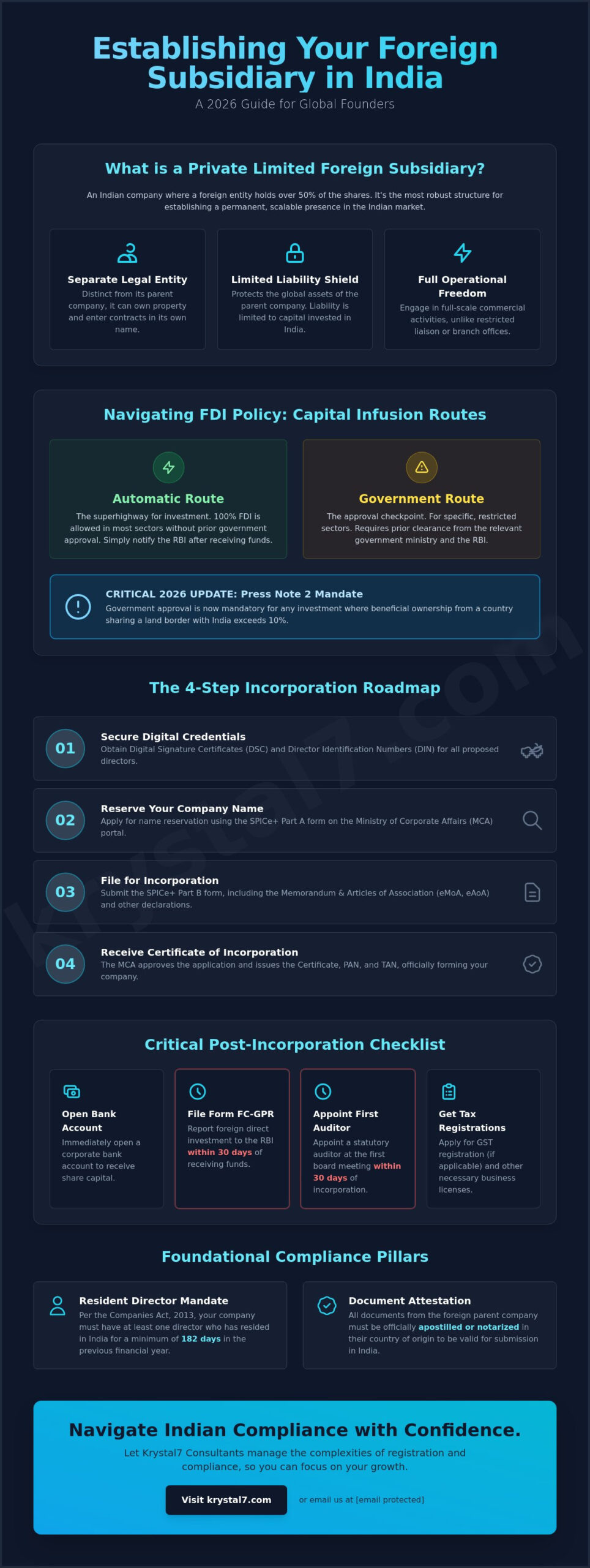
Setting up a private limited company foreign subsidiary requires a clear understanding of how capital enters India. Most international investors utilize the Automatic Route, which allows for 100% foreign direct investment (FDI) without prior clearance from the Reserve Bank of India (RBI). You simply notify the authorities through the FIRMS portal after the funds are received. This streamlined approach grants you the operational liberty to begin your market entry without bureaucratic delays.
Compliance with the Foreign Exchange Management Act (FEMA) is mandatory for every initial capital infusion. Significant updates arrived with Press Note 2 of 2026, which took effect on March 15, 2026. This regulation mandates government approval for any investment where beneficial ownership from a country sharing a land border with India exceeds 10%. Ensuring your capital structure aligns with these visual transparency standards is essential to avoid penalties or rejection at the MCA portal.
All filings and capital valuations must be denominated in Indian Rupee (INR). While the parent company provides the vision, the subsidiary must adhere to local financial reporting standards from day one. This methodical approach to documentation prevents the anxiety often associated with cross border compliances.
The Resident Director Requirement
Section 149(3) of the Companies Act, 2013, states that your entity must have at least one director who resides in India. This individual must have spent at least 182 days in the country during the financial year. They serve as a vital link between your global headquarters and local regulators. If you’re struggling to find a trustworthy local partner, our Foreign Subsidiary Registration experts can guide you through identifying compliant representation.
Sector-Specific FDI Caps and Prohibited Activities
While India is open for business, certain sectors remain off-limits to protect the national economy. You cannot invest foreign capital in gambling, lottery businesses, or the construction of farmhouses. However, manufacturing and software development continue to enjoy 100% FDI under the automatic route in 2026.
- Automatic Route: No prior approval needed for most tech, manufacturing, and service sectors.
- Approval Route: Required for bordering nations or sensitive industries like defense.
- Prohibited: Real estate trading, chit funds, and tobacco-related businesses.
Always verify your sector’s specific cap before finalizing your shareholder agreement. Accurate classification ensures your private limited company foreign subsidiary starts on a firm legal foundation and avoids the risk of FEMA violations.
Step-by-Step Process for Foreign Subsidiary Registration
Registering a private limited company foreign subsidiary in 2026 is a structured digital journey. The Ministry of Corporate Affairs (MCA) has centralized the workflow to provide a methodical path for international founders. This efficiency grants you the operational liberty to launch your Indian entity with confidence and total legal standing.
First, secure Class 3 Digital Signature Certificates (DSC) for your foreign directors. These certificates usually cost between ₹1,000 and ₹3,500 depending on the validity period. Once you have the DSC, submit your preferred company name through the RUN (Reserve Unique Name) service for a fee of ₹1,000. This initial step ensures your brand identity is protected within the Indian jurisdiction.
Navigating the SPICe+ Integrated Form
The SPICe+ form is the heart of the incorporation process. It allows you to apply for the Director Identification Number (DIN) for a fee of ₹500 per director. This integrated approach to company registration streamlines the entry for foreign entities by bundling PAN, TAN, and even GST registration into a single submission. You can also trigger your EPFO and ESIC registrations simultaneously, ensuring your subsidiary is ready to hire talent immediately.
The Apostille and Notarization Challenge
Foreign documents like the parent company’s charter and board resolutions must be apostilled in their country of origin. This step provides the visual transparency required by Indian regulators to verify the authenticity of your international records. If your documents aren’t in English, you must provide a certified translation. Many applications face MCA rejections because the execution of these documents doesn’t match the specific formatting requirements of the Companies Act, 2013.
After the MCA approves your SPICe+ filing, you’ll receive your Certificate of Incorporation (COI). This document confirms your legal status and includes your Corporate Identification Number (CIN). Your PAN and TAN are issued along with the COI, marking the moment your private limited company foreign subsidiary becomes a functional reality in the Indian market. This meticulous attention to detail during the filing phase prevents future hurdles with the TRACES portal or banking authorities.
Post-Incorporation Compliance for your Private Limited Company Foreign Subsidiary
Receiving your COI marks the start of your operational duties. You must appoint your first statutory auditor within 30 days of incorporation. This auditor verifies that your books of accounts reflect the true financial health of the business.
You also need to open a corporate bank account in India to receive the initial capital from your parent entity. The parent company must remit this capital within 180 days to maintain the company’s legal standing. This capital infusion allows you to begin local operations and meet your initial expenses in Indian Rupee (INR).
Managing the annual compliance for a private limited company requires a disciplined schedule. Directors must hold the Annual General Meeting (AGM) by September 30, 2026. This meeting serves as the primary forum for shareholders to review the company’s performance.
Following the meeting, you must file financial statements in Form AOC-4 within 30 days. You also need to submit the annual return in Form MGT-7 within 60 days of the AGM. These filings provide the MCA with a transparent view of your subsidiary’s activities.
The MCA levies a strict penalty of ₹100 per day for each late form. This methodical oversight prevents unnecessary financial burdens and protects your status in the Indian market. We recommend tracking these dates closely to ensure your business remains in good standing.
FEMA and RBI Reporting Obligations
When your private limited company foreign subsidiary receives its first inward remittance, you must act quickly. You have exactly 30 days to file Form FC-GPR via the FIRMS portal. This filing confirms the allotment of shares to the foreign investor.
Your valuation report must match FEMA requirements to provide the visual transparency regulators demand. Failure to report on time leads to heavy late submission fees. It may also trigger compounding proceedings under the Reserve Bank of India guidelines.
Taxation and Recurring Filings
Your subsidiary will interact with the GST portal monthly and the TRACES portal quarterly for TDS filings. You must also file annual income tax returns to stay compliant with the Income Tax Act. These recurring tasks ensure your business contributes correctly to the local economy.
If you have transactions with your parent company, you must maintain meticulous Transfer Pricing (TP) documentation. This proves your international transactions follow the “arm’s length” principle. It protects your entity from tax disputes and ensures financial openness.
Our Annual Compliance Package handles these technicalities so you can focus on your core business growth. Every director must also file Form DIR-3 KYC by September 30, 2026. Filing this after the due date results in a steep penalty of ₹5,000 to reactivate the DIN.
We maintain a detailed compliance calendar to ensure your venture never misses a deadline. This proactive approach grants you the liberation to lead your Indian team without administrative stress. We handle the complexity so you can pursue your primary goals.
Empowering Your Expansion: The Krystal7 Advantage
Establishing a private limited company foreign subsidiary is a bold step toward global growth. While the regulatory environment in India is full of opportunity, the administrative weight can often cloud your strategic vision. We believe that founders should be visionaries, not bureaucrats. Our mission is to provide the visual transparency and methodical support you need to navigate Indian law with total confidence.
We handle the meticulous details of company registration, GST filings, and RBI reporting so you can focus on building your brand. By delegating these complex tasks to a dedicated partner, you gain the operational liberty to scale without the constant anxiety of missing a deadline or violating a FEMA regulation. We transform complicated legal formalities into a clear, structured roadmap for your success.
Gurgaon: The Strategic Gateway for Subsidiaries
Our firm is strategically located in Gurgaon (Gurugram), the corporate heart of Northern India. This location provides us with immediate proximity to international airports and key government offices, ensuring your filings move through the system without delay. Being based in Haryana allows us to tap into an elite network of financial and legal resources within the National Capital Region (NCR). We serve as your dependable on-ground partner, providing the local institutional knowledge that international firms often struggle to find from a distance.
Transparent Processes, Clear Growth
Financial openness is the foundation of our partnership. We utilize fixed pricing models for our private limited company foreign subsidiary packages, ensuring you never encounter hidden administrative costs or surprise fees. This commitment to transparency extends to our communication; you’ll receive real-time updates on your incorporation and compliance status. We don’t just file forms; we build long-term partnerships invested in your Indian success story.
- Customized Solutions: We tailor our compliance packages to meet the specific needs of startups and SMEs entering the Indian market.
- Expert Oversight: Our team of Chartered Accountants ensures every document meets the highest standards of the Companies Act and GST Act.
- Human Touch: While we utilize the latest digital portals, we remain a supportive partner, always available to simplify complex financial concepts for your team.
Don’t let bureaucratic obstacles slow your momentum. Contact Krystal7 Consultants today at business@krystal7.com or visit krystal7.com to discover how we can help you establish and manage your Indian foreign subsidiary with ease.
Securing Your Future in the Indian Market
Navigating the 2026 FDI updates and mastering the SPICe+ digital workflow provides the foundation your business needs to thrive. You now understand that establishing a private limited company foreign subsidiary involves more than just filing forms; it requires meticulous attention to FEMA reporting and resident director mandates. By prioritizing these legal pillars, you protect your global assets and grant your Indian team the operational liberty they deserve.
Success in India depends on having a dependable partner who handles the bureaucratic weight while you pursue your primary goals. Our team of Chartered Accountants in Gurgaon specializes in cross border compliances and complex FEMA regulations. We offer transparent pricing with no hidden fees, ensuring you have visual clarity over every financial aspect of your expansion.
Ready to expand your business to India? Contact Krystal7 Consultants at business@krystal7.com or visit krystal7.com for expert assistance. We’re here to turn your vision of an Indian subsidiary into a compliant and profitable reality.
Frequently Asked Questions
Can a foreign company own 100% of an Indian Private Limited Company?
Yes, a foreign company can own 100% of the shares in an Indian entity, which is then classified as a Wholly Owned Subsidiary (WOS). Most sectors allow this under the automatic route without prior government approval. However, under Press Note 2 of 2026, investments from countries sharing a land border with India require government clearance if beneficial ownership exceeds 10%.
How much time does it take to register a foreign subsidiary in India in 2026?
The registration process typically takes 15 to 25 business days once all documents are ready. This timeline includes obtaining Digital Signature Certificates, securing name approval via the RUN service, and final MCA approval of the SPICe+ form. Providing apostilled documents promptly from your home country is the best way to ensure a methodical and fast approval process.
Is it mandatory to have an Indian director for a foreign subsidiary?
Yes, Section 149(3) of the Companies Act, 2013, mandates that every company must have at least one director who is a resident of India. This individual must have stayed in India for a minimum of 182 days during the financial year. This requirement ensures that your private limited company foreign subsidiary has local accountability and a direct point of contact for Indian regulators.
What are the minimum capital requirements for a foreign subsidiary?
India does not prescribe a specific minimum paid-up capital for incorporating a subsidiary. You can start with a nominal amount, though you must ensure the authorized capital covers your initial operational needs and registration fees. For example, the MCA fee for authorized capital up to ₹1,00,000 is only ₹200. This flexibility allows startups to scale their investment as their business grows.
What is Form FC-GPR and when should it be filed?
Form FC-GPR is a mandatory report filed with the RBI to notify them of foreign capital investment and share allotment. You must submit this form through the FIRMS portal within 30 days of issuing shares to the foreign parent company. Accurate filing is critical for FEMA compliance and ensures that your inward remittance is legally recognized by the Indian banking system.
Can a foreign subsidiary repatriate its profits back to the parent company?
Yes, a private limited company foreign subsidiary can repatriate its profits through dividends after paying the required corporate taxes in India. The process is efficient and provides the operational liberty global firms need to manage their international cash flow. You must ensure all annual filings and FEMA reporting are up to date before initiating the transfer through your authorized dealer bank.
What happens if a foreign subsidiary fails to meet annual compliance deadlines?
Missing deadlines results in immediate financial penalties and increased regulatory scrutiny. For instance, the MCA charges a penalty of ₹100 per day for late filing of financial statements (AOC-4) and annual returns (MGT-7). Continuous non-compliance can lead to the disqualification of directors or the company being struck off from the Register of Companies, causing significant administrative hurdles.
Do foreign directors need to visit India for the registration process?
No, foreign directors aren’t required to visit India at any stage of the incorporation process. The entire registration is handled digitally through the MCA portal and video-based KYC for Digital Signature Certificates. You only need to send the apostilled and notarized physical documents to our office in Gurgaon, allowing you to manage your expansion from your home headquarters.

Article by
Nihal Srivastava
Nihal Srivastava is the Co-Founder of Krystal7 Consultants, helping Indian entrepreneurs and startups navigate company registration, compliance, trademark protection, and regulatory requirements with clarity and confidence. With 6+ years of hands-on expertise in MCA filings, GST compliance, and corporate structuring, Nihal has guided 1000+ businesses across India through their legal and compliance journeys. He believes every business dream deserves crystal clear foundations, and that no founder should be held back by paperwork or red tape.