

ROC Filing Due Dates 2026: The Complete Compliance Calendar for Companies & LLPs
Is the fear of penalties for late corporate filings keeping you up at night? For dedicated entrepreneurs, juggling statutory deadlines, navigating complex regulatory platforms, and distinguishing between annual and event-based compliances can feel overwhelming—pulling focus away from what truly matters: growing your venture.
At Krystal7 Consultants, we believe compliance should empower your vision, not complicate it. That’s why we’ve created this definitive guide to bring you absolute clarity on all the crucial due dates for roc filing 2026. Consider this your master compliance calendar, meticulously designed to eliminate guesswork and help you master your statutory obligations with confidence.
Inside, you will find a simple, non-technical roadmap covering every important deadline for both Companies and LLPs. Leave the stress of potential penalties behind, ensure your business remains in perfect standing with state corporate authorities, and reclaim the freedom to focus on building your legacy.
Key Takeaways
- Master the essential annual forms for both Companies (AOC-4, MGT-7) and LLPs (Form 8, Form 11) to build your compliance roadmap.
- Discover how to identify and manage event-based filings-the hidden deadlines that carry significant non-compliance risks.
- Get a clear, consolidated view of all critical due dates for roc filing 2026 to avoid last-minute stress and ensure flawless compliance.
- Implement a proactive ‘Document Readiness’ strategy to streamline your audit process and make statutory filings effortless.
What is ROC Filing and Why Does it Matter in 2026?
Navigating corporate compliance can seem complex, but understanding its core components brings clarity and control. ROC filing is the mandatory annual submission of a company’s financial statements, annual returns, and other key management data to the Registrar of Companies. Governed by the Companies Act, 2013, and the LLP Act, 2008, this process is the backbone of corporate transparency in India. Understanding this framework is the first step toward successfully meeting all due dates for roc filing 2026.
In 2026, the Ministry of Corporate Affairs (MCA) continues its push for greater accountability and a more transparent business ecosystem. This isn’t just about creating more red tape; it’s about building a trustworthy economic environment. For your business, timely and accurate ROC filing is directly linked to maintaining your ‘Active’ compliance status on the MCA portal-a non-negotiable requirement for a healthy, growing enterprise.
The Role of the Registrar of Companies (ROC)
Think of the ROC as the primary regulator and custodian of corporate information in India. Every state has an ROC office responsible for administering the registration and compliance of companies within its jurisdiction. The data you submit is used by the Registrar of Companies (ROC) to maintain a public registry, offering stakeholders a clear view of a company’s operational and financial health. From incorporation to winding up, the ROC oversees the entire lifecycle of a registered company, ensuring statutory compliance at every stage.
Consequences of Non-Compliance: Beyond the Fines
Missing statutory deadlines can trigger a cascade of negative consequences that extend far beyond simple financial penalties. It puts your company’s reputation, your directors’ careers, and your future growth prospects at significant risk. The repercussions include:
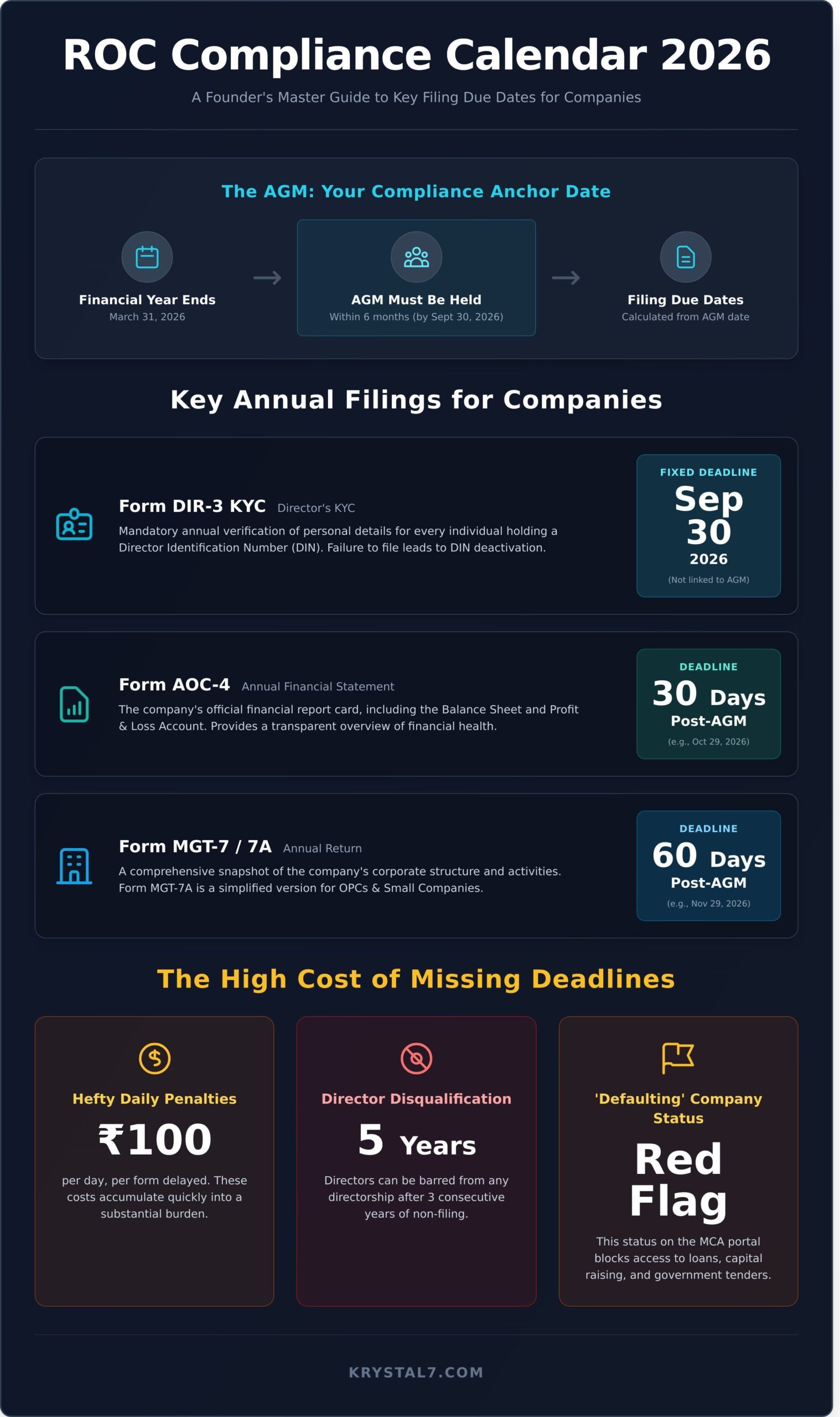
- Hefty Daily Penalties: A steep penalty of ₹100 per day, per form, is levied for delayed filings. This can quickly accumulate into a substantial financial burden.
- Director Disqualification: Directors of a company that fails to file for three consecutive years can be disqualified, barring them from holding a directorship in any company for five years.
- ‘Defaulting’ Company Status: A non-compliant company is marked as ‘Defaulting’ on the MCA portal. This status is a major red flag that effectively prevents you from raising capital, securing bank loans, or participating in tenders.
The Master ROC Compliance Calendar for 2026
Navigating the various due dates for roc filing 2026 can feel overwhelming, but with a clear calendar, you can transform compliance from a source of anxiety into a streamlined process. These timelines are not arbitrary; they are mandated by The Companies Act, 2013, which governs all statutory requirements. The key is understanding that most deadlines are linked to your company’s Annual General Meeting (AGM), which must be held within six months of the financial year’s end (i.e., by September 30th, 2026, for the FY 2025-26). This “days from AGM” logic empowers you to calculate your specific deadlines with precision, giving you the freedom to focus on growth.
Annual Financial Statement Filings (AOC-4)
This is your company’s official financial report card to the ROC. Form AOC-4 provides a transparent overview of your financial health, including the Balance Sheet and Profit & Loss Account for the preceding financial year.
- Purpose: To report the complete financial health and performance of your company.
- Standard Deadline: Within 30 days of your company’s AGM.
- Expected 2026 Date: October 29th, 2026 (assuming a September 30th AGM).
Annual Return Filings (MGT-7 & MGT-7A)
The Annual Return is a comprehensive snapshot of your company’s corporate structure and activities throughout the year. It’s crucial to file the correct version to maintain compliance and avoid unnecessary penalties.
- The Difference: Form MGT-7 is for most companies, while the abridged Form MGT-7A offers a simplified process for One Person Companies (OPCs) and Small Companies.
- Standard Deadline: Within 60 days of your company’s AGM.
- Expected 2026 Date: November 29th, 2026 (for a September 30th AGM).
Director-Specific Compliance (DIR-3 KYC)
This is a mandatory annual exercise for every individual holding a Director Identification Number (DIN). It’s a simple verification, but failing to complete it has significant consequences that can disrupt your company’s operations.
- Purpose: To verify and update the personal details of every director with the MCA.
- Hard Deadline: September 30th, 2026. This date is fixed and not linked to the AGM.
- Consequence of Non-Filing: Your DIN will be deactivated, preventing you from signing any company forms or acting as a director until it is reactivated after paying a penalty.
Beyond these core filings for private limited companies, remember to track other important dates for forms like DPT-3 (Return of Deposits) by June 30th, MSME-1 (for outstanding dues to MSMEs), and specific LLP filings such as Form 11 and Form 8.
Event-Based vs. Annual Filings: Don’t Miss These ‘Hidden’ Deadlines
While your annual compliance calendar provides a predictable rhythm, event-based filings are the hidden deadlines that can catch even the most diligent businesses off guard. Unlike annual returns, these are not tied to the financial year’s end. Instead, they are triggered by specific corporate actions, creating a dynamic set of due dates for roc filing 2026 that demand constant vigilance.
The danger lies in their reactive nature. A single board resolution to change your office address or appoint a new director starts a compliance clock, often with a very short fuse. Most of these event-based filings must be submitted to the Registrar of Companies (ROC) within a strict 15 or 30-day window. Overlooking them can result in hefty penalties and a complicated path back to full compliance.
To avoid this hassle, we recommend integrating a compliance review into your monthly accounting cycle. This simple, proactive step ensures that no corporate action goes unreported, giving you the clarity and freedom to focus on growth.
Common Event-Based Triggers for 2026
For Private Limited Companies, certain actions almost always require an immediate ROC filing. Stay ahead by tracking these common triggers:
- Change in Registered Office (Form INC-22): You have a strict 30-day limit from the date of the resolution to inform the ROC of your new official address.
- Appointment or Resignation of Directors (Form DIR-12): Any change to your company’s board composition must be filed promptly, typically within 30 days of the event.
- Increase in Authorized Capital (Form SH-7) & Allotment of Shares (Form PAS-3): Decisions impacting your company’s share structure require swift notification to maintain statutory records.
LLP Specific Event Filings
Limited Liability Partnerships (LLPs) also have their own set of event-based requirements that are distinct from companies. Key filings to monitor include:
- Changes in Designated Partners or their Details (Form 4): Similar to a company’s director changes, any modification to the list of designated partners or their personal details must be filed.
- Amendments to the LLP Agreement (Form 3): Any change to the foundational LLP agreement, which governs its operation, must be reported within 30 days.
It is crucial for partners to remember that the specific timelines and due dates for roc filing 2026 for LLP event-based compliance can differ from those for Private Limited companies, demanding careful and separate attention.
A Founder’s Strategy for Stress-Free Compliance
Meeting statutory deadlines doesn’t have to be a source of anxiety. With a proactive strategy, you can transform compliance from a last-minute hassle into a streamlined business process. This approach ensures you meet all due dates for roc filing 2026 with confidence, giving you the freedom to focus on what truly matters: growing your vision.
The foundation of a stress-free filing season is preparation. Before your auditor arrives, have a ‘Document Readiness’ checklist finalized. This should include key items like bank statements, loan agreements, statutory registers, and detailed ledgers. For founders managing multiple ventures, a simple Compliance Dashboard can provide Krystal-Clear visibility on deadlines for each entity, preventing any compliance from slipping through the cracks.
Remember, the entire filing timeline hinges on conducting your Annual General Meeting (AGM) on time, by September 30th. This is a non-negotiable deadline that sets the clock for your AOC-4 and MGT-7/7A filings. Also, ensure your Directors’ Digital Signatures (DSC) are valid and that you are familiar with the MCA V3 portal to avoid technical snags that can derail your schedule.
The 3-Step Preparation Framework
A methodical approach is your greatest asset. We recommend this simple, three-step timeline to stay ahead of all due dates for roc filing 2026:
- Finalize & Audit (By July/August): Close your books for the financial year and hand them over to your auditors. Completing the statutory audit well before September gives you ample time for review and approval.
- Board Meeting & AGM (By Early September): Conduct the Board Meeting to approve the financial statements and issue the notice for your AGM at least 21 clear days before the meeting date.
- File Early (By Mid-October): Once the AGM is complete, don’t wait. Begin uploading your signed forms to the MCA portal at least 10 days before the deadline to avoid the inevitable system overload.
Common Pitfalls to Avoid in 2026
Even the most prepared founders can encounter roadblocks. Steer clear of these common mistakes to ensure a smooth filing experience:
- The Last-Minute Rush: Waiting until the final week of October is a high-risk gamble. The MCA portal is known for performance issues under heavy traffic, which can lead to missed deadlines and unnecessary penalties.
- Incorrect Form Usage: Filing Form MGT-7A is only permissible for a One Person Company (OPC) or a ‘Small Company’. Misclassifying your company can lead to compliance issues. Double-check the latest turnover and paid-up capital thresholds.
- Overlooking Auditor Validity: An auditor’s five-year term may have expired. Verify that your auditor’s appointment, filed via ADT-1, is still valid for the financial year to avoid having your financial statements rejected.
Navigating these complexities is where expert guidance provides true clarity. If you’re feeling overwhelmed, the dedicated compliance team at krystal7.com is here to help you build a robust and stress-free compliance strategy.
Achieve Crystal-Clear Compliance with Krystal7
Navigating the complex landscape of statutory deadlines can be overwhelming for any business owner. Instead of letting compliance become a source of stress, what if it could be a streamlined, predictable part of your operations? This is where Krystal7 Consultants brings clarity. Our All-in-one Annual Compliance Package is designed to give you complete peace of mind.
We handle the entire ROC lifecycle for you, from preparing documents to filing returns, delivering true Freedom to Focus on what you do best: growing your business. Transparency is how we work. With our commitment to No Hidden Costs, you receive upfront, clear pricing, eliminating guesswork and unpleasant surprises. Your dedicated team includes:
- A Chartered Accountant for financial accuracy and advisory.
- A Company Secretary to manage all statutory and board compliance.
Why Krystal7 Consultants is the Choice for Modern Entrepreneurs
We pair elite, chartered expertise with a supportive, human touch. Your dedicated advisor is more than a consultant; they are a genuine partner invested in your success. Our methodical approach ensures all due dates for roc filing 2026 are tracked and met well in advance, guaranteeing zero late fees and maintaining your company’s pristine compliance record.
“Working with Krystal7 Consultants was a game-changer. The ‘Crystal Clarity’ they brought to our compliance was incredible. For the first time, we felt completely in control without being bogged down by the details. They are an essential part of our team.”
– Anika Sharma, CEO of Innovatech Solutions
Get Started with Your 2026 Compliance Audit
Your journey to effortless compliance begins with a simple, no-obligation consultation. A Krystal7 Consultants advisor will review your current standing, understand your business needs, and outline a clear path forward for all your compliance obligations. Worried about switching? We make the transition from your previous consultants seamless and hassle-free, managing all record transfers securely.
Don’t let deadlines dictate your focus. It’s time to build a foundation of absolute compliance. Secure your business legacy with our Annual Compliance Package.
Achieve Krystal-Clear Compliance in 2026 and Beyond
Navigating the landscape of ROC compliance requires more than just marking a calendar; it demands a proactive strategy. As we’ve covered, understanding the distinction between crucial annual and event-based filings is the key to maintaining your company’s good standing and avoiding costly penalties. Mastering the various due dates for roc filing 2026 is the foundation of a healthy, thriving business, but you don’t have to manage the complexity alone.
Instead of wrestling with deadlines and complex forms, imagine having the freedom to focus entirely on your business vision. Krystal7 makes this a reality. Our All-in-one Annual Compliance Package, managed by top-tier CAs and Company Secretaries, ensures every deadline is met with precision. With our zero-penalty guarantee for proactive clients and transparent pricing with no hidden ‘red tape’ fees, you can finally say goodbye to uncertainty. Streamline your business with our All-in-one Annual Compliance Package today.
Let 2026 be the year your business thrives, supported by a foundation of impeccable compliance. Your vision deserves it.
Frequently Asked Questions
What is the last date for ROC filing for the financial year 2025-26?
For the financial year 2025-26, the key due dates for ROC filing 2026 are October 30, 2026, for Form AOC-4 (Financial Statements) and November 29, 2026, for Form MGT-7 (Annual Return). These dates are crucial for maintaining your company’s compliance. Missing these deadlines can lead to significant penalties, so it is vital to plan ahead. We help streamline this process, ensuring every deadline is met with crystal clarity and without last-minute hassle.
Can I file ROC returns myself without a professional?
While the MCA portal allows for direct filing, the process is intricate and requires a deep understanding of the Companies Act and accounting standards. Errors or omissions can lead to rejection and penalties. Engaging a professional, like a Chartered Accountant or Company Secretary, ensures accuracy and saves you from potential legal issues. This gives you the freedom to focus on what you do best-growing your business, while we handle the complexities with complete transparency.
What is the penalty for late filing of AOC-4 and MGT-7 in 2026?
The penalty for late filing of ROC forms like AOC-4 and MGT-7 is a fixed additional fee of Rs. 100 per day for each day of default, per form. This means if both forms are delayed, the penalty accumulates at Rs. 200 per day. There is no maximum limit, so the amount can become substantial very quickly. Ensuring timely filing is not just about compliance; it’s a critical financial decision to avoid these burdensome and unnecessary costs.
Is it mandatory for a dormant company to file ROC returns?
Yes, it is absolutely mandatory. A company with ‘Dormant Status’ is not exempt from ROC filings. Instead of the standard annual returns, a dormant company must file a “Return of Dormant Company” in Form MSC-3 annually. This must be filed within 30 days from the end of each financial year. Failure to do so can result in penalties and may even lead to the company’s name being struck off from the Register of Companies.
How do I check my company’s ROC filing status on the MCA portal?
You can easily verify your company’s filing status on the Ministry of Corporate Affairs (MCA) portal. Navigate to ‘MCA Services,’ then ‘Master Data,’ and select ‘View Company/LLP Master Data.’ Enter your company’s Corporate Identification Number (CIN) and the captcha. The generated report will display key details, including the date of the last filed Annual Return and Balance Sheet, giving you a clear picture of your compliance standing. This transparency is key to good governance.
What documents are required for the DIR-3 KYC filing in 2026?
For DIR-3 KYC, every director must provide a unique personal mobile number and email ID for OTP verification. Key documents include a self-attested copy of your PAN card, Aadhaar card, and passport (if you are a foreign national). A recent proof of address, such as a utility bill or bank statement, is also required. For directors who have already completed their KYC in a prior year, a simpler web-based verification is sufficient if no personal details have changed.
Do LLPs have different ROC due dates than Private Limited companies?
Yes, Limited Liability Partnerships (LLPs) have their own distinct compliance calendar. An LLP must file Form 11 (Annual Return) by May 30th and Form 8 (Statement of Account & Solvency) by October 30th each year. These due dates for roc filing 2026 for LLPs are different from those for Private Limited companies, which file AOC-4 and MGT-7. It’s crucial to manage the correct deadlines based on your entity’s structure to ensure seamless compliance.
What happens if I miss the AGM deadline of September 30th?
Missing the Annual General Meeting (AGM) deadline of September 30th has a direct domino effect on your compliance. You cannot file your financial statements (AOC-4) and annual return (MGT-7) without first holding the AGM. This automatically pushes you into a late filing scenario, attracting the standard daily penalty of Rs. 100 per form. More importantly, it is a non-compliance of the Companies Act, which can lead to further adjudication and penalties on the company and its directors.

Article by
Nihal Srivastava
Nihal Srivastava is the Co-Founder of Krystal7 Consultants, helping Indian entrepreneurs and startups navigate company registration, compliance, trademark protection, and regulatory requirements with clarity and confidence. With 6+ years of hands-on expertise in MCA filings, GST compliance, and corporate structuring, Nihal has guided 1000+ businesses across India through their legal and compliance journeys. He believes every business dream deserves crystal clear foundations, and that no founder should be held back by paperwork or red tape.