

Choosing a Company Name: A Clear Guide to MCA Guidelines
You’ve crafted the perfect business plan and are ready to bring your vision to life. But there’s one critical hurdle that can stop your momentum cold: choosing a company name. The fear of a rejection notice from the Ministry of Corporate Affairs (MCA), the confusion over complex rules, and the worry of accidentally picking a taken name can turn an exciting step into a source of anxiety. Navigating the process of choosing a company name mca guidelines correctly is the key to avoiding this red tape and ensuring a smooth start for your venture.
This guide is here to provide that clarity. We will demystify the MCA’s regulations, transforming legal jargon into a straightforward, step-by-step roadmap. You will learn precisely how to check if your desired name is available, understand the rules for uniqueness and compliance, and confidently reserve a name that gets approved without hassle. Let’s eliminate the guesswork and give you the freedom to focus on what truly matters: building your business.
The Foundation: Why MCA Guidelines for Company Names Matter
Your company name is the cornerstone of your brand identity. It’s the first impression you make and the legacy you aim to build. In India, this crucial first step is overseen by a central authority to ensure fairness and order in the corporate ecosystem. This is where understanding the regulations set by the Ministry of Corporate Affairs (MCA) becomes non-negotiable. The MCA’s role is to ensure every proposed name is unique, appropriate, and not misleading to the public.
Getting this right from the beginning is more than just a compliance task; it’s a strategic move. A rejected name application means lost time, wasted application fees (around ₹1,000 per attempt), and a delay in your business launch. Adhering to the choosing a company name mca guidelines from day one provides a streamlined path to registration, saving you from unnecessary costs and administrative hassles, and giving you the freedom to focus on what truly matters: growing your venture.
The Purpose Behind the Rules
The MCA’s regulations aren’t arbitrary red tape. They are designed to create a transparent and trustworthy business environment for everyone. The core objectives are simple and powerful:
- Preventing Public Deception: The rules prevent names that might mislead stakeholders by implying a connection to the government, a different scale of operations, or an entirely different industry.
- Protecting Existing Businesses: By disallowing names that are identical or too similar to existing companies or registered trademarks, the MCA protects the intellectual property and brand equity of established entities.
- Maintaining a Distinct Identity: Every registered company must have a unique name to ensure clear legal and financial accountability, preventing confusion in contracts, taxation, and public records.
Key Legislation You Should Know
The entire framework for company incorporation and naming conventions is built upon a few key legal documents. The primary source of authority is the Companies Act, 2013, which lays down the fundamental principles. However, the specific, detailed criteria you’ll need to follow are outlined in Rule 8 of the Companies (Incorporation) Rules, 2014. While diving into legal text can feel overwhelming, our goal is to bring you clarity. In the next sections, we will break down these rules into simple, actionable insights to guide your decision-making process.
Decoding MCA Rule 8: What Makes a Company Name ‘Undesirable’?
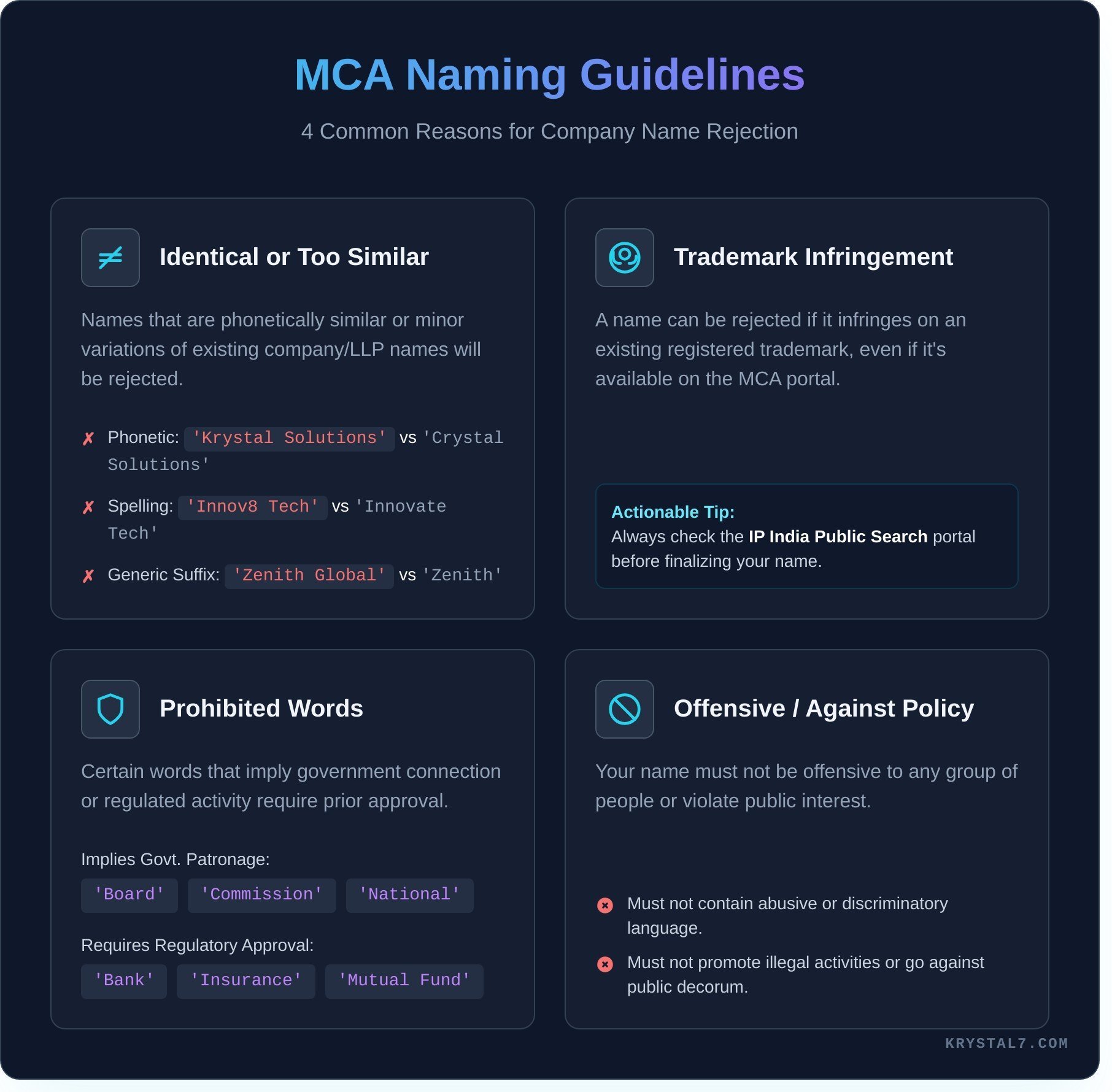
Navigating the process of choosing a company name mca guidelines means understanding one critical term: ‘undesirable’. As per Rule 8 of the Companies (Incorporation) Rules, 2014, the Ministry of Corporate Affairs (MCA) will reject any proposed name it deems undesirable. This isn’t about personal taste; it’s a set of clear, objective rules designed to prevent public confusion, trademark infringement, and misrepresentation. While branding resources like the SBA guide to choosing a business name are excellent for marketing, your first hurdle is purely legal. Let’s break down the four most common reasons for rejection to bring crystal clarity to your naming process.
Rule 1: Identical or Too Similar Names
This is the most frequent reason for name rejection. The MCA system scrutinizes names that are identical or phonetically similar to an existing company or LLP. The goal is to prevent two entities from sounding the same, even if they are spelled differently. Simply adding a generic word, changing the tense, or using a plural form is not enough to create a distinct name.
- Phonetic Similarity: ‘Krystal Clear Solutions’ would be rejected if ‘Crystal Clear Solutions’ already exists.
- Spelling & Spacing: ‘Innov8 Technologies’ is too similar to ‘Innovate Technologies’.
- Insufficient Differentiation: Adding ‘India’, ‘Global’, or ‘Enterprises’ to an existing name like ‘Zenith Motors’ to create ‘Zenith Motors India’ will likely be rejected.
Rule 2: Registered Trademark Infringement
A name might be available on the MCA portal but already registered as a trademark by another entity. A registered trademark grants exclusive rights to its owner, and the MCA will reject any name that infringes upon it. It is crucial to conduct a thorough search of the Indian Trademark Registry before finalizing your name. This step saves you from future legal hassles and rebranding costs.
Actionable Tip: Always check the public trademark search portal (IP India Public Search) in addition to the MCA name check.
Rule 3: Prohibited Words and Expressions
Certain words and expressions are restricted because they imply a connection to the government, a special status, or a regulated industry. Using them requires prior approval from the relevant authorities, such as the Central Government or regulatory bodies like RBI or SEBI.
- Requires Central Govt. Approval: Words like ‘Board’, ‘Commission’, ‘Authority’, and names of government schemes.
- Implies Govt. Patronage: ‘National’, ‘Union’, ‘Central’, ‘Federal’, ‘Rashtrapati’.
- Requires Regulatory Approval: ‘Bank’, ‘Insurance’, ‘Stock Exchange’, ‘Mutual Fund’, ‘Venture Capital’.
Rule 4: Offensive or Against Public Policy
Your company name must not be offensive to any section of people or be against the public interest. This rule is broad but essential for maintaining decorum and public order. Names that are abusive, discriminatory, or promote illegal activities will be rejected outright. The name should reflect a professional and legitimate business venture, aligning with the core principles of the choosing a company name mca guidelines.
Constructing Your Compliant Name: Suffixes and Structure
Now that you understand what to avoid, let’s move to the empowering part: building a name that is both memorable and compliant. A strong company name isn’t just creative; it has a specific, legally required structure. Adhering to this framework is the most direct path to navigating the process of choosing a company name mca guidelines with confidence. The formula is refreshingly simple:
[Unique Brand Name] + [Optional Activity Word] + [Mandatory Legal Suffix]
Let’s break down each component to give your business vision a clear, compliant identity.
Choosing the Correct Legal Suffix
This is the non-negotiable part of your company’s name. The suffix clearly communicates the legal structure of your business to the public, banks, and regulators. It’s the foundation of your corporate identity, and your choice depends entirely on your company type:
- Private Limited: For privately held companies with two or more members. This is the most common structure for startups and SMEs in India.
- Limited: For public companies, which can offer shares to the general public and may be listed on a stock exchange.
- OPC Private Limited: Specifically for a One Person Company, a structure that allows a single entrepreneur to operate a corporate entity with limited liability.
The Main Component: Your Unique Brand Name
This is where your brand’s personality shines. Your unique name is the first part of your business identity and must comply with MCA’s Rule 8, meaning it shouldn’t be identical or too similar to existing names or trademarks. We recommend combining unique, coined, or evocative words that reflect your brand’s ethos. While “Bangalore Software Services” is descriptive, a name like “Innovatech” or “Zenith Solutions” is more distinctive and easier to protect.
The Optional Component: Indicating Business Activity
Adding a word that describes your main business activity can provide immediate clarity. For instance, ‘Krystal7 Tech Solutions Private Limited’ clearly signals our industry. This can be beneficial for SEO and initial customer understanding. However, be cautious. A name like “Mumbai Garment Exports Private Limited” might feel restrictive if you later decide to expand into domestic retail or other product lines. Choose an activity word that aligns with your core vision but doesn’t limit your potential for future growth.
Your Action Plan: Checking Availability and Reserving Your Name
Understanding the theory is the first step; taking action is what brings your vision to life. After familiarizing yourself with the core principles of choosing a company name mca guidelines, it’s time to navigate the official process. This practical guide demystifies the Ministry of Corporate Affairs (MCA) portal, empowering you to check, apply for, and reserve your chosen name with confidence.
Step 1: Using the MCA’s Free Name Search
Before any formal application, perform a preliminary check using the MCA’s free search tool. This is your first line of defense against choosing a name that is already taken. Navigate to the MCA portal, find the ‘Check Company Name’ service, and enter your proposed name. The tool will show if any existing companies or LLPs have identical or phonetically similar names. Remember, this is an indicative search and not a final guarantee of availability.
Step 2: The RUN (Reserve Unique Name) Service
Once your preliminary check looks clear, the next step is the formal application through the RUN (Reserve Unique Name) web service. This is where you officially request the MCA to reserve your name. To complete the form, you will need:
- The proposed type of company (e.g., Private Limited, OPC).
- Two name options in order of your preference.
- A brief justification for the name’s significance, especially if it includes unique or specific words.
The government fee for this service is ₹1,000. Submitting two well-researched options significantly increases your chance of getting an approval on the first attempt.
Step 3: Submitting Your Application and Awaiting Approval
After submitting the RUN form and paying the fee, the Registrar of Companies (RoC) will review your application, typically within 24-48 working hours. If your name is approved, you will receive an official approval letter. This name is then reserved exclusively for you for 20 days, during which you must complete the company incorporation process. If it’s rejected, the RoC will provide a reason, allowing you to re-strategize and apply again.
Feeling overwhelmed by the forms and follow-ups? The path to your business launch should be exciting, not stressful. Let our experts handle the entire process for you. We provide the clarity and support you need to get it right the first time.
Beyond MCA Rules: Choosing a Name That Builds a Strong Brand
Securing an approved name from the Ministry of Corporate Affairs is a critical first step, but it’s only the beginning. The process of choosing a company name mca guidelines should be viewed not just as a compliance task, but as the foundational act of building your brand. A name that merely passes the legal test might be forgotten tomorrow. A name chosen with strategic foresight, however, becomes a valuable asset that drives growth, builds recognition, and connects with your customers for years to come.
At Krystal7, we provide the clarity to bridge this gap between legal requirement and business brilliance. Here are the key strategic considerations to ensure your name is built to last.
Is it Memorable and Easy to Spell?
Your company name is often the first interaction a customer has with your brand. If it’s difficult to remember, pronounce, or spell, you are creating unnecessary friction. Avoid complex industry jargon or creative but confusing spellings. A simple, intuitive name is far easier for customers to recall and, crucially, to type into a search engine. The easier you are to find, the faster your business can grow.
Check for Domain and Social Media Availability
In today’s digital-first world, your online identity is paramount. Before you finalise a name, conduct a thorough search for its availability as a domain name-ideally a .com or .in. Simultaneously, check if the name or a close variation is available as a handle on key social media platforms like Instagram, LinkedIn, and Facebook. A consistent brand name across all digital channels builds trust and makes your marketing efforts far more effective.
Does it Allow for Future Growth?
A common mistake is choosing a name that is too narrow. A name like ‘Gurgaon Web Design Services’ might seem perfect today, but what happens when you want to expand to Mumbai or offer digital marketing? Your name has suddenly become a limitation. Think about your long-term vision. Choose a broader, more evocative name that supports your ambitions and gives your venture the freedom to evolve without a costly rebranding down the line.
Navigating the nuances of choosing a company name mca guidelines while building a future-proof brand can feel overwhelming. Our experts at Krystal7 provide the clarity you need to make a confident, strategic choice from day one, giving you the freedom to focus on your vision.
From Guideline to Growth: Finalizing Your Company Name
Choosing a name for your company is more than a creative exercise; it’s a critical first step in your compliance journey. As we’ve seen, mastering the process of choosing a company name mca guidelines is foundational to your success. From understanding Rule 8 to avoid undesirable names to structuring your name with the right suffix, every detail matters for a smooth approval and a strong brand identity.
Navigating this process can feel complex, but you don’t have to handle the red tape alone. Let our team bring Krystal-Clear clarity to your registration. With Chartered expertise in MCA compliance and a dedicated advisor to guide you at every step, we ensure a streamlined process with no hidden fees, giving you the freedom to focus on your vision.
Start your business with confidence. Get expert help with your company registration today.
Your business journey starts with a name. Let’s make it a great one.
Frequently Asked Questions About Choosing a Company Name
What should I do if my first choice for a company name is rejected by the MCA?
If your name is rejected, the MCA will provide a reason, offering clarity on what to correct. You are typically allowed one resubmission within 15 days without an additional fee. Carefully review the rejection notes, re-evaluate your name against the MCA guidelines, and propose a new, compliant name. This is a common hurdle, and understanding the reason is the key to a successful second attempt, preventing further delays in your business journey.
How many name options can I propose in one RUN application?
Through the RUN (Reserve Unique Name) service, you can propose up to two names for your company in a single application, in order of preference. If your primary choice is unavailable, the second will be considered. For a more streamlined process via the SPICe+ form, you can propose one name. This integrated approach combines name reservation with the incorporation application, saving you valuable time and effort in launching your new venture.
How long does the MCA take to approve a company name?
Typically, the MCA processes name approval applications submitted via the RUN form within 2-3 working days. However, this timeline can vary based on the workload at the Central Registration Centre (CRC) and the complexity of your proposed name. Ensuring your name is unique and fully compliant with MCA rules is the best way to avoid delays. A well-prepared application helps streamline the process, bringing you closer to your business launch without unnecessary hold-ups.
Once my company name is approved, how long is the reservation valid?
Once the MCA approves your company name, it is reserved for you for a period of 20 days from the date of approval. You must complete the company incorporation process by filing the necessary forms, like SPICe+, within this window. If you fail to do so, the reservation will lapse, and the name will become available for others to claim. It’s crucial to act promptly to secure your chosen identity and keep your business registration on track.
Can I use a foreign word or my own name in the company name?
Yes, you can use a foreign word, provided it does not violate any guidelines and you can state its significance. Using your own name is also permissible, especially if it’s the name of the promoter(s). However, the name must not give a false impression of a different business structure or association. For example, using a surname like “Ambani” without any connection would be rejected. The key is ensuring the name is authentic and not misleading to the public.
What is the difference between a company name registration and a trademark?
A company name registration with the MCA gives you the legal right to operate your business under that specific name within India. It prevents others from registering a company with an identical or phonetically similar name. A trademark, however, protects your brand identity-including your logo, slogan, or brand name-across all of India for specific goods or services. While a company name is a legal requirement, a trademark is a strategic asset for brand protection and growth.
Do I need to hire a professional to choose and reserve a company name?
While not mandatory, hiring a professional is highly recommended for a smooth, hassle-free process. Navigating the nuances of choosing a company name mca guidelines can be complex. An expert can conduct a thorough search, identify potential conflicts, and frame the application correctly to minimize the chances of rejection. This saves you time, prevents potential resubmission fees, and provides the clarity and confidence needed to start your business on a solid legal footing.

Article by
Nihal Srivastava
Nihal Srivastava is the Co-Founder of Krystal7 Consultants, helping Indian entrepreneurs and startups navigate company registration, compliance, trademark protection, and regulatory requirements with clarity and confidence. With 6+ years of hands-on expertise in MCA filings, GST compliance, and corporate structuring, Nihal has guided 1000+ businesses across India through their legal and compliance journeys. He believes every business dream deserves crystal clear foundations, and that no founder should be held back by paperwork or red tape.