

Protecting My Brand Name from Competitors in India: A 2026 Legal Guide
Did you know that having your company name approved on the Ministry of Corporate Affairs (MCA) portal provides almost zero legal protection against a rival using that same name for their products? Many Indian founders realize too late that a Certificate of Incorporation isn’t a legal shield for their brand identity in the marketplace. It’s a stressful discovery, especially when you’re focused on protecting my brand name from competitors while building long-term trust. We understand that the technical complexity of the IP India portal and the fear of high legal fees can make the process feel overwhelming.
This guide offers the crystal clarity you need to secure your business identity by using the Trade Marks Act, 1999. You’ll discover how to gain full legal exclusivity and establish a clear roadmap to handle infringers effectively without the guesswork. We’ll explain the vital difference between your Corporate Identification Number (CIN) and a registered trademark. By the end of this article, you’ll have a streamlined strategy to safeguard your business vision and ensure your brand remains yours alone throughout 2026.
Key Takeaways
- Identify the critical risks of “passing off” and learn how Indian intellectual property laws safeguard your unique business identity from copycats.
- Master the essential steps for protecting my brand name from competitors through strategic trademark registration and correct class selection under the Trade Marks Act, 1999.
- Clear the confusion between MCA name approval and Trademark Office registration to ensure your brand is fully secured across all legal databases.
- Learn how to use the weekly Trademark Journal and digital monitoring tools to proactively spot and oppose similar marks before they harm your reputation.
- Discover how Krystal7’s chartered expertise streamlines the filing process and resolves complex IP Office objections, giving you the freedom to focus on scaling your venture.
Understanding Brand Vulnerability in the Competitive Indian Market
Building a successful business in India takes years of dedication. Protecting my brand name from competitors is often an afterthought for many founders until they spot a copycat product on a retail shelf or a social media ad. In the Indian legal landscape, brand protection involves securing exclusive rights to your name, logo, and slogans. This process is governed primarily by the Trade Marks Act, 1999. Without this legal shield, you remain vulnerable to “passing off.” This is a common legal issue where a competitor mimics your identity to ride on your hard-earned reputation.
To understand the full scope of your rights, it’s helpful to look at the history and framework of Indian trademark law. This legislation provides the foundation for legal recourse against those who attempt to dilute your brand. For Indian SMEs, brand dilution isn’t just a legal headache; it’s a direct financial drain. When a competitor mimics your identity, your marketing ROI drops. You lose the “freedom to focus” on growth because you’re forced to fight for your own identity. We provide crystal clarity in these situations, helping you establish two pillars of protection: MCA compliance and Trademark registration.
The High Cost of Inaction: Penalties and Market Loss
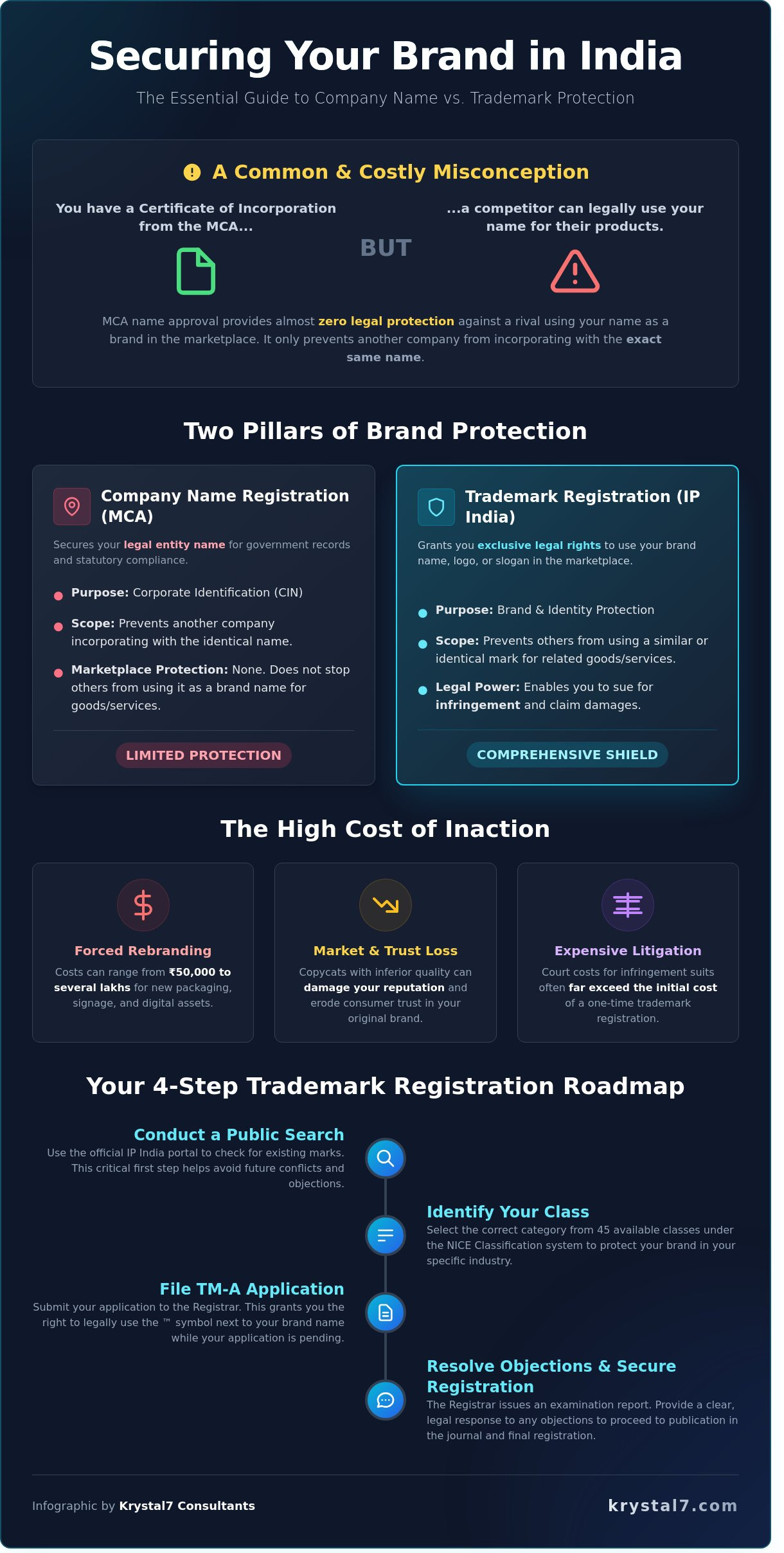
Losing a brand name often forces a total rebrand. This includes replacing packaging, signage, and digital assets, which can cost anywhere from 50,000 to several lakhs of INR. Beyond the direct money, copycats often deliver inferior quality that erodes consumer trust in your original vision. If you end up in an Indian court, litigation costs for infringement suits can quickly exceed the initial cost of registration. It’s much safer to build your legacy on a foundation of professional legal protection from day one.
Why Your Business Name Isn’t Automatically a Brand
Many founders believe that registering a name with the Ministry of Corporate Affairs (MCA) is enough. It’s not. A registered company name is for statutory compliance only. It prevents another entity from incorporating with that exact name, but it doesn’t stop them from using it as a brand for products. As explained in our guide on starting a Private Limited Company in India, company registration and trademarking are two different pillars. You need both to ensure you are truly protecting my brand name from competitors across all business sectors.
- MCA Registration: Secures your entity name for government records.
- Trademark Registration: Secures your brand name for the marketplace.
- Passing Off: A common law remedy for unregistered brands.
- Infringement: A statutory remedy available only for registered trademarks.
The Shield: Trademark Registration Under the Trade Marks Act, 1999
Securing your identity starts with the legal framework of the Trade Marks Act, 1999. This legislation provides the only foolproof method for protecting my brand name from competitors in the Indian market. It transforms your logo or name from a creative asset into a statutory right.
The registration process involves five critical steps managed by the Controller General of Patents, Designs and Trade Marks. Following these ensures your business builds on a foundation of legal clarity. Our team helps you move through these stages without the typical administrative headache.
- Step 1: Conduct a public search. Use the official Intellectual Property India portal to check for existing marks. This prevents future litigation and helps you avoid names that are already in use.
- Step 2: Identify your Class. India follows the international NICE Classification system. You must select the right category among 45 available classes to ensure your protection is valid for your specific industry.
- Step 3: File the TM-A application. Submit your application electronically to the Registrar. This step grants you the right to use the “TM” symbol while your application is pending.
- Step 4: Resolve objections. The Registrar issues an examination report within 30 to 90 days. You must provide a clear, legal response to any objections raised under Section 9 or Section 11 of the Act.
- Step 5: Secure your certificate. Once the mark is advertised in the Trade Marks Journal and remains unopposed for 4 months, you receive your registration certificate. This provides 10 years of protection, which you can renew indefinitely.
Choosing a “Strong” Mark for Better Protection
Not all brand names are equal in the eyes of the law. Descriptive names like “Fast Delivery” or generic terms like “Best Consulting” are nearly impossible to protect. This is because they describe a service rather than identify a specific source. A strong mark is one that is unique and non-descriptive. Fanciful or coined names offer the highest level of security when protecting my brand name from competitors.
Understanding Trademark Classes in India
India uses the NICE Classification to group goods and services. There are 34 classes for products and 11 for services. If your startup offers both software (Class 9) and consulting (Class 42), you must file in both categories to be fully covered. You can find detailed breakdowns of government and professional costs in our guide on Trademark Registration Fees in India. For a seamless filing experience, you can consult our legal strategists to ensure your application is accurate from day one.
Company Name vs. Trademark: Clearing the Confusion
Many entrepreneurs mistakenly believe that registering a Private Limited company or an LLP provides absolute brand protection. The Ministry of Corporate Affairs (MCA) only ensures that no two companies share an identical name in their database. It doesn’t prevent a rival from launching a product with a similar name or logo.
When you’re focused on protecting my brand name from competitors, you must look beyond the Corporate Identity Number (CIN). A CIN serves as a legal identifier for tax filings and statutory compliance. It doesn’t offer market exclusivity for your brand’s visual identity or reputation. You can explore advanced brand protection strategies in India to understand how legal layers shield your business from infringement.
A trademark registration covers phonetic similarities and visual overlaps that the MCA database might ignore. This prevents competitors from confusing your customers with lookalike logos or sounding like your brand. We help you secure both to ensure your business identity remains untouchable.
The MCA Name Reservation Process
The Reserve Unique Name (RUN) service on the MCA portal is your first step toward formalizing your entity. This web-based application allows you to propose two names for a new company. Once approved, the name remains reserved for exactly 20 days for new incorporations. You can find detailed guidance on Choosing a Company Name: Rules for Name Registration to avoid common rejection pitfalls.
Why You Need Both for Total Protection
Your company name protects your legal entity and ensures compliance with the Companies Act, 2013. Your trademark protects your market presence and the trust you’ve built with your audience. Without a trademark, another business could legally sell products using your brand name even if they have a different company name.
Consider a practical example. You might register your business as “XYZ Services Pvt Ltd” to handle contracts and payroll. However, your customers know you by your brand name, “Krystal.” While the MCA protects the “XYZ” name, only a trademark prevents a competitor from launching a “Krystal” brand in your industry. This dual approach provides the crystal clarity needed to grow your venture without fear of intellectual property theft.
Protecting my brand name from competitors requires a methodical strategy that covers both administrative and intellectual property rights. We streamline this process so you have the freedom to focus on your vision. Our team manages the red tape while you build your legacy.
The Sword: Proactive Strategies to Monitor and Enforce Your Rights
Registration provides your legal shield, but active monitoring is the sword that keeps your market share safe. You can’t rely on the government to notify you when a copycat emerges. Vigilance is the only way to ensure protecting my brand name from competitors remains a reality rather than a theory. Start by setting up Google Alerts for your brand name and primary product terms. It’s a free tool that provides immediate notifications whenever your brand is mentioned online.
Every Monday, the Trade Marks Registry publishes the Trademark Journal. This document lists every mark currently moving toward registration. You have a strict 4-month window from the publication date to file an opposition. If you miss this deadline, a competitor’s similar mark could be granted legal status. Beyond official journals, monitor marketplaces like Amazon India and Flipkart. Look for “passing off” attempts where sellers use similar phonetics or visual styles to confuse your customers.
When you spot a violation, don’t wait. Have a legal strategist issue a formal Cease and Desist notice. This document outlines your ownership and demands the competitor stop their activities immediately. In many Indian business disputes, a professional notice is enough to resolve the issue without a full court battle. It establishes a paper trail of your enforcement efforts, which is vital for any future litigation.
How to Handle Trademark Infringement
India provides both civil and criminal remedies for infringement. Civil actions in a District Court can result in damages or an account of profits. Criminal remedies under Section 115 of the Trade Marks Act, 1999, allow for police search and seizure. Your primary goal is often an “interim injunction.” This court order stops the competitor’s use of your name while the case is pending. Always maintain records of your “prior use,” such as invoices or advertisements dated before your registration. Under Section 34 of the Act, a prior user can sometimes prevail even against a registered owner.
Digital Brand Protection: Domains and Social Media
Cybersquatting is a frequent headache for Indian startups. Secure your .in and .com domains as soon as you finalize your name. If you sell goods online, enroll in the Amazon Brand Registry. This program allows Indian sellers to report and remove counterfeit listings within hours. For social media, use the dedicated IP infringement reporting tools on LinkedIn and Instagram. These platforms prioritize registered trademark holders in India, making it easier to take down impersonator accounts that confuse your audience.
Beyond legal enforcement, a proactive digital strategy is essential for market dominance. Partnering with a digital marketing specialist like Ribacoff Enterprises can help you secure your online reputation through expert SEO and social media management, ensuring your authentic brand always stands out from imitators.
This digital diligence is equally important for healthcare professionals who use platforms like drtiffanyyeoreddy.com to provide authoritative information on integrative wellness while protecting their professional identity from impersonation.
Furthermore, establishing a presence on niche-specific authority sites like uppercervicalcare.com ensures that practitioners are easily identifiable, helping to protect their brand name from competitors who might attempt to use similar terms in the healthcare space.
To further enhance these efforts, Aria Operations provides an AI-powered reputation intelligence agent specifically designed to protect and elevate the digital reputations of brands, offering proactive monitoring that complements traditional legal safeguards.
Effective enforcement requires a methodical approach to protecting my brand name from competitors through legal and digital channels.
Get the expert legal strategy you need to defend your brand today.
How Krystal7 Consultants Secures Your Intellectual Property
Securing your brand isn’t just a legal hurdle. It’s about building a legacy that nobody can touch. At Krystal7, we provide end-to-end trademark filing with krystal-clear transparency. You’ll never wonder about the status of your application. We handle the entire process through the Indian IP Office, ensuring your assets remain yours alone.
Our chartered expertise becomes your shield when challenges arise. If the MCA or IP Office raises objections, our legal strategists step in immediately. We’ve seen a 40 percent increase in trademark oppositions over the last three years in India. We manage these hurdles by attending hearings and drafting precise responses. This gives you the freedom to focus on scaling your business while we handle the red tape.
We don’t just file and forget. Our team provides continuous monitoring services to catch infringers before they dilute your brand value. Protecting my brand name from competitors requires vigilant oversight of the Trademark Journal. We integrate this vital brand protection into our Annual Compliance Package. This ensures your intellectual property stays secure alongside your statutory filings and tax returns.
Our Methodical Approach to Brand Clarity
We take care of the complex paperwork so you don’t have to. Our method is built on direct access to legal strategists who understand the nuances of Indian trademark law. You’ll get upfront pricing with no hidden costs. This is essential for Indian startups managing tight budgets. We believe transparency isn’t just a word; it’s how we work. You get elite expertise without the guesswork.
Start Your Protection Journey Today
The first step in protecting my brand name from competitors is a comprehensive trademark search. We analyze existing records to ensure your name is unique and registrable. Don’t leave your brand’s future to chance. Contact our Gurgaon office for a personalized brand audit tailored to your specific industry. We’ll help you map out a strategy that secures your vision for the long term.
Ready to secure your business dream? Contact Krystal7 Consultants at business@krystal7.com to begin your journey toward total brand clarity today. You can also visit krystal7.com for expert assistance with all your compliance needs.
Secure Your Market Position and Business Legacy
Your brand is more than just a logo. It’s the heartbeat of your business in the Indian market. Securing a trademark under the Trade Marks Act 1999 isn’t optional for founders who want to build a lasting legacy. This registration provides the legal clarity you need to stop infringement before it dilutes your hard-earned market share.
Taking proactive steps is the only way to ensure you’re effectively protecting my brand name from competitors. You must monitor the Trade Marks Registry regularly and recognize that a company name registration at the MCA doesn’t grant brand exclusivity. Krystal7 Consultants offers the elite expertise you need to navigate these statutory requirements with ease.
Our team provides transparent, upfront pricing designed specifically for Indian startups. You’ll work with a dedicated relationship manager who handles the complex filings and paperwork. This gives you the freedom to focus on your core business goals. We bring crystal clarity to your intellectual property strategy.
Protect your brand with Krystal7 Consultants today or reach out to us at business@krystal7.com for expert guidance. Your business vision deserves a shield that never falters.
Frequently Asked Questions
Is a registered company name the same as a trademark in India?
No, a registered company name and a trademark serve different legal purposes. You register a company name with the Ministry of Corporate Affairs (MCA) to create a legal entity like a Private Limited or LLP. A trademark is registered under the Trade Marks Act 1999 to give you exclusive rights to your brand identity. This registration is the primary tool for protecting my brand name from competitors across the Indian market.
Can I sue a competitor if I haven’t registered my trademark yet?
You can still take legal action through a “passing off” lawsuit even without a registration. This common law remedy requires you to prove that your brand has established a significant reputation and the competitor’s use causes confusion among customers. It’s often more expensive and difficult to prove than enforcing a registered trademark. Registration provides a statutory right that makes legal enforcement much simpler and faster.
How long does it take to get a trademark registration certificate in India?
It usually takes between 6 to 12 months to receive your registration certificate from the IP India portal. The timeline depends on whether the examiner raises objections or if a third party files an opposition during the four month advertisement period in the Trade Marks Journal. You can start using the ™ symbol immediately after filing your application to show you’re serious about your brand.
What is the penalty for trademark infringement under the Trade Marks Act 1999?
Trademark infringement is a cognizable offense under Sections 103 and 104 of the Act. Courts can award imprisonment for a term between six months and three years. Financial penalties range from INR 50,000 to INR 2,00,000. Civil remedies also include interim injunctions that stop the competitor from using your name while the case is pending.
Can a competitor use a name similar to mine if they are in a different industry?
Competitors can sometimes use similar names if they operate in an entirely different class of goods or services. India follows the NICE Classification system which divides businesses into 45 distinct classes. However, if your brand is recognized as a “well-known trademark” by the registry, you get protection across all classes regardless of the industry. This prevents others from riding on your hard earned reputation.
What should I do if I receive a Cease and Desist notice from a competitor?
You should immediately consult a legal strategist to evaluate the merit of the sender’s claim. Check your records to see if you used the name before the competitor’s registration date, as “prior user” rights are very strong in Indian law. Don’t ignore the notice. A well drafted response can often resolve the dispute and protect your business from an expensive court battle.
Do I need a separate trademark for my logo and my brand name?
You don’t strictly need separate filings, but it’s a smart strategy for long term growth. A word mark protects the name itself in any font or style, while a device mark protects the specific visual logo. Registering both separately ensures that protecting my brand name from competitors remains effective even if you decide to update your logo’s design or colors later.
How much does it cost to protect a brand name for an Indian startup?
The government filing fee for an Indian startup or individual is INR 4,500 per class for electronic filing. This is a 50 percent subsidy compared to the INR 9,000 fee charged to large enterprises. You must have a valid Startup India recognition certificate or a Udyam Registration to claim this lower rate. You’ll also need to account for professional advisory fees to ensure your application is filed correctly without errors.
For expert assistance with trademark registration and brand protection, contact Krystal7 Consultants at business@krystal7.com or visit krystal7.com today.

Article by
Nihal Srivastava
Nihal Srivastava is the Co-Founder of Krystal7 Consultants, helping Indian entrepreneurs and startups navigate company registration, compliance, trademark protection, and regulatory requirements with clarity and confidence. With 6+ years of hands-on expertise in MCA filings, GST compliance, and corporate structuring, Nihal has guided 1000+ businesses across India through their legal and compliance journeys. He believes every business dream deserves crystal clear foundations, and that no founder should be held back by paperwork or red tape.