

FEMA Compounding Application: A Complete Guide to Resolving FEMA Contraventions in 2026
What if a FEMA violation wasn’t a legal dead end, but a predictable administrative fee that buys back your peace of mind? Many Indian founders view a notice from the Reserve Bank of India as the start of a litigation nightmare. Filing a FEMA compounding application allows you to voluntarily admit a contravention and settle it without ever stepping foot in a courtroom.
We understand the anxiety that comes with complex RBI circulars and the fear of penalties reaching 300% of the transaction value. It’s overwhelming to keep up with the 2026 regulatory consolidations while trying to scale your business. This guide will show you how to navigate the compounding process to secure a clean compliance record and fix reporting errors permanently.
You’ll learn the step-by-step process for submitting your application through the PRAVAAH portal, the latest penalty caps for technical breaches, and the exact timelines for receiving your order. We’ve simplified the 180-day settlement journey so you can stop worrying about legal hurdles and get back to your core operations.
Key Takeaways
- Discover how Section 15 of the FEMA Act 1999 allows you to settle foreign exchange violations voluntarily and avoid the stress of lengthy litigation.
- Learn the precise steps to prepare a FEMA compounding application to rectify common startup errors like delayed FC-GPR filings or missed FLA returns.
- Understand the RBI’s transparent penalty matrix and how factors like the “gravity of contravention” influence your final settlement costs in INR.
- Navigate the 180-day settlement timeline with confidence to secure a clean compliance record and protect your business’s reputation.
- Transform complex regulatory hurdles into a clear path forward, granting you the operational liberty to focus on scaling your company.
What is a FEMA Compounding Application?
A FEMA compounding application is a strategic tool for business owners to regularize foreign exchange violations without facing harsh litigation. It functions as a voluntary settlement process where an entity admits to a breach and pays a specific monetary penalty to the Reserve Bank of India (RBI). This mechanism is rooted in Section 15 of the Foreign Exchange Management Act (FEMA), 1999. By choosing this path, you transform a potential legal crisis into a manageable administrative task.
Choosing to compound doesn’t mean your business is in trouble. It means you’re taking proactive control of your compliance record. Unresolved violations often lead to intense scrutiny from the Directorate of Enforcement (ED) and can halt your growth plans. Compounding brings immediate clarity to your company’s legal standing. It replaces the anxiety of “what if” with a clear, documented resolution that protects your long-term vision.
For Private Limited companies and LLPs in India, maintaining a clean record is vital for securing venture capital or exploring international markets. A pending contravention can stall a due diligence process for months. Compounding acts as a vital reset button. It ensures your business operates with full transparency and protects your professional standing in the eyes of regulators and stakeholders alike.
Contravention vs. Compounding: Knowing the Difference
It’s helpful to view these as two sides of the same coin. A contravention is the specific breach of FEMA rules, such as a delay in reporting an FDI transaction via the FIRMS portal. Compounding is the formal settlement that wipes the slate clean for that specific error. Compounding offers relief through transparency by converting a legal breach into a concluded administrative matter.
Who is Eligible to Apply for Compounding?
Most individuals and corporate entities that have unintentionally violated FEMA provisions can submit a FEMA compounding application. The RBI acts as the sole compounding authority for these cases. However, eligibility has strict boundaries. You can’t use this process for serious offenses involving money laundering, terror financing, or cases where there is a clear intent to defraud. For standard technical errors, like missing a filing deadline for annual returns, the compounding process remains the most efficient way to achieve legal closure.
The Step-by-Step FEMA Compounding Application Process
Success in resolving a contravention depends on a methodical approach. The process is designed to be transparent, ensuring that every applicant has a fair chance to regularize their compliance status. In 2026, the RBI has streamlined this through digital portals, but the underlying logic remains focused on accuracy and voluntary disclosure. Following a structured map helps you avoid the common pitfalls that lead to rejected filings.
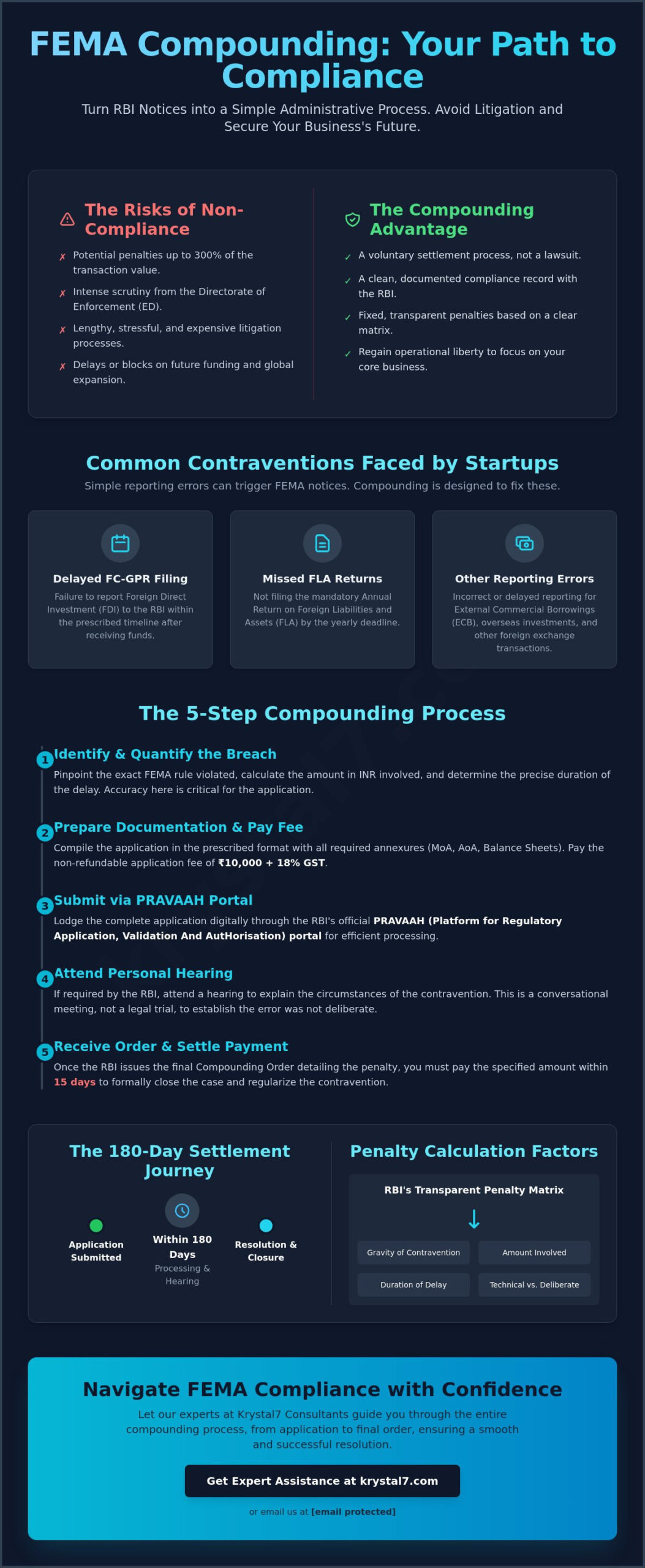
- Step 1: Identify and quantify the breach. Before filing, you must pinpoint the exact rule violated, such as a delay in reporting an FDI transaction via Form FC-GPR. You need to calculate the exact amount involved and the duration of the delay in days.
- Step 2: Prepare the documentation. Your FEMA compounding application must follow the prescribed format. At this stage, you’ll also pay the application fee of ₹10,000 plus 18% GST via NEFT or RTGS.
- Step 3: Submit through the PRAVAAH portal. Most applications are now processed digitally. Ensuring your annexures are complete prevents the RBI from returning your file for corrections, which can reset your timeline.
- Step 4: The personal hearing. The RBI may invite you to explain the circumstances of the breach. This is not a trial; it’s a conversation to establish that the error was technical rather than a deliberate attempt to evade the law.
- Step 5: Settlement and closure. Once the RBI issues the Compounding Order, you must pay the specified sum within 15 days. Missing this deadline can cancel the entire process and lead to further legal action.
Essential Documents for Your Application
A complete application package acts as your business’s voice before the regulator. You’ll need a certified copy of your Memorandum and Articles of Association (MoA/AoA) and audited balance sheets for the period when the contravention occurred. Additionally, you must provide a detailed undertaking that confirms no other similar compounding applications are pending or have been rejected in the last three years. These documents provide the financial openness the RBI requires to assess your case fairly.
Where to File: Regional Office vs. Central Office
Jurisdiction is determined by the nature of the breach and the total amount involved. Minor technical errors are often handled by Regional Offices, while larger, more complex transactions fall under the Central Office in Mumbai. Filing at the wrong desk can lead to significant delays in the 180-day settlement timeline. If you’re unsure where your case belongs, Krystal7’s Gurugram experts can help identify the right jurisdiction. You can also refer to the RBI’s official compounding FAQs for a breakdown of jurisdictional limits. Ensuring your paperwork reaches the right hands is the first step toward operational liberty. To keep your records pristine from the start, consider our annual compliance package to prevent future reporting gaps.
Common FEMA Contraventions Faced by Startups
Startups often prioritize growth over paperwork. This fast-paced environment leads to accidental oversights in foreign exchange reporting. While these errors are usually unintentional, the RBI treats them as technical breaches that require formal resolution. Identifying these gaps early allows you to take corrective action before they escalate into larger legal problems.
- Delayed reporting of FDI: This occurs when a company fails to file Form FC-GPR within 30 days of issuing shares to a foreign investor.
- Missed FLA Returns: Every Indian company that has received FDI or made an ODI must file the Annual Return on Foreign Liabilities and Assets (FLA).
- ECB non-compliance: Violations often involve failing to obtain a Loan Registration Number (LRN) or missing monthly reporting via Form ECB-2.
- ODI reporting gaps: These happen when an Indian entity invests abroad but fails to submit the Annual Performance Report (APR) or report the remittance in time.
Filing a FEMA compounding application becomes necessary when these timelines are missed. It serves as a bridge to bring your business back into the fold of compliant operations. You can find more details on the Reserve Bank of India’s official compounding process to understand how these breaches are classified.
The ‘Late Filing’ Trap: FC-GPR and FLA Returns
The 30-day window for FC-GPR is remarkably tight for a busy founder. Missing this deadline is the most frequent reason startups seek our help. Similarly, the July 15th deadline for FLA returns is a hard cutoff that many forget during the busy tax season. These filings are part of your broader Annual Compliance for Private Limited Company requirements. Neglecting them creates a “compliance debt” that only compounding can clear.
Issue of Shares Beyond the Prescribed Timeline
FEMA regulations mandate that you must allot shares within 60 days of receiving foreign inward remittance. If you cannot allot shares, you must refund the money to the foreign investor within 15 days from the end of that 60-day period. Failure to do either results in a contravention. Imagine a scenario where a parent company sends capital for a foreign subsidiary registration in India. If the Indian entity takes 75 days to allot shares due to administrative delays, it has technically breached the law. In such cases, a FEMA compounding application is the only way to regularize the capital structure and move forward with operational liberty.
Calculating Penalties and the 180-Day Timeline
Understanding the financial implications of a FEMA compounding application provides the clarity you need to move forward with confidence. The RBI doesn’t assign penalties randomly. Instead, it follows a structured matrix that balances the nature of the breach against the amount involved. This methodical approach ensures that while contraventions have consequences, the settlement remains a predictable administrative cost rather than an open-ended liability.
The RBI typically has a 180-day window from the date of receiving a complete application to issue a final compounding order. During this period, they evaluate the gravity of the contravention and whether the entity gained any “undue enrichment” from the delay. Once the order is passed, you have a strict 15-day deadline to pay the sum. Missing this window can invalidate the process and leave your business vulnerable to litigation again.
How the RBI Determines the Compounding Fee
The compounding fee consists of a fixed base amount and a variable component based on the duration of the delay. For quantifiable violations, the penalty can reach up to 300% of the sum involved, though it’s often lower for voluntary disclosures. If the violation is technical and cannot be quantified, a fixed penalty cap of ₹2 lakh applies as of 2026 to provide more certainty for startups. All compounding amounts must be paid in Indian Rupees (INR) via a Demand Draft in favor of the Reserve Bank of India.
Voluntary disclosure plays a massive role in reducing your final costs. When you admit an error via a FEMA compounding application before the RBI or ED discovers it, the authority often views the case with more leniency. It demonstrates a commitment to transparency and a desire to follow the law, which can lead to lower variable penalties for delays.
What Happens After the Compounding Order?
A compounding order is final and binding. You don’t have a right to appeal against the amount or the decision once the order is issued. This finality is actually a benefit, as it grants you immediate legal closure. After making the payment, ensure you receive a certificate of acknowledgement to record in your books. This step is a cornerstone of your Annual Compliance, keeping your record clean for future audits. If you need help calculating your potential exposure, reach out to Krystal7 Consultants for a detailed compliance review.
Achieving Operational Liberty with Krystal7 Consultants
At Krystal7 Consultants, we believe compliance should never be a barrier to your vision. Our approach transforms the daunting FEMA compounding application from a legal obstacle into a clear, scannable roadmap. We provide the visual transparency you need to understand your standing with the RBI at every stage. Our Gurugram-based experts serve as your dedicated bridge to the regulator, handling the intricate paperwork so you don’t have to. We act as a trusted partner in your journey, ensuring that administrative complexity never slows your momentum.
Our goal is to grant you total operational liberty. By delegating these administrative burdens to us, you gain the freedom to focus on scaling your business. We don’t just fix past errors; we help you build a robust Private Limited Company compliance framework that prevents future contraventions. This proactive stance ensures your company remains a visionary in the eyes of investors and partners. We bring order to complicated processes, allowing you to pursue your primary goals with security and optimism.
We believe in a personalized, long-term partnership that goes beyond simple form-filling. Our advisors possess deep institutional knowledge and professional designations that establish elite authority in the financial sector. We describe handling complexity so you can pursue growth with calm competence. This methodical approach builds a foundation of reliability and trust, which is essential when dealing with the Reserve Bank of India.
Why Professional Assistance is Critical for FEMA
A single error in your application can lead to a rejection by the RBI, forcing you to restart the 180-day timeline. Our meticulous team ensures every annexure is accurate and every calculation is verified according to the latest 2026 regulations. During personal hearings, we represent your interests with polished confidence, presenting your case effectively to the compounding authority. We also implement automated systems for your future filings, ensuring you never miss a 30-day window or an FLA deadline again. This human touch, combined with elite expertise, ensures your business stays protected from heavy litigation.
Contact Krystal7 for FEMA & RBI Compliance
You don’t have to carry the weight of regulatory uncertainty alone. We offer a one-stop solution for startups and foreign subsidiaries looking to regularize their records. Our elite consultants handle the administrative complexity while you drive your primary goals forward. It’s time to end the anxiety of non-compliance and secure the peace of mind your business deserves. We are always available to provide the support and guidance necessary for your expansion in the Indian market.
Successfully filing a FEMA compounding application requires a partner who understands the value of precision and openness. We are committed to your long-term success through methodical guidance and personal dedication. Reach out to Krystal7 Consultants today at business@krystal7.com or visit krystal7.com to start your journey toward a clean compliance record and total operational liberty.
Secure Your Operational Liberty Today
Fixing a foreign exchange violation shouldn’t feel like a legal dead end. By submitting a FEMA compounding application, you replace the fear of massive RBI penalties with a transparent, predictable settlement process. This proactive step grants you the freedom to focus on your core business without the weight of pending litigation affecting your growth. Achieving a clean compliance record isn’t just about avoiding fines; it’s about building a trustworthy foundation for your company’s future expansion.
Krystal7 Consultants is an expert CA firm based in Gurugram with a proven track record in handling complex RBI compliance cases. We specialize in foreign subsidiary registration and cross-border regulatory matters. Don’t let FEMA contraventions stall your growth. Contact Krystal7 Consultants at business@krystal7.com or visit krystal7.com for expert assistance. We’re here to turn your compliance challenges into operational liberty so you can scale with confidence.
Frequently Asked Questions
Can I apply for FEMA compounding after the ED has started an investigation?
You generally cannot apply for compounding if the Directorate of Enforcement (ED) has already initiated an investigation into a serious violation. This process is designed for technical breaches where there is no “intent to defraud” or suspicion of money laundering. If your case is already under ED scrutiny for serious offenses, the RBI’s compounding authority won’t be able to process your request.
What is the fee for filing a FEMA compounding application with the RBI?
The standard application fee is ₹10,000 plus 18% GST, totaling ₹11,800. You must pay this amount via NEFT or RTGS through the PRAVAAH portal or as directed by the RBI. It’s important to keep the payment proof ready as you’ll need to submit it along with your application to ensure the process begins without administrative delays.
How long does the entire FEMA compounding process take from start to finish?
The entire process typically takes 180 days from the date the RBI receives a complete FEMA compounding application. This six-month window allows the authorities to review your documents, conduct a hearing if needed, and calculate the final penalty. If your initial filing is incomplete or missing annexures, the timeline can stretch beyond this period while you provide the required clarity.
Is it mandatory to attend a personal hearing for compounding?
Attending a personal hearing is optional and not a mandatory requirement for the applicant. You can choose to have the RBI pass the compounding order based on your written submissions and documentation. However, attending the hearing gives you a valuable opportunity to explain the context of the breach and demonstrate that the error was purely technical and unintentional.
Can a compounding order be challenged in a court of law?
You cannot challenge a compounding order in any court of law because it’s a voluntary settlement process. Since you admit to the contravention when you file the application, the law doesn’t provide a right to appeal the final order or the penalty amount. Once the order is issued, it’s final and binding, requiring you to pay the sum in INR to achieve legal closure.
What happens if I fail to pay the compounding amount within 15 days?
If you fail to pay the specified sum within 15 days of the order, the compounding order becomes null and void. The RBI will treat the contravention as if it was never settled, which can lead to the case being referred to the ED for further investigation or prosecution. It’s vital to have your funds prepared in advance to meet this strict statutory deadline.
Does compounding cover all future violations of the same nature?
No, a compounding order only settles the specific breach and the specific amount mentioned in that particular FEMA compounding application. It doesn’t provide a “blanket cover” for future mistakes. If your company repeats the same error, such as a late FLA return in the following year, you’ll have to start a fresh compounding process which may attract higher penalties for being a repeat offender.
Is FEMA compounding applicable to individuals or only to companies?
FEMA compounding is applicable to both individuals and all types of business entities, including Private Limited companies and LLPs. Any “person” as defined under the Act who has contravened foreign exchange regulations can seek relief through this process. Whether you’re a founder who missed a reporting deadline or an individual investor with an unreported remittance, you can use compounding to regularize your record.

Article by
Nihal Srivastava
Nihal Srivastava is the Co-Founder of Krystal7 Consultants, helping Indian entrepreneurs and startups navigate company registration, compliance, trademark protection, and regulatory requirements with clarity and confidence. With 6+ years of hands-on expertise in MCA filings, GST compliance, and corporate structuring, Nihal has guided 1000+ businesses across India through their legal and compliance journeys. He believes every business dream deserves crystal clear foundations, and that no founder should be held back by paperwork or red tape.