

FDI Compliance India: The Complete Founder’s Guide for Foreign Subsidiaries (2026)
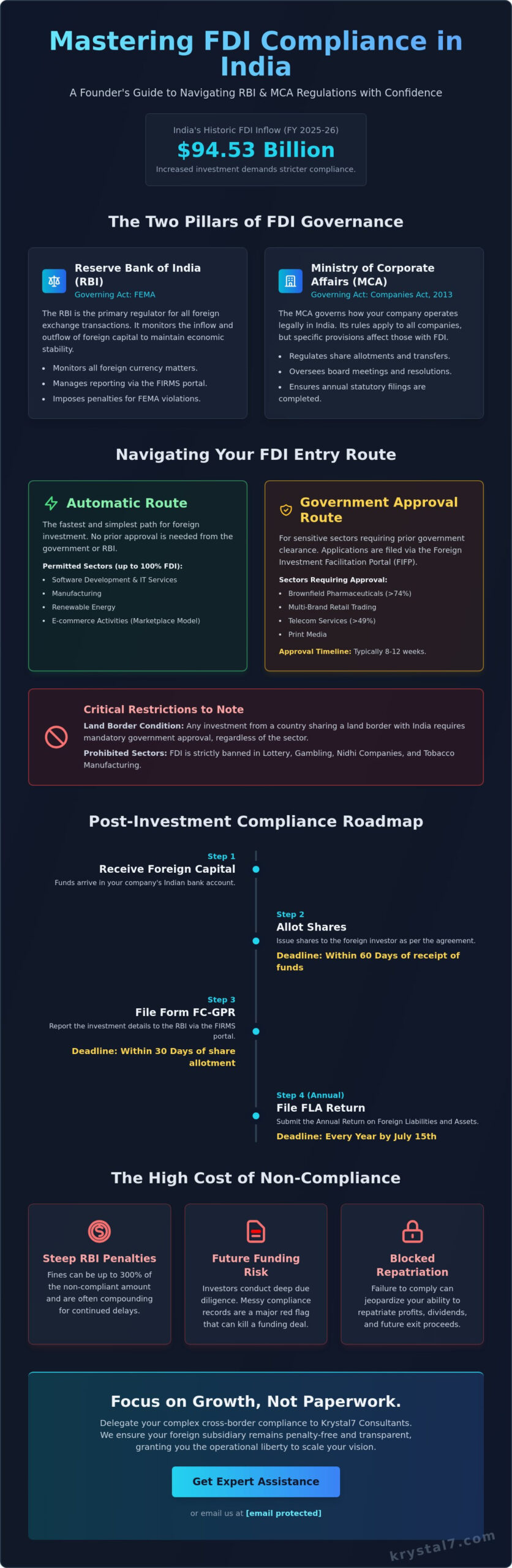
With India recording a historic $94.53 billion in gross FDI inflows for the 2025-2026 fiscal year, the opportunity for foreign subsidiaries has never been greater. However, this record-breaking surge in investment comes with a sharper focus from regulators on how that capital is managed and reported. Maintaining FDI compliance India is no longer just a checkbox; it’s the foundation of your operational liberty and long-term security.
We know that the fear of heavy RBI penalties or the confusion between MCA and FEMA regulations can feel overwhelming. You want to focus on scaling your vision, not deciphering complex legal jargon or worrying about a 300% penalty on non-quantifiable amounts. This guide provides the clarity you need to handle your foreign subsidiary’s obligations with total confidence and precision.
You’ll find a clear checklist of mandatory filings, including the latest 2026 updates on beneficial ownership and the shift toward substance-over-form evaluations. From mastering Form FC-GPR deadlines to ensuring your FLA returns are filed accurately by July 15th, we’ve mapped out the path to keeping your business penalty-free and transparent.
Key Takeaways
- Understand the distinct roles of the RBI and MCA to ensure your foreign subsidiary meets all statutory obligations under FEMA.
- Identify whether your business sector qualifies for the Automatic Route to simplify your FDI compliance India strategy.
- Learn the critical 30-day reporting window for Form FC-GPR on the FIRMS portal to avoid immediate regulatory friction.
- Stay penalty-free by mastering the July 15th deadline for annual FLA returns and the 60-day rule for share allotments.
- Discover how delegating complex cross-border paperwork to a methodical partner grants you the operational liberty to scale your startup.
Understanding the Landscape of FDI Compliance India
Starting a foreign subsidiary in India is a bold step toward global growth. However, the moment that foreign capital hits your Indian bank account, your role as a founder shifts. You’ve moved from the “fundraising” phase into the “regulatory” phase. This is where FDI compliance India becomes your most important operational pillar. It’s not just about following rules; it’s about maintaining a transparent relationship with the Indian government.
The framework for these rules is the Foreign Exchange Management Act (FEMA). The government uses this act to monitor every rupee that enters the country. Understanding the history of Foreign Direct Investment in India reveals a clear trend. While the doors are open for investment, the scrutiny on the source and use of funds has tightened. You’ll find yourself reporting to two major authorities: the Reserve Bank of India (RBI) for currency matters and the Ministry of Corporate Affairs (MCA) for company law.
Why Compliance is Your Best Growth Strategy
Think of compliance as a shield for your business. RBI penalties are notoriously steep and often compounding. A simple delay in filing can lead to costs that drain your startup’s runway. Beyond avoiding fines, a meticulous record is essential for future funding. When you approach Series A or B investors, they’ll conduct deep due diligence. Messy paperwork can kill a deal. Staying compliant also guarantees your right to repatriate profits and dividends later. It’s the key to your operational liberty.
The Legal Pillars: FEMA and the Companies Act, 2013
Your business exists at the intersection of two legal worlds. First, you must follow the Companies Act, 2013, which dictates how you run your private limited company india. This includes board meetings, audits, and share allotments. Second, FEMA rules apply specifically because your capital is foreign. These rules are detailed in the Consolidated FDI Policy from the DPIIT and the “Master Directions” from the RBI. Keeping these two pillars in balance is the secret to successful FDI compliance India. It ensures your subsidiary remains a “good citizen” in the eyes of the Indian regulators.
Navigating FDI Routes: Automatic vs. Government Approval
Identifying your entry route is the first critical step in FDI compliance India. Not all sectors are treated equally; the government balances economic openness with national security. For most founders, the “Automatic Route” is the goal. This path allows you to receive foreign capital without any prior approval from the RBI or the central government. It’s the standard for sectors like manufacturing, software development, and renewable energy, where 100% FDI is permitted freely.
However, some industries remain under the “Government Approval Route.” This includes sensitive areas like brownfield pharmaceuticals (above 74%) or multi-brand retail trading. You must also be aware of prohibited sectors. The Indian government strictly bans FDI in lottery businesses, gambling, and the manufacturing of tobacco products. According to the Invest India FDI Guide, even liberalized sectors like telecom have nuances. While 100% FDI is allowed, it’s only automatic up to 49%, requiring a ministry nod for anything higher.
Is Your Business Eligible for the Automatic Route?
Your eligibility depends heavily on your National Industrial Classification (NIC) code. This code defines your business activity in the eyes of the regulator. Most Gurgaon-based SaaS and service startups fall squarely into the automatic route, which simplifies your initial setup. But there’s a catch. If your investor is from a country sharing a land border with India, you must seek government approval regardless of the sector. The only exception is a “safe harbor” for small investments where the beneficial ownership is 10% or less with no control rights.
The Process for Government Approval
When your business falls under the approval route, you’ll file your proposal via the Foreign Investment Facilitation Portal (FIFP). This portal acts as a single window, routing your application to the relevant ministry. The process is methodical and requires deep transparency regarding your governance structure and operational control. You can typically expect a decision within 8 to 12 weeks, provided your documentation is precise. If the route ahead feels unclear, you can explore our compliance packages to ensure your entry strategy is sound. This meticulous planning prevents future friction with the RBI.
Essential Post-Investment Reporting: FC-GPR and FLA Returns
Once your foreign capital arrives in India, the clock starts ticking on your reporting obligations. This is the active phase of FDI compliance India, where precision is your best tool for avoiding regulatory friction. All reporting now happens through the Foreign Investment Reporting and Management System (FIRMS) portal. This digital platform uses the Single Master Form (SMF) to integrate various reporting requirements into one interface, bringing much-needed transparency to the process.
Your first priority is the issuance of shares. You must allot shares to your foreign investor within 60 days of receiving the investment funds. Once the allotment is complete, you have a strict 30-day window to file Form FC-GPR. This form notifies the RBI about the details of the investment, ensuring the capital inflow is recorded correctly under FEMA guidelines.
Mastering the FC-GPR Filing
Filing the FC-GPR isn’t just about filling out a form; it’s about providing a clear audit trail. You’ll need to upload the Foreign Inward Remittance Certificate (FIRC) and a KYC report from your authorized dealer bank. A critical step involves obtaining a valuation certificate from a Chartered Accountant. This certificate proves that the shares were issued at or above the “fair value,” preventing any undervaluation of Indian equity. Common errors that lead to RBI rejections include mismatched NIC codes or using the wrong exchange rate for INR conversions. Ensuring these details are meticulous from day one protects your subsidiary’s standing.
Annual Compliance: The FLA Return
The Foreign Liabilities and Assets (FLA) return is your yearly health check with the RBI. Every Indian company that has received FDI or made an Overseas Direct Investment (ODI) must file this return by July 15th each year. It captures the total foreign investment held in your company as of March 31st. Even if you didn’t receive new funds during the year, you must file if you have outstanding foreign assets or liabilities.
Managing this filing becomes much simpler when you link it with your annual compliance for private limited company workflow. If your accounts aren’t audited by the July deadline, you can file a provisional return and submit a revised version by September 30th. Don’t overlook this; failing to file the FLA return can lead to a daily penalty of ₹5,000, which compounds quickly. Keeping this cycle organized ensures your business remains a dependable partner for your global investors.
Key Deadlines and Penalties for Non-Compliance
Missing a deadline in the world of FDI compliance India is a costly mistake that most founders don’t realize they’ve made until the RBI sends a notice. The regulatory framework is designed for transparency; when that transparency is delayed, the system triggers automatic penalties. Understanding these timelines is the only way to protect your subsidiary’s capital and your professional standing.
The most common pitfall is the 30-day rule for Form FC-GPR. You must file this form within 30 days of allotting shares to your foreign investor. Remember, the allotment itself must occur within 60 days of receiving the funds. If you miss this window, you move from a simple filing into the territory of Late Submission Fees (LSF). While an LSF of ₹7,500 might seem manageable, ongoing delays can escalate into serious adjudicated penalties.
Penalty Structure for FEMA Violations
The RBI categorizes violations into quantifiable and non-quantifiable breaches. For serious contraventions, penalties can reach up to 300% of the sum involved. If the amount cannot be quantified, you face a flat penalty of ₹2,00,000. Additionally, a daily penalty of ₹5,000 applies for as long as the non-compliance continues. Your Authorized Dealer (AD) Bank monitors these timelines closely and won’t process future outward remittances if your records aren’t clean. For minor technical breaches, the penalty is capped at ₹2 lakh under Master Direction 04/2025-26, but reaching this stage still creates administrative friction.
If you’ve already missed a deadline, “Compounding” is your path to resolution. This process allows you to admit the lapse and pay a specific fine to the RBI to “settle” the offence. It prevents the matter from escalating to a full legal battle. If your records feel disorganized, you can get a compliance health check to identify and fix these gaps before they become expensive liabilities.
A Founder’s Compliance Calendar for 2026
Staying ahead of the RBI requires a methodical approach. Use this structure to keep your FDI compliance India on track throughout the year:
- Monthly: Review bank statements for inward remittances and ensure FIRCs are generated immediately.
- Quarterly: Hold mandatory board meetings to approve share allotments or review foreign liability status.
- Annual (July 15th): File your FLA return. Even if your audit isn’t finished, file a provisional return to avoid the ₹5,000 daily fine.
- Annual (September 30th): Submit revised FLA returns if you filed provisionally in July.
- Anniversary: Sync your FDI reporting with the anniversary of your company registration to ensure all MCA filings match your RBI data.
How Krystal7 Consultants Simplifies Your Cross-Border Compliance
Deciphering the bureaucratic maze of Indian regulations shouldn’t distract you from your primary mission: scaling your business. At Krystal7 Consultants, we adopt a “Transparency First” approach to every filing, ensuring your records are always audit-ready. We manage the entire lifecycle of your investment, from the moment capital enters your bank account to the final submission of annual FLA returns.
Our presence in Gurgaon gives us a distinct edge for subsidiaries registered in Haryana. We maintain a methodical pulse on local MCA requirements and regional banking workflows. This local expertise allows us to provide a level of personal dedication that generic global firms simply can’t match. We handle the complexity so you can enjoy the operational liberty you’ve worked hard to build.
Expert Advisory for Startups and SMEs
Every industry has its own set of nuances under FEMA. We create personalized compliance roadmaps that align with your specific NIC code and growth plans. Our team takes the lead in liaising with your Authorized Dealer (AD) Banks to ensure that FIRCs and KYC reports are processed without delay. We also draft meticulous valuation reports that meet stringent RBI standards, protecting you from future share allotment disputes.
Get Started with a Compliance Audit
If you’re unsure about your subsidiary’s current standing, a compliance audit is the best place to start. We review your past filings to identify any hidden gaps that might require “Compounding” with the RBI. By fixing these issues now, we clear the path for your future funding rounds and profit repatriations. We also set up automated alerts for your 2026 deadlines to ensure you never face a late submission fee again.
Investing in professional FDI compliance India services today prevents expensive legal hurdles tomorrow. Let us be your trusted partner in this journey toward sustainable growth.
For expert assistance with your foreign subsidiary, contact Krystal7 Consultants at business@krystal7.com or visit krystal7.com today.
Secure Your Subsidiary’s Future with Proactive Compliance
Mastering FDI compliance India is the most effective way to protect your venture’s capital and reputation. By staying ahead of the July 15th FLA deadline and ensuring meticulous FC-GPR filings, you build a foundation of trust with the RBI. This transparency doesn’t just prevent penalties. It paves the way for smooth profit repatriation and successful future funding rounds.
Don’t let compliance slow down your growth. Our Gurugram-based experts specialize in foreign subsidiary management with transparent, fixed-fee compliance packages. Contact Krystal7 Consultants at business@krystal7.com or visit krystal7.com for expert FDI assistance.
Your journey as a global founder is a visionary one. We’re here to ensure your path remains clear, secure, and ready for scale.
Frequently Asked Questions
What is the primary objective of FDI compliance in India?
The primary objective is to maintain financial transparency and national security by monitoring the inflow of foreign capital. It ensures that investments align with sectoral caps and identifying the ultimate beneficial owners, especially from sensitive jurisdictions. This framework allows the RBI to track the utilization of funds and ensure they stay within permitted business activities defined by FEMA.
Can a foreign individual start a Private Limited Company in India under the automatic route?
Yes, a foreign individual can incorporate a Private Limited Company in India under the automatic route for most sectors like software or manufacturing. You must still follow the Companies Act, 2013, and fulfill all RBI reporting requirements. However, if the individual is a citizen of a country sharing a land border with India, prior government approval is mandatory regardless of the business sector.
What happens if I fail to file the FC-GPR within 30 days of share allotment?
Missing the 30-day window for Form FC-GPR triggers an automatic Late Submission Fee (LSF) of ₹7,500. If the delay continues, your Authorized Dealer bank may stop processing future foreign remittances. You might also need to undergo the “Compounding of Offences” process with the RBI to regularize the breach and avoid more severe adjudicated penalties that can reach up to 300% of the investment.
Is a valuation report from a Chartered Accountant mandatory for FDI?
Yes, a valuation report from a Chartered Accountant or a SEBI-registered Merchant Banker is mandatory for all FDI transactions. This report ensures that shares are issued at or above the fair market value, preventing the undervaluation of Indian equity. The RBI uses this certificate to verify that the price paid by the foreign investor meets the “pricing guidelines” established under FEMA regulations.
What is the FIRMS portal, and how do I register my company on it?
The FIRMS (Foreign Investment Reporting and Management System) portal is the RBI’s digital platform for all foreign investment reporting. To register, your company must first create an “Entity User” account on the portal. Once approved, you create an “Authorized Representative” account. This allows you to access the Single Master Form (SMF) required for reporting capital inflows and share allotments.
Do I need to file an FLA return even if there was no new investment this year?
Yes, you must file the FLA return by July 15th even if you received no new funds during the year. As long as your company has outstanding foreign assets or liabilities on its balance sheet, the annual reporting requirement for FDI compliance India remains active. Failing to file this return results in a daily penalty of ₹5,000 until the non-compliance is resolved.
What is the difference between FDI and ODI compliance for an Indian company?
FDI compliance covers foreign capital coming into your Indian company from an overseas investor. In contrast, Overseas Direct Investment (ODI) compliance applies when your Indian entity invests in a foreign business. Both require separate filings on the FIRMS portal. While FDI uses forms like FC-GPR, ODI involves filing the Annual Performance Report (APR) to track the performance of your foreign subsidiary.
How much are the typical penalties for late filing of FDI forms in 2026?
In 2026, typical penalties include a flat delayed filing fee of ₹7,500 for minor technical lapses. For ongoing non-compliance, a daily penalty of ₹5,000 applies. For serious violations where the amount is quantifiable, FDI compliance India regulations allow for penalties up to 300% of the total sum involved. If the amount isn’t quantifiable, the RBI can impose a flat penalty of ₹2,00,000 per breach.

Article by
Nihal Srivastava
Nihal Srivastava is the Co-Founder of Krystal7 Consultants, helping Indian entrepreneurs and startups navigate company registration, compliance, trademark protection, and regulatory requirements with clarity and confidence. With 6+ years of hands-on expertise in MCA filings, GST compliance, and corporate structuring, Nihal has guided 1000+ businesses across India through their legal and compliance journeys. He believes every business dream deserves crystal clear foundations, and that no founder should be held back by paperwork or red tape.