

TP Documentation India: The Complete Compliance Guide for 2026
What if a single oversight in your compliance folder could trigger a penalty equal to 2% of your entire transaction value? For many Indian entrepreneurs, the fear of an Income Tax Department audit isn’t about the tax itself, but the crushing weight of avoidable fines. We understand that managing TP documentation India feels like trying to solve a puzzle where the pieces keep changing. Between the new Income-tax Act, 2025, and the transition to new reporting forms, the technical jargon can feel overwhelming for any busy founder.
This guide simplifies the complexity and offers you a clear roadmap to master Indian Transfer Pricing regulations while keeping your business penalty-free. You’ll find a straightforward checklist of required documents, clear explanations of the latest 2026 deadlines, and practical steps to calculate the Arm’s Length Price without the usual stress. We’re here to help you transform your compliance burden into a tool for transparency and operational liberty. By the end of this article, you’ll have the peace of mind needed to focus on your global growth while we handle the meticulous details of your tax folders.
Key Takeaways
- Understand the Arm’s Length Principle to ensure your cross-border transactions meet the rigorous standards of Indian tax authorities.
- Learn how to navigate the three-tier structure and maintain mandatory TP documentation India to stay ahead of Rule 10D requirements.
- Discover how Transfer Pricing rules apply to domestic deals, ensuring your Specified Domestic Transactions over INR 20 Crore remain compliant.
- Master the 2026 compliance calendar to avoid the 2% transaction value penalty by filing Form 3CEB before the October 31 deadline.
- Gain the clarity needed to simplify complex FAR analysis and secure your business’s operational liberty during tax assessments.
What is TP Documentation in India and Why Does it Matter?
Transfer Pricing documentation isn’t just a compliance burden; it’s a transparency tool that protects your operational liberty. At its core, What is Transfer Pricing? refers to the pricing of transactions between related entities, such as a parent company and its foreign subsidiary. In the Indian context, this ensures that profits aren’t artificially shifted out of the country to low-tax jurisdictions. While Chapter X of the Income-tax Act, 1961 laid the groundwork, the new Income-tax Act, 2025 now serves as the legal backbone for these regulations. For many entrepreneurs, scaling a private limited company India involves international expansion, making TP documentation India a critical part of their annual roadmap. It’s the difference between a smooth tax assessment and a long, expensive legal battle.
The Arm’s Length Principle Explained
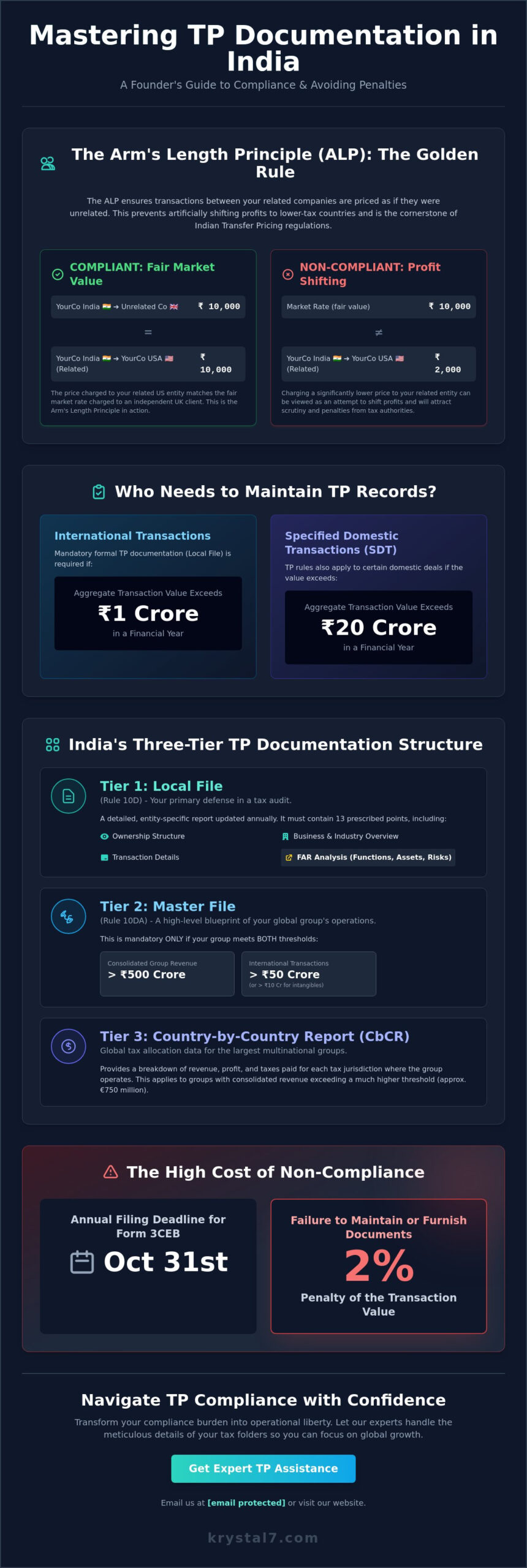
The “Arm’s Length Principle” (ALP) is the gold standard used by Indian tax authorities to evaluate your transactions. It requires that prices charged between related parties, known as controlled transactions, match the prices charged between independent entities, or uncontrolled transactions. For example, if your Gurgaon office provides software services to your US parent company, you must charge a price similar to what you’d bill an unrelated client in London. Maintaining visual transparency in these pricing models prevents future scrutiny. It proves to the tax department that your inter-company deals are fair and market-driven, rather than a strategy to reduce tax liability.
Who is Mandated to Maintain TP Records?
The requirement to maintain records kicks in the moment you engage in an international transaction with an Associated Enterprise (AE). Under Section 92A, AEs are entities linked by common management, control, or substantial capital investment. Your journey into this regulatory landscape often begins right after company registration if you plan to share resources or services with a foreign entity. While every international transaction must follow the arm’s length rule, maintaining a formal Local File is mandatory if your aggregate international transactions exceed INR 1 Crore in a financial year. This methodical approach provides order to complicated processes, ensuring your business remains secure during tax assessments.
The Three-Tier TP Documentation Structure
India’s approach to transfer pricing follows a global blueprint designed to bring order to cross-border financial reporting. This framework, largely influenced by the Base Erosion and Profit Shifting (BEPS) Action 13, ensures that every transaction is visible and justifiable. The Three-Tier TP Documentation Structure established by the OECD is now the standard for Indian businesses. It creates a hierarchy of reporting that ranges from entity-specific details to broad global overviews. By following this structure, you ensure your TP documentation India remains robust against tax assessments and unexpected audits.
The Local File: Your Primary Defense
Rule 10D of the Income-tax Rules, 2026, mandates the creation of the Local File. This document is the core of your compliance strategy. It requires 13 specific types of information, including ownership structure, detailed business descriptions, and pricing methodologies for international transactions. The most critical component is the “Functional, Asset, and Risk” (FAR) analysis. This analysis maps out who performs the work, what assets are utilized, and who bears the financial risks. Because business models and market conditions change, you must update this file every year alongside your annual compliance for a private limited company. Keeping this file updated provides the visual transparency required to satisfy tax officers during scrutiny.
Master File and CbCR Thresholds
For larger multinational groups, the reporting requirements expand to provide a wider lens on global operations. The Master File, governed by Rule 10DA, provides a high-level overview of the global group’s business operations and transfer pricing policies. This is mandatory only if your consolidated group revenue exceeds INR 500 Crore and your aggregate value of international transactions exceeds INR 50 Crore (or INR 10 Crore for intangible property transactions).
The highest tier is the Country-by-Country Report (CbCR). This applies to massive multinational enterprise groups with a consolidated global revenue exceeding INR 6,400 Crore in the preceding accounting year. If you’re a startup or an SME, don’t let these large numbers cause anxiety. Most emerging businesses only need to focus on the Local File and the filing of Form 3CEB. If you’re unsure which tier applies to your current scale, you can reach out for a methodical review of your compliance obligations. We help you identify exactly what you need so you can focus on your primary business goals.
Specified Domestic Transactions (SDT) vs. International Transactions
Transfer pricing isn’t just a hurdle for businesses with foreign subsidiaries. It also applies to transactions within the Indian borders. Under Section 92BA of the Income-tax Act, Specified Domestic Transactions (SDT) require the same level of meticulous reporting as international ones. This ensures that profit shifting doesn’t occur between related Indian entities to exploit tax-exempt status or specific deductions. If your aggregate domestic transactions with related parties exceed INR 20 Crore in a financial year, maintaining contemporaneous TP documentation India becomes a mandatory part of your business roadmap.
Common SDT Scenarios for Indian Businesses
Most domestic compliance issues arise when a taxpayer engages with a related party that enjoys a tax holiday, such as a unit in a Special Economic Zone (SEZ). Inter-unit transfers of goods or services also fall under this scanner if they impact the overall tax liability of the company. Domestic transparency is just as vital as international clarity to prevent the Income Tax Department from re-characterizing your business expenses. Keeping a detailed record of these internal dealings provides the visual transparency needed to justify your tax positions during an assessment.
Calculating the Arm’s Length Price
To remain penalty-free, you must prove that your transaction prices reflect fair market value using one of the six prescribed methods. The Central Board of Direct Taxes (CBDT) recognizes the following approaches:
- Comparable Uncontrolled Price (CUP) Method
- Resale Price Method (RPM)
- Cost Plus Method (CPM)
- Profit Split Method (PSM)
- Transactional Net Margin Method (TNMM)
- The “Other Method” for unique transaction types
You must select the “Most Appropriate Method” (MAM) based on the nature of your business and the availability of data. We recommend using official data from the MCA and GST portals to verify your benchmarks and ensure your calculations are accurate. This methodical approach replaces uncertainty with rational justification, protecting your company from heavy adjustments during tax audits.
2026 Compliance Calendar: Filing Form 3CEB and TP Documentation India
Staying ahead of deadlines ensures your cross-border business remains penalty-free. The new Income-tax Rules, 2026 enforce a strict timeline for TP documentation India. Following this roadmap helps you maintain operational liberty while satisfying the tax department’s requirements for the 2026-27 Assessment Year.
First, partner with a Chartered Accountant to obtain the audit report in Form 3CEB. Then, complete your contemporaneous documentation under Rule 10D before the filing date. Finally, file Form 3CEB by October 31, 2026, and submit your Income Tax Return (ITR) by November 30, 2026.
The Income Tax Department now uses advanced data analytics to identify inconsistencies instantly. Tax authorities levy a graded fee of INR 50,000 for filing Form 3CEB up to one month late. This fee increases to INR 1,00,000 for any delay beyond thirty days.
The tax department applies a penalty of 2% of the transaction value if you fail to maintain mandatory TP documentation India. Underreporting income due to transfer pricing adjustments also attracts a penalty of 50% of the tax payable on that income. These financial consequences can significantly impact your bottom line.
Audit readiness requires organized evidence long before an officer requests it. Ensure all inter-company agreements carry current dates and reflect your actual operational practices. These documents serve as the foundation for your FAR analysis.
Keep external benchmarks and database search reports ready to justify your pricing method. Confirm that your annual compliance for private limited company filings match your transfer pricing data. Book a compliance health check with our experts to secure your business against these risks.
Navigating TP Documentation with Krystal7 Consultants
Managing TP documentation India shouldn’t feel like a bureaucratic obstacle that halts your momentum. We provide visual transparency by breaking down complex tax filings into manageable, logical steps. Our methodical approach to FAR analysis ensures that every function, asset, and risk is accounted for, creating a robust defense for your cross-border transactions. We believe that clarity in your financial records is the foundation of long-term business security.
Our team aims to liberate founders from the heavy administrative burden of Chapter X compliance. By delegating these meticulous tasks to our experts, you gain the freedom to focus on your primary business goals and visionary growth. Being based in Gurgaon, we combine deep local institutional knowledge with a global perspective to serve your unique needs. We handle the complexity so you can pursue your ambitions with calm competence and total peace of mind.
Expert Advisory for Foreign Subsidiaries
Scaling a startup in a new market requires a trusted partner who understands the nuances of Indian regulations. We offer specialized support for foreign subsidiaries, handling everything from initial registration to complex annual filings. Our advisors provide a high-level professional touch while maintaining a human connection that makes compliance approachable. You get direct access to experienced Chartered Accountants who simplify technical jargon into actionable insights.
We ensure that your inter-company pricing models are not only compliant but also optimized for operational efficiency. This includes meticulous benchmarking against industry standards to justify your Arm’s Length Price. Our detailed step-by-step process descriptions suggest a detail-oriented approach that protects you during tax assessments. We stay constantly available to guide you through the evolving landscape of Indian tax law.
Your Partner in Operational Liberty
Outsourcing your transfer pricing needs to Krystal7 is a strategic growth move that safeguards your company’s future. We help you maintain a penalty-free status while you explore other growth initiatives, such as the stand up india loan scheme or broader financial advisory. Our goal is to provide a krystal-clear assessment of your obligations to ensure your journey remains smooth and predictable. We bring order to complicated processes, allowing you to focus on scaling your vision.
Mastering the complexities of TP documentation India is essential for any business operating across borders in 2026. Whether you need help with a Local File or a comprehensive Form 3CEB audit, we are here to ensure your business remains secure and optimized. Contact Krystal7 Consultants today at business@krystal7.com or visit krystal7.com for expert assistance with your compliance roadmap.
Secure Your Business Roadmap for 2026 and Beyond
Mastering your TP documentation India is the most effective way to protect your operational liberty from the 2% transaction value penalty. By understanding the three-tier structure and meeting the October 31 deadline for Form 3CEB, you transform a complex administrative burden into a transparent asset. This clarity doesn’t just satisfy tax authorities; it grants you the peace of mind to focus on scaling your vision. You’ve worked hard to build your business, and keeping your cross-border transactions compliant ensures that your growth remains uninterrupted.
Our Gurgaon-based team provides elite Chartered Accountancy expertise with a focus on foreign subsidiary compliance and methodical FAR analysis. We offer transparent, benefit-driven pricing models that bring order to your global operations and simplify the new 2026 reporting requirements. Secure your business with expert TP documentation; contact Krystal7 Consultants today at business@krystal7.com or visit krystal7.com for expert assistance. Your journey toward a penalty-free future starts with a single, krystal-clear step, and we’re ready to be your dependable partner every mile of the way.
Frequently Asked Questions
Is TP documentation mandatory for all Indian companies with foreign parents?
Maintaining formal TP documentation India is mandatory if your international transactions with a foreign parent exceed INR 1 Crore in a financial year. Even if your transactions fall below this limit, you must still ensure your pricing follows the arm’s length principle to avoid tax adjustments. Keeping basic records is a methodical way to protect your business during a routine check.
What is the penalty for not filing Form 3CEB in India?
Filing Form 3CEB after the October 31 deadline triggers an automatic graded fee under the new levy system. You’ll face a fee of INR 50,000 for a delay of up to one month, which doubles to INR 1,00,000 for any delay beyond that. This fee is separate from the 2% penalty applied for failing to maintain specific transaction records.
Can a small startup be exempt from TP documentation requirements?
No startup is exempt from the requirement to transact at an arm’s length price, but smaller entities have fewer reporting hurdles. You aren’t required to maintain the exhaustive Local File under Rule 10D unless your international transactions cross the INR 1 Crore threshold. We recommend keeping simple internal benchmarks to provide visual transparency if an officer asks for justification.
What is the difference between a Master File and a Local File in India?
The Local File is an entity-specific document that details your local transactions and FAR analysis. The Master File provides a high-level overview of the entire global group’s operations and only applies if the consolidated group revenue exceeds INR 500 Crore. Most Indian SMEs only need to focus on the Local File to remain compliant.
How is the Arm’s Length Price calculated for service-based startups?
Service-based startups typically use the Transactional Net Margin Method (TNMM) to determine their pricing. This involves comparing your net profit margins with those of similar independent companies found on official Indian databases. It’s a reliable way to prove your margins are fair and market-driven.
What is the deadline for TP filing for the financial year 2025-26?
You must file the accountant’s report in Form 3CEB by October 31, 2026, for the 2025-26 financial year. Your final Income Tax Return (ITR) must then be submitted by November 30, 2026. Missing these dates can lead to the graded fees and penalties mentioned in our compliance roadmap.
Do I need TP documentation for domestic transactions with my sister concern?
Documentation is required if these dealings qualify as Specified Domestic Transactions (SDT) under Section 92BA. This rule applies when the aggregate value of such transactions with related parties exceeds INR 20 Crore in a year. It’s a vital step to ensure your domestic tax-exempt units aren’t unfairly shifting profits.
How long must I retain my TP documentation records under Indian law?
You must retain your TP documentation India records for a period of 8 years from the end of the relevant assessment year. Keeping these files organized ensures you have the evidence needed for any future tax assessments. This long-term storage is a core part of maintaining your operational liberty and tax security.

Article by
Nihal Srivastava
Nihal Srivastava is the Co-Founder of Krystal7 Consultants, helping Indian entrepreneurs and startups navigate company registration, compliance, trademark protection, and regulatory requirements with clarity and confidence. With 6+ years of hands-on expertise in MCA filings, GST compliance, and corporate structuring, Nihal has guided 1000+ businesses across India through their legal and compliance journeys. He believes every business dream deserves crystal clear foundations, and that no founder should be held back by paperwork or red tape.